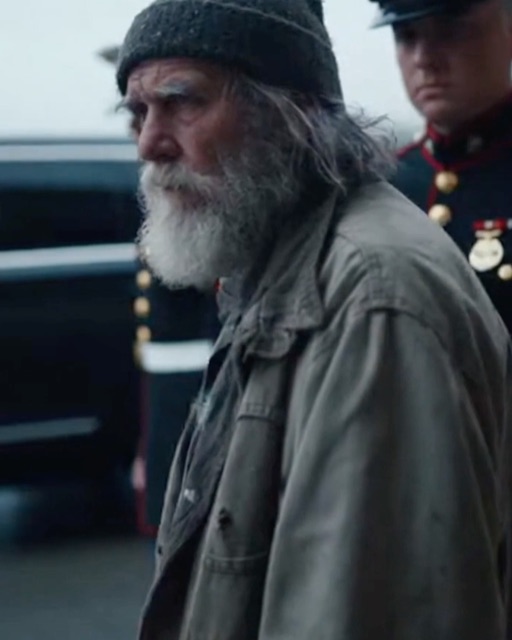
“Escort him off the property,” I snapped at the MPs.
My voice echoed in the cold Seattle air. I was the coordinator for my brother James’s wedding. He was a Marine Captain marrying the love of his life, Emily. We had Senators and Generals inside. I needed perfection.
And this man? He was a stain on the picture.
He was shivering, wrapped in layers of ancient, grime-covered rags that smelled of wet pavement and old smoke. He stood by the side entrance, staring intensely at the glass doors where the bride was about to walk through.
“Sir, you need to leave,” I said, stepping between him and the venue.
He didn’t look at me. His sunken eyes were locked on the door. “I just wanted to see her,” he whispered. His voice sounded like gravel. “Just once.”
“Now,” I signaled the security detail.
The younger MP hesitated, looking at the man’s frail posture, but orders were orders. He grabbed the man’s arm.
The homeless man pulled back – not fighting, just an instinctive flinch of shame. The MP grabbed harder to secure him, and with a loud RIP, the man’s threadbare jacket tore open at the shoulder.
The fabric fell away, exposing his chest to the freezing wind.
That’s when I saw it.
Swinging out from beneath the dirty rags was a piece of metal on a greasy shoelace. It wasn’t jewelry. It caught the grey light, dull and heavy.
At that exact second, the side door opened. My brother James, looking sharp in his Dress Blues, stepped out to see what the commotion was.
“What is going on out h – ”
James stopped mid-sentence.
He didn’t look at me. He didn’t look at the MPs. His eyes were glued to the piece of metal dangling against the homeless man’s dirty shirt.
The air left the conversation. The silence was absolute.
My arrogant frustration vanished, replaced by a cold knot in my stomach. I watched the color drain completely from my brother’s face. James, a man I had never seen cry, started to tremble.
He slowly raised his hand and saluted.
I looked back at the homeless man, confused. “James? It’s just a vagrant. I’m handling it.”
James turned to me, his eyes burning with a mix of fury and heartbreak I had never seen before.
“That’s not a vagrant,” James whispered, his voice shaking. “Look at the medal, you idiot.”
I looked closer. It wasn’t just metal. It was a blue ribbon with a gold star.
“That is the Congressional Medal of Honor,” James said, stepping forward to wrap the dirty man in a hug. “And this is the man who saved my life.”
The homeless man finally broke his stare from the door. He looked at James, and for the first time, a flicker of recognition crossed his face.
“Captain?” he rasped. “Captain Miller?”
James pulled back, holding the man by his frail shoulders. “Sergeant Peterson. Arthur. My God, what happened to you?”
The MPs had gone rigid, their hands dropping to their sides as if electrocuted. They looked from the medal to James, then back to the man they were about to drag away.
I felt like the ground had turned to quicksand beneath my feet. Sergeant Peterson. I knew that name. James had talked about him for years.
He was the legend from his first tour in Afghanistan. The man who had single-handedly held off an ambush, dragging three wounded men, including my brother, to safety.
James had a piece of shrapnel in his leg that was supposed to have killed him. Sergeant Peterson had carried him for over a mile under fire.
The military had told us Sergeant Peterson was discharged with full honors and had moved away to live a quiet life. No one had heard from him since.
And here he was. Broken. Starving.
“We thought… we thought you were doing okay,” James stammered, his voice thick with emotion.
Arthur Peterson just shook his head, shame etched into every line on his face. “Things got loud,” he said softly. “The world… it got too loud.”
The words hung there, a simple explanation for a collapse I couldn’t possibly comprehend.
I looked at my own clean hands, my tailored suit, the pristine white rose pinned to my lapel. My perfect wedding. My perfect, meaningless picture.
“I need to get him inside,” James said, turning to me with an intensity that pinned me to the spot.
My coordinator brain, the one obsessed with timelines and appearances, screamed in protest. “James, we can’t. Look at him. The guests…”
“I don’t give a damn about the guests!” James roared, and the sound was so full of pain it silenced me instantly. “The only reason I am standing here today, the only reason I am alive to get married, is because of him.”
He pointed at Arthur Peterson. “This wedding is happening because of him. He belongs in there more than anyone.”
I had no response. The truth of his words was like a physical blow.
“What do you need me to do?” I asked, my own voice a stranger to my ears.
A plan formed in James’s eyes, the Captain taking charge once more. “There’s a suite upstairs for me and Emily tonight. Get the key.”
He turned to the MPs. “I need one of you to go to the store. Get a razor, shaving cream, soap, a toothbrush. Get a suit. Black. Size 42 regular, I’m guessing. And shoes. Size 10.”
The younger MP nodded, already pulling out his phone. “On it, Captain.”
“And you,” James said, looking back at me. “You go inside. You stall. Tell them there’s a… a delay with the flowers. Tell them anything. Buy me an hour.”
He put a protective arm around Sergeant Peterson’s shoulders. “Come on, Sergeant. Let’s get you warmed up.”
Arthur looked back toward the glass doors one last time, a look of profound longing on his face. “I just wanted to see her,” he repeated, his voice cracking. “I heard she was getting married.”
“You’re going to do better than that,” James promised him. “I swear to you.”
I watched them disappear into the venue, my brother in his immaculate uniform supporting the skeletal frame of a hero.
I took a deep breath, straightened my tie, and walked back into the warm, glittering reception hall. The air was filled with polite chatter and the soft melody of a string quartet.
It felt like a different universe.
I found Emily’s mother, a kind woman named Sarah, and explained there was a minor logistical hiccup. She smiled, completely unconcerned, her mind only on her daughter’s happiness.
I felt a fresh wave of shame.
I spent the next hour making small talk, topping up champagne glasses, and lying through my teeth to Generals about a “wardrobe malfunction.” Every minute felt like an eternity. My mind was upstairs with my brother and the man I had treated like garbage.
Then, my phone buzzed. It was James.
“We need you.”
I excused myself and ran up the stairs to the bridal suite. I knocked softly.
The door opened, and James stood there. His expression was unreadable.
I stepped inside. The room smelled of soap and steam. On the bed were several shopping bags.
And sitting in a chair by the window was Sergeant Peterson.
Or rather, it was the man he used to be.
His hair was damp and combed. His face, though still gaunt, was clean-shaven, revealing a strong jawline I hadn’t seen beneath the grime. He was wearing a new white shirt and black trousers. He looked smaller without the layers of rags, but more solid. More human.
He looked like a soldier.
“We were talking,” James said quietly, closing the door behind me.
Arthur didn’t look at me. He was staring out the window at the Puget Sound. “He told me about the girl,” he said, his voice clearer now. “Emily.”
“Yes,” I said, unsure where this was going. “She’s a wonderful woman. An ER nurse. James is a lucky man.”
Arthur nodded slowly. “Her mother was a nurse,” he whispered. “She had the same smile. Always knew how to fix things.”
A strange feeling settled over the room. James was looking at Arthur with an expression I couldn’t decipher.
“Sergeant,” James said gently. “What was your wife’s name?”
Arthur closed his eyes. A single tear traced a path down his clean-shaven cheek. “Clara,” he said. “Her name was Clara.”
James knelt in front of him. “And what was your daughter’s name, Arthur?”
The man’s breath hitched. He looked from James to me, his eyes wide with a terror that seemed older and deeper than war.
“Her name… is Emily,” he choked out. “Emily Peterson.”
The world stopped.
My brother’s bride. Emily. Her last name was Franklin. Her father, she had told us, was a soldier who had died in combat when she was a little girl. Her mother, Clara, had remarried a man named Franklin, who had raised Emily as his own.
Clara had passed away from cancer five years ago.
“Her mother told her I was gone,” Arthur whispered, the story tumbling out of him now. “It was kinder that way.”
He explained that after his final tour, the one where he’d saved James, he came home a different man. The nightmares, the shaking, the noise in his head – it was too much. He started drinking. He couldn’t hold a job.
He saw the fear in his wife’s eyes. He saw how his own daughter, his little Emily, would flinch when he yelled in his sleep.
“I was a ghost,” he said, his voice hollow. “A monster haunting my own house. So I left. I told Clara to tell her I died a hero. Better she remember that man than see the one I’d become.”
He had drifted for years, city to city, never staying anywhere long. The guilt was a constant companion. Then, a few weeks ago, he’d heard through the veterans’ grapevine about a Marine Captain named James Miller getting married in Seattle.
He knew it had to be the same man. He found the announcement online. And he saw her picture. His Emily. All grown up.
“I didn’t come for a handout,” he insisted, looking at us desperately. “I swear. I just… I had to see her. I had to know she was happy.”
My heart broke. It shattered into a million pieces for this man, for my brother, and for the woman downstairs who was about to marry the man her father had saved.
This was the twist of fate so unbelievable it could only be true.
“She thinks you’re dead,” I said, the words feeling heavy and stupid in my mouth.
“It’s better that way,” Arthur repeated, though his voice lacked conviction.
James stood up, his face set like stone. “No,” he said. “It’s not.”
He looked at me. “She has a right to know.”
“Today, James?” I pleaded. “On her wedding day? This could destroy her.”
“Or,” he countered, his gaze unwavering, “it could be the greatest gift she’s ever received. To know her father is not only alive, but he is the man who is responsible for all the happiness she is about to have.”
He was right. It was a terrifying, beautiful, impossible truth.
“What do we do?” I asked.
James walked over to the closet and pulled out the new black suit jacket. He held it out for Arthur.
“First, you put this on,” James said. “Then, you go meet your daughter.”
Arthur stared at the jacket as if it were a bomb. “I can’t. She’ll hate me.”
“No, she won’t,” James said with absolute certainty. He helped the trembling man put his arms through the sleeves. “She has her mother’s heart. And she has your courage.”
We walked down the hallway, a strange procession of three. Me, my brother in his decorated uniform, and a hero in a borrowed suit. It felt like we were walking toward a cliff’s edge.
We stopped outside the bridal room. We could hear the soft laughter of Emily and her bridesmaids inside.
James knocked.
The door opened, and Emily’s maid of honor, her sister, looked out. Her eyes widened when she saw us.
“Is everything okay?” she asked.
“We need a moment with Emily,” James said calmly. “Alone.”
She nodded, sensing the gravity of the situation, and disappeared back inside. A moment later, the bridesmaids filed out, giving us confused looks.
Then, the doorway was filled by Emily.
She was radiant, a vision in white. Her smile was brilliant, but it faltered when she saw our faces.
“James? What is it? You look like you’ve seen a ghost.”
Her eyes moved past James, past me, and landed on Arthur, who was standing slightly behind us, half-hidden in the shadows of the hall.
She tilted her head. A flicker of confusion crossed her face. “I’m sorry, do I know you?”
Arthur took a shaky step forward into the light.
Time seemed to slow down. Emily’s eyes scanned his face, his jawline, the deep-set eyes that were a mirror of her own.
I saw the moment it happened. The moment a forgotten memory, a ghost of a feeling from early childhood, sparked in her mind.
Her hand flew to her mouth. The color drained from her face.
“Daddy?”
The word was a tiny, fragile whisper, a sound from a lifetime ago.
Arthur began to sob, silent, wracking gasps of air. He couldn’t speak. He just nodded, his own eyes filled with a universe of pain and love.
Emily didn’t hesitate. She didn’t ask for an explanation. She didn’t care about her perfect dress or her perfect makeup.
She ran.
She threw her arms around his neck, burying her face in the shoulder of his new suit jacket, and held on as if she were trying to pour twenty years of missed hugs into a single embrace.
“I thought you were gone,” she cried. “Mom said you died. She said you were a hero.”
James stepped forward and put his hand on Arthur’s shoulder. “He is,” James said, his voice thick. “He’s the greatest hero I’ve ever known.”
And there, in the hallway of a fancy venue, the whole story came out. James explained how Arthur had saved him, and Arthur, with Emily’s hand in his, haltingly explained why he had left.
There was no anger in her. There was only a profound, heartbreaking, and beautiful sense of understanding. She looked at her father, this man who had been shattered by war, and saw not the man who had left, but the man who had come back.
After a few minutes, she pulled back, wiping tears from her face, smearing her mascara. She didn’t care.
She looked at her step-father, a good man who was waiting downstairs to walk her down the aisle. Then she looked back at Arthur.
“I need you to do something for me,” she said to him, her voice strong now.
“Anything,” he whispered.
“I need you to walk me down the aisle.”
A half-hour later, the music finally began to play. The guests, who had been murmuring with curiosity, fell silent.
The doors at the back of the hall opened.
First, her step-father walked out and took his seat in the front row, beaming with a pride that was selfless and pure.
Then, Emily appeared.
On her arm was her father, Sergeant Arthur Peterson, Medal of Honor recipient, his back a little straighter, his head held a little higher. He was still thin, still scarred by the life he had lived, but in that moment, he was the most dignified man in the room.
A quiet murmur rippled through the crowd as Generals and Senators recognized the face of a man they’d only seen in grainy photos from years ago. They rose to their feet. One by one, every uniformed service member in the room stood and saluted.
As Arthur walked his daughter toward my brother, he caught my eye. He gave me a small, hesitant nod. It wasn’t forgiveness. It was something more. It was a shared understanding.
I had been obsessed with creating a perfect day, but I had been blind to what perfection truly is.
Perfection isn’t about flawless flower arrangements or a strict timeline. It’s not about appearances or impressing important people.
Perfection is the ragged, messy, beautiful, and improbable reunion of a father and his daughter. It’s the humbling grace of a second chance. It’s recognizing the hero hidden inside the rags of a broken man.