“Careful, honey, that kicks like a mule,” the lead instructor sneered.
I was there to audit their ballistics data. They treated me like a lost tourist. To humiliate me, one of the guys – a massive guy named Rick – handed me his custom long-range rifle.
“Go ahead,” he smirked. “If you hit the target, I’ll quit my job.”
The target was a speck. 3,000 yards out. Impossible for anyone but the top 1% of snipers.
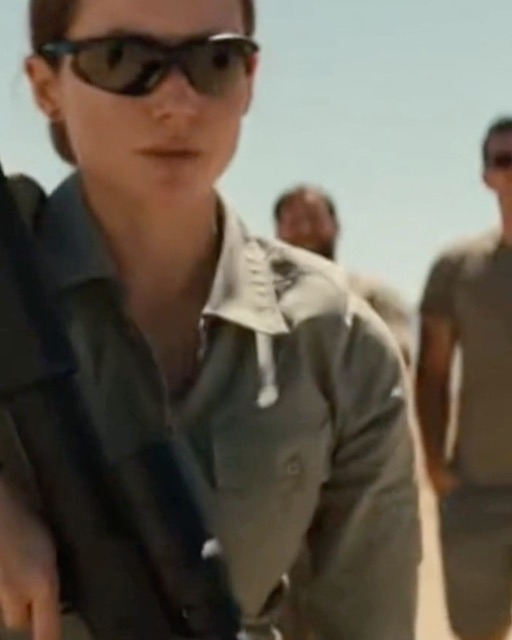
I didn’t argue. I didn’t tremble. I just laid down in the dust.
The moment my cheek touched the stock, my breathing shifted. My heart rate dropped to 40 beats per minute. The world went quiet.
Boom.
The silence that followed was deafening. Then, the faint ping of the hit echoed back.
Rick’s jaw hit the floor. He looked at me with terror in his eyes.
“Who are you?” he stammered.
I stood up, dusted off my skirt, and handed him a specific coin from my pocket.
“You can keep your job, Rick,” I said. “Just never tell anyone you met…”
“…the Ghost.” The word hung in the air, unspoken but understood by the symbol on the coin.
It was an old liberty dollar, but the face had been worn smooth. In its place was a simple, hand-etched engraving: a hooded specter with a single, hollow eye.
It was the calling card for an internal investigations unit so deep, most of the military didn’t even believe it existed. We were the people they sent when things went wrong in places that weren’t on any map.
Rick’s face went from terrified to ghostly white. He’d heard the stories, the barracks rumors about the auditors who weren’t just auditors.
The lead instructor, a man named Sergeant Major Davies, stalked over. His sneer was gone, replaced by a tight, calculating frown.
“What’s going on here?” he demanded, his eyes flicking from my face to the rifle still warm in my hands.
“Just admiring the equipment,” I said, my voice as mild as a spring morning. “It’s very well-maintained.”
Davies snatched the rifle from my grasp, his knuckles white. He saw the coin in Rick’s trembling palm.
For a split second, a flicker of pure panic crossed his face before he masked it with professional authority.
“Rick, back to the line,” he barked. “And you, Ms. Thorne, my office. Now. The data isn’t going to audit itself.”
He turned and marched off without waiting for a reply. The other instructors, who had been laughing moments before, now avoided my gaze like I was the plague.
I followed him, the desert sun hot on my back. The real reason I was here had nothing to do with a long-range shot.
That was just an introduction.
Davies’ office was small and impeccably neat, a stark contrast to the man’s abrasive personality. Medals and commendations gleamed from a display case on the wall.
He sat behind his metal desk and gestured for me to take the uncomfortable-looking chair opposite him.
“That was quite a display out there,” he said, his voice low and hard. “You trying to make a point?”
“Just testing the calibration,” I replied, meeting his stare. “The windage was off by a quarter-minute of angle. You might want to have your armorer look at that.”
His eye twitched. It was a subtle tell, but it was there. He wasn’t just angry; he was nervous.
“My men are the best in the world,” he stated, leaning forward. “Their equipment is flawless.”
“Nobody’s flawless, Sergeant Major,” I said softly. “That’s why people like me have jobs.”
For the next two hours, we played a game. He presented me with data logs, ammunition inventories, and performance reports.
I scanned through them, my mind a quiet machine. I wasn’t just looking at the numbers.
I was looking for the spaces between the numbers.
The report on a night-vision scope that failed during a training exercise in low-light conditions. The log showed it was replaced.
But the requisition form for the replacement was dated two days before the reported failure.
A small thing. A simple clerical error, most would say. To me, it was a loose thread.
I pulled on it.
“I see here you had a failure with a PVS-31 scope last month,” I said, pointing to the line on the screen.
“Equipment breaks,” he grunted, not looking up from his own paperwork. “We got a new one.”
“And the operator, a Corporal Jennings? The report says he sustained a minor injury. A sprained ankle during the exercise.”
“It was dark. He missed a step. It happens,” Davies said, his voice tight.
I stayed silent. I let the silence hang in the air, heavy and thick. I’d learned long ago that people rushed to fill a silence, often with things they didn’t mean to say.
Finally, he looked up, his eyes like chips of ice. “Is there a problem, Ms. Thorne?”
“No,” I said, closing the laptop. “Not at all. I think I have everything I need for today.”
As I stood to leave, I paused at the door. “By the way, I spoke to Corporal Jennings before I came here. He’s on medical leave.”
Davies’ jaw muscle clenched.
“His ankle is fine,” I continued. “It’s the shrapnel in his left eye they’re still working on. The scope didn’t just fail, Sergeant Major. It exploded.”
I closed the door behind me, leaving him alone in the sterile, quiet office with the truth.
Later that evening, I was in the small, soulless motel room the army had booked for me, poring over schematics on a secure tablet.
There was a soft knock on the door. It wasn’t the knock of a soldier or an officer. It was hesitant. Frightened.
I opened it to find Rick standing there, twisting the brim of his cap in his massive hands. He looked even bigger in the narrow motel hallway.
“Ma’am,” he mumbled, not meeting my eyes. “Can I… can I talk to you?”
I stepped aside and let him in. He sat awkwardly on the edge of the bed, looking like a bear that had wandered into a dollhouse.
“That shot…” he began, his voice barely a whisper. “I’ve never seen anything like it. And the coin… the guys talk about it. The Ghosts.”
“We’re just auditors, Rick,” I said, pouring him a glass of water from a plastic bottle.
He shook his head, finally looking at me. The terror was gone, replaced by a desperate kind of sincerity.
“No, you’re not,” he said. “I know why you’re here. It’s about Jennings, isn’t it?”
I didn’t answer. I just watched him.
“Look, I was there that night,” he rushed on, the words tumbling out. “I was on the line with him. The scope didn’t just pop. It went off like a flashbang in his face. It was bad, ma’am. Real bad.”
“The official report says it was a minor equipment failure,” I stated calmly.
“The official report is a lie,” Rick spat, his fear momentarily replaced by anger. “Davies wrote it himself. He told us all what to say. He said it was for the good of the unit, to avoid an investigation that would shut us down.”
He took a shaky breath. “But that’s not the real reason.”
“Go on,” I prompted.
“I saw him, a few weeks before the accident. He was meeting with some corporate guy. A suit. From the company that makes those scopes. They were in the supply depot late at night. Davies was handed a thick envelope.”
Rick wrung his hands together. “I didn’t think anything of it at the time. But after what happened to Jennings… and now you’re here… I think he’s been signing off on faulty gear. Defective stuff. In exchange for money.”
He looked at me, his eyes pleading. “Jennings is a good kid. He’s got a wife, a baby on the way. He might lose his eye. All because Davies wanted a payday.”
Here it was. The real story. Not a tale of heroism and valor, but a grubby little story of greed and betrayal.
“Why didn’t you report it?” I asked, my voice even.
“To who?” he asked, a bitter laugh escaping his lips. “Davies is a legend around here. He’s got friends in high places. I’m just a grunt. It would be my word against his. I’d be ruined.”
I stood up and walked to the window, looking out at the endless, dark desert.
“You did the right thing by coming to me, Rick,” I said, my back to him.
“What are you going to do?” he asked.
“I’m going to finish my audit,” I replied.
The next day, I didn’t go back to Davies’ office. I went to the armory.
Using a clearance code that made the armorer’s eyes widen, I requested all the scopes from the same batch as the one that had injured Corporal Jennings.
I spent the morning disassembling them, piece by piece. On the outside, they looked perfect. Inside, it was a different story.
The wiring was substandard. The power regulators were cheap knock-offs from an unauthorized supplier. They were ticking time bombs, just waiting for a power surge.
Someone had signed off on them, certifying them as mission-ready. The signature on the inspection certificate was crisp and clear.
SGM Davies.
I took pictures, logged the evidence, and sealed the defective scopes in evidence bags. The thread was no longer loose. It was a rope, and it was tightening.
My final stop was the base’s financial services office. Another code, another set of wide eyes from a young lieutenant who probably thought I was there to audit his lunch receipts.
I wasn’t interested in government accounts. I was interested in Sergeant Major Davies’ personal banking records.
It didn’t take long. A series of large, untraceable cash deposits over the last six months. They coincided perfectly with the procurement dates for the new, faulty equipment.
He wasn’t just covering his tracks. He was practically laying down a welcome mat for anyone who knew where to look. Arrogance had made him sloppy.
I had everything I needed.
I called Davies and asked him to meet me back at the range that evening. I told him I needed to sign off on my final report.
He agreed, his voice sounding relieved. He thought he had weathered the storm.
The sun was setting as I stood at the same firing position as the day before. The desert was painted in hues of orange and purple.
Davies arrived alone, walking with the confident swagger of a man who believed he was untouchable.
“All done, Ms. Thorne?” he asked, a hint of the old sneer returning to his voice. “Find any more dusty rifles?”
“I did,” I said, not turning to look at him. “But I found something much more interesting in your bank account.”
The swagger vanished. He stopped dead in his tracks.
“I don’t know what you’re talking about,” he said, his voice flat.
“Let me refresh your memory,” I said, finally turning to face him. “Five deposits. Ten thousand dollars each. All within 48 hours of you signing off on defective shipments from a certain optics manufacturer.”
I laid a thin folder on the shooting mat between us. “A manufacturer, I might add, that is about to be indicted for fraud.”
His face was a mask of fury. “You have no authority…”
“My authority comes from the people you betrayed,” I cut him off, my voice dropping to a whisper. “It comes from every soldier you put in harm’s way for a handful of cash. It comes from Corporal Jennings and the eye he’s probably going to lose.”
He took a step towards me, his hands clenching into fists. “You’re finished. When I’m done with you, you’ll be auditing paper clips in a basement in Alaska.”
“I don’t think so,” I said calmly.
From the shadows of the nearby munitions shed, Rick stepped out. He wasn’t alone. Two military police officers were with him, their faces grim.
Davies’s face crumbled. The mask of the decorated war hero dissolved, revealing the weak, greedy man underneath. It was over. He knew it.
The MPs cuffed him and read him his rights. His medals and commendations wouldn’t help him now.
As they led him away, he looked back at me, his eyes filled with a venomous hatred. “Who are you?” he hissed, the same question Rick had asked, but with a completely different meaning.
“I’m just a civilian consultant,” I said quietly.
Rick walked over to me, the setting sun casting a long shadow behind him.
“Thank you,” he said, his voice thick with emotion. “You gave Jennings his justice.”
“You did, Rick,” I corrected him. “You saw something wrong, and you spoke up. That takes a different kind of courage. The kind that matters most.”
He looked down at his boots, then back up at me, a newfound respect in his eyes. He wasn’t the same arrogant man who had challenged me a day earlier. He had been humbled, and in that humility, he had found his strength.
“What happens now?” he asked.
“Now, you go back to being one of the best instructors in the world,” I said. “And you make sure no one ever forgets the real price of integrity.”
I packed my bag, my work here done. My report would be filed, and the system would grind on. The corrupt optics company would be exposed. The procedures would be changed. Corporal Jennings would be taken care of.
As I walked to my car in the twilight, I thought about the nature of my job. I didn’t carry a weapon into battle anymore. I carried a pen, a laptop, and the quiet authority of the truth.
My battles were fought in quiet offices and dusty records rooms, against a different kind of enemy. An enemy that wore the same uniform as the heroes.
It’s easy to admire the loud strength, the one that makes a 3,000-yard shot. But the world is held together by the quiet strength, the one that sees an injustice and refuses to look away. It’s the courage to speak up when it’s easier to stay silent, to choose integrity when no one is watching.
That’s the kind of strength that truly hits the mark, every single time.