
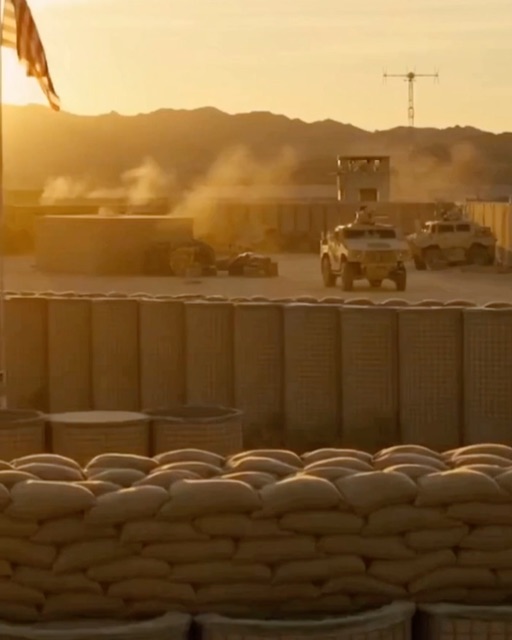
They didn’t see my rifle case or my quals when I stepped off the transport at FOB Sentinel. They saw a ponytail, a duffel, and five-foot-seven. Someone by the sandbag wall muttered, “Just a girl,” and a few laughs chased it down the wind.
“Sector Four,” the sergeant said, handing me the dead-end corner post like a shrug.
“Copy,” I answered. That annoyed him more than if I’d fought.
Back home, top of my sniper class meant something. Out here, it didn’t last three seconds. You got judged by rumor, posture, and whether you flinched.
Night fell fast. The base lights blinked to blackout. Minutes later, the first thumps rolled in from the ridge – testing shots. Guys scrambled, shoulders bumped mine, someone told me to “hold the binoculars and stay low.”
I slid into my spot, clicked in. Breath steady. The scope turned the world into math.
Targets ghosted along the rocks. I called distances, wind, elevation – clean, quiet. No one answered me on the net.
Then a voice did answer.
It repeated my callouts. Same numbers. Same cadence. But not from my team’s channel.
From ours.
The ridgeline rounds adjusted – like we’d just handed them a ruler. My stomach dropped. Someone was feeding our positions back to them. Not from the ridge. From inside the wire.
I pivoted the scope off the rocks and onto the comms tower glass. A shape moved. A shoulder. A face.
My blood ran cold.
Because the silhouette in my crosshairs wasn’t an enemy—it was the same smirk from the sandbag wall, framed in our patch and a headset I wasn’t issued.
My heart was a hammer against my ribs, but my hands were steady. It was Sergeant Miller. The man who’d been laughing loudest just hours before.
I couldn’t just shoot. You don’t fire on a friendly. It was the first rule, the unbreakable rule.
They’d call it a tragic mistake, a panic fire. I’d be the one they broke.
The base comms were compromised. My own radio was a death sentence if I used it to call him out. He’d hear. He’d know.
A mortar round landed fifty yards away, showering my post with dirt and pebbles. The assault was getting more accurate. Miller was good at his betrayal.
I watched him through the scope. He was calm, leaning against the railing, speaking softly into his mic like he was ordering a pizza.
He was giving them the coordinates for the motor pool. I could see the enemy spotters adjusting their aim.
I had to do something. I couldn’t expose him, but I couldn’t let him succeed.
So I made a choice. If he was going to use my intel, I’d give him the wrong intel.
My own radio crackled to life in my ear. A panicked voice from the command post. “Where is it coming from? We need eyes!”
I ignored the command net. I keyed my own squad channel, the one Miller was likely monitoring.
“Target identified,” I said, my voice as flat as a firing range. “Heavy concentration, grid square two-seven-niner. Old bunker complex.”
It was a lie. Grid two-seven-niner was a collapsed network of caves, empty for a decade. A rock pile.
Through my scope, I watched Miller. He paused. He looked down at his own map, then spoke into his headset again.
Seconds later, the incoming fire shifted. Mortars and machine gun rounds chewed up the empty hillside, pulverizing useless stone.
A small, cold knot of triumph tightened in my chest. It worked. He took the bait.
He thought I was just another pair of eyes, another voice on the radio he could exploit. He didn’t think I was listening back.
The battle raged on for another hour. It became a deadly chess match played in whispers over the radio.
I’d spot a real enemy position moving towards the barracks. I’d stay silent.
Then I’d call out a ghost target near an abandoned well, and watch as Miller dutifully relayed my false information.
The enemy wasted ammunition on empty sandbags, on shattered walls, on shadows.
But they were getting frustrated. The probing attacks were failing. They were going to try something big.
I saw it forming. A large group, at least two dozen strong, moving not toward the walls, but toward a weak point in the southern perimeter. Near the generator farm.
If they took out the generators, the whole base would go dark. The automated defenses, the command center—everything would fail.
Miller saw them too. I saw him straighten up, his voice urgent in his mic. He wasn’t falling for a bluff this time. He was giving them the real prize.
My time was up. I couldn’t misdirect him from this.
I had to cut the cord.
My eyes scanned his position in the comms tower. He was a shadow behind glass. I couldn’t get a clean shot at him, and I still couldn’t break that rule.
But I didn’t need to shoot him.
I saw the thin black cable running from his specialized headset to a portable long-range transmitter perched on the railing beside him. That was his link. That was the weapon.
It was a tiny target. At this distance, with the wind and the chaos, it was nearly impossible. The power pack was no bigger than a deck of cards.
My training took over. The noise of the battle faded away. The fear, the anger—it all dissolved into pure mechanics.
Breathe in.
The world shrunk to the circle of my scope. The crosshairs settled on the small, dark box.
Breathe out.
My finger rested on the trigger. There was a moment of perfect stillness between heartbeats.
I squeezed.
The rifle bucked against my shoulder. The crack of the shot was swallowed by the symphony of war around me.
Through the scope, I saw the power pack on the railing explode in a shower of sparks and plastic. Miller flinched back, ripping the now-dead headset from his ears.
He stared at the smoking ruin of his equipment. He looked around wildly, trying to figure out where the shot came from.
His eyes swept across the defensive posts. They passed right over me. I was just part of the darkness.
The betrayal was severed. On the ridge, the enemy assault faltered. Their intel had suddenly gone blind. They were confused, disorganized.
The tide of the fight turned instantly. Our counter-attack, no longer predicted and targeted, pushed them back with overwhelming force.
But I wasn’t watching the ridge anymore. I was watching Miller.
He was scrambling, grabbing a standard rifle. He knew he was caught. He was trying to blend in, to become just another soldier in the fight.
I un-clipped my radio from my belt. It was time to make the call.
I switched to the command channel. “Captain Thorne, this is Corporal Sharma, Sector Four. We have an insider threat. Sergeant Miller in the comms tower is compromised.”
The line was silent for a full ten seconds. I could almost hear the disbelief.
“Repeat that, Corporal?” Thorne’s voice was dangerously calm.
“Miller’s been feeding them our positions, sir. I’ve just disabled his transmitter. He is hostile.”
Another pause. “Stay at your post, Sharma. A team is on its way.”
I didn’t stay at my post. Miller was on the move. He was heading for the stairs, trying to get down into the chaos of the base and disappear.
I slung my rifle over my shoulder and moved. My corner of the world had been quiet, a sniper’s nest. Now I was running into the heart of the noise.
Smoke stung my eyes. The air was thick with the smell of cordite and hot metal. I kept my eyes on the comms tower, tracking his descent.
I met him at the bottom of the metal staircase.
He saw me and his face twisted into a snarl of recognition and pure hatred. “You,” he spat.
“It’s over, Miller,” I said, my own rifle now leveled at his chest.
“Just a girl,” he sneered, raising his weapon. “You should’ve just stayed low and held the binoculars.”
He was faster than I expected. He lunged, not to shoot, but to knock my rifle aside.
We crashed against the concrete wall of the tower. He was stronger, heavier. His hands were around my throat, squeezing.
Black spots danced in my vision. My rifle was useless, pinned between us.
But a sniper’s greatest weapon isn’t their rifle. It’s their mind. Their control.
I stopped fighting his strength. I went limp for a split second, then drove my knee hard into his thigh, hitting a nerve cluster we were taught to target.
His leg buckled with a cry of pain. His grip loosened just enough.
I twisted, using his own weight against him, and slammed his head back into the steel support beam of the staircase.
He slumped to the ground, dazed. I kicked his rifle away and had him in zip-ties before the fire team rounded the corner.
Captain Thorne was with them. He looked at me, then at the groaning sergeant on the ground, then at the sparking transmitter high above on the tower railing.
He didn’t say a word. He just knelt, checked Miller’s ties, and had his men haul him away.
The rest of the night was a blur. Debriefings. Reports. Statements.
They found the rest of Miller’s gear in his bunk. A satellite phone and bank transfer codes. He’d sold out his friends, his unit, for money.
They also found something else. Information on a past ambush. A sniper team that had been lost on a patrol a few months before I arrived. The official report said they’d been unlucky, caught in a surprise attack.
Miller’s data showed it wasn’t a surprise. He’d sold their route and position, too.
He hadn’t just betrayed us tonight. He’d been doing it for months. He was the reason good men were dead.
The next morning, the base was quiet. The adrenaline had faded, leaving behind a bone-deep exhaustion.
I was cleaning my rifle when the sergeant who’d assigned me to Sector Four walked up. The same one who’d given me the dead-end post with a shrug.
He stood there for a moment, not speaking. I didn’t look up. I just kept meticulously cleaning each part of the bolt carrier group.
“Sharma,” he finally said. His voice was rough.
I paused, looking at him.
He held out his hand. In it was a small, worn wooden case. “This was my father’s,” he said. “He was a Marine marksman.”
I didn’t know what to say.
“A good rifle is nothing without the person behind it,” he continued, his eyes meeting mine. “We forgot that. I forgot that.”
He placed the cleaning kit beside me. “I’m sorry,” he mumbled, then turned and walked away before I could respond.
Later that day, Captain Thorne called me to his office.
“Your transfer just came through, Corporal,” he said, sliding a piece of paper across his desk. “Top of my sniper class didn’t mean anything, you thought.”
He smiled, a rare, genuine thing. “It means everything now. You’re not in Sector Four anymore. You’re leading my new scout sniper team.”
I looked at him, stunned.
“You didn’t just save this base, Sharma,” he said, his voice serious. “You reminded us what a soldier is. It’s not about gender, or size, or how loud you talk. It’s about what you do when the lights go out.”
As I walked out of his office, back into the harsh sun of the courtyard, I saw the men from the fire team. The ones who had laughed.
They weren’t laughing now. They nodded. It wasn’t a gesture of awe or praise. It was something better.
It was respect.
I learned something important out there, under that star-dusted sky filled with smoke and tracers. It’s that in the defining moments of our lives, we aren’t judged by the labels others give us. We are judged by the choices we make when everything is on the line. True strength isn’t about the noise you make or the space you take up. It’s about the quiet integrity that holds the line when no one else can, proving that the steadiest hand can belong to anyone, even “just a girl.”



