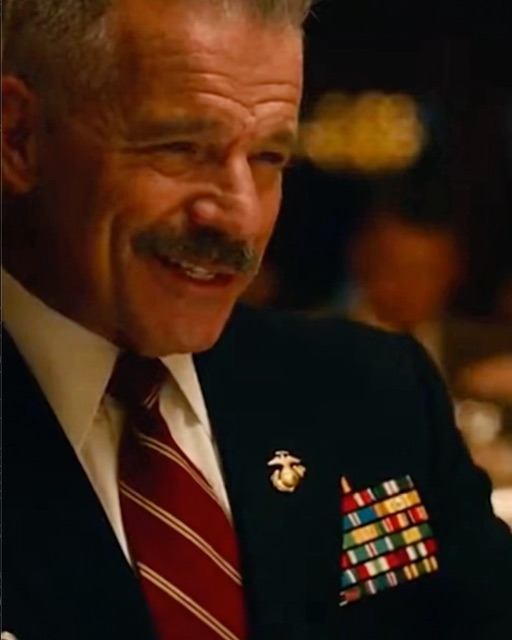
“Ladies don’t get call signs,” my retired Marine stepfather announced at my brother’s commissioning dinner, smiling like he’d just put me back in my place. Forks paused. Bourbon breathed. Someone snorted.
I grew up in Annapolis. Coffee, salt air, engine grease. My dad was Navy – quiet, steady, the kind of man who could spread a chart on a kitchen table and make the world make sense. When the chaplain came to our door, the sea went from an idea to a promise.
Then my mom married Dale. Bronze Star in a shadow box, voice built for command, and a punch line ready every time I walked in the room. My deployments were “cruises.” My warfare pin? “Water wings.” Everyone laughed just enough to make sure I heard it. Everyone except his son, Tyler – the only one who ever asked what my quals actually meant.
I won’t tell you everything about the South China Sea. I can’t. Twelve Americans on a dying hull, pressure spiking, and me holding steel where it shouldn’t hold. All twelve got home. No headlines. No interviews. Just a call sign that moved through wardrooms like a rumor with teeth.
Iron Ten.
I never said those words at home. Not once. You learn what truths are safe to carry to certain tables.
At Quantico, for Tyler, I kept my mouth shut. White tablecloths. Wood-paneled walls. Too much bourbon. Dale raised his glass. “Every man here has bled for this country,” he said, grinning. The room chuckled on cue. “Ladies don’t get call signs. What would hers even be? Cupcake?”
My blood went cold. Eight years of swallowing it hit my ribs at once.
I set my leather briefcase on the table. The click echoed.
“Iron Ten,” I said.
The laughter died so fast you could hear the chairs scrape. At the far end, a Navy commander went still. Tyler’s face changed—recognition, not confusion. Dale kept smiling, waiting for the room to follow him.
It didn’t.
The commander pushed back his chair and stood, eyes on me, not him. He reached into his dress blues, set a battered challenge coin on the white tablecloth, and said, “Ma’am, the drinks are on me tonight.”
His voice was quiet, but it carried across the entire room. Dale’s smile finally faltered, a flicker of confusion in his eyes.
The commander, a man with salt in the lines around his eyes, didn’t break his gaze from mine. “I was the Executive Officer of the Pacific Fleet’s disaster response team.”
He took a slow breath.
“We got the bird-dog report on the USS Stethem two years ago. A catastrophic steam line rupture in the aft engine room.”
A few more officers were standing now. They weren’t looking at Dale anymore.
“The report said the pressure door buckled. It was compromised. Couldn’t be sealed.”
He gestured toward me with a nod. “The damage control officer on scene made a choice. She braced the door with her own body and a section of iron grating.”
The room was utterly silent. You could have heard a medal drop.
“She held it for ten minutes. Ten minutes in over one hundred and seventy degrees, with superheated steam blasting welds around her.”
He looked around the room, meeting the eyes of the young Marines and the old salts alike.
“The report said twelve sailors were trapped behind that door. Twelve sailors who got out because she turned herself into a bulkhead.”
Dale’s face had gone from tan to a pasty gray. My mother was staring at me, her mouth slightly open, as if seeing me for the very first time.
Tyler looked like he was carved from stone. His eyes, fixed on me, were shining.
The commander finally looked at Dale, his expression flat, devoid of any warmth. “They don’t give out call signs like that for being a ‘Cupcake’.”
He paused, letting the words hang in the air.
“They give them out because iron is what you test other metals against. And she’s the standard.”
He picked up his coin, walked the length of the table, and placed it squarely in front of me. He didn’t salute—that wasn’t the custom indoors, not like this. He just gave a short, sharp nod. It was more than enough.
Then, one by one, other men and women at the tables began to stand. An older Gunnery Sergeant. A young Army Captain. They didn’t say anything. They just stood. A silent, rolling thunder of respect.
Dale finally broke. He shoved his chair back so hard it screeched against the polished wood floor. “This is ridiculous,” he spat, his voice tight with fury and humiliation.
He pointed a trembling finger at me. “This is my son’s night. You always have to make it about you.”
He turned and stormed out of the dining hall, the heavy doors swinging shut behind him. The silence he left was heavier than the noise had been.
My mother looked from the door to me, her expression a mess of confusion, hurt, and a dawning, terrible understanding. She gave a little shake of her head and hurried out after her husband.
Tyler was the only one at our table still sitting. He slowly pushed his plate away and looked at me, his gaze steady.
“I knew you were a badass,” he said, his voice thick with emotion. “I just didn’t know the specifics.”
He stood up, walked around the table, and pulled me into a hug, right there in the middle of the silent room. “Thank you for coming, Iron Ten,” he whispered in my ear.
That night, for the first time, I felt like I had a brother.
The drive home was quiet. I didn’t go back to my mom’s house. I got a room at a hotel near the base, needing the sterile quiet and the anonymous space.
My phone buzzed around midnight. It was my mom. I let it go to voicemail.
It buzzed again. Tyler. I answered.
“He’s losing his mind,” Tyler said, his voice low. “Saying you staged it. That you paid that commander to embarrass him.”
I closed my eyes. “Of course he is.”
“Mom’s just… quiet,” he continued. “She’s sitting in the living room, looking at his shadow box on the wall.”
That image hit me harder than anything else. That box was the centerpiece of their home, the altar of Dale’s authority.
“Tyler, it’s your night,” I said, my voice tired. “Don’t let this ruin it.”
“Ruin it?” he laughed, a short, sharp sound. “You made it the proudest night of my life. I have a sister who is the standard. How many new lieutenants can say that?”
We talked for a while longer before hanging up. I felt a warmth in my chest that had nothing to do with bourbon.
The next morning, I got a text from a number I didn’t recognize. “This is Commander Riggs. I hope you’ll allow me to buy you a coffee. There’s more I’d like to say.”
We met at a small café off base. He was in civilian clothes, looking more like a history professor than a fleet commander.
“I never got to thank you,” he said after we’d gotten our drinks. “Properly.”
“You did more than enough last night, sir,” I replied.
He shook his head. “My son was one of those twelve sailors. Matthew.”
My breath caught in my throat. I remembered their faces, pale and soot-stained, as they scrambled through the gap I was holding open. I couldn’t place a Matthew.
“He was the youngest,” Riggs continued, his voice softer now. “A fireman apprentice. It was his first deployment. He almost didn’t re-enlist. Said the sea was too hungry.”
He looked out the window.
“But then he told me about what happened. He didn’t know your name. No one did. They just called you the ‘lady with the iron arms’.”
He turned back to me, his eyes full of a father’s gratitude. “You didn’t just save his life. You showed him what courage and leadership actually look like. He’s a Petty Officer Second Class now, aiming for Chief.”
We sat in silence for a moment, the weight of his words settling between us.
“Last night,” he said, changing the subject slightly. “Your stepfather. Dale, right? Dale Peterson?”
I nodded, a knot forming in my stomach.
“Wore his ribbons on his lapel,” Riggs mused. “Bronze Star with a ‘V’. Impressive.”
“It’s his favorite story,” I said flatly.
Riggs swirled the coffee in his cup. “I was a lieutenant back then. Same area of operations. I remember the incident that star came from. A bad ambush outside Fallujah.”
He looked at me directly. “The story we heard was different from the one he probably tells.”
Here it was. The other shoe. The one I didn’t even know was in the air.
“The official citation says he rallied his men and led a counter-assault after his platoon commander was hit,” I recited from memory.
Riggs gave a wry, sad smile. “That’s a version of the truth. His CO was hit, that’s true. But Dale didn’t rally anyone. He froze.”
The coffee in my hand felt cold.
“Everyone freezes at some point,” Riggs said, his tone kind. “There’s no shame in that. The shame is in what comes next.”
He leaned forward slightly.
“A young medic, a kid named Samuels, barely twenty years old, crawled under fire to the wounded CO. He stabilized him, then started organizing the men who were pinned down. He coordinated their fire, got on the radio, and called in support.”
My mind was reeling.
“Samuels directed the fight for almost an hour. Dale just stayed behind cover. When the relief column finally broke through, Dale was the highest-ranking man on his feet. He took credit. For everything.”
“The medic… Samuels?” I asked, my voice barely a whisper.
“He put Dale in for the medal,” Riggs said, his jaw tightening. “Said it was for the good of the unit’s morale. Samuels was a quiet kid. Believed in the Corps more than he believed in his own ambition. He was awarded a Navy and Marine Corps Commendation Medal. A good medal, but it wasn’t a Bronze Star for valor.”
I thought about the shadow box. The gleaming medal on its velvet backing. Dale’s voice booming at barbecues, recounting “his” firefight.
“How do you know all this?” I asked.
“Samuels was in my platoon a year later,” Riggs said. “One night, he told me the whole story. Not out of bitterness. More like… a confession. He felt guilty for not telling the truth in the first place.”
Riggs finished his coffee. “I’m telling you this because honor is a funny thing. Some people wear it on their chest. Other people live it in their bones.”
He stood up to leave. “Your father, the Navy man. What was his name?”
“Robert,” I said.
“Did Robert ever like him?”
I thought of my dad’s quiet disapproval, the way he’d get a certain look in his eye whenever Dale started telling his war stories. “No,” I said. “Not for a minute.”
Riggs nodded, as if that confirmed everything. “He must have been a very good man.”
I went to my mom’s house that afternoon. Dale’s car was gone. She was in the living room, just as Tyler had described, staring at the shadow box.
She looked up when I came in. Her eyes were red.
“I called the base records office,” she said, her voice thin and brittle. “I asked for the full citation for his medal. They’re sending it.”
I didn’t say anything. I just waited.
“He told me you humiliated him,” she said. “That you made him look small in front of his son.”
“And what do you think?” I asked.
She finally looked at me, really looked at me. “I think I’ve been listening to the wrong stories for a very long time.”
I sat with her. I didn’t tell her what Riggs had told me. I didn’t need to. The truth has its own gravity; it pulls everything into its orbit eventually.
I told her about the Stethem. I told her about the heat, the noise, the wrenching fear, and the faces of the sailors who came through that door. I told her about Commander Riggs’s son, Matthew.
When I was done, she was crying silently.
“All these years,” she whispered. “He called your service a ‘hobby.’ And I let him.”
A week later, Tyler called me. “The shadow box is gone,” he said.
“What?”
“Mom took it down. It’s in the attic. She told him that honor has to be lived, not just displayed. He’s been… quiet ever since.”
It was the beginning of the end for them. Not with a bang, but with a quiet, crushing realization. My mother couldn’t unsee the man behind the medals. She couldn’t unhear the silence that had condemned him at that dinner.
Six months later, they were separated. My mom moved into a small apartment back in Annapolis, near the water. It was the first time I’d seen her truly smile in a decade. She started volunteering at the USO, talking to young sailors, a quiet pride in her eyes I’d never seen before.
Dale’s world shrank. The respect he commanded was built on a borrowed story, and when the foundation cracked, the whole structure came down. People didn’t laugh at his jokes anymore. Invitations to military balls and retirement dinners dried up. His voice, once built for command, now just seemed loud.
The last time I saw him was at a local diner. He was alone at a booth, staring into a cup of coffee, looking smaller than I’d ever seen him. He saw me, but he looked away, as if I were the ghost at his feast.
Last fall, Tyler, now a First Lieutenant, flew me out to his base for a family day. We stood on the tarmac, the scent of jet fuel thick in the air.
He handed me a small, framed photo. It was of him and my dad, taken years ago at a Navy football game. Two quiet, steady men.
“I keep this on my desk,” Tyler said. “To remind me what real strength looks like.”
I looked from the photo to the sky, a deep, endless blue. I thought about the stories we tell ourselves, and the truths we choose to live by.
Honor isn’t found in a glass case or a loud story told over drinks. It’s not about the medals you’re given, but about the integrity you hold when no one is looking. It’s forged in the quiet, sweltering heat of a moment when you choose to become the bulkhead, to hold the line, not for glory, but because twelve people are counting on you to get them home.
Some people think strength is the loudest voice in the room. I learned it’s the steady hand that holds the steel.