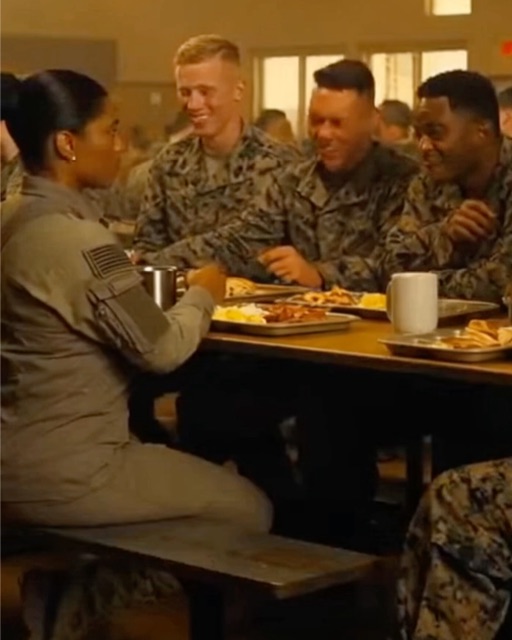
“They give those out as participation trophies now?” Sergeant Dalton barked, loud on purpose. McKay and Russo snickered into their eggs.
She didn’t blink.
She took a slow sip of orange juice, eyes steady.
Then she said one word, soft as a match being struck.
“Run.”
They laughed harder, never noticing the two-star standing right behind them.
Her tray touched the table. The room went dead silent.
“On your feet,” the General said, voice like a door slamming. Three chairs scraped back, too slow.
I was three tables over, fork in midair. My heart pounded.
You could feel the air change, like before a storm.
Lieutenant Commander Monica Hale didn’t raise her voice. She didn’t flinch.
Nine years downrange with Naval Special Warfare will do that to you. The Trident on her chest wasn’t shiny.
It was scratched to hell.
Dalton smirked. “Sir, with respect – ”
“None taken,” the General cut in. He stepped past them and put a steady hand on her tray.
“Ma’am.”
Their faces drained. He called her ma’am.
He turned to the hall. “Sergeants, you think you know who you’re talking to?” His eyes were ice.
“You don’t. But I do.”
Someone dropped a spoon. It sounded like a gunshot.
He pulled something from his pocket and set it beside her Trident. A creased, sand-stained document.
The edges were torn like it had lived in a ruck for years.
“Mountains,” the General said quietly. “North of Sinjar. Winter ops. Buried mission. You remember, Commander?”
She nodded once. “I remember.”
Dalton’s jaw worked. McKay stared at the floor.
Russo stopped breathing.
The General slid the paper across, just enough for the top line to show. Operation name.
Unit. Three signatures.
“Read it,” he told them. “Out loud.”
My blood ran cold as Dalton’s lips stumbled over the first name. Then the second.
But when the General unfolded the bottom corner and I saw the third signature, I realized exactly whose lives she’d already saved, and whose careers were about to be over.
The chow hall stayed quiet. Even the hum of the fridges sounded loud.
Dalton swallowed and tried again. “Statement of Rescue, 3rd Battalion, 7th Marines, attached to Joint Task Force Pine, Northern Corridor, Sinjar Mountains.”
His voice shook on the next bit. “Rescued personnel: Sergeant C. Dalton. Corporal P. McKay. Lance Corporal J. Russo.”
Russo blinked and looked like he might throw up. His hands were shaking.
The General pointed at the bottom of the page. “Signatures of survivors.”
Dalton read his own name. McKay read his.
Russo read his, out of breath like he’d just sprinted a mile.
Monica Hale didn’t look at them. She just held the tray like it weighed nothing at all.
The General nodded once. “Those signatures are yours,” he said.
“And your description of the person who roped you off that scree slope before the avalanche, then hand-carried you two clicks to an HLZ, is right there too.”
Dalton’s eyes ran over the next paragraph. His mouth moved.
He stopped on a sentence and blinked again.
“Read it,” the General said, softer this time.
Dalton pushed air through clenched teeth. “Rescuer identified only as Hale-Actual, smaller build, voice female over comms, probably Navy, unknown unit, likely NSW.”
McKay swallowed hard and didn’t look up. “We never saw her face, sir.”
Russo finally spoke, so quiet I barely heard it. “We were pretty out of it.”
The General nodded like he knew. “You were frostbitten, concussed, and bleeding through your boots.”
“You didn’t see the faces of the people who saved you, but you signed the paper that day, and I signed it with you as witness.”
He tapped the corner of the paper where his own name was scrawled. It matched the lines around his eyes.
He slid the paper back toward Monica Hale. “I keep a copy because the world forgets the right things and remembers the wrong ones,” he said.
“Let’s not add to that.”
No one breathed.
Hale set the tray down gently. Then she stood and turned to Dalton, McKay, and Russo.
“Grab your gear,” she said, calm as a winter lake. “You owe me a run.”
They froze. No one moved.
The General didn’t raise his voice. “Now.”
Chairs skidded. Boots squeaked.
Russo almost tripped over his own foot and caught himself on the table. His ears were red to the lobes.
I watched them go and saw something in Dalton’s face that didn’t fit his usual bark. It looked like shame trying to learn how to walk.
The General kept his hand lightly on her tray. “Ma’am, I apologize for the mess,” he said.
She shook her head. “It’s fine, sir.”
He pressed his lips into a thin line. “It isn’t.”
He glanced around the hall and found me watching because I wasn’t subtle. He waved me over.
“Corporal,” he said, and I stood so fast my bench rocked. “Walk with us.”
I grabbed my cover and fell in step as they pushed through the double doors into the morning light.
The air outside was cool but not cold. We were at Pendleton, and the hills looked pale and rolled under a clear sky.
Dalton, McKay, and Russo were waiting by the training field, hands on belts, eyes on boots.
Hale didn’t make a scene. She didn’t bark or boast.
She just said, “Five miles. Easy pace. I’ll set it.”
Dalton nodded, a short ugly thing. “Aye, ma’am.”
McKay swallowed and tugged his cap a notch lower. “Aye.”
Russo looked like he wanted to apologize right then. He didn’t find the words.
They took off down the perimeter path, a loose line on the dirt by the fence. Hale’s stride was smooth.
She stayed half a step ahead of Dalton and didn’t seem bothered by the incline. He was already breathing hard.
I stayed with the General at the start line because he didn’t need to run to make his point. He stood with his hands behind his back and watched them disappear past the motor pool.
He didn’t talk for a while. He just chewed the inside of his cheek like he was still in the mountains himself.
He finally spoke without looking at me. “You know why I carry that paper, Corporal?”
“Not really, sir,” I said. “I figure it’s a reminder.”
He nodded once. “It is for me, and for people like them.”
He jabbed his chin toward the runners cresting the first rise. “It isn’t just a record of a rescue.”
“It’s a receipt.”
I frowned and felt dumb even as I did it. “Sir?”
“It’s a receipt for a debt,” he said, eyes bright. “I owe her my career.”
“She doesn’t think that way, but it’s true.”
I swallowed. “Were you there, sir?”
“I wasn’t on the mountain, no,” he said softly. “I was commanding the task force that sent her up there against a clock and a weather window that took a week off our lives.”
He took a breath and let it out. “I was also the one who signed the denial when her valor recommendation stalled because the op was buried under three layers of classification.”
He rubbed his temple with one knuckle. “We were moving too fast and too quiet.”
“Things got missed.”
I watched Hale and the sergeants hit the far turn. She shortened her stride to keep them close, but I could see she wasn’t near her limit.
“Did she know you denied it?” I asked.
He smiled without humor. “She called me two months later and told me to stop worrying about my paperwork and get my people home.”
“Then she hung up.”
We stood there in the sun and listened to the base waking up. A bus hissed and a flag snapped.
He cleared his throat. “Corporal, I know who you are,” he said.
That sent a weird chill up my back. “Yes, sir?”
“You were in supply during the rainouts last year,” he said. “You turned your warehouse into sleeping space for the Guardsmen who got stranded.”
I felt my ears heat. “We just had cots and dry floors, sir.”
He shook his head. “You did right.”
He looked at the track and back at me. “People forget the right things.”
The runners came into view again, sweat starting to darken their shirts. Dalton’s jaw was set like a gear stuck in place.
Hale ran light, hands low and loose. She looked over and said something to Russo.
He nodded and found a laugh that made it to his eyes.
McKay’s face was already streaked with dust. He stumbled a little on a rut and she steadied him with one hand on his elbow without breaking stride.
By mile three Dalton’s mouth was white at the corners. He wasn’t smiling now.
When they crossed the line at five, Hale wasn’t even winded. She gave them a minute and then clapped her hands once.
“Stretch,” she said. “Then chow.”
Dalton wiped an arm across his face and nodded. “Ma’am,” he said, rough and slow.
He looked like he wanted to say more and maybe didn’t know how.
Russo beat him to it. “Ma’am, I’m sorry,” he blurted.
He held his hands out like he was trying not to beg. “We didn’t know.”
Hale tilted her head. “You don’t have to know someone’s past to give them respect,” she said.
McKay cleared his throat and stared at his boots. “We were out of line.”
Dalton licked lips gone dry. “I was out of line.”
He raised his eyes and met hers. “Thank you for what you did up there.”
He nodded at the hills because he couldn’t find words for mountains.
Hale looked at each of them in turn. “You were cold and scared and you kept your heads and moved when I told you,” she said.
“You did fine.”
The General stepped forward then. His hands were still behind his back.
“Sergeants,” he said. “You’ll present yourselves to First Sergeant after chow for paperwork related to disrespect to a commissioned officer.”
Dalton flinched. McKay stiffened. Russo’s shoulders sank.
The General held up a hand. “You will also spend two weeks every evening volunteering in the rehab ward at the base hospital.”
“You will read to people who are relearning how to hold forks.”
“You will push wheelchairs for men who never got to finish their runs.”
None of them argued. They all nodded like they were saying prayers.
Hale didn’t say anything about that. She just looked past them at the low hills like she was measuring something invisible.
I ended up jogging after her as she cut toward the armory. I don’t know why I did it.
“Ma’am,” I said, and she slowed enough to match my stride.
“You good, Corporal?” she asked.
“Yes, ma’am,” I said. “I just wanted to ask you something.”
She didn’t say no. She didn’t tell me to mind my business.
“What was it like up there?” I asked.
She breathed once like she was tasting cold air again. “It was louder and quieter than you can imagine.”
“The wind screamed, but you hear your own heart like a drum in your teeth.”
She smiled a little. “The mountains don’t care about you, and that’s almost a relief.”
She glanced over at me. “They were stubborn, those three,” she said.
“They were shaking and they still tried to argue with me about leaving their packs.”
I laughed before I thought about it. “Sounds like Marines.”
She nodded. “They were good.”
“We were late to the party because the birds couldn’t find a hole through the mess, so we went on foot the last mile.”
She shifted her shoulders like a weight remembered. “One of them couldn’t feel his feet.”
She didn’t name him. She didn’t have to.
“We wrapped them in space blankets and moved,” she said. “I didn’t know their names then either.”
“They were faces under hoods and a weight on a rope and a voice that was trying not to break.”
She didn’t look at me. “It’s weird being a ghost in your own story.”
I didn’t know what to say to that, so I just stayed with her until the building swallowed her up.
That afternoon the base felt different. Word had gotten around fast.
Mess hall talk works like a radio nobody controls. People were quieter as they came through the line.
Dalton sat with McKay and Russo at the edge of the room and kept their voices low. They ate slow and left no trash.
I ended up on runner duty later, carrying paper from the division office to the med ward. The General signed the form assigning the sergeants to volunteer shifts.
He didn’t look like a man taking a victory lap. He looked like a man trying to set a bone right.
The first night at the hospital, I stayed to help because the ward supervisor asked for extra hands. Fluorescent lights hummed over the long room and TV glow bounced off walls.
A kid no older than nineteen was balancing a spoon in his fingers like it was a new animal. His mom sat with a face folded into something braver than I’ve ever been.
Dalton showed up with his sleeves rolled and a pair of white socks in a pocket like he didn’t know where to put his hands. He glanced at me and then away.
He went straight to the first bed and said hello. His voice was too loud.
By the end of the hour he had learned to speak softer. He had also learned how to lift a wheelchair flap without pinching skin.
Russo found a partner in a guy who had been airborne before a wrong landing broke him into parts and they laughed about football like it was medicine.
McKay folded blankets with corners sharp as corners could be and then curled one edge softer when a woman with scars asked him to stop making her bed look like a barracks inspection.
Hale didn’t show up there. That wasn’t her assignment or her ego.
She went back to her own work and the world that didn’t notice when she carried it.
A week passed and something changed in the way people looked at her in the hallways. There was still the glance at the Trident because it’s a bright piece of metal.
But there was also a nod that meant we see you. Not we know you, but we see you.
That mattered.
Two weeks later a heat wave rolled off the hills and threw a spark into dry grass. By noon the smoke was a curtain.
By one we had an engine company in our lot and orange helicopters clawing the sky. The wind felt wrong.
I was hauling cases of water to a staging area when Hale came around the corner with a radio on her shoulder. She wasn’t in dress anything.
She wore a beat-up ball cap and a shirt with the sleeves cut off.
“Command wants a shelter stood up in the field house,” she said. She didn’t say it to me.
She said it to the air and the people in it who knew how to carry.
I nodded anyway and started pulling pallets. Dalton fell in next to me with a hand truck.
He didn’t look at me, but he bumped my arm with his and that was enough.
By three the field house smelled like sweat and rubber. Cots lined the floor and families lined the cots.
A little boy cried and then stopped mid-breath when somebody put a cool bottle in his hands. His sister coughed until she didn’t.
The General walked through, jacket off, and handed out masks like it was Halloween and he’d finally found the good candy.
He didn’t stay long. He went back to the fire line with a bad feeling written all over his face.
Hale arranged a corner for pets because some people would not leave their dogs and you can plan better if you know what matters.
She sent Russo and McKay to the motor pool to beg for fans. They came back with three and a promise for more.
Dalton lifted and moved and lifted again until his shirt stuck to him. He didn’t brag. He didn’t need to.
Around sunset the sky turned a color I couldn’t name. Embers blew like fireflies and the air tasted like old pennies.
A Ranger unit on mutual aid rolled in and set up a table by the door. A Navy chief I didn’t know started a list and a mother signed her kids in with a shaking hand.
It was chaos and then it wasn’t, and then it was again. That’s how those days go.
Sometime after dark a small woman with gray in her hair started gasping in a way that made your hackles rise.
Hale was at her side before the sound settled. She checked a pulse and looked at the ceiling like she was either counting or praying.
“Who’s got a vehicle clear?” she asked.
Dalton’s hand went up before his brain caught all the details. “I do.”
“Keys,” she said. He slapped them into her palm like a ritual.
She squared her shoulders at the older woman and smiled in a way that made her look like a neighbor and not like a storm.
“We’re going to the hospital, Miss,” she said. “You’re going to be fine.”
She pointed at me. “Corporal, you’re coming too.”
I didn’t argue. I grabbed a mask and went.
It was a tight ride because the road was half-closed and fire made its own rules. Hale drove like she could see three seconds into the future.
The woman’s breathing evened out with the siren drag of our engine. Dalton kept a steady voice in the back about farms and soccer fields and quiet mornings.
When we slid into the emergency lane, a nurse took one look and waved us in like we were the last plane out.
We stayed long enough to hear that the woman was going to be alright. Then we went back.
The field house was a hum and a low thrum of tired bodies. Somebody had started a card game with kids and a pack of playing cards that had been in a pocket for a decade.
Russo handed me a bottle and a grin. McKay looked at me and said nothing, but his eyes said a lot.
Hale leaned against a wall for twenty seconds and then moved again. I don’t think she knew how to stop.
By midnight the worst had passed. The edge of the wildland crews held.
The shelter quieted because people can sleep anywhere if they have to. Dalton sat on the floor by the door with his back to the wall and his head tipped, not quite asleep.
The General came in with soot on his face and a smile that barely lifted one corner. He saw Hale and walked straight to her.
“You did good,” he said. That was all.
She shrugged. “We all did.”
He reached into his pocket and pulled out the sand-stained paper. He looked at it and then back at her.
“This is yours,” he said.
She shook her head. “Keep it.”
He looked down at it and smiled in a tired way. “No,” he said.
“It’s time.”
She took it like it might break. She didn’t look at the names.
She folded it smaller and slid it into her own pocket. Then she sighed.
“Fine,” she said. “I’ll hang it somewhere no one sees.”
He laughed once. “That’s about right.”
Three days after the fire, when the ash settled and the families went home to sweep off their doorsteps, the commander of the division called a formation on the parade ground.
It wasn’t a big ceremony. No cameras. Just a half circle of people in dusty uniforms and sunburned faces.
The General spoke for five minutes about duty and respect and the quiet kinds of courage. He kept it plain.
Then he called Dalton, McKay, and Russo forward. They stood like they were about to be cut in half.
He handed them each a small coin from his pocket. It was an old unit coin, scratched and heavy.
“Carry this,” he said. “And remember what it cost to earn it.”
Then he turned to Hale. “Lieutenant Commander,” he said. “Front and center.”
She went without drama. That’s her way.
He reached into a folder and pulled out a new piece of paper. The crisp edges caught the light.
“This is not the one I denied,” he said.
“It’s something I should have done sooner.”
He read the citation for a Navy and Marine Corps Commendation Medal for actions during the wildfire response. It named names of people she had led and lives moved safely.
It didn’t mention the mountain or the rope or the cold. It didn’t have to.
When he pinned the ribbon on her blouse, the wind picked up and the flag snapped. Someone coughed, and someone else swallowed a tear.
Dalton stepped forward at the end without being told. He faced Hale like a man who had learned the value of measuring twice.
“Ma’am,” he said. “I know this doesn’t cover it.”
He held out a folded note. His hands shook a little.
“It’s a letter to my mother,” he said. “I told her what you did for me.”
“I told her the name of the person my kids will hear about when they ask me why I don’t quit when things get ugly.”
Hale took the note like it weighed a hundred years. She glanced up at him and nodded.
“I’ll blame the dust in my eyes,” she said, and that made half the formation smile.
We broke after that. People drifted back to their places and the day slid into chores and checklists and coffee that had been warming too long.
Later I found Hale by the fence looking out at hills that would be green again if we just gave them some time.
“Thank you for letting me run my mouth the other day,” I said. I don’t know why I said that.
She laughed a little. “You didn’t,” she said. “You listened.”
“That’s rarer than people think.”
I kicked at a patch of dirt and watched it dust my boot. “Can I ask another question?”
She nodded.
“Did you always know you could do this stuff?” I asked. “The cold, the fire, the people?”
She rolled her shoulders, and they creaked like old leather. “No,” she said.
“I failed the first time I tried to get into the pipeline. I couldn’t keep my head under the water when another student pushed me and I saw black where I was supposed to see blue.”
She smiled at the memory like it had stopped hurting. “I went home and swore I was done.”
“What changed?” I asked.
“My neighbor needed her porch steps fixed because her husband was deployed,” she said.
“I didn’t know a damn thing about carpentry, so I watched videos and I tried and I messed it up twice.”
She looked at her hands like they were tools she borrowed every day. “The third time I built those steps solid enough to carry her and her kids and probably a small truck.”
“I went back to the pipeline after that.”
She shrugged. “I didn’t know I could do any of it until I did it.”
“After that, it was just one more small thing, then another, until someone else started believing too.”
We stood and let that settle. Words can sit for a while without going stale.
The General came up behind us after a minute. He didn’t clear his throat or stomp his boots.
“Ma’am,” he said to her. “Corporal,” he said to me.
He looked out at the hills too. “I can’t unfurl all the secrets and I can’t rewrite every report,” he said.
“But I can tell you this much.”
He raised his eyebrows like he was inviting us both into a club we were already in. “People will surprise you in both directions,” he said.
“They’ll be cruel when it’s easy and brave when it’s hard.”
“Your job is to hold yourself to the better version and pull them toward it when you can.”
Hale nodded once. “That sounds right,” she said.
He clapped her shoulder and left us there to finish thinking in the sun.
A month later the sergeants finished their nights at the hospital. They kept going once a week anyway.
Nobody told them to. They just did.
Russo started bringing his guitar because one of the patients said music made time pass without scraping so much.
McKay learned to braid hair because a woman with scars had a daughter who trusted him with it. He got better and he didn’t make the ends too tight.
Dalton took the longer shifts and always took the last walk around the ward, touching doorframes like knots in a rope he was making stronger.
I saw it all because I kept going too. It turns out moving cases and refilling hand sanitizer and listening to a man talk about a sunrise he remembered from twenty years ago is something I can do.
Hale kept her edges worn down where no one could see them. She disappeared out to a range in the desert for a week and came back with dust in her eyebrows and a sun line that almost smiled.
When she passed the chow hall one morning, the new guys stepped aside. They didn’t know all the stories, and maybe they didn’t need to.
They gave her room out of instinct and a thing older than words. It’s the kind of respect that comes from a thousand small right choices, not a single loud one.
One day I asked Dalton what had changed for him exactly. We were stacking boxes in a warehouse that smelled like cardboard and lemon cleaner.
He thought for a long time and didn’t pretend he had an answer I’d like. “The first night at the ward,” he said.
“I watched a man who used to carry fifty pounds on his back drop his spoon twice.”
He set a box down and leaned on it. “I heard myself wanting to say hurry up in my head.”
He looked at me like he hated that version of himself. “Then I saw him grin at his own shaking like he’d just beaten a record and I felt small.”
He shrugged like it didn’t fit right. “That, and the mountain,” he said. “I didn’t know I was being helped by someone I’d call weak in a chow line.”
He spat at his own word and shook his head. “I won’t make that mistake again.”
Neither would I. I don’t think any of us would.
Even when I sat in my bunk later with no sounds but the click of someone typing two rooms over and the far-off rumble of a truck going someplace new, I could hear that one word she had said at the start.
Run.
She meant move. She meant get out of your own way.
She meant don’t waste time proving how tough you are to someone who already knows what tough costs.
I carry that with me now like a list in my pocket. Run isn’t always on your feet.
Sometimes it’s an apology you make before anyone asks for it.
Sometimes it’s a hand under someone’s elbow or a chair pulled up next to a bed or a piece of paper folded smaller until it fits a place right over your heart.
If there’s a lesson here, it’s simple and it sticks. You don’t know who you’re talking to, or what they’ve carried for you already.
Respect costs you nothing and it pays off in ways you can’t count.
And if you get it wrong, fix it fast, then do the kind of work that makes you worth forgiving.