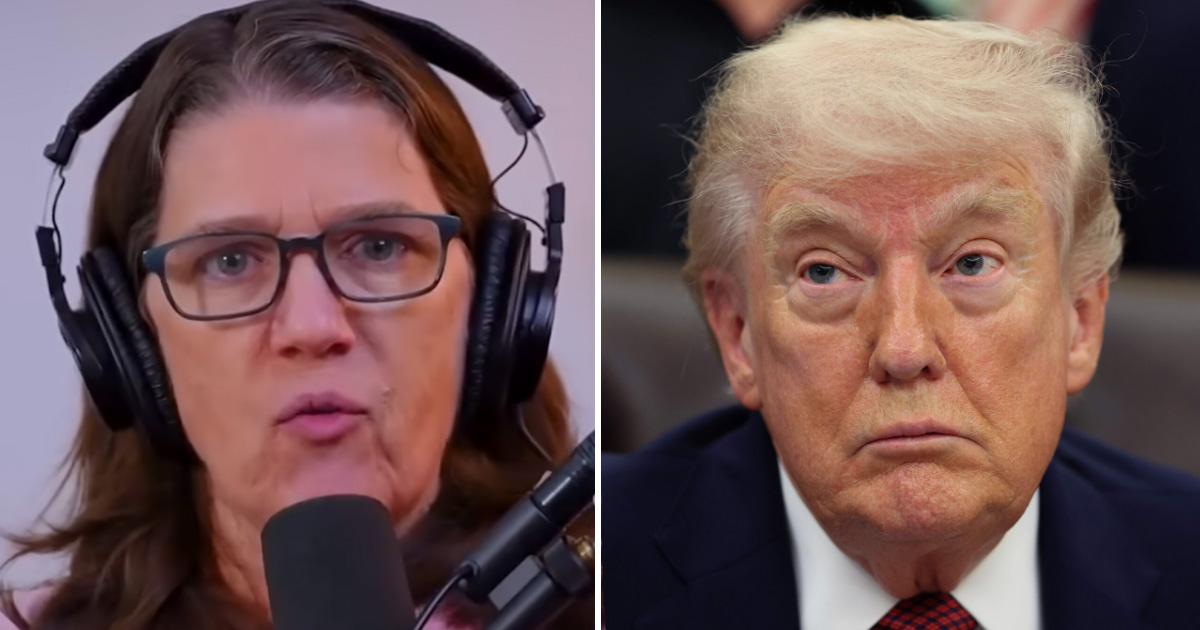
Mary Trump has once again spoken publicly about her uncle, President Donald Trump, offering a stark assessment of his state of mind and what she believes drives much of his behavior. In a wide-ranging conversation with journalist Steven Beschloss, she described him as “an empty, unloved man” and suggested he is experiencing a decline in both mental and physical resilience.
Her remarks centered on his recent appearance at the G7 summit in France, a high-profile moment watched closely by supporters and critics alike. According to reporting from LADbible, Mary Trump said, “He may still have moments when he appears more coherent, but psychically he’s in a downward spiral.” It was a pointed observation from a family member who has long maintained that the pressures of public life magnify his inner struggles.
Mary Trump’s view of what worries the President most
Mary Trump also shared what she believes is her uncle’s greatest fear: public humiliation. In her words, “He’s experiencing constant narcissistic injuries, and nothing terrifies Donald more than humiliation.” She added a sharp coda: “The problem for him is that nobody humiliates Donald more effectively than Donald humiliates himself.”
For those unfamiliar with the term “narcissistic injuries,” it’s a phrase often used to describe blows to one’s self-image or pride. Mary Trump, who has a background in psychology and has written extensively about her family, argues that highly visible missteps, criticism, and moments of confusion can feel intensely threatening to someone who is preoccupied with public standing. In this view, even small errors or criticisms might loom large, because they challenge a carefully crafted image of strength and success.
In practical terms, this means that moments on the world stage—like a summit with other leaders—carry extra emotional weight. Every gesture, pause, or stumble is scrutinized. For those who thrive on projecting control, even routine awkwardness can be difficult to accept. Mary Trump portrays her uncle as particularly sensitive to these moments, believing that perceived slights or missteps quickly become deeply personal and painful.
A G7 appearance under a bright global spotlight
Global gatherings such as the G7 are made for television and instant reaction. Clips and comments circulate almost immediately, and interpretations multiply. In such an environment, allies and critics can see very different things in the same footage. Supporters may say the President looked focused and firm, while detractors might detect hesitation or confusion. Mary Trump’s comments come against this backdrop, presenting her interpretation of how her uncle experiences the pressure and how it affects him over time.
While she did not offer a detailed point-by-point analysis of the summit, her emphasis on a “downward spiral” suggests she views these events as part of a pattern. In her telling, it is not a single incident but a series of highly public moments—each laden with the possibility of embarrassment—that amplify his stress, sharpen his defensiveness, and lead to more of the same behavior she criticizes.
A forceful response from the White House
The White House did not leave Mary Trump’s remarks unanswered. Communications Director Steven Cheung dismissed her claims in strongly worded terms, saying: “She’s a stone cold loser who doesn’t have a clue about anything.” He went further, adding: “Her entire worth as a human being is predicated on spewing lies about President Trump in a sad attempt to stay relevant.”
That rebuke underscores just how sharply divided opinions about Mary Trump have become. To critics inside the administration, she is a family member trading on the Trump name to attack the President. To her supporters, she is speaking candidly about patterns she believes she knows firsthand. The clash of these perspectives has become a familiar feature of political life in recent years—especially when the source of criticism is someone from within a prominent family.
Recent online confusion that drew attention
Mary Trump’s latest comments are landing at a time when the President’s online activity has also sparked conversation. On Father’s Day, he shared a Truth Social post praising a “great daughter,” accompanied by a photograph of a woman who was not related to him. The post read, “Great daughter, My Honor!!! President DJT,” and was later deleted. According to LadBible, some observers concluded the woman was likely Margo Casimatidis, who is married to billionaire businessman and Trump supporter John Catsimatidis.
While social media mix-ups can happen to anyone, the Father’s Day post quickly fed into broader public debate. To critics, it seemed like yet another confusing moment. To supporters, it was a minor online misstep blown out of proportion. In the modern media environment, where a single post can become headline news within minutes, even small errors can take on an outsized significance—particularly when they reinforce a preexisting narrative.
Official word on the President’s health
Amid these conversations, the White House has pushed back against suggestions that the President is unwell. Following a recent medical examination, White House physician Dr. Sean Barbabella stated that the President is in overall “excellent health.” He also noted that the President received a perfect score—30 out of 30—on a cognitive impairment assessment.
For those who are curious about what such a score means, many common screening tools are designed to quickly gauge memory, attention, language, and problem-solving. They are not the same as a full neuropsychological workup, but they can be useful to flag potential concerns. A maximum score on a standard screening indicates that, at least by that measure, no impairment was detected. The White House has used this result to argue that the President remains mentally fit for the demands of office.
This is where the conversation often splits. Critics may argue that a pristine test score does not guarantee all-day mental sharpness, while supporters point to the score as solid evidence of capacity. As with many aspects of political life, data points are filtered through people’s prior beliefs, and a single result rarely changes every mind.
Why Mary Trump’s commentary attracts attention
Mary Trump is not a neutral observer in the eyes of many Americans. She is both a family member and a persistent critic, having authored a best-selling book that made news for its personal and psychological portrait of her uncle. That combination—a relative with professional training in psychology—makes her views newsworthy, even if some dispute their fairness or accuracy.
Her central claim this time is not new, but it is blunt: she believes the President is emotionally fragile when faced with public embarrassment, and that this fragility is increasingly apparent. By tying her remarks to the high-visibility setting of a G7 summit, she links private vulnerabilities with public duty. For her, the connection is straightforward: a leader’s fear of humiliation can shape decisions, reactions, and relationships with allies and opponents alike.
Humiliation, image, and the pressures of leadership
It can be helpful to step back and consider the broader human element. For leaders of any age, public life demands constant performance. Words are parsed, missteps replayed, and the glare never dims. A single awkward clip can dominate a news cycle. The pressure to maintain composure, command, and clarity is immense.
In that light, Mary Trump’s focus on humiliation speaks to something recognizable. Many people, not just public figures, fear being embarrassed in front of others. The difference for a president is scale. Every podium is global, every stumble is seen by millions, and every criticism echoes for days. For someone who is especially sensitive to slights, the treadmill of public life may become emotionally exhausting.
Of course, sensitivity and stamina are not mutually exclusive. Many leaders have withstood public scorn and carried on effectively. What Mary Trump is arguing is not merely that her uncle dislikes criticism, but that it cuts to the core of how he understands himself, prompting a cycle of defensiveness that she believes has deepened over time.
Supporters, critics, and the battle for the narrative
Reactions to Mary Trump’s remarks tend to fall into familiar patterns. Supporters of the President often see such critiques as opportunistic, politically motivated, or simply unfair. They point to official medical assessments, long schedules, and public appearances as evidence of vigor. They also emphasize policy results and argue that critics have been predicting collapse for years without seeing it materialize.
Critics, on the other hand, treat each questionable moment—whether it’s a muddled comment, a confusing post, or an awkward exchange—as reinforcing their worries. For them, Mary Trump’s perspective is not just a family quarrel but a key to understanding the President’s choices and reactions, including how he handles pressure, criticism, and setbacks.
In a deeply polarized time, both interpretations can exist side by side, each with its own facts and emphases. That is part of why the conversation persists, and why each new appearance, statement, or slip becomes a test in the court of public opinion.
Reading between the lines, without jumping to conclusions
For readers who are trying to make sense of all this, a balanced approach can help. It is reasonable to accept that someone who has spent decades building an image cares deeply about how he is seen. It is also fair to note that a clean bill of health and a perfect score on a standard cognitive test carry real weight. Neither fact cancels the other.
Public life is full of contradictions. A person can be strong in one setting and falter in another. A leader can be resilient and still bristle at criticism. Mary Trump is offering a lens—one shaped by family history and her own interpretations. The White House offers another lens, grounded in official assessments and a defense of the President’s capacity. Both are part of the larger picture that voters and citizens must weigh.
The Father’s Day post as a case study
The brief Father’s Day post that was shared and then deleted is a useful example. On one level, it could be chalked up to a simple mistake—mislabeled photo, hurried posting, or staff error. On another level, in the midst of intense scrutiny and ongoing questions, it becomes one more data point for those inclined to worry. The truth may be mundane, yet the reaction tells us something about how tightly every moment is interpreted in today’s environment.
Mary Trump’s argument is that these missteps are not isolated, but rather part of a larger pattern that reflects her uncle’s psychological state. Whether one accepts that conclusion or not, the speed with which a small moment can become a national talking point underscores how little room public figures have for error—and how the fear of humiliation can, in itself, become a source of pressure.
What to watch in the months ahead
Looking forward, the focus will likely remain on three areas. The first is major public appearances—summits, speeches, and interviews—where split-second impressions create lasting narratives. The second is the President’s online presence, where posts reflect both his voice and the realities of modern communication. The third is ongoing health disclosures, from routine checkups to any new evaluations, which the White House will continue to highlight as reassurance.
For Mary Trump’s part, she has shown no sign of retreating from the debate. Her remarks suggest she believes the pressures of office and the demand to project unshakeable confidence will remain difficult for her uncle to manage. For the administration, the strategy is equally clear: reject her claims, point to medical evidence, and move the conversation back to policy and accomplishments.
The bottom line
Mary Trump’s latest comments paint a portrait of a leader preoccupied with avoiding humiliation and increasingly weighed down by the unending glare of public attention. The White House’s response could not be more categorical, dismissing her claims and underscoring the President’s clean bill of health and perfect cognitive screening score.
Between those poles lies a simple truth about modern politics: image and reality are intertwined, and both are judged in real time. Supporters and critics will continue to see what they expect to see, yet the stakes remain high. Every summit, every statement, and every post offers fresh evidence to each side. Whether one accepts Mary Trump’s diagnosis or the White House’s defense, the conversation about resilience, perception, and the burdens of leadership is sure to continue.
As with any public figure, the full picture emerges over time, not from a single interview or a single test result. For now, Mary Trump has added another chapter to a long-running family drama that doubles as a political story. And once again, it has people talking about what truly motivates the President, how he handles the spotlight, and where his limits may lie.