
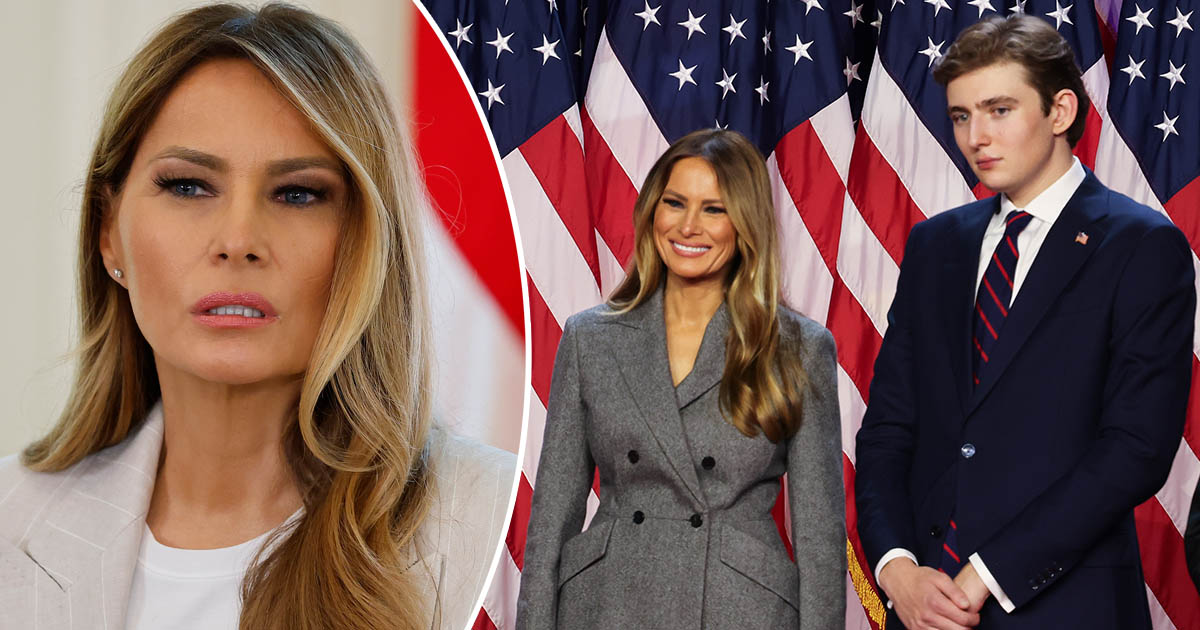
A mother-first approach in a high-profile role
Melania Trump has long made it known that her son, Barron, is her top priority. Even while serving a second term as First Lady, with the demands and expectations that come with life in the public eye, she has emphasized that motherhood guides her choices. Reports have even suggested she would not live at the White House full-time, choosing instead to split her time to provide steady support for her son in New York when needed.
That commitment to family has been a defining feature of her public role. As the new term began, she made clear that her schedule would be shaped around the needs of her family. Her message was straightforward and relatable to many parents and grandparents: family comes first, even when duty calls.
During a conversation with Fox News, she explained her plans in simple terms. “I will be in the White House. And you know when I need to be in New York, I will be in New York. When I need to be in Palm Beach, I will be in Palm Beach. But my first priority is, you know, to be a mom, to be a first lady, to be a wife. And once we are in on January 20, you serve the country.” Those words offered a window into how she intended to balance family life with public service.
A quieter public presence, by design
As the months unfolded, observers noticed that Melania Trump maintained a lower public profile than many expected. According to reports, she spent comparatively little time at the White House early on in the term, especially in the first hundred days. That choice, as described in media coverage, contrasted with the more traditional, highly visible approach many First Ladies have taken in the past.
Coverage also noted that certain ceremonial activities at the residence were being handled differently this time around. Instead of focusing on redecorating, receptions, and public tours, Melania appeared to be selectively choosing when to step forward, concentrating on occasions and issues that aligned closely with her interests and priorities. A historian of First Ladies, Katherine Jellison, even remarked that her low-profile approach was reminiscent of Bess Truman, highlighting just how unusual such a quiet style is in modern times.
While some found the approach surprising, others saw it as consistent with what Melania had been saying all along. The role of First Lady has never had a fixed job description, and each individual brings a different spirit to the position. For Melania, being present for her son and shaping her time carefully seems to have been central to her plan.
Stepping forward on moments that matter
At the same time, reports indicated that Melania Trump began taking on more influence behind the scenes and on the occasions when she chose to appear in public. One widely discussed example involved a diplomatic moment during a meeting between President Donald Trump and Vladimir Putin in Alaska. According to accounts, the First Lady personally delivered a letter to the Russian leader, focusing on the human cost of the conflict in Ukraine and Russia, especially its impact on children.
Her message was clear and heartfelt. “Mr. Putin, you can singlehandedly restore their melodic laughter,” Melania Trump wrote. “In protecting the innocence of these children, you will do more than serve Russia alone—you serve humanity itself.” She added a direct appeal for action, writing, “Such a bold idea transcends all human division, and you, Mr. Putin, are fit to implement this vision with a stroke of the pen today. It is time.”
That letter drew attention both for its tone and its focus. By centering the conversation on the welfare of children, it reflected Melania’s ongoing interest in issues that affect families, and it suggested a broader vision for her public role during this term—one that highlights compassion, stability, and the value of childhood.
A trusted voice in private
Observers inside and outside Washington have also commented on Melania Trump’s influence within the administration. Some described her as a crucial confidante, a perspective echoed by Kellyanne Conway, who said, “Behind closed doors, Trump has, for decades, regarded his wife as a top confidante and counsellor. Whether as an international business mogul, or TV star, or leader of the free world, it is Melania’s opinion that he has consistently sought.”
Other voices around the White House have noticed a shift as well, describing her as more active and involved in select matters. Whether that change reflects a new dynamic in the administration or simply a clearer view of her ongoing role is open to interpretation. What is evident is that Melania Trump has chosen to speak up most loudly where she feels her voice can do the most good, especially where children and families are concerned.
Be Best and the digital lives of children
Melania Trump’s Be Best initiative has always had a strong focus on children’s well-being, particularly when it comes to online behavior and safety. In this term, that focus has extended to one of the most important topics in our time: artificial intelligence. On September 4, she hosted a meeting of the White House Task Force on Artificial Intelligence Education to discuss how parents and children can approach new technology with confidence and care.
In that session, she offered a striking point of view, suggesting that we should think about AI as we do about the children in our lives—full of potential, yet in need of guidance. Her words were simple and memorable. “The robots are here. Our future is no longer science fiction,” she said. “As leaders and parents, we must manage AI’s growth responsibly. During this primitive stage, it is our duty to treat AI as we would our own children: empowering, but with watchful guidance.” She summed up the moment by saying, “We are living in a moment of wonder. And it is our responsibility to prepare the children of America.”
For many families, especially those who did not grow up with smartphones and voice assistants, the fast pace of technology can feel overwhelming. Melania’s message aimed to make the subject feel less intimidating and more like a shared journey. By comparing AI to children, she suggested an approach that emphasizes patience, supervision, and the belief that with the right support, young people and new tools can thrive together.
What treating AI like a child really means
Melania Trump’s comparison of AI and children is, at its core, a call for thoughtful, steady guidance. Just as children learn best when adults set clear expectations, model good behavior, and provide encouragement, AI can be introduced into family life in ways that build trust and understanding. The idea is not to fear technology, but to approach it with open eyes.
For parents and grandparents, this mindset can turn a confusing subject into a manageable one. It starts with curiosity. Rather than keeping AI at arm’s length, many families have found it helpful to explore it together. That can be as simple as asking a virtual assistant to set a timer for dinner, trying a language learning app with a grandchild, or using a photo organizer that helps identify faces from family albums. These small steps build comfort without demanding advanced technical skills.
Guidance also matters. Just as families talk about bedtimes or homework routines, they can have calm, clear conversations about when and how AI should be used. Some families choose to keep devices out of bedrooms, or to designate certain hours each evening as “tech-free” time for conversation, reading, or hobbies. Others set standing rules about what information should never be shared with online tools. These are familiar parenting strategies, simply applied to a new landscape.
When Melania spoke about empowering with “watchful guidance,” she was pointing to a balance that many households already know well. It is the balance between allowing children to explore and learn on their own, and staying close enough to help them handle what they might not yet understand. In the world of AI, that can mean showing children how to question what they see online, reminding them that not every answer a system provides is the final word, and encouraging them to ask a trusted adult when something seems off.
Making sense of AI in daily life
For those who did not grow up with the internet, AI may sound abstract. But in practice, it often appears in everyday moments. Many phones now organize photos by recognizing places and faces. Streaming services suggest new shows based on what you have already watched. Voice assistants set timers, read the weather, or play music without a touch. In schools, educational tools adapt to a child’s progress, giving extra practice where it is needed. These are common uses of AI that help families save time and stay connected.
That said, it is sensible to stay aware of potential pitfalls. Children are naturally curious, and they may not always realize when they are sharing personal information. Just as older generations taught children to be careful with strangers at the door, today’s families can show young people how to be careful with digital tools. The lesson is the same: be polite, be cautious, and if something seems unusual, check with a parent or guardian.
Melania’s framing helps keep the tone positive. Treat AI like a child, she suggests, with hope for what it can become and with care for how it learns. That spirit turns the conversation away from fear and toward responsibility, which may be exactly what many households need in order to feel more comfortable navigating change.
The enduring theme: children first
Across all of these developments—her travel schedule, her measured public appearances, her letter centered on the well-being of children, and her remarks on AI—one theme connects the dots. Melania Trump continues to organize her work around the needs and futures of young people. For her, the most urgent questions appear to be how to safeguard childhood, how to encourage kindness and safety online, and how to prepare the next generation for a world in which technology plays a larger role every year.
People may have different opinions about politics, but the desire to see children grow up safely and confidently is widely shared. Melania’s statements tap into that common ground. Her call for “watchful guidance” is something many grandparents, parents, teachers, and caregivers understand instinctively. It affirms the idea that adults can shape a healthier environment—digital and otherwise—through steady involvement and loving boundaries.
From the East Wing to the kitchen table
There is also a practical side to this. While events at the White House often seem far removed from daily routines, the principles Melania Trump described are easy to bring home. A calm conversation after dinner about what children watched online that day can be a powerful habit. Many families keep that talk gentle and open-ended, inviting children to share what they liked and what made them uneasy.
Another simple step is to learn together. Children enjoy showing adults new features on a phone or tablet. When a grandparent or parent asks a child to teach them, it not only builds the child’s confidence, it also gives the adult a better sense of the apps and tools the child enjoys. That shared understanding makes guidance more natural and more effective.
Families can also create a sense of shared responsibility. When a new device comes into the home, talking through what it does, when it should be used, and where it should be stored can prevent misunderstandings later. No complicated rules are needed—just clear expectations and the reminder that devices are there to help, not to distract from life’s most important moments.
Why this message resonates now
Technology has changed quickly in a short time. Many adults remember rotary phones, paper maps, and handwritten letters. Now, messages travel instantly, photos live in the cloud, and voice assistants answer from the kitchen counter. That pace of change can be disorienting, especially when children adopt new tools faster than adults do.
In that context, Melania Trump’s comparison of AI and children lands with a certain gentle wisdom. It does not require anyone to become an expert overnight. It does not ask families to accept every new thing. It invites adults to do what they have always done at their best—offer patience, attention, and a steady example. When leaders remind us of those timeless habits, it can make new challenges feel more manageable.
Her approach also underscores hope. Calling this “a moment of wonder” recognizes that technology can amplify creativity, strengthen connections, and open doors to learning. When guided well, these tools can help children practice languages, explore history, or discover music. They can keep grandparents and grandchildren close, even across long distances. The key is not to let the tools run the household, but to place them in service of the values the household holds dear.
Looking ahead
As Melania Trump continues her work as First Lady, it seems likely that children’s well-being, online safety, and the thoughtful use of new technology will remain central to her agenda. Whether she appears often in front of cameras or speaks more selectively, her recent actions suggest a consistent direction. She is focusing her attention where she believes it can do the most good, with a steady eye on how decisions today shape the world children will inherit.
For many readers, the takeaway is both simple and encouraging. You do not need a background in computers to guide children through the age of AI. You need the same qualities that have always defined good caregiving: care, consistency, curiosity, and courage. With those in place, families can welcome helpful innovations while keeping childhood safe, warm, and grounded.
Melania Trump’s remarks invite the nation to approach artificial intelligence with the same loving caution and faith we bring to raising our kids and grandkids. That framing brings the conversation back to what matters most. However quickly technology moves, the heart of the task remains familiar—nurture the young, guard their innocence, and prepare them well for the world ahead.



