I’m in the 75th Ranger Regiment. I thought I was untouchable.
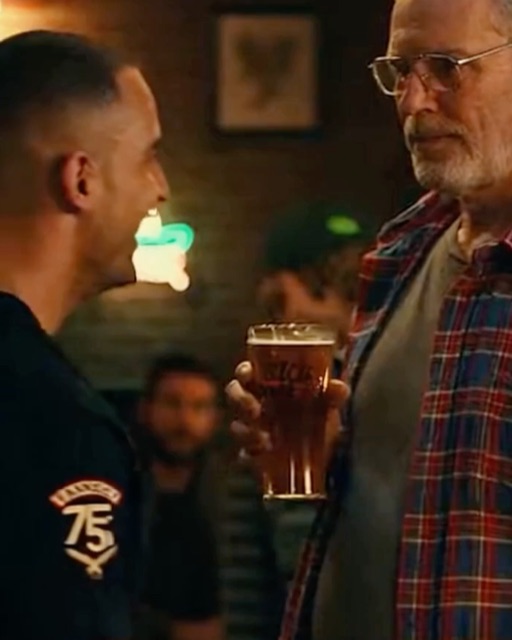
At O’Malley’s pub, this pot-bellied old-timer named Carl starts yapping about “real conditioning.” I laughed in his face. “Prove it, pops. Push-ups to failure. Loser buys the round.”
Bar went dead silent. I dropped first – cranked out 80 clean reps. Chest burning, I stood, smirking.
Carl took off his glasses. No palms on the dirty floor. Knuckles only.
He didn’t stop at 80. Or 100. One-twenty. Stood up dry as bone, grabbed his beer. “Pay up, kid.”
Rolled his flannel sleeve for his watch.
My blood turned to ice.
Faded blue ink: double-headed eagle gripping a dagger.
Not some unit patch.
The kill-brand of the Serbian butcher Interpol’s hunted since ’95.
I didn’t grab my wallet.
My hand went for my sidearm.
He locked eyes and whispered, “The man in the red truck across the street. He’s not here for the beer.”
My training took over.
I didn’t turn my head. I used the reflection in the mirror behind the bar.
Sure enough, a beat-up red Ford was parked under a flickering streetlight. A silhouette sat behind the wheel.
My whole world tilted on its axis.
This wasn’t some random encounter. This was something else entirely.
“Who are you?” I mouthed, my voice gone.
Carl took a slow sip of his beer, never breaking eye contact. “The guy who’s about to save your life. If you’re smart enough to let me.”
He nodded toward the back door, the one that led to the alley. “On my count. Three.”
My mind was a hornet’s nest of questions and protocols.
“Two.”
Engage a known hostile? Apprehend? This was domestic soil. I was off-duty.
“One.”
He moved, not with the shuffle of an old man, but with an economy of motion that was terrifyingly precise.
He didn’t run. He flowed toward the exit.
I followed, my hand still glued to the grip of my pistol.
The alley was dark, smelling of stale beer and garbage.
“They’re watching the front,” Carl said, his voice a low gravel. “They’ll have a man covering this alley in thirty seconds.”
He pointed to a rusted fire escape ladder. “Up. Now.”
I hesitated for a fraction of a second. “That tattoo…”
“Is a long story,” he cut me off, his eyes hard as flint. “And we’ll have time for it if we’re not dead. Move it, Ranger.”
He knew what I was. He’d known from the moment I walked in.
The arrogance, the haircut, the way I carried myself. He’d read me like a book.
I started climbing, the cold metal biting into my hands.
Carl was right behind me, moving with an eerie silence for a man his size. He didn’t even seem to be breathing hard.
We reached the roof, a flat expanse of tar and gravel.
Below, we heard the crunch of feet in the alley. A low voice speaking a language I recognized from my last tour. Serbian.
My blood ran cold again. It was real. All of it.
“This way,” Carl grunted, leading me toward the far edge of the building.
We crossed to the next rooftop, a short but heart-stopping leap over a chasm of darkness.
He landed like a cat. I landed like a soldier, with a thud that felt loud enough to wake the city.
He gave me a look. It wasn’t angry. It was the look of a teacher disappointed in a student.
We navigated two more buildings before descending another fire escape into a different, quieter street.
An old, unassuming sedan was parked by the curb.
“Get in,” he said, pulling a key from his pocket.
The car smelled of old coffee and something metallic, like oil. It started with a low rumble.
“Alright,” I said, my voice finally steady. “Talk. Now. Who are you, and what the hell is going on?”
Carl pulled away from the curb, his eyes constantly scanning the mirrors.
“The man you think I am,” he began, “Dragomir Volkov. The Butcher of Srebrenica. I’ve been hunting him for twenty years.”
I stared at him, at the faded tattoo on his wrist. “That’s his mark. The intel is specific.”
“The intel is wrong,” Carl said flatly. “It was disinformation from the start, planted by Volkov himself. He branded his top lieutenants with that mark. A loyalty test. He made the world hunt his own men while he vanished.”
He glanced at me. “My team and I, we were tasked with infiltrating his unit. Off the books. Deep cover. To get the brand, you had to do things. Things that don’t wash off.”
A silence filled the car, heavier than any I’d ever known.
“So your team…?”
“Gone,” he said, his voice devoid of emotion. “One by one. Picked off over the years. I’m the last one left.”
He took a sharp right, his movements calm and practiced.
“The tattoo isn’t a brand of a killer,” he said, his eyes meeting mine in the rearview mirror. “It’s the mark of the men who hunted him. A ghost unit that was buried and forgotten. He’s been hunting us ever since, tying up loose ends.”
It was a hell of a story. Plausible enough to be terrifying.
“Why me?” I asked. “Why pull a civilian, even a soldier, into this?”
“I didn’t pull you in, kid. You were already in it. You just didn’t know.”
He saw the confusion on my face.
“You served under Sergeant Major Phillips, didn’t you?”
The name hit me like a physical blow. Phillips was my mentor, my guide. The man who shaped me into a Ranger. He was killed by an IED in Afghanistan three years ago.
“How do you know that?”
“It wasn’t a random IED,” Carl said gently. “It was a targeted hit. Phillips was ex-Delta. Before that, he was part of my unit. He was one of us.”
The car seemed to shrink around me. The air grew thin.
“He got out, started a family, rejoined the regular army. He thought he was safe. But Volkov has a long memory. And deep pockets.”
Carl continued. “Phillips knew Volkov was in the States. He was getting close. Too close. So Volkov had him eliminated, disguised as a casualty of war. And he used his network to keep an eye on anyone close to Phillips. Especially his prized protégé.”
He looked at me. “That’s you, son. You’ve been on their radar for years.”
My cockiness in the bar felt like a distant, shameful memory. I had walked around thinking I was a predator, when all along, I was the prey.
“So the men at the bar…”
“Volkov’s watchers. They’ve been trying to get a line on me for months. They saw you, a Ranger, talking to me. They must have thought I’d finally made contact with my old world. They were getting ready to clean house. Both of us.”
He pulled into the garage of a small, tidy-looking suburban house. It was the last place on earth you’d expect to find a ghost.
The inside was spartan. A small kitchen, a living room with a single armchair and a wall of books. No photos. No personal effects.
“This is your safe house?” I asked, skeptical.
“The best place to hide is in the open,” he said, walking over to a bookshelf. He pulled a thick volume on Renaissance art.
A section of the wall clicked open, revealing a hidden room.
It was an armory. And an intelligence hub.
Weapons of every kind were racked neatly. On a long desk, multiple monitors glowed with satellite maps and data streams.
This was real. This old man was the genuine article.
“Volkov didn’t just disappear,” Carl explained, his back to me as he typed on a keyboard. “He reinvented himself. He laundered his money, bought a new face, a new identity. He’s a pillar of the community now.”
An image appeared on the main screen.
It was a man I recognized from the local news. Arthur Vance.
A wealthy philanthropist. A patron of the arts. A man who donated millions to veterans’ charities.
“No,” I whispered. “It can’t be.”
“It is,” Carl said. “He hides behind the very people he spent his life destroying. The perfect cover.”
The twist was so sickening, so deeply cynical, it almost broke me. The man who had my mentor killed was now posing as a friend to all veterans.
“We have to do something. We can take this to the authorities, to my C.O.”
Carl shook his head. “And say what? That a respected billionaire is a long-dead war criminal, based on the word of a disavowed ghost and a hot-headed Ranger? Vance, or Volkov, has judges and politicians in his pocket. We’d be buried in a black site before the sun came up.”
He turned to face me, and for the first time, I saw the weariness in his eyes. The weight of twenty years of solitary war.
“There’s only one way,” he said. “We expose him. Publicly. In a way he can’t escape.”
“How?”
“Vance is hosting his annual Veterans’ Benevolence Gala in three days,” Carl said, a new file opening on the screen. It was a floor plan of a grand ballroom. “It’s his big night. He’ll be surrounded by cameras, politicians, generals. He feels untouchable there.”
“And that’s where we hit him.”
For the next seventy-two hours, I got an education that made my Ranger training look like preschool.
Carl taught me about a different kind of warfare. A war fought with information, with patience, with psychology.
He wasn’t just a soldier; he was a spymaster, a strategist. He showed me how Volkov’s entire philanthropic empire was a front, a complex web to move money and assets for a new generation of criminals.
The plan was simple in its audacity.
I would attend the gala. My uniform would be my ticket in. Carl had already arranged for me to be on the list of “honored guests.”
Carl would be on the outside, running technical support.
My job was not to engage Volkov. It was to get close to his right-hand man, a man named Stefan, who was always by his side.
“Stefan was there that day,” Carl said, his voice low. “He was the one who held the branding iron. He has a tell, a habit from the old days. When he’s nervous, he rubs his left thumb over his index finger. On that finger, under the skin, is a small shard of shrapnel from an old wound. He’s proud of it.”
The final piece of the plan was a piece of high-tech wizardry. A small, directional microphone, disguised as a lapel pin, that could isolate a single conversation in a crowded room.
And a tiny projector, the size of a cufflink, that could throw a clear image onto a flat surface from thirty feet away.
“You’re not going to get him to confess to war crimes,” Carl instructed me. “He’s too smart for that. You need to get him on something they can’t bury. Something current.”
The night of the gala, my dress blues felt like a costume.
I walked into the ballroom, a glittering palace of wealth and influence. And there he was, Arthur Vance, shaking hands, his smile radiating warmth and sincerity. He looked like a kind grandfather.
It was obscene.
I found Stefan near the buffet, a mountain of a man in a tailored suit.
I engaged him, using a shared, fabricated military story Carl had prepped me on. I steered the conversation toward modern military hardware, then to private security.
“Mr. Vance must have the best security money can buy,” I said casually.
Stefan smiled, a predator’s smile. “The very best.”
“I hear he’s expanding,” I pushed. “Moving into logistics. Big shipping contracts.”
That’s when I saw it. The thumb, rubbing unconsciously over the index finger. He was getting nervous.
“Mr. Vance is a businessman,” Stefan said coolly.
“Of course,” I said, leaning in slightly. “But shipping containers are a great way to move things other than what’s on the manifest. Weapons. People. That’s a dangerous game. Risky.”
His eyes narrowed. “You talk a lot for a soldier.”
“I listen more,” I replied. I activated the mic. “And I hear things. I hear Mr. Vance’s new logistics company just secured a route through the Balkans. A route that avoids all the usual customs checks. That’s not for shipping medical supplies.”
Stefan’s face went pale. He knew I knew.
“You and I need to have a private conversation,” he hissed.
He led me to a quiet corridor, away from the main hall. Perfect.
As he began to threaten me, I kept him talking. He laid out the whole operation, the shipping routes, the shell corporations, gloating about how untouchable they were.
He thought he was intimidating a lone soldier. He was actually writing his boss’s epitaph.
Meanwhile, Carl was working his magic.
He spliced the audio feed from my pin directly into the ballroom’s AV system.
And as Arthur Vance stepped up to the podium to give his keynote address about honoring heroes, another voice filled the room.
Stefan’s voice. Loud, clear, and damning.
“…the Feds can’t touch us. The whole route is greased. From the port in Odessa to the warehouses in Albania, it’s our pipeline.”
The room fell silent. Vance froze at the podium, his folksy smile melting into a mask of pure fury.
He looked for Stefan, saw him with me, and understood.
But Carl wasn’t done.
As the audio played, the cufflink on my wrist whirred to life.
It projected a crystal-clear image onto the white wall behind the podium, right above Vance’s head.
It wasn’t a picture of the shipping routes.
It was an old, grainy photograph. A young Dragomir Volkov, twenty years younger, standing over a mass grave. On his wrist, clear as day, was the double-headed eagle gripping a dagger.
And on his face, a scar above his right eye, a scar that was still faintly visible beneath the expensive plastic surgery of Arthur Vance.
The gasp from the crowd was a physical thing.
It was over. There was no spinning this. No denying it.
Security, real federal agents who were part of the governor’s detail, swarmed him.
In the chaos, I slipped out the same way I came in.
Carl was waiting in the sedan a block away. I got in, my heart still hammering against my ribs.
He didn’t say anything. He just handed me a bottle of water.
We drove in silence for a while, the city lights flashing by.
“What now?” I finally asked.
“For him? A hole so deep he’ll never see the sun again,” Carl said. “For me? I’m going fishing. For real this time.”
He pulled up near the bus station.
“My work is done,” he said, looking over at me. “But yours is just beginning.”
He reached into his glove box and pulled out a small, worn book. It was a copy of “Meditations” by Marcus Aurelius.
“Phillips gave me this a long time ago,” he said. “Figured he’d want you to have it.”
He got out of the car, a pot-bellied old man in a flannel shirt once more.
“Carl,” I said, stopping him. “Thank you.”
He just nodded. “Stay humble, kid. The loudest man in the room is always the weakest.”
Then he turned and disappeared into the shadows of the station, a ghost fading back into the world.
I never saw him again.
I drove home, the weight of the last few days settling on me.
I wasn’t untouchable. I wasn’t the toughest guy in the room. I was just a kid who got a lesson in what true strength really is.
It’s not about how many push-ups you can do, or the patch on your shoulder.
It’s quiet. It’s patient. It’s the lonely, thankless work of a man like Carl, who hunted monsters for twenty years, not for glory or medals, but because it was the right thing to do.
I opened the book he gave me. On the inside cover, in my old Sergeant Major’s familiar handwriting, was a short note.
“True strength is controlling your anger, and true power is showing restraint. Be a warrior in the garden, not a gardener in the war. I’m proud of you.”
My arrogance hadn’t been strength; it had been a shield for my own insecurities. Carl, and the memory of Phillips, had shown me that.
I’m still a Ranger. But I walk a little softer now. I listen more than I talk.
And sometimes, when I’m in a bar, I’ll see a young, cocky soldier puffing his chest out, and I don’t laugh.
I just buy him a beer and hope he learns his lesson an easier way than I did. Because the real titans of this world aren’t the ones making all the noise.
They’re the quiet old men who have already paid the price for our peace, and who ask for nothing in return.