“Cover that thing,” my aunt said, loud enough for the potato salad to flinch. “People are eating.”
Laughter. A few side-eyes. My throat burned. I stared at the grill so I wouldn’t cry.
Then her husband – the Colonel – set his drink down like it weighed a hundred pounds and walked straight to me.
He didn’t look at my face. He looked at the raised line on my forearm, the double-mark under the elbow. His jaw clenched.
“Ma’am,” he said quietly. “Where did you get that?”
Kendra laughed. “Pierce, don’t—”
He lifted a hand and she went silent. I could hear the sprinkler ticking. Someone muted the radio.
“Overseas,” I said. My voice came out thin.
His eyes flicked up, and something like fear crossed them. Not for himself. For me.
“That pattern,” he murmured. “I’ve only seen it once. After-action photos. Iron Storm.”
The yard froze. My brother’s smirk died on his face. Even the kids stood there dripping.
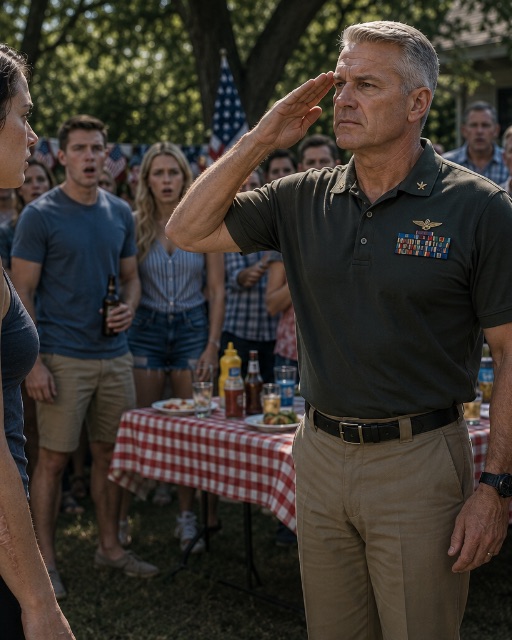
The Colonel stepped closer, heels together, back straight—and he saluted me. My heart pounded in my ears.
When he dropped his hand, he turned to my aunt. His voice went steel-cold. “You will not speak to her like that. Not after what she—”
Kendra’s lipstick parted. Her glass trembled.
He reached into his wallet, pulled out a sun-faded photo, and held it up so the whole family could see—but when my eyes hit the circled face in that picture, my aunt’s knees actually buckled.
The man in the photo was young, maybe nineteen, with a grin that was too big for his face and familiar, bright blue eyes. Kendra’s eyes.
“That’s…” my grandpa Arthur started, his voice raspy. “That looks like Daniel.”
My cousin. Kendra’s son. The one nobody talked about.
The one she told everyone was “finding himself” backpacking through Europe.
“He wasn’t in Europe, Kendra,” Pierce said, his voice dangerously low. “He was in my unit.”
Kendra let out a sound like a stepped-on bird. She stumbled back, catching herself on a patio chair.
“You’re lying,” she whispered, shaking her head. “He would have told me.”
“Why would he?” Pierce shot back, his military bearing cracking just enough to show the anger underneath. “After you told him he was a disgrace for enlisting? After you told him not to come home in uniform?”
The whole family was silent now, a tableau of half-eaten burgers and gaping mouths. My brother Mark, who had been laughing moments before, was staring at his shoes like they held the secrets to the universe.
I couldn’t breathe. My arm, the one with the scar, started to ache with a phantom pain.
The memory I kept buried under years of therapy and quiet determination came rushing back.
It wasn’t a memory in full color. It was in shades of dust, red, and the blinding white of medical tents.
I was a surgical resident who’d volunteered for a two-year tour. I wanted to do something that mattered, something more than stitching up weekend warriors after bar fights.
Operation Iron Storm was a name whispered with a mix of dread and respect. It was a push into a heavily contested area.
Our field hospital was a frantic ballet of organized chaos. The air smelled of sand, antiseptic, and fear.
I had been on my feet for twenty-six hours when the first wave of casualties from the ambush came in. They just kept coming.
Young men, boys really, with injuries I’d only read about in textbooks.
Then they brought him in.
He was pale under a layer of grime and sweat, but he was conscious. And he was cracking jokes.
“Hey Doc,” he’d said, his voice weak but clear. “Think you can fix me up? I’ve got a date with a steak dinner when I get back stateside.”
I stabilized the tourniquet on his leg. It was bad. Really bad.
“We’ll do our best,” I told him, trying to keep my voice steady. “What’s your name, soldier?”
“Daniel,” he said, and then he grinned that same grin from Pierce’s photo. “But my mom calls me a headache.”
My heart squeezed. He looked so much like my own younger cousins.
We were in the middle of a delicate vascular repair when the world turned to white noise and pressure.
A secondary device. A mortar that fell short. The tent buckled and ripped.
Something slammed into my arm, hot and sharp. It felt like being branded and stabbed at the same time.
For a second, I thought I was going to pass out. The pain was blinding.
Blood was pouring down my forearm, dripping from my fingertips onto Daniel’s already wounded body.
But he was looking at me. His eyes were wide with panic, not for himself, but for me.
“Doc! You’re hit!”
My arm was on fire, but the adrenaline was a cold wave washing over me. I couldn’t stop. If I stopped, he would lose his leg. Or his life.
“I’m fine,” I gritted out, my own blood mixing with his. I clamped the bleeder on my arm with a hemostat from the tray, a clumsy, desperate move.
Then I went back to work on him, my hand shaking but my focus absolute.
That’s how I got the scar. The shrapnel tore a furrow, then skipped, creating the unique double-mark.
I finished the surgery with one arm slick with my own blood. I didn’t know if he would make it. I just knew I had given him a chance.
I was medevaced out the next day. I never learned his last name. I never knew what happened to him.
Until now. Standing in my grandpa’s backyard.
“This is Sergeant Daniel Miller,” Pierce said, tapping the photo. His eyes were locked on his wife. “He was awarded the Silver Star for valor.”
Pierce turned to the rest of us. “We were pinned down. An IED took out our lead vehicle. Daniel, without orders, laid down suppressive fire and dragged three wounded men to cover, including me.”
He paused, swallowing hard. “He saved my life. He took the shrapnel that was meant for me.”
Pierce’s gaze fell on my arm again, this time with dawning, gut-wrenching understanding.
“And you,” he said to me, his voice thick with emotion. “You were his surgeon. He talked about you in his letters.”
My legs felt weak. Daniel. Her son.
“He said a doctor with fire in her eyes got hit saving him, and she just kept going. He said he owed her everything.”
He looked from me to Kendra, and the final piece of the puzzle clicked into place for everyone. The ugly scar was a badge of honor, earned while saving the son she had thrown away.
Kendra was making small, wounded noises. “No. No, he’s fine. He’s in Spain. He sends postcards.”
“He’s never sent you a postcard in his life, Kendra,” Pierce said, the quiet authority in his voice leaving no room for argument. “I sent those. I wrote them for him.”
The collective gasp from the family was sharp.
“He didn’t want you to worry,” Pierce continued, his voice softening slightly, a crack in his steel exterior. “But mostly, he didn’t want to face your disappointment. He was so ashamed of what you thought of him.”
My aunt looked like she had been struck. Her perfectly painted face was a mask of disbelief and horror.
“He lost his leg,” Pierce said bluntly. “He saved my life and lost his leg, and his biggest fear was that his own mother would see him as broken.”
Tears were now streaming down Kendra’s face, ruining her expensive makeup. She looked at me, at my arm, and for the first time, she wasn’t seeing a flaw.
She was seeing a connection. A sacrifice. A story she had refused to be a part of.
“Is he…?” Kendra couldn’t finish the sentence. The question hung in the air. Is he alive?
“He’s alive,” Pierce confirmed. “He’s at a rehab facility in San Antonio. Learning to walk again. To live again. He’s been there for eighteen months.”
My grandpa Arthur finally moved. He walked over to Kendra and put a hand on her shoulder. He looked old, so much older than he had at the start of his own birthday party.
“You told me he was angry with us,” Grandpa said, his voice trembling. “You said he wanted space.”
“I was protecting him!” Kendra cried, her voice rising to a hysterical shriek. “I didn’t want him to go! I didn’t want him to get hurt!”
“So you hurt him first?” Pierce asked, his question a surgeon’s scalpel, clean and devastating. “You pushed him away so you wouldn’t have to feel the fear? His whole life, all he ever wanted was your approval.”
He folded the photograph and put it back in his wallet. The party was over. The smell of charcoal and cut grass seemed to belong to another world.
My brother, Mark, came over to me. He wouldn’t meet my eyes.
“Sarah,” he mumbled. “I’m so sorry. I didn’t know.”
I just nodded. I was still processing. The boy on my table, the one with the brave grin, was my cousin.
The next few days were a blur. The family fractured.
Kendra locked herself in her room. Pierce stayed at a hotel. He called me once.
“I need to apologize,” he said, his voice weary. “For my wife. For everything.”
“You don’t need to apologize,” I told him, my voice stronger than it had been in years. “You told the truth.”
“He wants to see you,” Pierce said after a beat. “Daniel. He knows who you are now. I told him.”
A week later, I flew to San Antonio.
The facility was bright and clean, filled with a quiet, determined energy.
Pierce met me at the entrance. He looked tired but resolute.
He led me to a gymnasium where people were working with prosthetics, lifting weights, encouraging each other.
And there he was.
He was taller than I remembered. He had a new leg, a sleek carbon-fiber prosthetic. He was concentrating, taking careful, deliberate steps between two parallel bars.
His face was thinner, etched with lines of pain and effort that hadn’t been there before. But when he looked up and saw me, he broke into that same, familiar grin.
“Hey Doc,” he said, his voice steady. “Heard you were in the neighborhood.”
Tears pricked my eyes. I walked over to him.
“It’s Sarah,” I said. “My name is Sarah.”
“Daniel,” he replied, holding a hand out. I shook it. His grip was strong.
We talked for hours. He told me about his recovery. He told me about the friends he’d lost. He never once spoke with bitterness.
I told him about my life, about finishing my residency, about the scar I always tried to hide.
“Don’t hide it,” he said, his blue eyes serious. He gently touched my forearm, his fingers tracing the raised, jagged line. “This means you’re a survivor. Just like me.”
He looked at his own prosthetic leg. “We’ve all got scars, Sarah. Some you can see. Some you can’t.”
The day before I was due to fly home, Pierce called me.
“She’s here,” he said simply. “Kendra is here. She wants to see him. He’s agreed, but he wants you there, too.”
I stood in the corner of Daniel’s small, neat room, feeling like an intruder.
When Kendra walked in, she was almost unrecognizable. Her hair wasn’t perfectly styled. She wore no makeup. She just looked like a terrified mother.
She stopped in the doorway when she saw Daniel standing by the window, leaning on a cane.
For a long moment, neither of them spoke.
“They told me you were brave,” Kendra finally whispered, her voice breaking.
Daniel turned to face her. His expression was guarded. “I was just doing my job.”
“Your job was to come home safe,” she cried, tears finally spilling. “That was your only job.”
“I couldn’t,” he said quietly. “I’m sorry.”
“No,” she sobbed, taking a hesitant step into the room. “No, I’m sorry. I’m the one who’s sorry, Daniel. For every horrible thing I said. For not being your mother when you needed me most.”
She looked from his prosthetic leg up to his face. “I was so scared of losing you that I pushed you away. Can you ever forgive me?”
Daniel looked at her, his own eyes welling up. He took a slow, deliberate step toward her. Then another.
He wrapped his arms around her, and she collapsed against him, her shoulders shaking with years of pent-up fear and regret.
I slipped out of the room, closing the door quietly behind me, leaving them to find their way back to each other. Pierce was waiting in the hall, his stoic expression softened by relief.
He simply nodded at me, a silent thank you that said more than words ever could.
That day, something in me healed. My scar didn’t disappear, but its weight did.
It was no longer a mark of trauma I had to hide or be ashamed of. It was a reminder. A testament to a moment where pain and purpose collided. It was the story of a boy’s courage and a mother’s second chance.
We all carry scars. Some are etched on our skin, visible reminders of battles we’ve fought. Others are hidden deeper, in the quiet corners of our hearts. They speak of loss, of fear, of words left unsaid.
But they don’t have to be endings. Sometimes, if we are brave enough to let the light in, they can become the starting point for our greatest healing, connecting us in ways we never thought possible. They are not signs of what broke us, but proof of how we put ourselves back together.