
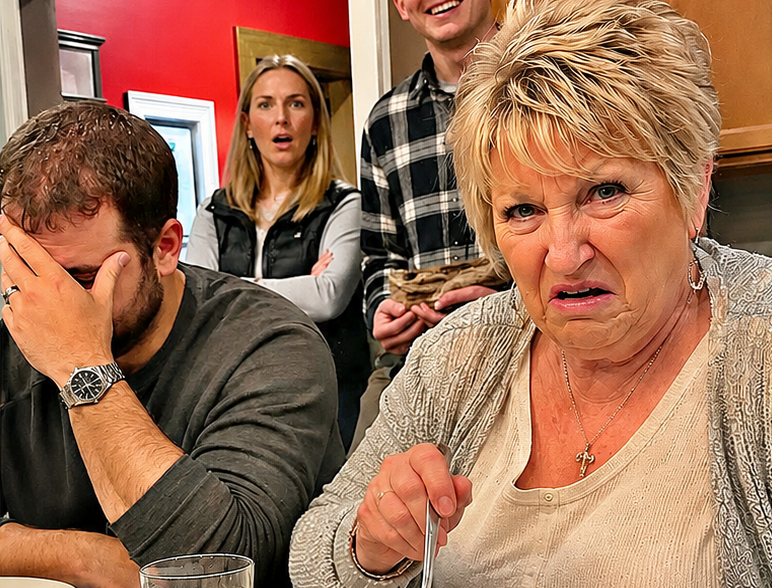
Sundays, my husband’s entire family gathers to eat dinner together.
And EVERY Sunday, I end up at the center of the jokes.
Sally, my mother-in-law, makes a point of pointing out EVERYTHING I do wrong – she’s commented on the way I fold towels and how I look after our dog.
But the thing she mocks most is my cooking.
She says I don’t know how to season things, my meals have no taste, and that I’m STARVING her son Mark.
Usually, I’d just smile and take it silently.
Last Sunday, though, was DIFFERENT.
Thirteen relatives gathered around our table after three hours of me preparing stew.
Sally took a bite, then spat it back into her plate for everyone to see.
“No wonder my son looks like he’s starving!” she shouted, quieting all talk.
“This food is so bland and bitter, no human could possibly eat this.”
“Is this how you treat MY son?”
Laughter came from a couple of cousins, while silence fell over the rest.
Embarrassment and anger filled my cheeks with heat.
I glanced at Mark NEXT to me.
He had gone pale – not out of shame.
He stared at his mother and then his meal.
Sally was starting up with another nasty jab – when Mark swiftly stood, his chair scraping loudly on the floor.
What Three Years of Sundays Actually Looked Like
I should back up.
Mark and I have been married three years. We bought the house eighteen months ago. And somewhere between the wedding and the mortgage, Sunday dinners became a standing obligation. Not a suggestion. An obligation.
Sally lives twelve minutes away. She knows this. She uses it.
The first Sunday I hosted, I made roast chicken with garlic and rosemary, roasted potatoes, green beans with almonds. I was nervous but it came out well. My own mother had taught me that recipe when I was fourteen, standing on a step stool in her kitchen in Columbus.
Sally ate two bites and said the chicken was dry.
Mark said, “Mom, it’s fine.”
She said, “I’m just being honest.”
That was the template. That was every Sunday for three years.
Over time the comments got specific in a way that felt almost studied. The towels I mentioned – Sally walked into our bathroom, opened the cabinet, and actually took one out to demonstrate the correct fold. Like a demonstration. In my own house. I stood in the doorway watching her and didn’t say a word.
The dog thing was worse. Our beagle, Chester, is a little overweight. The vet said to cut back his portions slightly, no big deal. Sally announced at dinner one night that Chester looked “neglected” and that she’d read online that overfeeding dogs is a form of abuse. She said this while eating my pot roast. She had two helpings.
Mark would always go quiet. Not cold, not dismissive. Just quiet, in that way some people go quiet when they’ve been trained since childhood to wait out the storm.
I understood it. I didn’t love it.
The Stew That Started It
Last Sunday I made beef stew. Three hours, start to finish. Chuck roast I’d trimmed myself, carrots and celery and two russet potatoes, bay leaves, a splash of red wine, beef broth. Nothing fancy. Real food. The kind of thing that fills a house with a smell that makes people walk into the kitchen and lift the lid without asking.
Mark’s cousin Diane did exactly that around four o’clock. She said it smelled amazing.
That should have been a good sign.
Thirteen people around the table. Sally at the far end across from her sister Roberta, who has never said a single unkind thing to me in three years and who I suspect finds these Sundays as exhausting as I do. Mark’s brother Gary and his wife Pam. Two of Gary’s kids, teenagers who mostly looked at their phones until food appeared. A few others – cousins, an uncle, the usual configuration.
I ladled stew into the good bowls. The ones we got as a wedding gift that I only use for company.
I sat down. Mark squeezed my hand under the table.
Sally had been quiet through most of the setup, which I’d noticed. She gets loud when she’s building toward something. The quiet is worse.
She picked up her spoon. Took one bite.
And then she spat it back onto the plate.
Not quietly. Not discreetly. She made a sound.
“No wonder my son looks like he’s starving,” she said, and her voice carried the full length of the table. “This food is so bland and bitter, no human could possibly eat this. Is this how you treat MY son?”
Two of the younger cousins laughed. Not mean laughing, more startled laughing, the kind that happens when something so uncomfortable occurs that the body doesn’t know what else to do.
Everyone else went still.
My face went hot. I looked at my bowl. I thought about the three hours. I thought about Chester’s vet appointment last week and the dry-cleaning I’d picked up and the work presentation I’d stayed up finishing at midnight and every other thing I’d managed that week without anyone noticing or asking. I thought about all of that and I pressed my lips together.
Then I looked at Mark.
What His Face Did
He wasn’t pale the way people go pale when they’re embarrassed.
It was different. His color dropped the way it does when something resolves. Like a decision being made somewhere behind his eyes.
He’d been looking at his mother. Then he looked down at his stew. He picked up his spoon and took a slow bite. Chewed. Set the spoon down.
Sally was opening her mouth again – she had that intake of breath that meant she was winding up for the next one – and Mark stood up.
His chair scraped so hard on the hardwood that Roberta flinched.
He didn’t raise his voice. That’s the thing I want to be clear about. Mark doesn’t raise his voice. He never has.
He said, “Mom. Stop.”
Sally blinked. “I’m just saying – “
“I know what you’re saying. You’ve been saying it for three years.” He put his hands flat on the table. “The stew is good. I’m not starving. I have never been starving. And you will not do that in our home again.”
The table was so quiet I could hear the refrigerator hum from the kitchen.
Sally looked around at the other relatives, doing that thing where you seek an audience to validate you. Nobody gave it to her. Gary looked at his plate. Roberta looked at her hands. The teenagers had actually put their phones down.
“I was only being honest,” Sally said, quieter now.
“No,” Mark said. “You were being cruel. There’s a difference. You know there’s a difference.”
The Part Nobody Expected
Here’s where it got strange.
Sally’s sister Roberta, who I said never says anything unkind, looked up from her hands.
“Sally,” she said. “He’s right.”
That was it. Four words.
But Roberta is seventy-one years old and she is the oldest person in that family and she does not weigh in. She has not weighed in on anything in the entire time I’ve known these people. She came to our wedding and brought us a beautiful set of bowls and hugged me at the door and that was the most she’d ever communicated with me directly.
Sally turned to look at her sister and something moved across her face that I couldn’t read.
“You don’t know – ” Sally started.
“I’ve watched you do this every week,” Roberta said. “Every week. And I’ve kept my mouth shut because I didn’t want the trouble. But she cooked for thirteen people and you spat it on the plate. That’s not honesty. That’s something else.”
Nobody moved.
Sally picked up her napkin. She put it on the table. She pushed her chair back and she walked out through the front door. We heard her car start.
Mark sat back down.
He picked up his spoon.
He kept eating.
After
Dinner finished. People talked, slowly at first and then more normally. Gary’s wife Pam asked me for the stew recipe before she left, which I think was her way of saying something she didn’t have a word for. Roberta hugged me at the door again, the same as the wedding. Longer this time.
Mark and I washed dishes after everyone left. He washed, I dried. Chester sat on his bed in the corner doing nothing useful.
Mark said, “I should have done that sooner.”
I said, “Yeah.”
He said, “I’m sorry it took me this long.”
I didn’t say it was fine, because it wasn’t entirely fine. Three years is a long time to smile and take it silently. But I also know how long it takes some people to get there. I know what it costs.
I put the good bowls back in the cabinet.
Sally called the next morning. I don’t know exactly what was said because Mark took the call in the other room. It lasted eleven minutes. When he came back he said she wasn’t ready to apologize but that she’d agreed not to come to Sunday dinners for a while.
I made coffee. I poured him a cup.
“That’s okay,” I said. And I meant it.
The Sunday after that, it was just us. I made pasta. Nothing complicated. Mark had two bowls and then sat on the couch with Chester and fell asleep watching baseball, which is the most content I have ever seen any human being.
The towels in the cabinet are folded however I fold them.
—
If this one hit close to home, pass it along to someone who needs to see it.



