“Atlas, heel!” I shouted.
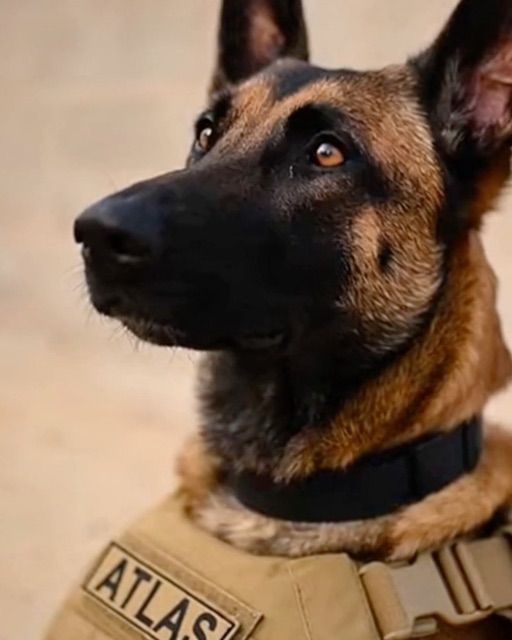
My Belgian Malinois ignored me. He was growling at the closed door, the hair on his back standing straight up. This wasn’t like him. Atlas was a precision instrument, a 40-mission veteran who lived for my command.
“Atlas!” I stepped forward to grab his harness.
That’s when he turned on me. He slammed his 80-pound body into my chest, knocking me backward into the hallway wall. I was furious. I thought he had snapped. I reached for him, but he turned and launched himself through the door before the breach team was even ready.
The room exploded with gunfire.
Atlas didn’t yelp. He didn’t retreat. He drew every single round of fire onto himself.
When the silence finally fell, I ran inside. Atlas was lying there, his breathing shallow. I held his head in my lap as he took his final breath, telling him he was the best boy, the bravest boy.
But it wasn’t until the medic moved his body that my blood ran cold.
I looked at the spot on the floor where Atlas had pinned the insurgent. My flashlight caught the glint of a wire.
He hadn’t just charged a gunman. He had spotted what none of us saw. If he had listened to my order and stayed by my side, we would have all walked straight into a pressure-plate IED. A dead man’s switch.
The realization hit me like a physical blow, harder than when Atlas had slammed into my chest. My anger, that hot flash of betrayal I’d felt in the hall, turned to ice in my veins.
It wasn’t a snap. It wasn’t a moment of madness. It was a choice.
He had shoved me out of the way. He had put himself between me and the blast radius.
The EOD tech, a guy named Ramirez, came over later. His face was pale.
“You need to see this, Marcus,” he said, his voice low.
He showed me the diagram. The pressure plate was wired to enough explosives to bring the entire building down on our heads. Not just our team, but the team clearing the floor above us, too.
“He didn’t just save you,” Ramirez said, shaking his head in disbelief. “He saved all of us.”
I just nodded, unable to speak. The words were stuck in my throat, choked by a grief so profound it felt like I was drowning.
My last words to him were an angry shout. My last thought about him was that he had failed.
The ride back to the base was a blur. I remember the silence in the vehicle, the weight of the other guys’ gazes on me. They knew.
I clutched his empty harness, the worn leather cool against my sweating palms. It still smelled of him, that familiar, dusty, dog smell that had been a constant comfort for four years.
Back in my room, the quiet was deafening. His water bowl was still full. His favorite chew toy, a frayed piece of rope we called “Mr. Raggedy,” was lying by his empty bed.
Every corner of the small room held a memory of him. Him nudging my hand for a scratch behind the ears. Him snoring softly at the foot of my bunk. Him waiting by the door, tail thumping a low, steady rhythm, ready for work.
He was more than my partner. He was my anchor in the chaos.
The next few weeks were a hell of my own making. They put me on administrative duty, citing protocol and psychological evaluation. I knew what it really was. They saw a man who had lost his partner and was coming apart at the seams.
I barely slept. When I did, I dreamt of the hallway. I’d see Atlas turn, his eyes locking with mine for a split second. In the dream, I saw what I had missed in the moment: not aggression, but desperation. A silent plea for me to understand.
Then I’d wake up, shouting his name into the darkness.
The guilt was a physical thing, a heavy cloak I couldn’t take off. He had trusted his instincts over my command, and his instincts had been perfect. I was the one who had been wrong.
I started going over the mission reports, not just the last one, but all of them. Forty successful deployments. Dozens of finds. Countless lives saved. Atlas’s record was flawless.
So why did this one feel different?
His reaction wasn’t his standard alert for explosives. Usually, he would go passive. He’d sit, lock his eyes on the source, and wait for me. It was a calm, controlled, unshakable focus.
This was not that. This was violent. It was personal. He didn’t just want to indicate a threat; he wanted to eliminate it.
I couldn’t shake the feeling that I was missing something important.
I went to see Sergeant Peterson, the old-timer who ran the kennels. He’d been working with military dogs since before I was born. He had rheumy eyes and hands as tough as old leather.
He listened patiently as I laid it all out, my voice cracking.
“Dogs are honest creatures, Marcus,” he said, packing tobacco into an old pipe. “They don’t have ulterior motives. If he broke protocol, he had a reason that outweighed all his training.”
“But what reason?” I asked, my frustration boiling over. “To save us? Of course. But the way he did it… he hated that man.”
Peterson lit his pipe, the sweet smoke filling the small office. “Hate is a human word. For a dog, it’s simpler. A threat. A memory.”
“A memory?”
“Their noses are time machines,” Peterson said, pointing the stem of his pipe at me. “They can smell the past. A scent can be tied to a memory of fear, of a chase, of a threat. You look at the man. I’d wager Atlas remembered the smell.”
His words stuck with me. A smell.
I went back to the archives, my commander giving me a look that was equal parts pity and concern. I didn’t care. I pulled the file on the insurgent Atlas had taken down.
His name was Tariq Al-Hamad. A mid-level bomb-maker, known for his skill with complex triggers. His file photo showed a man with cold, empty eyes.
I started cross-referencing his known locations with our own deployment history. It was a long shot, a desperate attempt to find meaning in the meaningless.
For days, I found nothing. Just a string of dead ends. I was about to give up, to accept that I was just a grieving handler chasing ghosts.
Then I saw it. A minor footnote in an after-action report from a year ago. We were in Kandahar province. A raid on a suspected IED factory.
Atlas and I had been on that mission. We had found the bomb-making materials, but the target himself had slipped away just minutes before we arrived.
Atlas had picked up a scent. He tracked it for two miles through a maze of alleys and streets before it vanished in a crowded bazaar. We never got the guy.
I read the report again, my heart starting to pound. An informant had provided a small detail about the bomb-maker’s habits. It was deemed irrelevant at the time.
He was a constant chewer of licorice root. The informant said you could smell it on him from ten feet away.
Licorice root.
The memory hit me with the force of a physical impact. The room. The moment I ran in after the gunfire stopped. There had been a smell under the metallic tang of blood and cordite.
A faint, sweet, earthy scent.
I had dismissed it, my mind focused only on Atlas. But it was there. It was the smell of licorice.
It all clicked into place. Atlas hadn’t just smelled a bomb. He had smelled the bomber.
He had smelled the man we had chased a year ago. The one that got away.
This wasn’t just about detecting a threat. It was unfinished business. He remembered that scent, a scent tied to a failure, to a danger that had escaped. When he smelled it again, all of his training, all of his carefully honed discipline, was overridden by a single, primal purpose: to neutralize the threat he had been denied before.
He hadn’t just been a good boy following his nose. He was a veteran soldier finishing a fight.
This new understanding didn’t lessen the pain, but it shifted it. My guilt started to recede, replaced by a profound, heartbreaking pride. He wasn’t just a tool; he was a warrior with a memory and a will of his own.
I thought that was the end of the story. I thought I finally had my peace. I was wrong.
Driven by a new kind of curiosity, I requested the evidence logs from Al-Hamad’s safe house. I wanted to see everything they had pulled from that room.
My CO thought I was crazy, but he signed off on it. Maybe he figured it was the only way for me to move on.
The evidence box was mostly what you’d expect. Burner phones, wiring, schematics. But at the bottom, there was a small, grimy leather notebook.
It was his journal. An intel officer had already translated it. The report said it was mostly technical notes and anti-Western propaganda. Standard stuff.
I asked for the journal itself. I spent a night just turning the pages, the spidery script meaningless to me.
Then I got to the back pages. There were sketches. Crude, but detailed.
He had drawn diagrams of his devices. Plans for future attacks.
And then I saw a drawing that made the air leave my lungs. It was a dog. A Belgian Malinois, with its distinct pointed ears and dark muzzle. It was unmistakable. It was Atlas.
Under the sketch was a date. The date of our raid in Kandahar a year ago.
My hands were trembling as I turned the page.
There was another sketch. A man in tactical gear, a rifle held at the ready. The drawing was rough, but the set of the shoulders, the way he held his head… it was me.
Tariq Al-Hamad hadn’t just been a target who got away. He knew who we were. He knew he was being hunted by a specific K-9 team.
He wasn’t just running. He was watching. He was planning.
The trap in that room, the pressure-plate IED, wasn’t for just any soldiers. The intelligence suggested it was meant for a high-value target, a visiting official maybe. But the journal told a different story.
It was a personal trap. It was designed for a man who worked with a dog. A man who would enter a room with his partner at his side, right where the trigger was placed.
It was meant for me.
Atlas hadn’t just charged a gunman. He hadn’t just stopped a bomb. He hadn’t just finished an old hunt.
He recognized the man who was hunting his partner.
That final, desperate act wasn’t just about protecting the team. It was about protecting me. He slammed into my chest, knocking me away from the door, away from the trigger, because he knew the threat in that room had my name on it.
His disobedience wasn’t a failure of training. It was the ultimate expression of loyalty. A bond so deep that he broke all the rules to honor it.
I finally understood. In that last moment, he wasn’t my K-9. He was my guardian.
The weight of that revelation settled on me, not as a burden, but as a gift. A painful, terrible, beautiful gift.
I put in for a transfer the next week. Not out of the unit, but back to the States. I was going to be an instructor at the K-9 training school.
My commanding officer thought I was running away, but he was wrong. I was running toward something.
I needed to honor Atlas. The best way I could do that was to help forge that same incredible bond for a new generation of handlers and their partners. To teach them that what they have is more than a working relationship.
I built a small memorial at the edge of the training field. A simple granite stone with a brass plaque. It just has his name, “Atlas,” and the dates of his service. Below it, I had them engrave the unit’s motto.
Fidelis Usque Ad Mortem.
Faithful Unto Death.
Now, I spend my days with puppies who are all paws and no discipline. I work with young handlers who are nervous and eager.
I tell them all the stories of Atlas’s heroism. But I also tell them the story of his final mission.
I teach them the commands, the protocols, the rules. But then I teach them the most important lesson of all.
Look into your partner’s eyes. Learn their language. Trust their instincts, especially when they contradict your own. Because the bond you build is forged in something deeper than obedience.
It’s forged in a silent, unbreakable promise.
Sometimes I’m out on the field, watching a young Malinois chase a ball, and for a second, I’ll see a flash of my old friend. I’ll feel that familiar ache in my chest.
But it’s not just grief anymore. It’s gratitude. He taught me that the greatest commands are not the ones we give, but the ones we are wise enough to understand. He was my dog. He was my partner. And in the end, he was my savior.
He disobeyed my direct order, and it was the last, and greatest, thing he ever did.