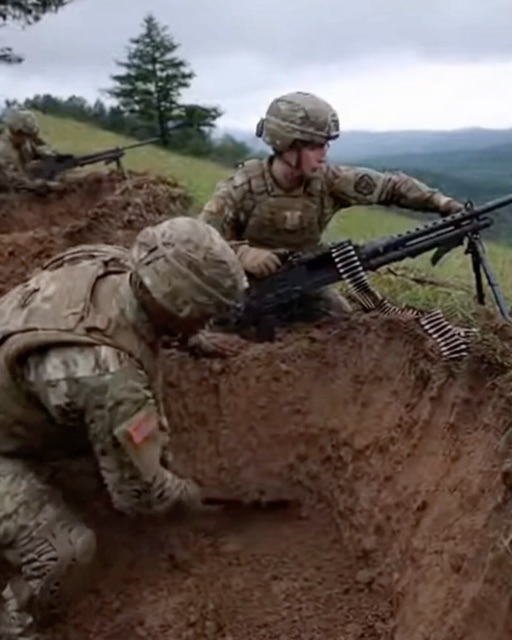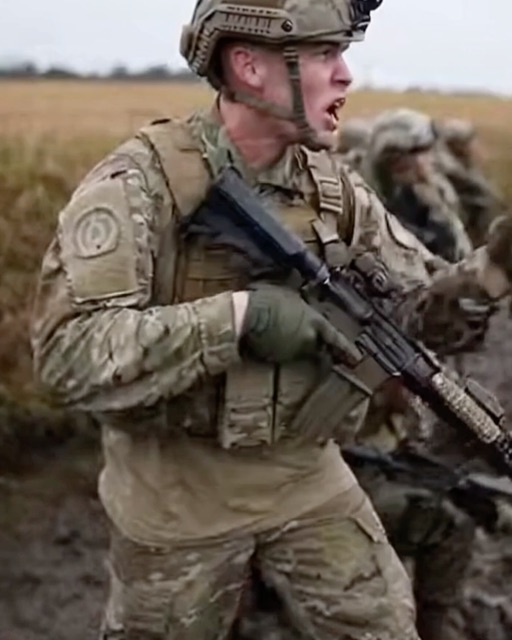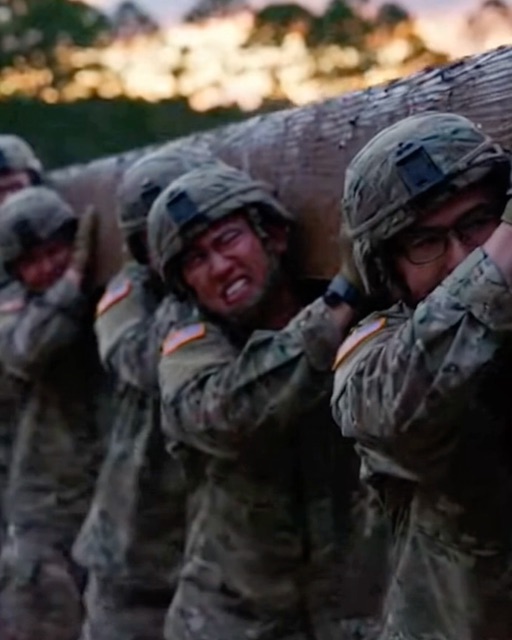
We’d been marching for hours under full ruck, smoked from the obstacles. The timber carry was supposed to be straightforward: 12 of us hoisting a 400-pound log across broken ground at Timber Lane.
But in the mud, my boot slipped at the rear. The whole thing tilted hard. Three guys buckled under the sudden shift. Shouts erupted. We were seconds from total collapse.
Then Sergeant Harlan was there, barking orders like thunder.
“Lower together! Reset grips! Tall guys rear! On my count – UP!”
We snapped to it. No hesitation. Grips adjusted. A specialist shuffled closer under the load without being told. Another followed. The timber leveled out – heavier, but solid.
We crossed that lane bent double, shoulders screaming, boots sucking mud. But we made it. Stronger than before.
At the drop point, we collapsed, gasping. Sergeant Harlan scanned us, sweat dripping off his helmet.
“What kept that from turning into a cluster?” he growled.
Corporal Tate wiped his face. “Everyone shared the weight, Sergeant. Before it became one guy’s problem.”
Harlan nodded slow. His eyes locked on me – the idiot who’d slipped.
“That’s exactly it,” he said. His voice dropped low, just for us. “And kid… that’s why I transferred in last month. Because the man who slipped that log? He’s my…”
My stomach dropped.
“…son of a man I owe my life to.”
The air went dead silent. You could have heard a pin drop in the mud. Every eye in the platoon swiveled from Harlan to me.
I just stared at him, my mind a blank screen. My dad? My dad worked in logistics for a shipping company. He was quiet, walked with a slight limp he never talked about, and spent his weekends fixing our leaky faucet.
He’d served, sure. A long time ago. But he never, ever spoke of it.
Harlan ignored the stares. “Get to the mess hall. Hydrate.”
The platoon broke apart, but they moved differently around me. Whispers started, little glances. I was no longer Private Miller, the guy who slipped.
I was someone else. I was marked.
The next few weeks were the hardest of my life. I had thought basic training was tough before. Now, it was a special kind of hell designed just for me.
If the platoon did twenty push-ups, Harlan would stand over me. “Miller, you owe me ten more.”
If we ran five miles, he’d be at my side for the last quarter mile. “Your stride is sloppy, Miller. Pick it up. You’re dragging down the man behind you.”
He inspected my rifle with a magnifying glass. He made me re-lace my boots three times because one was a fraction looser than the other.
The rest of the platoon started to resent it. I could feel it. A guy named Peterson, who was built like a vending machine and twice as mean, made it his personal mission to let me know.
“Must be nice having a guardian angel, Miller,” he’d sneer in the barracks. “Screwing up and getting extra ‘attention’ for it.”
I tried to explain. “He’s not helping me. He’s killing me.”
Peterson just laughed. “Sure looks that way.”
The weight was different now. It wasn’t a 400-pound timber. It was the weight of expectation, of a debt I didn’t understand, and the isolation that came with it.
I wanted to quit. I’d lie in my bunk at night, muscles aching, mind spinning, and think about just giving up. I didn’t ask for this. I didn’t ask for Sergeant Harlan or his mysterious life debt to a man I barely knew.
One evening, after a particularly brutal day on the range, Harlan found me cleaning my rifle long after everyone else was done. I was making sure it was perfect. Spotless.
He didn’t say anything for a long time, just stood there.
“You think I’m doing this to be cruel, don’t you?” he finally said, his voice softer than I’d ever heard it.
I didn’t look up. “I don’t know what to think, Sergeant.”
“Your father’s name is David, right?”
I nodded, my hands stilling.
“David Miller was the best man I ever knew,” Harlan said. “He was smart, fast, and he had a sense of humor that could get you through the darkest night.”
He pulled up a footlocker and sat down, the metal groaning under his weight.
“We were in a bad spot once. A very bad spot. Pinned down in a dusty little town you’ve never heard of. It all went sideways in a second.”
He paused, and for the first time, I saw something other than steel in his eyes. I saw a memory. A painful one.
“We were moving between buildings when the world exploded. I was out in the open. A sitting duck. I saw the muzzle flash from a second-story window.”
“I froze,” he admitted. “Just for a second. But a second is a lifetime out there.”
“Your dad didn’t freeze. He was behind me. He shoved me, hard. Pushed me right into a ditch as the rounds stitched the air where I’d been standing.”
He looked at his hands. “One of them caught him in the leg. Badly. It was over for him. His career, everything. He got a medal and a medical discharge.”
“I got to keep living my life,” Harlan said, his voice thick. “I got married. Had kids. Made Sergeant Major. All because David Miller was faster than me. Because he took a hit that was meant for me.”
Now I understood the limp. The silence. The way my dad would sometimes stare at nothing, a million miles away. It wasn’t just a job in his past. It was a life.
“When I saw your enlistment papers come across my desk,” Harlan continued, “I pulled every string I had to get transferred here. I made a promise to your father on that dusty street. I told him I’d look out for him.”
He looked at me directly now. “He made me promise something else. He said, ‘If my son ever joins, don’t make it easy on him. Make him strong. Make him the man who doesn’t freeze.’”
The air in the room felt heavy with his words. My resentment, my anger, it all just evaporated, replaced by a profound, aching understanding.
Harlan wasn’t punishing me. He was honoring a promise. He was forging me.
He stood up. “Your father’s sacrifice gave me a second chance. I won’t let his son waste his first one by not being prepared. Clean your weapon. Lights out in five.”
He left, and I sat there in the quiet, the smell of gun oil sharp in my nose. I wasn’t carrying his weight anymore. I was carrying my father’s legacy.
Things didn’t get easier after that. In fact, they got harder. But now, I understood why. And I met every challenge head-on. I pushed harder, ran faster, and studied longer.
The platoon started to notice the change. The whispers died down. The animosity from Peterson, however, did not. He saw my new determination as arrogance.
The final test before graduation was a three-day field training exercise. The big one. We were dropped in the middle of nowhere with a map, a compass, and a series of objectives to complete.
My fire team was me, Tate, a quiet guy named Santos, and Peterson.
From the start, Peterson was a problem. He disagreed with every decision Tate, our team leader, made. He thought he knew better, faster routes.
On the second night, it was pouring rain. Cold, miserable, and dark. We were navigating through a dense forest to our next checkpoint.
“This is stupid,” Peterson grumbled, shining his red-lensed flashlight on the map. “We’re going in circles. There’s a ridge a half-mile to the east. We go over that, it’ll shave three hours off our time.”
Tate shook his head. “Sergeant Harlan’s brief was clear. Stick to the valleys. The ridges are exposed and the footing is treacherous in this weather.”
“Harlan’s not out here, is he?” Peterson shot back. “I’m going. You guys can play in the mud if you want.”
He started to move off before Tate could stop him. I looked at Tate, who sighed. “We can’t split the team. We follow him.”
It was a mistake. The ridge was a nightmare of slick rocks and tangled roots hidden by the darkness. Twenty minutes in, Peterson, trying to rush, let out a sharp cry.
We found him at the bottom of a short, steep drop. His leg was bent at a nasty angle. His face was pale with pain.
“My ankle,” he gasped. “I think it’s broken.”
We were miles off course, in the driving rain, with a man down. Panic started to creep in.
But then I heard Harlan’s voice in my head. “You don’t get to fail, because your failure isn’t just yours.”
I took charge. “Tate, get on the radio, see if you can get a signal. Santos, get the first aid kit. We need to splint that.”
I knelt beside Peterson. He looked at me, his usual arrogance gone, replaced by fear. “I messed up, Miller. I really messed up.”
“Yeah, you did,” I said, cutting his pant leg open with my knife. “But we’re a team. We’ll get you out.”
We used two sturdy branches and a roll of duct tape to immobilize his leg. The radio was useless; the storm was too strong.
There was only one option. We had to carry him.
We fashioned a makeshift stretcher from our ponchos and branches, but it was too clumsy on the uneven ground.
“It’s not going to work,” Tate said, his voice strained. “We can’t get enough leverage.”
I looked at Peterson, then at my own shoulders. I thought about the timber. I thought about sharing the weight.
“Get him on my back,” I said. “The fireman’s carry.”
“Miller, you can’t,” Tate argued. “It’s miles to the extraction point. You’ll never make it.”
“I’m not doing it alone,” I said, looking him in the eye. “We’ll switch out every quarter mile. We share the load.”
It was the most grueling journey of my life. More than the timber, more than any forced march. The weight of a full-grown man, his gear, and my own, was crushing.
But every time my legs screamed and my lungs burned, Tate or Santos would be there, ready to take over. We moved slowly, methodically, a three-man team carrying a fourth.
We stumbled into the checkpoint just after dawn, covered in mud, exhausted, but together.
Sergeant Harlan was there, waiting. His face was unreadable as his medics took Peterson.
He walked over to us. We braced for the worst. We’d missed our objective. We’d broken protocol.
He looked at me, then at Tate and Santos.
“You left the designated route,” he stated.
“Yes, Sergeant,” Tate said.
“You missed your rendezvous time by six hours.”
“Yes, Sergeant.”
He was quiet for a moment. Then he looked at the medics loading Peterson into a vehicle.
“But you didn’t leave your man behind,” he said softly. His eyes met mine. “You carried the weight. All of you.”
A ghost of a smile touched his lips. “Your father would be proud, Miller.”
That was it. That was all he said. But it was more than enough.
Graduation day was bright and sunny. Our families sat in the stands. I saw my dad, standing next to my mom. He wasn’t smiling, but his eyes were fixed on me, and I saw the pride radiating from him.
After the ceremony, Sergeant Harlan walked over to my parents. He and my dad didn’t say a word. They just shook hands. It was a long handshake, full of unspoken history, of debt and gratitude, of a promise fulfilled.
My dad finally turned to me. He put his hand on my shoulder, the same one that ached from carrying Peterson.
“The Sergeant told me what you did,” he said, his voice quiet. “Out on the ridge.”
I just nodded.
“Being strong isn’t about how much you can lift by yourself, son,” he said, giving my shoulder a squeeze. “It’s about knowing when to help someone else carry their load. That’s the one lesson I always hoped you’d learn.”
For the first time, we weren’t just father and son. We were two men who understood the cost of a promise and the true meaning of strength.
The greatest burdens we carry are often the ones we can’t see. But they are never meant to be carried alone. Sometimes, the person pushing you the hardest is the one trying to make you strong enough to stand, so you can one day help someone else who has slipped. The weight is always shared. It has to be.