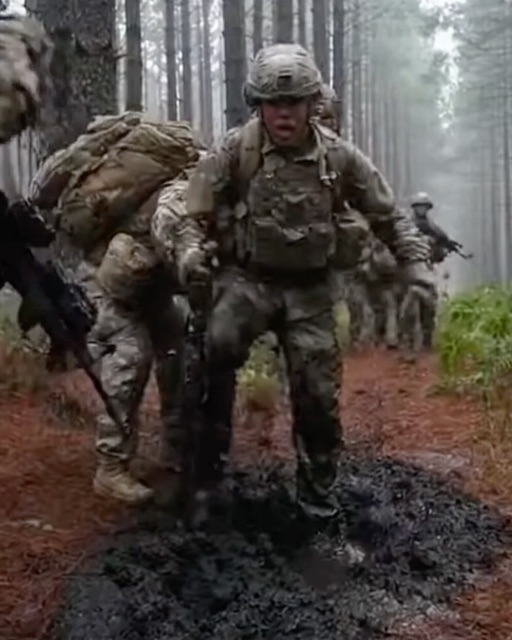
We had been moving for hours through a wet pine forest. My platoon was exhausted, pushing through a field lane that had already chewed up our dry socks and our patience.
The tree line ahead looked solid.
It wasn’t.
I hit a patch of rotten ground hidden under pine needles and instantly dropped thigh-deep into black, freezing mud. The guy behind me slammed into my ruck. The whole file compressed. Panic set in.
“Freeze the file!” Sergeant Craig yelled, appearing out of nowhere. “Nobody crowds the hole!”
He dropped beside me. “Stop fighting it. Let the team work.”
I tried to hold still, but my other boot started sliding. The suction was terrifying. For one second, I knew I was going all the way under.
That’s when Sergeant Craig did the unthinkable. He stepped straight into the sinkhole with me, sinking to his chest, and wrapped both arms around my waist to stop the slide cold.
With three soldiers hauling and Craig lifting, I came free in one violent, filthy surge.
I collapsed on the pine needles, shaking and stammering apologies.
“Don’t,” Craig panted, his uniform caked in thick black sludge. “The ground lied.”
I thought he was talking about the terrain. I thought he was a hero.
But as I wiped the mud from my eyes, I noticed Craig wasn’t looking at me anymore. His face had turned ghost-pale. He was staring in pure terror at the hole I had just been pulled from.
When I was down there, my boot had kicked against something heavy. I thought it was a tree root.
But as the muddy water bubbled and settled, a large, heavy object floated to the surface.
My blood ran cold. Craig slowly reached down to unholster his sidearm, but not before I recognized the distinctive markings on the floating canvas bag, and I realized exactly whose it was.
It was Private Finch’s.
Finch had been gone for six weeks. The official word was that he’d gone AWOL, disappearing one weekend without a trace.
His stencil, FN4582, was faded but clear on the side of the duffel bag now bobbing in the muck.
Sergeant Craig didn’t say a word. His hand was still on his pistol, his knuckles white.
The other two soldiers, Corporal Davis and a new private named Santoro, were just staring, confused.
“What is that, Sergeant?” Davis asked, his voice low. “That’s Finch’s bag.”
Craig finally looked away from the hole. He looked at us, his eyes wide and pleading.
“It’s nothing,” he said, his voice a harsh whisper. “It must have fallen off a truck.”
He took a step forward, his boot squelching. He was going to push it back under.
“Sergeant, no,” I said, my voice barely working. “We have to report this.”
The look he gave me was pure ice. It wasn’t the look of a sergeant to his private. It was something else entirely. Something primal and cornered.
“Private Miller,” he said, the name a warning. “You are cold, you are in shock. You’re not thinking clearly.”
He took another step, using his big frame to block the view from Davis and Santoro. He was trying to handle this, to make it go away.
But I had seen his face. I saw the raw fear when that bag surfaced. This wasn’t a surprise to him.
He was terrified because his secret had just floated up from the grave he’d left it in.
“We continue the mission,” Craig announced, his voice suddenly loud and back to its usual command tone. “The hole is a hazard. We mark it and move on. Is that clear?”
Davis and Santoro nodded, still looking uneasy but trained to follow orders.
I didn’t nod. I just stared at him, the mud dripping from my uniform, my heart pounding a rhythm of dread.
He knew. He knew that I knew.
The rest of the training exercise was a blur. We moved through the woods, but my mind was stuck back at that muddy hole.
Sergeant Craig was a good NCO. He was tough but fair, the kind of leader you’d follow anywhere. He was the guy who stayed late to help you clean your rifle, who knew the names of your siblings.
The guy who jumped into a sinkhole to save you.
But that action wasn’t heroic anymore. It was an act of desperation. He hadn’t jumped in to save me from the mud. He’d jumped in to keep me from finding what was in the mud.
My boot hadn’t just kicked a bag. I realized with a fresh wave of nausea. There was something else down there. Something much heavier.
The bag was just what came loose.
Back at the barracks, the official report was filed. I was treated for mild hypothermia. The incident was logged as a terrain misjudgment.
No mention of the bag. No mention of Private Finch.
That night, Sergeant Craig found me by the armory. He wasn’t in uniform.
“Miller,” he said, his voice quiet. He looked exhausted, older than he had that morning.
“We need to talk,” he continued, glancing around to make sure we were alone.
I just stood there, waiting.
“What you saw today… you misunderstood,” he started. “Finch was into some bad stuff. He dropped that bag and ran. I was trying to handle it quietly, to protect the platoon’s reputation.”
The lie was so thin I could see right through it.
“He went AWOL, Sergeant. That’s what they told us,” I said, my voice flat.
“That’s the story,” he agreed. “And it’s the best one for everyone. Let it go, Miller. For your own good.”
It was a threat, wrapped in a blanket of friendly advice.
I lay in my bunk that night, unable to sleep. Finch hadn’t been a model soldier. He was quiet, a bit of a loner, and always seemed to be short on cash.
But a deserter? It never felt right.
The next day, I started asking questions. I was careful. I talked to Finch’s old bunkmate, a guy named Peterson.
“Did Finch ever talk about leaving?” I asked while we were cleaning weapons.
Peterson shrugged. “Not really. He talked about his debts. He owed some guys off-post a lot of money. Said he had a plan to pay it all back at once.”
A plan to pay it back. That stuck with me.
I remembered seeing Finch near the supply depot a few times late at night. He’d always seemed nervous, carrying a duffel bag that looked too heavy.
His bag. The one in the mud.
An inventory report from two months ago had been posted and then taken down. A dozen sets of night-vision goggles had gone missing. High-value gear.
No one was ever formally accused, but the investigation just… stopped. It stopped right around the time Finch disappeared.
The pieces were clicking into place, forming a picture I didn’t want to see.
Finch was stealing gear. He was selling it to pay off his debts. Sergeant Craig must have found out.
But what happened in those woods?
I needed proof. Something more than a gut feeling and a floating bag that was now, officially, a hallucination.
I remembered that new recruits were assigned the old lockers of soldiers who had left. Finch’s locker was probably still in use.
I found the private who had it. I told him I thought my spare set of dog tags might have fallen behind it. It was a flimsy excuse, but he was tired and didn’t care.
He helped me pull the heavy metal locker away from the wall.
And there it was. Not my dog tags, but a small, folded piece of paper, covered in dust.
It was a note, written in Finch’s cramped handwriting. It wasn’t a suicide note or a confession. It was a list.
A list of serial numbers for NVGs. Next to them were dates, times, and a single name: “Craig.”
My breath hitched. This wasn’t what I expected.
It wasn’t a confrontation. It was a transaction. Craig’s name was on the list of stolen gear.
Was Sergeant Craig in on it? Was he the buyer? Or was he helping Finch?
No, that couldn’t be right. The fear on his face was real. It was the fear of being discovered.
My understanding of the situation tilted on its axis. Sergeant Craig wasn’t covering up a simple accident. He was covering up his own involvement.
He was dirty. The man I looked up to, the man who’d been my mentor, was a criminal.
The weight of that little piece of paper in my hand felt immense. It was the key to everything.
I had to confront him. I couldn’t go to the Captain, not yet. Not with just a note and a memory. I needed to see his face when I showed it to him.
I found him in the motor pool that evening, working late on a Humvee. The bay was empty, the air thick with the smell of grease and steel.
“Sergeant,” I said, my voice steadier than I felt.
He looked up from the engine, a wrench in his hand. He wiped sweat from his brow. “What is it, Miller?”
I didn’t say anything. I just unfolded the piece of paper and held it out for him to see.
He squinted at it. As his eyes focused on the name at the bottom of the list, all the color drained from his face. It was the same ghost-pale look he’d had at the sinkhole.
He dropped the wrench. It clattered loudly on the concrete floor.
“Where did you get this?” he whispered, his eyes darting around the empty motor pool.
“It doesn’t matter,” I said. “Just tell me what happened, Sergeant. Tell me the truth.”
He leaned back against the vehicle, all the strength gone out of him. He looked defeated.
“You don’t understand, Miller,” he sighed, running a shaky hand through his hair. “You think you know, but you don’t.”
For a long time, he just stared at the floor. The only sound was the buzz of the overhead fluorescent lights.
“Finch was a mess,” he began, his voice raspy with emotion. “Gambling debts, loan sharks… they were going to hurt him bad. He came to me for help.”
I waited, my heart pounding.
“He was stealing gear. Selling it. He thought it was the only way out,” Craig continued. “I caught him. I should have turned him in right then. That’s what I should have done.”
He looked up at me, his eyes filled with a deep, haunting regret.
“But he was one of my guys. He was desperate. I thought I could handle it. I thought I could save him.”
This was the twist I hadn’t seen coming.
“I confronted him out in the training area, the day he disappeared,” Craig said. “I told him to give me the gear, that I’d find a way to return it anonymously. I told him I’d help him get clean, get him the help he needed.”
He paused, swallowing hard.
“He refused. He was scared. He said his buyers would kill him if he didn’t deliver. We argued. He was holding the bag, the one you saw.”
Craig pointed a trembling finger at me. “He tried to run. I grabbed the bag. We struggled. We were right on the edge of that soft patch of ground.”
He closed his eyes, as if replaying the moment.
“The ground gave way. He went in, Miller. Just like you did. But he went in fast.”
The air in the motor pool suddenly felt cold and heavy.
“He was sinking. He was screaming for me to help him. I reached for him, but I was holding the bag of stolen gear. It was so heavy.”
Tears started to stream down Sergeant Craig’s face. He didn’t bother to wipe them away.
“In that moment, I panicked. All I could think about was this scandal. A soldier from my platoon stealing, another one dead in a training accident. My career, the platoon’s honor… all of it.”
His voice broke. “So I made a choice. A terrible, horrible choice.”
“I let go of his hand.”
The words hung in the air between us, sickening and final.
“And then I did something worse,” he choked out. “To make sure he stayed down, to make sure no one would ever find him… I pushed the bag in after him. I used the gear to weigh him down.”
He covered his face with his hands, his body shaking with sobs. “I buried him in the mud with the evidence of his crime to hide my own failure.”
He had saved me not to hide a murder he committed, but to hide the life he failed to save. His jump into the sinkhole was a desperate, instinctive act to shove the evidence – the bag – back down into the dark.
He hadn’t killed Finch. But he had let him die. And that was a secret that had been eating him alive for six weeks.
We stood there in silence for what felt like an eternity. He was no longer Sergeant Craig, my heroic NCO. He was just a man, broken by a single, catastrophic decision made in a moment of fear.
“We have to tell someone,” I said softly.
He looked up, the tears still tracking through the grease on his cheeks. He nodded slowly.
“I know,” he whispered. “I’m done running. I’m so tired of running.”
Together, we walked out of the motor pool and straight to the Company Commander’s office.
Captain Wallace listened without interruption as Sergeant Craig confessed everything, his voice cracking but his story unwavering. He held nothing back.
The military police were called. The training area was sealed off. And just as Craig had said, they found Private Finch.
The platoon was shaken to its core. The man we all respected, the leader we trusted, was a fallen hero. He was taken into custody, and a heavy silence fell over the barracks.
But the story didn’t end there.
During the broader investigation sparked by Craig’s confession, the military police looked into the loan sharks Finch owed money to. They weren’t just preying on one desperate soldier.
They were a sophisticated criminal ring, targeting vulnerable service members on multiple bases, trapping them in debt and then forcing them to steal government property. Finch wasn’t the first, and he wouldn’t have been the last.
By uncovering the truth about that one muddy hole, we had inadvertently exposed a much larger threat, protecting countless other soldiers from the same fate as Finch.
Sergeant Craig was court-martialed. He was found guilty of dereliction of duty, obstruction of justice, and involuntary manslaughter. He was dishonorably discharged and sentenced to prison.
I was the prosecution’s main witness. It was the hardest thing I’ve ever had to do.
A few months later, I got a letter from him, postmarked from a military prison.
“Miller,” it began. “I don’t expect you to forgive me. What I did was unforgivable. But I want to thank you. You freed me from a prison I had built for myself long before I got to this one. The truth was a heavier weight than any bag. Don’t ever be afraid to carry it.”
I folded the letter and put it away. He was right.
The world isn’t black and white. It’s not a simple story of heroes and villains. Sergeant Craig was a good man who made a terrible mistake in a moment of weakness, and it cost him everything. He tried to bury his failure in the mud, but the truth has a way of floating to the surface.
My platoon didn’t see me as a snitch. They saw me as someone who stood up for what was right, even when it was painful and complicated. I didn’t do it for a medal or for recognition. I did it because a man was dead, and his story deserved to be told.
The most important lesson I learned wasn’t about tactics or survival. It was that true courage isn’t about jumping into a hole to save someone. It’s about having the strength to face the ugly truth buried inside, and the integrity to bring it into the light, no matter the cost. It’s a quiet, heavy kind of bravery, but it’s the kind that truly matters.