I took nights because after 2200, the hallways were mine.
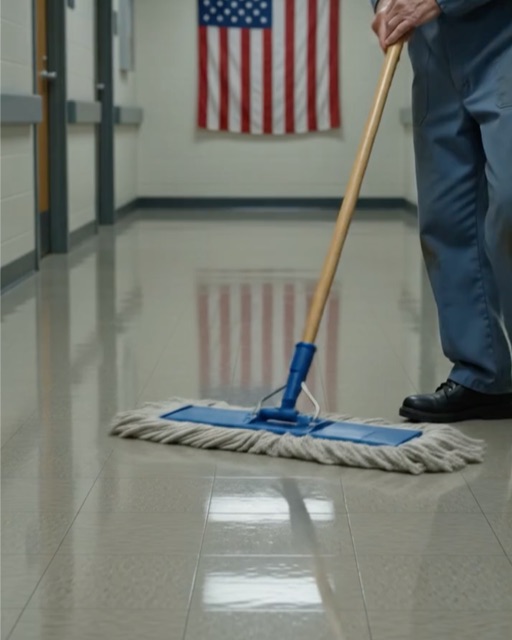
Mop. Bucket. Waxer. Floors so clean the flag’s stripes looked like they were floating.
At seventy-one, that quiet felt like mercy.
The young officers at Fort Ashburn didn’t know my name. Most tossed me a stiff “sir.” One called me “old man” under his breath.
Captain Mercer didn’t bother whispering.
“Don’t miss a spot, Chief,” he said, stepping right over the wet floor sign. He dragged mud straight through the shine I’d just laid down.
His friends laughed.
I didn’t. Something in me went still – the kind of still you only learn under incoming.
I bent to move the sign.
That’s when the base commander’s door flew open.
Colonel Sandoval stepped out, white as paper, phone pressed to his ear.
He looked at me like I’d walked out of a headstone.
“Yes, General,” he said, voice tight. “He’s right here.”
Every chuckle died.
Sandoval lowered the phone, choosing his words like they weighed a ton. “Mr. Donnelly, the Pentagon needs you on a secure line.”
Mercer blinked. “For what?”
Sandoval didn’t look at him. “A memorial review.”
I wiped my hands on a rag. “Which one?”
He swallowed. “Operation Iron Psalm.”
The mop slipped from my fingers and clattered across the tile.
No one breathed.
Iron Psalm wasn’t on any wall. It wasn’t supposed to exist.
Thirty-six men came home from that valley.
Only one man knew why.
They walked me into the conference room. Three screens glowed. A three-star general stared out from one. A Senate seal filled another. The third showed a scanned photo of a kid in desert dust, twenty-eight, jaw tight, an American flag folded under his arm.
Captain Mercer hugged the back wall like it could hide him.
The general leaned in. “Chief Warrant Officer Donnelly,” he said quietly, “for forty years, we’ve put the wrong name on the record.”
My throat closed.
On the table sat a sealed citation, edges yellowed to tea-stain brown.
Colonel Sandoval broke it open.
The first line read: For actions above and beyond the call of duty.
Mercer whispered, “You got the Medal of Honor?”
I shook my head. “I refused it.”
Silence hit like a blast wave.
The general’s voice dropped. “Then tell them why, Chief.”
I looked at the captain who’d tracked mud across my floor. Then at the flag in the corner that saw it all.
And I said the name of the man who really earned it – the man they’d stamped “COWARD” in the base newspaper clipping—tapping that grainy photo on the screen with a shaking finger.
“Private First Class, Samuel Finch.”
My voice was gravelly, a road I hadn’t traveled in decades.
The General on screen nodded slowly. “Tell us what happened in that valley, Mr. Donnelly. From the beginning.”
Captain Mercer shifted his weight, suddenly finding his polished boots very interesting. His friends had evaporated, leaving him alone in the spotlight he’d never wanted.
I took a breath. The air in the room felt thick, like dust before a storm.
“Iron Psalm wasn’t a mission,” I started. “It was a mistake.”
“We were sent into the Tangi Valley. Command called it a ‘reconnaissance in force.’ The men called it a death trap.”
“It was a narrow canyon with a dozen hiding spots for every one of our guys. We were flies in a bottle.”
I was a Dustoff pilot back then. Chief Warrant Officer Donnelly, call sign ‘Angel One.’ My job was to pluck the wounded from hell and get them to heaven, which was a field hospital forty klicks away.
On the ground was Bravo Company. A hundred and fifty men, mostly kids. Eager. Scared.
Among them was Sammy Finch.
He wasn’t a standard grunt. He was quiet, drew cartoons in a little notebook. He sent most of his paycheck home to his mom and his little sister.
He was assigned the M60 machine gun. The big pig. It’s a heavy, brutal weapon, and it usually goes to the biggest, most solid guy in the platoon.
Sammy was not that guy. He was wiry, all elbows and Adam’s apple. But he could hump that gun for miles and never complain.
The morning of the operation, the air felt wrong. Too quiet. Even the birds were smart enough to leave.
We were dropping supplies and providing air cover. From two thousand feet, you see things the ground-pounders can’t. You see the whole chessboard.
The ambush started at 0900. It wasn’t one position; it was everywhere at once. RPGs from the high ground, machine gun nests from the caves.
Bravo Company’s lead platoon was pinned down, caught in the middle of a killing field.
That’s where Sammy Finch was. His gun was the only thing keeping a dozen of his friends from being overrun. He laid down fire, switching barrels when they glowed red, just like he was trained.
I was flying a carousel pattern overhead, watching the tracers walk across the valley floor. My co-pilot, a young warrant officer named Peters, was calling out targets.
The radio was a nightmare. A dozen voices screaming at once.
Then my radio crackled with a voice I didn’t recognize, panicked and thin. It was a lieutenant from Charlie Company, the reserve force, a mile back up the valley.
“We have movement! A large enemy force moving on our position from the east ridge! They’re trying to cut us off and box Bravo in!”
I looked east. He was right. It wasn’t just a small group; it was at least fifty fighters, moving fast, using the terrain to stay hidden. If they got behind Bravo Company, it would be a massacre. No one would get out.
They were completely unaware. Their focus was on the hornet’s nest in front of them.
I tried to raise Bravo’s commander, a Captain Wallace. “Bravo Six, this is Angel One! You have a significant enemy force moving to flank your rear! Repeat, you are about to be enveloped!”
Static. Nothing but screams and the pop-pop-pop of gunfire. His radio must have been hit, or he was… gone.
Down on the valley floor, Sammy Finch was still on his gun. He was in a small outcropping of rocks, a perfect defensive position for the fight in front of him.
But from my vantage point, I saw his head snap to the east. I don’t know how. Maybe he saw a flash of movement. Maybe it was just instinct.
He saw what I saw. He saw what Charlie Company saw.
And he knew his own platoon couldn’t hear the warnings.
I watched him. He looked at the flanking force. He looked back at his platoon, pinned down and fighting for their lives.
Then he did something that, on paper, was unforgivable.
He abandoned his post.
He grabbed a satchel of grenades, leaving the hot M60 behind, and he ran. Not away from the fight. He ran straight towards the enemy’s main line.
His platoon sergeant screamed his name over the radio. “Finch! Get back on that gun! That’s an order, private!”
But Sammy didn’t stop. He was running across open ground, a lone figure kicking up dust.
To everyone in his platoon, it looked like the worst kind of cowardice. The man with the most important weapon had cracked under pressure and deserted them.
A few seconds after he left, the enemy surged forward and overran his position. Two men who had taken cover behind him were killed instantly.
Those were the facts. That’s what went into the official report. Private Finch deserted his post, resulting in the deaths of two of his comrades.
Here in the conference room, I paused. I looked at Captain Mercer. His face was pale. The arrogance had been scraped away, leaving something raw and uncertain.
“But that’s not what I saw,” I continued, my voice firm.
“Sammy wasn’t running away. He was running to warn them.”
He was running towards Captain Wallace’s command post, which was a hundred meters away. He was trying to deliver the message the radio couldn’t.
He was a runner, a messenger, because it was the only thing he could do.
And he knew he wouldn’t make it.
As he ran, he pulled the pins on his grenades and started tossing them into the cave mouths that pocketed the cliffside. He wasn’t trying to kill the enemy; he was trying to get their attention.
He was making a target of himself. Drawing their fire away from his friends.
It worked.
The machine guns that were chewing up his platoon swiveled toward him. RPGs that were aimed at the main group turned his way.
For about fifteen seconds, Private Samuel Finch was the most important man in the Tangi Valley. He absorbed the full fury of the enemy.
And in those fifteen seconds, the pressure on his platoon eased just enough. They pulled back, reorganized, and found better cover.
Those fifteen seconds saved them.
I saw it. I saw him get hit. Once, then twice. He went down, but he got back up. He kept moving, stumbling, towards the command post.
He made it about ten more yards before an RPG found him.
There was just a puff of red dust. And then, nothing. He was gone.
My co-pilot Peters was crying. “He’s gone, Chief. My God.”
Just then, my bird shuddered. We’d taken a hit in the tail rotor. We were going down.
I managed to auto-rotate into a controlled crash about half a klick from the main fight. The landing was hard. Peters was gone, and I had shrapnel in my leg.
But we were alive. The survivors of Bravo Company, rallied by a young sergeant, fought their way to my downed chopper. We formed a perimeter around the wreckage.
That’s where I supposedly earned the medal. I used the .50-cal from the chopper door to hold off a charge. I helped patch up the wounded. I did what any soldier would do. I survived.
We held out for six hours until reinforcements finally broke through.
When the dust settled, the story of Iron Psalm was written.
It was a story of heroism and sacrifice. But it needed a villain. It needed a reason for the initial losses.
The official narrative latched onto the platoon sergeant’s report: Private Finch deserted his post. Two men died because of it.
He was the scapegoat. The coward.
I tried to tell them. In the debrief, I screamed until my throat was raw. I told them what I saw from the air. I told them Sammy was a hero.
They patted me on the shoulder. They said I was suffering from shock, from trauma. They pointed to the official logs. The platoon sergeant’s testimony. The fact that the M60 was found unmanned.
My co-pilot, the only other witness in the air, was dead. The men in Charlie Company who saw the flanking force were too far away to see Finch’s run.
My story was an outlier. An emotional outburst from a pilot who’d just lost his aircraft and his friend.
So they gave me a medal for my part. And they stamped Sammy’s file with ‘Cowardice in the face of the enemy.’ They sent a letter to his mother telling her that her son had died in disgrace.
I couldn’t accept it. I couldn’t wear a medal for heroism on the same day they buried a true hero under a mountain of lies.
So I refused it. I told them I wouldn’t accept it until they cleared Sammy’s name.
They told me to drop it, or I’d face a court-martial for insubordination. So I got out. I left the army I loved, because it had lied.
I took the quietest job I could find. Mopping floors. Where no one knew my name.
And for forty years, I’ve carried that valley with me every single day.
Silence descended on the conference room. It was heavier than any silence I had ever known.
Colonel Sandoval was staring at his hands on the table.
Captain Mercer was looking at me, his eyes wide with a horrifying understanding. There were tears welling in them.
The three-star General on the screen cleared his throat. The sound was like a rockslide.
“Mr. Donnelly,” he said, his voice thick with emotion. “We believe you.”
He paused. “Things are different now. We have new analytical tools. A researcher at the archives was reviewing declassified documents from Iron Psalm for a historical paper. She cross-referenced your debriefing—which was buried—with newly digitized comms logs from Charlie Company and topographical heat maps of the engagement.”
“Your story,” the General said, “matched the data perfectly. It took forty years for the technology to prove what you knew in your heart all along.”
He then looked directly at Captain Mercer.
“Captain,” the General said, his tone shifting, becoming pointed. “What was your father’s name?”
Mercer’s voice was a choked whisper. “Major Thomas Mercer, sir.”
“And what unit did he serve with in the Tangi Valley?”
Mercer’s face went completely white. He looked like he was going to be sick.
“He was… he was the company commander for Charlie Company, sir.”
The General nodded. “That’s right. His platoon was spared the main ambush because they were alerted to a flanking maneuver they never saw coming. He spent his whole life wondering why they were so lucky that day.”
“The message that saved your father’s life, Captain… the message that allowed him to come home and have a family… the message that led to you, standing in this room right now… was delivered by Private Samuel Finch.”
The dam broke. Captain Mercer let out a single, ragged sob. He leaned against the wall as if his legs could no longer support him. He wasn’t just looking at a janitor anymore. He was looking at the ghost of a man who had saved his entire lineage.
“The citation on the table, Mr. Donnelly,” the General said softly. “It’s not yours.”
Colonel Sandoval pushed the document toward me.
I picked it up. My hands were shaking.
The first line read: For actions above and beyond the call of duty, the Medal of Honor is posthumously awarded to Private First Class Samuel Finch.
Tears I hadn’t allowed myself to cry for forty years streamed down my face.
“There’s one more thing,” the General said. “The researcher who uncovered all this… she had a personal stake in it. She’s been fighting this battle for a decade. We have her on the line.”
A new face appeared on the third screen. A woman in her late forties, with kind, intelligent eyes that looked so much like the boy in the grainy photo.
“Mr. Donnelly?” she said, her voice trembling. “My name is Sarah Finch. Sammy was my father.”
I couldn’t speak. I could only nod, clutching the citation.
“My mother passed away believing my father was a coward,” she said, tears rolling down her cheeks. “I promised her I would clear his name. I… I just wanted to thank you. For never forgetting him. For forty years, you were the only one who carried the truth. You were his final friend.”
I finally found my voice. It was hoarse, broken. “He was the bravest man I ever knew, Sarah. The very bravest.”
A week later, there was a ceremony at the base. The parade ground was packed.
They flew Sarah Finch in. I stood beside her, in a borrowed suit that Colonel Sandoval insisted I wear.
Captain Mercer was there, in the back. Our eyes met. He gave me a slow, deliberate nod. It was a gesture of profound respect, an apology, and a thank you, all in one.
They read the citation. They played Taps. A general presented the Medal of Honor to Sarah.
She held it in her hands, looking at it as if it contained the sun. Then she turned to me.
“He would have wanted you to have this,” she whispered, trying to hand me the medal.
I gently closed her fingers around it. “No,” I said. “It’s finally home.”
That night, after the dignitaries had left and the base had gone quiet, I went back to the hallway.
I filled my bucket. I grabbed my mop.
The floor gleamed under the fluorescent lights. The stripes of the flag in the hallway seemed to ripple, to breathe.
As I worked, Colonel Sandoval appeared, holding two cups of coffee. He handed one to me.
“I was thinking of retiring, you know,” I said, looking at my reflection in the polished floor.
“You’ve earned it, Mr. Donnelly,” he replied kindly.
“No,” I said, taking a sip of the hot coffee. “I don’t think so. I like the quiet.”
But it was a different kind of quiet now. It wasn’t the quiet of being forgotten.
It was the quiet of a job well done. The quiet of peace.
Because some duties don’t end when the uniform comes off. The most important ones—the duties of honor, of truth, of remembering the fallen—are for life. And true heroes aren’t always the ones with medals on their chests; sometimes, they’re the ones who make sure the medals end up on the right chests, no matter how long it takes.