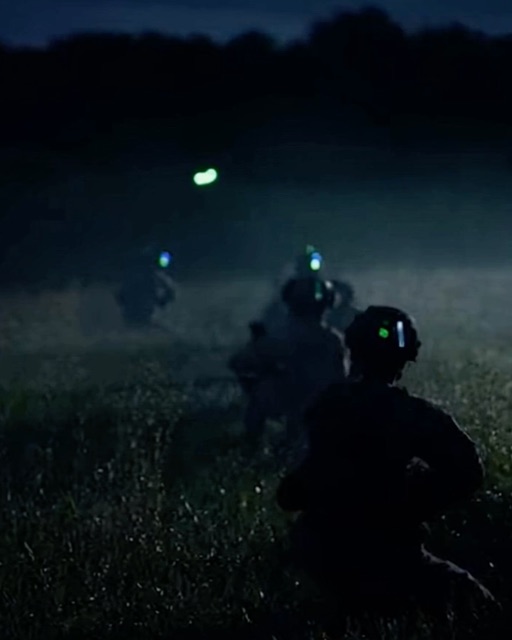
We were moving in dead silence through the wet, pitch-black woods. Blackout conditions. No talking, no flashlights. Just the faint green glow of chem lights clipped to our gear.
Then, the lead squad drifted.
It wasn’t much. Just a few degrees off the route. But in the dark, a few degrees is all it takes to walk off a map.
I dropped to one knee in the wet grass, checking the tree line silhouette. That’s when I saw it.
A single green chem light glowing in a ravine to our left. Completely off the training lane. Where absolutely no one was supposed to be.
“Lead squad halt,” I whispered. My blood ran cold. “Security out.”
My Platoon Sergeant, Todd, crawled up next to me. “That’s not command’s marker,” he muttered.
We crept toward the glowing light, expecting to find a lost private from another unit who had wandered off the trail.
But it wasn’t a soldier.
The chem light was zip-tied to the door handle of a dark civilian SUV, parked deep in the brush where no vehicles were allowed.
Todd raised his night vision goggles. “Sir… what is a civilian car doing out in the impact zone?”
I didn’t answer. I froze. My heart pounded so hard I thought my ribs would crack as I wiped the mud off the rear license plate.
I knew that plate. I knew the dent on the bumper.
I stepped closer, looked through the fogged-up glass of the driver’s side window, and realized the person sitting inside was my wife, Sarah.
For a moment, the world stopped. The woods, the rain, the thirty soldiers behind me – they all vanished.
All I could see was her face, illuminated by the faint glow of the dashboard lights. Her head was leaning against the window, her eyes closed.
“Sir?” Todd’s voice was a low growl, pulling me back to reality. “Is everything alright?”
I couldn’t form words. I just nodded, my mind a chaotic storm of questions. What was she doing here? In the middle of a live-fire training area? At two in the morning?
We were miles from any public road. This wasn’t a place you just accidentally found. You had to drive through a locked gate and down a restricted access road.
My first thought was that she was in trouble. Hurt. Stranded.
I motioned for Todd to hold our position and moved silently to the driver’s side door, my rifle held low. My hand trembled as I reached for the handle.
Then, I saw movement in the passenger seat.
A figure shifted in the darkness. My training kicked in instantly. Threat. My hand dropped from the handle and went to my sidearm.
I saw the silhouette of a man’s head. He leaned over, and for a horrifying, gut-wrenching second, I thought he was kissing her.
A hot, white-hot rage flooded my veins, so powerful it almost buckled my knees. It felt like a physical blow, knocking the air from my lungs.
Every rational thought evaporated, replaced by a singular, blinding image of betrayal. My wife. In a car. With another man. In the middle of nowhere.
This was why she’d been distant lately. Why she’d been quiet and jumpy when I asked about her day.
The puzzle pieces I didn’t even know existed slammed together into a picture of pure devastation.
My duty as a Platoon Leader, the safety of my men, the mission – it all became a distant hum. There was only the cold steel of the door handle and the fire in my chest.
Todd must have seen the change in my posture. He moved up beside me, a silent, steady presence. “Sir, let’s call this in. Let the MPs handle it.”
His voice was calm, but I could hear the urgency. He was trying to stop me from doing something stupid. He was trying to protect me from myself.
“No,” I managed to choke out, the word scraping my throat. “I’ll handle it.”
I took a deep breath, trying to force the officer back into control, to shove the broken husband down. I tapped firmly on the glass with my knuckle.
Sarah’s head shot up. Her eyes went wide with panic when she saw me standing there in my full gear, my face smeared with camouflage paint.
The man beside her jerked upright, his face a mask of fear.
Sarah fumbled with the door lock, her hands shaking. The click echoed in the silent woods. I pulled the door open.
The damp air rushed in, carrying the scent of pine and rain and her perfume.
“Mark,” she breathed, her voice barely a whisper. “What are you doing here?”
“What am I doing here?” I repeated, my voice dangerously low. I could feel Todd and the rest of the platoon watching, listening. “I’m working, Sarah. The better question is, what in God’s name are you doing here?”
I stared at the man in the passenger seat. He looked familiar, but my mind was too clouded with anger to place him. He was thin, pale, with haunted eyes that refused to meet mine.
“Get out of the car,” I said to him, my voice flat and cold.
“Mark, please,” Sarah pleaded, grabbing my arm. “It’s not what you think.”
“Isn’t it?” I snapped, pulling my arm away. “It looks exactly like what I think.”
The man slowly opened his door and stepped out, raising his hands slightly as if I were a cop about to arrest him. It was only then, as he stood in the faint moonlight filtering through the canopy, that I recognized him.
It was Daniel. Daniel Peterson.
He’d been in my squad during my first deployment. A good soldier. A funny guy who could make you laugh in the worst situations. I’d heard he’d gotten out a year ago, that he was having a hard time adjusting.
Seeing him here, now, shattered my theory of betrayal into a million confusing pieces.
“Daniel?” I asked, the anger in my voice replaced by sheer bewilderment.
He just stared at the muddy ground, his shoulders slumped in defeat.
“Mark, you have to listen to me,” Sarah said, her voice urgent as she got out of the car. “We have to help him.”
“Help him do what? Trespass on a federal military installation? In an active impact zone?” I gestured wildly around us. “Artillery is scheduled to start firing in this sector in less than three hours, Sarah! People could die.”
My mind was reeling, trying to connect the dots. My wife. My old squad mate. A clandestine meeting in the most dangerous part of the base.
“He called me,” Sarah explained, her words tumbling out in a rush. “He was a mess. He said he couldn’t take it anymore. He kept talking about ‘going back,’ about finding a quiet place.”
She took a breath, her eyes welling with tears. “He told me he was driving out here. I knew what he meant, Mark. He wasn’t planning on driving back.”
The weight of her words settled on me, crushing the last of my anger and replacing it with a cold, creeping dread. The impact zone. A quiet place.
Daniel was going to let the artillery shells solve the problems he couldn’t face back home. He came out here to die.
“He wouldn’t answer my calls after that,” Sarah continued, her voice cracking. “I knew you were training out here somewhere. I called your unit, but they couldn’t tell me anything. So I drove to the access gate. It was open… someone must have forgotten to lock it. I just started driving, hoping I’d find him.”
She had been searching for him. The chem light tied to her door—it wasn’t a marker for a secret rendezvous. It was a beacon. She was hoping that if I was out here, I would see it. She was looking for me.
My entire body went numb. I had been seconds away from destroying my marriage, from accusing the woman I loved of the worst possible betrayal, all because my pride and fear had jumped to the ugliest conclusion.
In reality, she had been braver than me. While I was leading a routine training mission, she was driving into the dark, alone, to save a man’s life.
I looked at Daniel. The haunted look in his eyes made sense now. He wasn’t a home-wrecker; he was a ghost. A casualty of a war that had ended for us on paper, but not in his head.
“Sir,” Todd’s voice was right behind me, steady and professional. “We have a situation here that’s above our pay grade. We need to report it.”
He was right. By the book, I had to call the Military Police. They would take Daniel into custody. Sarah would be cited for trespassing. It would be a bureaucratic nightmare that would offer Daniel no real help, only punishment and shame. His life would be effectively over.
I looked at Sarah’s tear-streaked face, then at Daniel’s empty stare. I thought about the man he used to be, the soldier who had my back more times than I could count.
The Army teaches you to follow orders, to stick to the plan, to eliminate variables. But it also teaches you to take care of your own. To leave no one behind. That creed doesn’t stop when you take the uniform off.
I made a decision. It was the wrong one for my career, but it was the right one for my soul.
“No,” I said to Todd, my voice firm. “We’re not calling anyone.”
Todd stared at me, his expression unreadable in the dark. “Sir, with all due respect, this man is a civilian. She is a civilian. They are in a restricted military zone. This is a massive breach of protocol.”
“He’s not a civilian, Sergeant,” I said, my gaze fixed on Daniel. “He’s one of ours. And we’re not leaving him behind.”
I turned to my wife. “Sarah, give me your keys.”
She handed them over without a word. I tossed them to Todd. “Sergeant, I need you to get her car out of here. Take the service road back to the main gate. I’ll call ahead to the gate guard and tell them to expect you, say you’re a support vehicle that took a wrong turn.”
It was a flimsy story, but it might just work.
Todd hesitated for a fraction of a second. I saw the conflict in his eyes—the career NCO warring with the man who understood loyalty. He looked from me, to Sarah, to the broken soldier standing beside the car.
Then he gave a single, sharp nod. “Understood, sir.” He turned to the two soldiers closest to him. “You two, with me. Let’s get this vehicle moved.”
As they got in the car, I walked over to Daniel. I put a hand on his shoulder. He flinched, but didn’t pull away.
“It’s okay, Danny,” I said softly, using the old nickname from years ago. “I’ve got you.”
He finally looked at me, and for the first time, I saw a flicker of something other than despair in his eyes. A glimmer of recognition. Of trust.
“The noise…” he whispered. “I can’t get it to stop, Mark.”
“I know,” I said. “We’re going to find you a quiet place. A real one.”
Todd got the SUV started and began the slow, careful process of turning it around in the narrow ravine.
I turned back to my platoon, who were watching the whole scene unfold in disciplined silence. They were good soldiers. They trusted my judgment.
“We’re taking a detour,” I announced. “We have a new mission. We’re walking a brother home.”
I had Daniel and Sarah fall in with me at the center of the formation. As we began to move, my soldiers instinctively formed a protective bubble around them, absorbing them into our silent, moving column as if they were one of us.
We walked for what felt like hours, not on a compass azimuth, but following the service trails that I knew led back toward the cantonment area. The only sounds were the soft crunch of boots on wet leaves and Daniel’s quiet, ragged breathing.
Sarah walked beside me, her hand finding mine in the darkness. She squeezed it, a silent thank you that said more than words ever could. I squeezed back, a silent apology for my doubt.
We finally reached the edge of the training area, where the woods gave way to the manicured lawns behind the base chapel. The lights of the main post were a comforting glow in the distance.
I halted the platoon. “Todd,” I said. “Take the platoon back to the barracks. Get them squared away. I’ll handle the paperwork for the ‘navigational error’.”
“Yes, sir,” he said. There was a new respect in his voice. He knew the risk I was taking. He knew I was trusting him to have my back. He called the platoon to attention, and they moved off into the darkness without a single backward glance.
The base chaplain, a good man named Father Michael, was an old friend. I knew he was a night owl. I walked Daniel and Sarah up the steps of the empty chapel and knocked on the heavy oak door of his office.
A light flicked on, and a moment later, the door opened. Father Michael stood there in his pajamas, a look of concern on his face that quickly turned to understanding as he saw the state Daniel was in.
He didn’t ask questions about what we were doing there at four in the morning. He just opened the door wider.
“Come in,” he said, his voice warm and kind. “There’s coffee on. Let’s talk.”
I left Daniel in his care, knowing he was finally in a safe place where he could get the help he needed, not the punishment the system would have prescribed. Sarah and I walked out into the pre-dawn quiet.
The sky was beginning to lighten in the east, painting the clouds in shades of gray and pink. We stood by my truck, not speaking for a long time.
“I’m sorry,” I finally said, the words feeling small and inadequate. “For what I thought. For what I almost said.”
She leaned her head on my shoulder. “You didn’t know. You saw what you saw, and you were scared.”
“I should have trusted you,” I said.
“We trust each other now,” she replied, and I knew she was right. Our marriage hadn’t been broken in that ravine. It had been forged into something stronger.
Daniel got the help he needed. Father Michael and I pulled some strings, and he was admitted to a civilian treatment facility, no official record of his nighttime excursion ever being filed. Todd and the rest of my platoon never spoke a word of it. They knew what we had done was a different kind of duty, a higher calling.
I learned something important that night, out there in the dark woods. A leader’s job isn’t just about following the map or the rulebook. It’s about knowing when to put the map away and follow your heart. True strength isn’t just about discipline and orders; it’s measured in compassion and understanding. Sometimes, the most important mission is the one that isn’t on the schedule, and the person you have to save isn’t wearing the same uniform as you. It’s about recognizing the humanity in a crisis and choosing people over protocol.