The ground was lying to us.
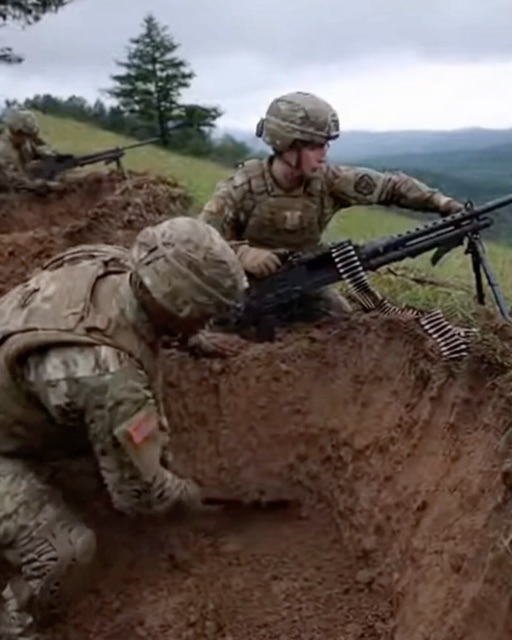
Our active-duty platoon was digging fighting positions on a remote ridgeline, but the earth kept collapsing inward under our entrenching tools. The machine gun team was losing time and depth, struggling with a massive runoff cut in the hill.
Our section leader, Travis, moved down the line fast. “You two, deepen that wall. Sandbags on the low side now.”
He jumped into the hole to help the frustrated gunner clear the mud. “Build the position the ground allows,” Travis muttered, hacking away at the unusually soft earth.
That’s when Platoon Sergeant Wayne appeared at the top of the ridge, his face completely pale.
“Why didn’t you leave them to fix their own hole?” Wayne yelled down. “Get out of there. Fill it back in and move the gun fifty meters west. Now!”
It made zero tactical sense. This was the only high ground.
My heart pounded. Wayne was a twenty-year veteran. He never panicked. But right now, he was sweating through his uniform, his eyes locked in terror on the exact patch of dirt we were standing on.
Travis ignored him. “Just one more scoop for the drainage channel,” he whispered to us, driving his shovel deep into the mud.
Clank.
He didn’t hit a rock. He hit metal.
My blood ran cold as Travis aggressively brushed away the wet earth. It wasn’t an old landmine or a rusted pipe. It was a brand-new, heavy-duty steel lockbox.
Wayne screamed at us to step away and started sprinting down the hill, his hand dropping directly to his sidearm.
Travis didn’t hesitate. He smashed the padlock with the heavy edge of his entrenching tool and kicked the lid open. I peered over his shoulder, and my jaw hit the floor.
Inside the box wasn’t ammunition, maps, or field rations. It was a stack of civilian passports, bundles of cash, and a single, terrifying photograph that proved our Platoon Sergeant was a traitor.
The photo was crisp, professional. Wayne was there, in civilian clothes, shaking hands with a man I recognized from intelligence briefings. A local strongman, a kingpin in everything from smuggling to extortion, named Marcus Thorne. But it was the third person in the photo that made my stomach turn. A young girl, maybe ten years old, stood beside Thorne, her hand in his. She was looking at the camera with wide, empty eyes. She looked just like the little girl in the framed photo on Sergeant Wayne’s desk back at the barracks. His daughter.
Wayne finally reached us, his chest heaving, his face a mask of desperation. His sidearm was still holstered, but his hand trembled just above it.
“You don’t understand,” he gasped, his voice ragged. “Put it back. Please, Travis. Just close the box.”
Travis stood up slowly, his own face hard as granite. He held up the photograph. “Explain this, Sergeant. Explain shaking hands with Thorne while he holds your daughter.”
My mind was reeling. This wasn’t just corruption. The passports, the cash, the photo – it screamed of something far darker. Human trafficking. And our Platoon Sergeant, a man we trusted with our lives, was in the middle of it.
“He has them,” Wayne choked out, tears welling in his eyes. “He has my wife and my little girl. This box… it’s how I pay him. It’s how I keep them alive.”
Travis scoffed, his disgust palpable. “Pay him with what? Fake passports? You’re moving people for him, aren’t you? That’s what this is.”
The accusation hung in the air, heavy and suffocating. The other soldiers in the machine gun team had stopped digging, their eyes wide, watching the drama unfold.
“No,” Wayne pleaded, taking a step forward. “It’s not what you think. That cash is every cent I have. My savings, my deployment pay. The passports are blanks he makes me hold. It’s a dead drop. If I miss one, if anyone finds out…” He trailed off, his gaze falling on the open box like it was a coffin.
I looked from Wayne’s shattered face to Travis’s rigid posture. Travis was a man of black and white, of honor and duty. In his eyes, Wayne had crossed a line that could never be uncrossed. But I saw something else. I saw the pure, undiluted terror of a father who was watching his world burn down. It didn’t feel like the panic of a guilty man being caught. It felt like the agony of a trapped animal.
“We have to report this, Sam,” Travis said to me, his voice low and firm, not taking his eyes off Wayne. “This is way above our pay grade.”
“If you make that call, they’re dead,” Wayne whispered, the words barely audible. “Thorne will know. He has eyes everywhere. He told me. The moment the brass gets involved, he’ll know, and he’ll make me watch.”
The raw pain in his voice was a physical thing. It hit me in the chest.
Travis picked up one of the passports. “And how many other little girls are on these, Sergeant? How many families have you helped destroy to save your own?”
Wayne flinched as if he’d been struck. “None. I swear on my life. They’re leverage. He makes me move the box from one drop point to another on these training exercises. He uses the military’s movements to hide his own. I’m just a mule.”
A cold realization washed over me. Thorne wasn’t just using Wayne. He was using the entire U.S. Army as his personal delivery service, and no one was the wiser.
Travis still wasn’t buying it. He was already reaching for the radio on his vest. “I’m calling it in.”
“Wait,” I said, stepping between them. I don’t know why I did it. Every part of my training screamed at me to follow my section leader’s command. But my gut was screaming louder. “Just wait one minute, Travis.”
I turned to Wayne. “Is there anything else in the box?”
Wayne shook his head numbly. “Just what you see. And a burner phone at the bottom. He calls it when the drop is done.”
I knelt and rummaged beneath the cash and passports. Sure enough, a cheap, plastic-wrapped phone was tucked into a corner. I picked it up.
“What’s the plan, Wayne?” I asked, my voice steady. “How were you supposed to get out of this?”
“There is no plan,” he said, his voice cracking. “I just do what he says. Every week, a new drop, a new impossible task. And every week, he sends me a picture of my daughter holding today’s newspaper. Just to prove she’s still…”
He couldn’t finish the sentence. He didn’t have to.
Travis looked at me, his eyes narrowed. He was a good leader because he listened, even when he disagreed. He saw the doubt on my face and lowered his hand from his radio.
“Alright,” Travis said, his tone shifting from accusatory to analytical. “If this is a dead drop, there’s a pickup. When and where?”
Wayne looked stunned by the question. “I don’t know. He calls on the burner after I re-bury the box and move away. He gives me new coordinates for the next one.”
Suddenly, the phone in my hand vibrated. It buzzed once, a short, sharp pulse.
We all froze.
“That’s the signal,” Wayne breathed. “That means his guy is watching. He saw you open the box.”
A new kind of fear, cold and sharp, pierced through the confusion. We weren’t just discovering a crime anymore. We were part of it. We were compromised.
“He’s watching us right now?” I whispered, my eyes scanning the dense tree line surrounding the ridge. The familiar training area suddenly felt alien and hostile.
Travis reacted instantly. “Everyone back to the perimeter! Act normal! Finish your positions!” he barked at the other soldiers, who scrambled to obey, their faces a mixture of fear and confusion. He then turned to Wayne. “Put everything back in the box. And put that phone on speaker.”
Wayne’s hands trembled so badly he could barely gather the scattered bundles of cash. I helped him, my heart hammering against my ribs. We placed the lid back on the box, not bothering to relock it, and slid it back into the muddy hole.
The burner phone vibrated again, this time with an incoming call.
I held my breath as Wayne answered and pressed the speaker button.
A voice, distorted and metallic, crackled through the tiny speaker. “You have a problem, Sergeant.”
“There was a complication,” Wayne said, trying to keep his voice from shaking. “The ground was unstable. My men had to dig a new position.”
“I don’t care about your excuses,” the voice hissed. “I care about my property. You were seen. Your men were seen.”
A long, terrifying pause followed. I could picture Thorne on the other end, deciding whether Wayne’s family lived or died.
“The deal has changed,” the voice continued. “The original pickup is off. You will bring the box yourself. To me. You, and the two curious children who were with you.”
My blood turned to ice. He meant me and Travis.
“No,” Wayne said immediately. “They’re not involved. This is between you and me.”
“They are involved now,” the voice said flatly. “There’s a service road at the base of this ridge. An old logging trail. Two kilometers east. You have one hour. Come alone, just the three of you. No one else. If I see one more uniform, if I hear one whisper on your radios, your daughter will pay the price for your incompetence. Do you understand me?”
“I understand,” Wayne said, his voice hollow.
The line went dead.
For a moment, nobody moved. The three of us stood in the muddy hole, the architects of our own disaster. We were trapped. If we called for help, Wayne’s family would be lost. If we went, we were walking into an ambush with a known killer.
Travis was the first to speak. He looked at me, then at Wayne, and a new kind of determination settled on his face. The anger was gone, replaced by the cold, hard focus of a soldier with a mission.
“Okay,” Travis said. “He wants the three of us. He’ll get the three of us.”
He wasn’t talking about surrender. I could see it in his eyes. He was talking about a fight.
“We can’t,” Wayne said, shaking his head. “He’ll kill you. He’ll kill all of us.”
“He’ll kill your family if we don’t do something,” Travis countered. “You’ve been playing his game for weeks, maybe months. Look where it’s gotten you. It’s time we start playing ours.”
He looked at me. “Sam, what’s our ammo count?”
I did a quick mental check. “Standard loadout. Six mags each. No frags, this is a training op.”
“It’ll have to do,” Travis said. He pulled Wayne up out of the hole. “Listen to me, Sergeant. You’re going to lead us to that road. But you’re not going to be a victim anymore. You’re going to be a soldier. You’re going to help us get your family back.”
A flicker of something I hadn’t seen before – hope—ignited in Wayne’s eyes. It was faint, but it was there.
We had less than an hour. We moved fast, covering the box with a thin layer of mud and marking the spot. Travis used his radio, but not to call for backup. He spoke in clipped, coded language to the other section leaders, reporting a “potential hostile spotter” and ordering the rest of the platoon to move to a defensive position on the far side of the ridge, “observe and report only,” effectively taking them out of play but keeping them as a last-resort cavalry. It was a huge risk, a career-ending breach of protocol if he was wrong.
Then the three of us slipped away from the position, moving through the dense underbrush like ghosts. We didn’t follow the easy path. We moved parallel to it, using the terrain for cover. Every snapped twig, every rustle of leaves, sounded like a gunshot in the silent woods.
Wayne was in front, his knowledge of these hills now a critical asset. He knew the deadfalls, the creek beds, the paths that wouldn’t be on any map. The man who had been a broken shell just minutes before was now operating on pure instinct, his focus narrowed to a single point: the logging trail.
As we got closer, Travis laid out the plan in hushed whispers. “They’ll expect us to walk right down the middle of the road. We’re not going to. Sam, you’ll be our overwatch. Find high ground with a clear view of the road. Wayne and I will make the approach. Your job is to identify, count, and be our eyes. Do not engage unless I give the signal. The signal is ‘Thunder’.”
My job was to be the lookout. It was the most important role and the most helpless.
We found the spot about two hundred meters from the logging trail. It was a rocky outcrop, covered in moss and ferns, offering a perfect, concealed view of a small clearing where the trail widened. I crawled into position, my rifle feeling impossibly heavy.
Travis and Wayne continued forward, disappearing into the shadows. I was alone, my heart pounding a frantic rhythm against the cold rock.
Minutes stretched into an eternity. Finally, I saw movement. A single black SUV, mud-caked and menacing, rolled slowly into the clearing and stopped. The engine cut, and the woods fell silent again.
Two men got out. One was Marcus Thorne. He was exactly as he appeared in the intelligence photos—tall, impeccably dressed even in the middle of nowhere, with a cruel smile playing on his lips. The other man was a mountain of muscle, his hands empty but his eyes constantly scanning the tree line.
They waited.
Then, Travis and Wayne emerged from the trees on the far side of the clearing. Wayne was carrying the steel lockbox. They stopped at the edge of the road, about thirty feet from the SUV.
“You brought my package, Sergeant,” Thorne called out, his voice echoing slightly in the quiet air. “And the two strays. Good boys.”
“Where are they?” Wayne demanded, his voice shaking but loud. “Where is my family?”
Thorne chuckled. “Business first.” He nodded to his bodyguard, who started walking towards Wayne. “The box.”
Travis put a hand on Wayne’s arm, stopping him. “We want proof of life. Now. Or this box and everything in it gets scattered all over this forest.”
Thorne’s smile vanished. He stared at Travis, a flicker of surprise in his eyes. He wasn’t used to being challenged. He pulled a phone from his pocket, tapped the screen, and turned it towards them.
Even from my position, I could see the small screen. A video feed. A woman and a little girl, tied to chairs in a dark room. They were alive. Wayne let out a strangled sob.
“Satisfied?” Thorne sneered.
It was then that I saw it. Something no one else could see from their angle. A third man, armed with a rifle, was stealthily exiting the rear of the SUV. He was using the vehicle as cover, getting into a flanking position.
They weren’t planning on making a trade. They were planning an execution.
My mind raced. I couldn’t wait for Travis’s signal. By the time I warned him, it would be too late.
I took a deep breath, centered my rifle scope on the third man, and let the air out slowly.
This was it. The moment where rules and regulations burned away, leaving only the mission. Protect your people.
“Thunder,” I whispered into my radio, and squeezed the trigger.
The shot cracked through the silence. The gunman behind the SUV dropped without a sound.
All hell broke loose.
Thorne’s bodyguard drew a pistol, but Travis was faster. He shoved Wayne to the ground and opened fire. Thorne dove back towards the open door of his SUV, using it for cover.
I acquired my next target, the massive bodyguard, but he was moving, using suppressive fire to cover Thorne. Bullets ripped through the trees around Travis and Wayne.
“Wayne, the box!” Travis yelled.
In a move of pure, desperate rage, Wayne did something none of us could have predicted. He didn’t run or hide. He charged. He ran straight at the bodyguard, holding the heavy steel box like a battering ram.
He slammed into the big man with all his weight, sending them both tumbling to the ground. The bodyguard’s pistol went flying.
Thorne saw his chance. He raised his own weapon from behind the car door, aiming directly at the tangled heap of Wayne and his man.
I had a clear shot. I took it.
The bullet punched through the SUV’s window, shattering it. Thorne cried out, clutching his shoulder as his pistol clattered to the ground.
It was over in seconds. Travis had the bodyguard in cuffs, and I was scrambling down from my perch, my rifle ready.
Wayne was on his feet, breathing heavily, his eyes locked on Thorne, who was now being held at gunpoint by Travis.
“My family,” Wayne gasped. “Where are they?”
Thorne, grimacing in pain, just spat on the ground.
But his phone, dropped during the chaos, lay face up on the dirt. The video feed was still active. I grabbed it. The room was dark, but it was a live feed. I could hear the faint sound of a train horn in the background.
I knew that sound. There was only one place near the base where the freight line ran that close to a main road. An old, abandoned warehouse district just outside the town.
Reinforcements, called in by Travis on the main radio the second the shooting stopped, arrived in a storm of dust and sirens. We handed Thorne and his man over to the MPs, and the information from the phone to a grim-faced captain.
The next two hours were the longest of my life. We weren’t allowed to go on the raid, but we sat with Wayne in the back of an ambulance, waiting for news. He didn’t speak. He just stared into nothing, his hands clasped so tightly his knuckles were white.
Then, a call came over the radio. The warehouse was secure. Two more of Thorne’s men were in custody. And a woman and a young girl were safe. They were on their way.
When the patrol car pulled up, the back door opened and Wayne’s daughter came flying out, screaming “Daddy!”
Wayne caught her, lifting her up and burying his face in her hair, sobbing uncontrollably. His wife followed, her face bruised but her eyes shining with tears as she wrapped her arms around them both. It was a reunion I will never forget, a perfect moment of light after so much darkness.
In the end, Platoon Sergeant Wayne wasn’t a traitor. He was a hero, forced into an impossible choice. He faced a board of inquiry, but with our testimony and the evidence against Thorne, he was cleared of any wrongdoing. He had failed to report, yes, but he had done so under extreme duress to protect his family. They gave him a desk job for a while, to let him heal.
Travis got a commendation. He bent the rules, but he saved a family and brought down a major criminal enterprise that was operating right under our noses. He proved that sometimes, leadership isn’t about following orders. It’s about making the right call, no matter the cost.
I learned something out on that ridge. The world isn’t black and white, and neither are people. Sometimes the most honorable-looking people hide the darkest secrets, and sometimes the ones who look like traitors are just fathers, willing to do anything in the world to hear their daughter call their name one more time. Duty is important, but compassion is what makes us human. That’s the line you can never cross.