“Put her on the mat. Maybe humiliation will teach her to stay out of a real soldier’s way.”
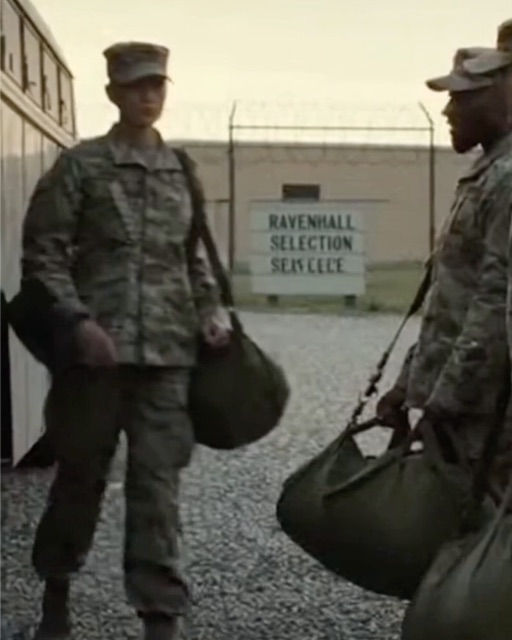
I’m a physical therapist at a military training facility. Yesterday, I was wiping down equipment when Todd, a loudmouthed recruit who never stopped bragging, cornered the new girl. We only knew her as Tracy. She was quiet, unassuming, and mostly kept to herself. Todd had been ruthless all week, loudly calling her a “clerical error” who didn’t belong in the advanced combat program.
“Step on the mat… or admit you’re a fraud,” Todd barked.
The whole room went dead silent. I froze, holding my breath.
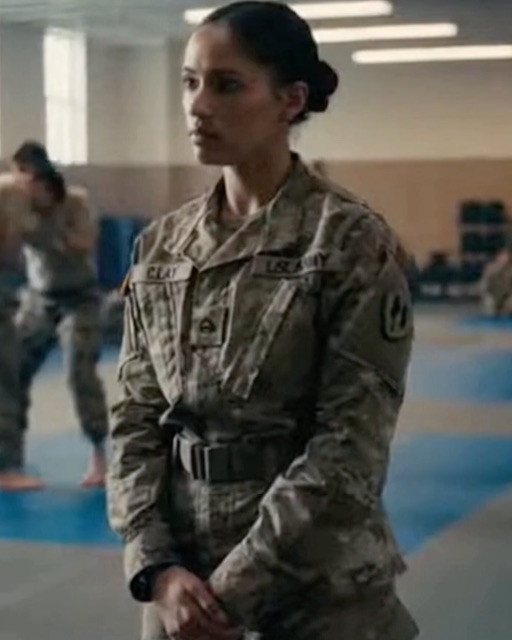
Tracy didn’t say a word. She just tightened her hand wraps, her face completely blank, and stepped forward. Todd lunged at her, massive and aggressive, trying to end it instantly.
But what happened next took exactly three seconds.
One step to the side. One blur of motion. One sickening thud.
Todd hit the ground, completely unconscious. My jaw dropped. Nobody moved. Nobody even breathed.
Suddenly, the Base Commander pushed through the gym’s double doors. He didn’t even glance at Todd on the floor. He walked straight up to Tracy, stood at strict attention, and saluted her. His hands were actually shaking.
He handed her a sealed black folder. But as she took it, the clasp snapped open, and I saw the classified photograph clipped to the front page… and my blood ran cold.
It was my brother, Daniel.
He was kneeling in the dirt, his face gaunt and bearded, but it was him. His eyes, the same ones I’d looked up to my whole life, were hollowed out with exhaustion. He was wearing tattered clothes in a dusty, foreign-looking courtyard.
I hadn’t seen Daniel in two years.
Two years, one month, and six days, to be exact. He was an Army Ranger, declared Missing in Action, presumed dead after his unit was ambushed on a covert operation.
My legs felt like they were made of concrete. I couldn’t move. I couldn’t speak.
The Base Commander, General Wallace, finally noticed me staring. His expression, hard as granite a moment before, softened with something that looked like pity.
“Michael,” he said, his voice a low rumble. “My office. Now.”
He turned to Tracy. “You too.”
The walk to his office was the longest of my life. The gym was still silent, except for a couple of medics who had arrived to check on Todd. Nobody looked at him. All eyes were on Tracy, this quiet girl who had just become the biggest mystery on the base.
Inside the General’s office, the heavy door clicked shut, sealing us off from the world.
General Wallace sat down heavily behind his desk. “There’s no easy way to say this, son.”
He nodded toward the folder Tracy was now holding tightly. “We have credible intelligence. Your brother is alive.”
The words hit me like a physical blow. Hope, a feeling I had buried deep down, flared so painfully in my chest it was hard to breathe. Alive.
“He’s being held by a splinter group in a remote, mountainous region,” the General continued. “This is not official. We can’t send in a team. Plausible deniability is paramount.”
My mind was reeling. What did any of this have to do with Tracy, or with me?
“This is Specialist Anya Petrova,” the General said, gesturing to the woman I knew as Tracy. “She is not a recruit. She is here for one reason, and one reason only. To bring your brother home.”
Anya, not Tracy. She finally looked at me, and for the first time, her face wasn’t blank. It was focused, intense, like a hawk studying its prey. There was a story of a hundred battles in her eyes.
“Why?” I managed to whisper, the word scratching my throat. “Why are you telling me this?”
Anya spoke for the first time since I’d met her. Her voice was calm and steady, with a faint, unplaceable accent.
“Because I need your help, Michael.”
I must have looked as confused as I felt. Me? Help her? I rehab pulled hamstrings and strained shoulders. I wasn’t a soldier.
“The intelligence is new, but it’s limited,” she explained, opening the folder on the General’s desk. She pointed to the photograph. “This was taken by a drone three days ago. He’s been moved frequently. We think they’re using him for his expertise.”
Daniel was an expert in communications technology. It made a horrible kind of sense.
“We have one window to get him out,” Anya said, her gaze locking onto mine. “It’s in five days. But I can’t go in blind. I need to know everything about him.”
“I… I can tell you what he’s like,” I stammered.
“No,” she said, shaking her head slightly. “Not what he’s like. I need to know how he’s built. I’ve read his file. I know he dislocated his left shoulder in training six years ago. I know he had surgery on his right ACL a year before he deployed.”
She paused, letting it sink in. “You were his physical therapist for both recoveries. Weren’t you?”
I just nodded, my mouth dry. I had spent months working with Daniel, helping him rebuild his strength, pushing him to get back into fighting shape. I knew every knot of scar tissue, every subtle imbalance in his posture, every weakness he tried to hide.
“When I get to him, he will be injured. He will be malnourished. He will be weak,” Anya stated, not as a possibility, but as a fact. “His left shoulder will be the first thing to give out under stress. His right knee won’t be able to support a dead-weight carry for more than a few hundred yards.”
She looked at me, and her eyes were not asking, they were assessing. “I need to know his limits better than he does. I need to know the fastest way to get him mobile. I need to know which muscles will fail first. You know his body. You know his breaking points.”
General Wallace leaned forward. “Michael, she’s the best there is. A ghost. But this is a different kind of mission. It’s not about overwhelming force. It’s a precision rescue. Your knowledge… it could be the difference between Daniel coming home or us losing him for good.”
My world had been turned completely upside down. The quiet girl in the gym wasn’t just a soldier; she was a legend. And my brother, who I had mourned and tried to forget, was alive. He was alive, and his life depended on me.
I took a deep breath. “What do you need me to do?”
The next four days were a blur. Anya and I were given a secure room deep in the base’s operations center. It was filled with monitors, maps, and a single cot. Anya never seemed to sleep.
She drilled me relentlessly. We went over every detail of Daniel’s medical history.
“He favors his right leg when he’s exhausted. He’ll try to hide it, but watch his hips. The left one will drop slightly,” I explained, pointing to an anatomical chart.
“Good,” she’d say, making a note. “What about his grip strength? Post-shoulder injury.”
“Weaker on the left. If you have to pull him, use his right arm. It’s his anchor.”
We watched the grainy drone footage for hours. I saw things she didn’t. The way Daniel shifted his weight to protect his bad knee. The slight slump in his left shoulder that told me he was in constant, low-grade pain.
I was no soldier, but this was my territory. The human body. My brother’s body.
I wasn’t just giving her information. I was helping her build a strategy based on physiology. We created a profile of his physical state, predicting his stamina, his speed, his deficiencies. Anya absorbed it all, her mind like a supercomputer.
One afternoon, I took a break and walked through the gym. I saw Todd. He was alone, punching a heavy bag. He wasn’t loud or arrogant anymore. He was just… working. His movements were clumsy, inefficient. He was all brute force, no technique.
He saw me watching and stopped, a flicker of shame on his face. He looked like a kid who had been told the truth for the first time.
He just nodded at me, a silent admission of his own foolishness, and went back to the bag. He was finally trying to learn instead of just posturing.
Seeing him, I realized something. Anya had taken him down not just with skill, but with a profound understanding of his mechanics. She saw his lunge for what it was: an over-committed, off-balance attack. She used his own weight and momentum against him.
It was exactly what we were doing for Daniel’s rescue. We were using the enemy’s own prison, Daniel’s own physical weaknesses, to map out his path to freedom.
On the final night, Anya laid out the plan. She would go in alone, under the cover of a moonless night. I would be at a remote communications outpost, miles away, with a direct link to her. I would watch through a high-tech drone, my eyes in the sky.
“You are not a passenger, Michael,” she told me, her voice softer than I’d ever heard it. “You are my co-pilot. When I find him, I need you to assess his condition from what you can see. You guide me on how to move him.”
The reality of it crashed down on me. I was terrified. But the image of Daniel’s face in that photograph burned in my mind.
The next evening, I found myself in a dark, cramped tent filled with glowing screens. A satellite feed showed a bird’s-eye view of the compound where Daniel was being held. It was a collection of mud-brick buildings surrounded by a high wall.
“I’m in position,” Anya’s voice crackled in my ear, calm as ever. A tiny, heat-signature blip moved on the screen. She was a shadow, flowing over the wall like water.
My heart hammered against my ribs. I could do nothing but watch and wait.
She moved through the compound with an unreal grace, disabling two guards without a sound. She reached the building they believed Daniel was in. The drone’s thermal camera showed one heat signature inside.
“I’m going in,” she whispered.
The next few minutes were agonizing silence. Then, her voice came back, strained. “I have him. He’s in bad shape.”
The camera feed shifted as she half-carried, half-dragged Daniel out into the moonlight. My breath caught in my throat. He was so thin. He was stumbling, his right leg buckling.
“Talk to me, Michael,” Anya panted into the mic.
My training, my purpose, kicked in. The fear was still there, but it was now a tool, sharpening my focus.
“His right knee is failing,” I said, my voice steady. “You can’t put any more weight on it. Shift your support to his left side. Use your body as a brace for his torso.”
“Copy,” she grunted.
“He’s favoring his left shoulder,” I continued, watching his pained movements. “The joint is unstable. Don’t pull him by his arm. You need to get his right arm over your shoulder. That’s his strong side.”
For what felt like an eternity, I was her eyes, her brain, her partner. I guided her through the courtyard, telling her when to rest, how to position him, how to manage his failing body. We were a team, separated by thousands of miles but connected by a single purpose.
They were almost at the wall when an alarm blared. Shouts erupted from the other buildings.
“They know we’re here!” Anya yelled. “We have to go. Now!”
She practically threw Daniel over the wall before scrambling up after him. They were exposed. Gunfire erupted behind them.
“The extraction point is half a mile north,” she said, her breathing ragged. “I don’t think he can make it.”
“He can,” I said, my voice filled with a certainty I didn’t know I possessed. “He’s the most stubborn person I know. Tell him I’m waiting for him. Tell him I’m on the radio. Tell him to remember our last hike up Old Ridge Mountain.”
It was a memory from our childhood, a grueling hike where he had sprained his ankle, and I had helped him walk the last two miles home.
There was a pause. Then I heard Anya’s voice, not in my ear, but faintly in the background, talking to Daniel. Then another voice, raspy and weak, but unmistakable.
“Michael? You’re there?”
Tears streamed down my face. “I’m here, Dan. I’m here. Now get moving.”
I don’t know how they made it. But they did. I watched on the screen as a helicopter descended in a swirl of dust and they were pulled inside.
Two weeks later, I was standing in a sterile white room at a military hospital. Daniel was sitting up in bed. He was still too thin, and there were new scars on his face, but his eyes were clear. They were the eyes I remembered.
When he saw me, he smiled. It was the best thing I had ever seen.
I walked over and we just held on to each other for a long time. There were no words big enough for the moment.
Later, Anya came to see me. She was back in her simple civilian clothes, looking like any other person you’d pass on the street. The ghost was gone.
“He’s only here because of you,” she said quietly.
“We were a team,” I replied, finally understanding.
“Yes, we were,” she agreed. “You have a different kind of strength, Michael. Don’t ever underestimate it.”
She was right. I had spent my life on the sidelines, helping soldiers, but never considering myself one of them. I didn’t have their physical power or their training. But I had my own expertise, my own knowledge. And when it mattered most, that was enough.
True strength isn’t always about the size of your muscles or the volume of your voice. It’s not about the uniform you wear or the weapons you carry. Sometimes, it’s the quiet knowledge you hold inside. It’s the dedication to your craft, the love for your family, the courage to step up when you’re terrified.
It’s about understanding that everyone has a vital role to play, and the most unassuming person in the room might just be the one who can save the day.