The siren split the evening like a blade. Floodlights kicked to life. Smoke bled across the motor pool. Someone yelled “Incoming!” and a burst of automatic fire chewed the perimeter wall two lots down.
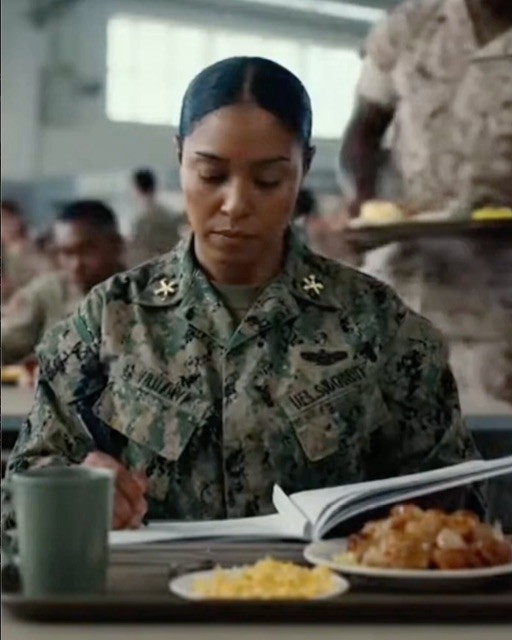
I was midway through a maintenance checklist, no slot, no team, no billet that mattered. Rejected. Twice. “Too small.” “Too slow.” “Not suited.” They stamped it in red and moved on.
Then the net went to chaos. Shooters pinned. Tower three silent. QRF cut off by a burning utility truck. A medic stranded behind a Jersey barrier screaming for smoke he couldn’t throw.
A rifle hit my chest.
“Take it,” the staff sergeant said, eyes pinned to the skyline. No ceremony. No speech.
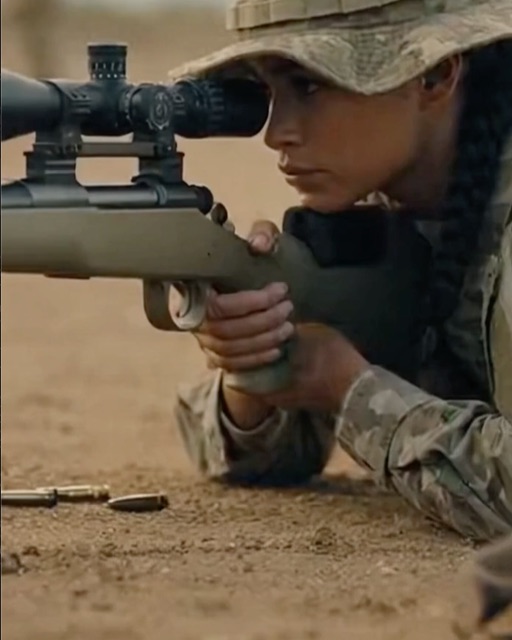
I didn’t argue. No victory grin. No anything. Just safety off, optic up. My hands were steady. My breathing settled into the old count before my brain could catch up.
I climbed to the nearest rooftop, boots slipping on pea gravel slick with dust. The wind shifted across the long lane between the maintenance sheds and the fuel point; I watched the thin flag at the ECP twitch right, right, then flatten. Fading light turned everything into silhouettes with sharp edges.
“TOC, this is Overwatch One,” I said into a borrowed handset. “Eyes on two shooters, southwest wall, behind the busted forklift. PID confirmed. Stand by.”
Static. Then, “Overwatch One, you are green.”
I sunk the stock into bone and let the world compress into glass. The reticle settled. My heart didn’t. It pounded, but in its own metronome. Brass kissed concrete by my right boot with each press, a neat punctuation against the screaming below.
First shot. The forklift silhouette shuddered. One target disappeared.
Silence on net. A breath you could hear in the wire.
Then, movement. A second head rose, inching toward the pinned lane. I rode the wind, corrected, exhaled. Second shot. The medic’s cursing turned into a run.
“Who is that?” someone whispered over the channel, hot-mic and awed.
No answer. Just problems lining up.
A pickup nosed toward the gate, lights off, tail sagging under weight. I didn’t aim at the windshield. I walked the glass left, found the driver’s shoulder behind the pillar, and waited for the brake lights to flare. The moment the red blinked, I pressed. The truck slewed hard, jammed diagonally, and the entry lane sealed like a cork.
“Lane closed,” I said. My voice sounded like someone else’s – flat, calm, not surprised.
Rounds snapped past, ricochets sparking from the rooftop lip. My jaw clenched, but my hands didn’t. I shifted to the long alley behind the motor pool. A shadow hugged the wall, muzzle flash stitching the night. I watched the heat ripple, counted his rhythm – two fast, one slow. On his slow, I sent one. The flash went dark.
“Tower three back up,” another voice yelled, shaky. “We’re clear on the east catwalk.”
“Copy,” I said, already scanning. I tracked smoke spooling from a can tossed too wide. I let it bloom uselessly and stayed patient. Time stretched, then collapsed. You learn not to chase. You let the mistake come to you.
Third target broke cover behind the conex row, sprinting low, rifle high. I didn’t chase. I held the line where he had to cross into open. He hit it. I pressed. He pitched. The net went quiet again.
No cheers. No fist pumps. Just breathing. Just work.
I kept seeing the black-ink words in my file—Not Recommended, Not Assessed, Not Suited—as if they were taped to the inside of the scope cap. “On paper” has no heartbeat. “On paper” doesn’t smell the CLP mixed with smoke. “On paper” doesn’t listen to a medic run out of swearing and start praying under his breath.
Another burst cracked from the far fuel berm, high and desperate. I felt the wind die, the evening go heavier, the light drain one last notch. I bumped the optic, nudged my cheek weld, let the reticle breathe. Fourth press. Brass spun, rang, settled.
“Net, possible last shooter down,” Ops said, tentative now. “Verify.”
I scanned. I waited longer than was comfortable. No movement. No flicker. No sound but distant sirens and the strange quiet that follows panic when people realize they’re still alive.
“Overwatch One, status?”
“Up. Rounds expended, four. Lanes clear. QRF moving.”
The base began to breathe again. Boots pounded. Someone laughed and cut it short, embarrassed. In the glow of the emergency strobes, faces turned up toward my roofline. In the TOC, I imagined screens switching from chaos to a single block of green. I could hear people start to listen through the headset, really listen, as if the net itself had turned to a room where everyone stood perfectly still.
I locked the bolt, safetied the rifle, and handed it back down the ladder to a private with eyes too wide for his face. He looked at the weapon like it had done a magic trick. It hadn’t. It had just told the truth.
The truth is simple: under pressure, you are what you always were.
“Overwatch One,” a new voice came on, clipped and formal, the kind you only hear when the room goes full brass. “Stand by for higher.”
I froze—not in fear, but in that brief stillness before a shot breaks. I knew that voice. I remembered it from a conference room with bad coffee and a stack of forms with boxes too small to fit a person.
“Overwatch One, this is higher,” he said, each word careful. I could hear paper sliding, a chair creak, a headset adjust. “Please state your name for the record.”
I pressed the ear cup tighter, felt the grit under my cheek, and tasted metal on the back of my tongue. The entire net seemed to lean in.
Because the man asking was the one who stamped DENIED on my file—twice—and now the whole base was waiting to hear what he would say next.
I took a breath. A real one this time. Not for a shot, but for me.
“This is Corporal Dunn, sir,” I said.
The silence that followed was heavier than the gunfire had been. It wasn’t static. It was held breath. Dozens of them. On the channel, I could hear someone mutter my name, Dunn, like they were trying to place it.
Then, Major Hayes’s voice came back, strained, tight. “Corporal Dunn. Report to the TOC. Now.”
The line clicked dead. No ‘thank you.’ No ‘good job.’ Just a summons.
I climbed down the ladder, my knees feeling watery for the first time all night. The private who took the rifle was still there, staring. Staff Sergeant Miller, the man who’d tossed it to me, just nodded once, his face grim. He knew who Hayes was. He knew what this meant.
My walk across the motor pool felt like a mile. The chaos was being organized now. Medics were working under portable lights. The fire on the utility truck was out, leaving a black, skeletal hulk that smelled of burnt rubber and chemicals. I passed the Jersey barrier where the pinned medic had been. A young soldier, probably not even twenty, was sitting on an ammo can getting his arm bandaged.
He looked up as I passed, his eyes locking on mine. He didn’t know who I was, not really. But someone must have pointed up at the roof. He gave a short, sharp nod, a gesture of thanks so profound it almost buckled my legs.
I just nodded back and kept walking.
The TOC was a hive of controlled energy. The air was thick with the smell of sweat and hot electronics. Screens glowed with maps and status reports, all of them now flashing green. When I pushed through the door, the low murmur of conversation stopped. Every single head turned.
They weren’t looking at a hero. They were looking at a ghost. Corporal Dunn from maintenance. The quiet one who kept the generators running. The one who had washed out of selection. Twice.
Major Hayes stood in the center of the room, by the main tactical plot. He was a tall man, built like a fire hydrant, with a face that looked like it had been carved from granite and left out in the rain. His eyes, cold and gray, found me and held me in place.
“Clear the room,” he said, his voice a low rumble. He never took his eyes off me.
Operators and analysts filed out, some glancing at me with curiosity, others with a dawning respect. The door clicked shut, leaving just the two of us and the hum of the servers.
He gestured to a chair. I didn’t take it. I stood at attention, my posture straight, my gaze fixed on the wall just over his shoulder. It was the only way I knew how to handle this.
“You have any idea what you did tonight, Corporal?” he asked. His tone wasn’t angry. It was something else. Something I couldn’t place.
“I responded to the threat, sir,” I said, my voice level.
“You responded to the threat,” he repeated, walking a slow circle around me. “Four hostiles neutralized. An armored vehicle disabled, blocking the main ECP. You single-handedly broke the back of a complex attack. With four rounds.”
He stopped in front of me again. “Four rounds, Dunn. The QRF expended four hundred and didn’t have a single confirmed hit before you came on the net.”
I remained silent. There was nothing to say. The facts were the facts.
He sighed, a heavy, tired sound. He finally broke eye contact and stared at the tactical map. “I read your file again. Both of them. It says you can’t hump the required weight. It says your five-mile run time is thirty seconds outside the required parameter. It says you failed the stress-shoot portion because you were too slow. Too methodical.”
He turned back to me, and for the first time, I saw a crack in his granite face. It was a flicker of something that looked a lot like regret.
“I was the one who added that last comment, Dunn. ‘Too methodical.’ I wrote that. I watched you on the range. Everyone else was running and gunning, speed and aggression. You weren’t. You took your time. You waited. You let the targets present themselves perfectly before you engaged. You passed, but you were slow. And in this line of work, slow gets you killed.”
He paused, letting his words hang in the air. “That’s what I thought, anyway.”
This was the twist I never saw coming. It wasn’t about my size or my speed. It was about his philosophy. His doctrine.
“Sir, with all due respect,” I started, my voice quiet but firm. “Speed is fine for a fair fight. Tonight wasn’t a fair fight. They had us pinned. They had the initiative. Rushing in would have just added to the body count.”
“My methods may be slow,” I continued, finally meeting his gaze. “But they are certain. I don’t miss.”
Major Hayes stared at me, his jaw working. I could see a battle being fought behind his eyes. He was a man who had built his entire career on a certain set of rules, and I had just proven them all wrong.
“I had a soldier,” he said, his voice suddenly soft, distant. “Five years ago. Sergeant Evans. He was like you in some ways. Didn’t fit the mold. A thinker, not a rusher. Brilliant marksman. I pushed him. I told him he needed to be faster, more aggressive. To fit in with the team.”
He looked down at his hands. “We were on an operation. Pinned down in a narrow street. He did what I taught him. He pushed hard, fast. He ran to a new position to get a better angle. He was fast. But the enemy was waiting for fast.”
The silence in the room was absolute.
“He never got to take the shot,” Hayes finished, his voice raw. “They got him on the move. I’ve carried that ever since. I see someone who doesn’t fit the pattern, someone who thinks differently… and I get scared. I see Evans.”
He looked up at me, his eyes filled with a pain that had nothing to do with tonight. “I didn’t reject you because I thought you were incapable, Dunn. I rejected you because you reminded me of my greatest failure. I saw your methodical approach and called it a weakness because I was too afraid to admit it might be a strength. The one I told Evans to abandon.”
The admission hit me harder than any bullet. My entire career, my self-doubt, the red stamps on my file—it was all because of a ghost. Because of a man’s fear and his misplaced guilt.
A part of me wanted to be angry. But looking at him, all I felt was a strange, sad sort of understanding.
“Sir,” I said. “You didn’t fail Sergeant Evans. His loss was a tragedy of circumstance. But tonight, you almost failed the men out there by holding on to that tragedy. You almost failed me.”
He flinched, but he nodded. “I know.”
“The men in Tower Three are alive because I was patient,” I said. “The medic is alive because I waited for the perfect moment. The QRF, the team I wasn’t good enough to join, is alive because I was too slow.”
I let that sink in.
“Your file says you’re not suited for this team,” Major Hayes said, his voice finding its command tone again, but changed. Different. “You’re right. It was wrong.”
He walked over to his desk, picked up a pen, and pulled a hard copy of a roster from a folder. He drew a hard, black line through a name. Then, in the empty space, he wrote mine.
“No,” he said, looking at what he wrote. He scribbled it out.
My heart sank. For a moment, I thought he was going to change his mind.
He tore off a fresh sheet of paper from a notepad. “Putting you on the team isn’t the right move. That’s forcing a square peg into a round hole. That’s what I tried to do with Evans. It’s what I did to you.”
He started writing again, sketching out a diagram, a new box on the command structure.
“Tonight, this base didn’t need another operator to run and gun. It needed an eye. It needed a scalpel. It needed someone who could see the whole problem and solve it with four precise actions.”
He turned the notepad around. It was a new position, one that had never existed on this base. Designated Marksman, Overwatch. Reporting directly to the TOC. My name was at the top.
“I’m not giving you a slot, Corporal Dunn,” he said. “I’m creating one for you. We’re going to build this position around your skills. Not the other way around. You’ll write the doctrine. You’ll define the role.”
I was speechless. This was more than an apology. This was validation. This was a chance to build something new, to turn my supposed weakness into an official strength.
The door to the TOC opened. It was the young medic, his arm in a sling, his face pale but determined. He walked straight up to me, ignoring the Major completely.
“You’re Dunn?” he asked, his voice thick with emotion.
“Yes.”
“My name is Corbin,” he said, sticking out his good hand. “I was the one behind that barrier. I thought I was dead. My wife’s name… I was saying my wife’s name. Then… silence. Thank you. That’s all. Just… thank you.”
I shook his hand. It was warm and real.
That’s when I understood. It was never about the file. It was never about the run times or the weight I could carry. It wasn’t even about Major Hayes and his ghosts. It was about the person on the other end of the radio, the one praying behind a concrete barrier.
In the end, our worth isn’t defined by the boxes others try to put us in, or the tests we are told we must pass. It’s defined by what we do when the sirens blare and everything goes red. It’s measured not by our speed, but by our impact. And sometimes, the slowest, most methodical path is the one that saves everyone.