I’ve worked at Fort Helios for eleven years. Eleven years of pushing a cart nobody looks at, fixing things nobody notices are broken, clocking in before the sun and clocking out after the guards change shift. My name is Rena Collins. You wouldn’t remember it if I told you twice.
I clean the drainage grates along the east perimeter. I replace filters in the ventilation units near the airstrip. I patch fencing. I haul chemical waste drums to the designated lot behind Building 9. I do it all in the same pair of coveralls I’ve had since 2016, faded so thin you can almost see through the elbows.
Nobody talks to me. Nobody has to.
That’s the deal when you’re contracted maintenance at a naval installation. You exist on paper and nowhere else. The officers look through you. The enlisted guys nod sometimes, but it’s the kind of nod you give a vending machine – acknowledgment without awareness.
I was fine with that.
Until Tuesday.
I had a work order for the K-9 compound. Routine stuff – a busted latch on one of the exterior kennel gates, a drainage issue near the training yard. I’d been there before, maybe twice, always during off-hours when the dogs were crated.
This time, I came during active training.
I didn’t think anything of it. I pushed my cart through the main gate, head down, same as always. The compound was alive – handlers running drills, dogs cycling through detection exercises, a couple of Malinois doing bite work on padded sleeves.
I made it maybe fifteen steps past the threshold.
Then everything went quiet.
Not gradually. Not like a conversation winding down. It was like someone hit mute on the whole world.
I looked up.
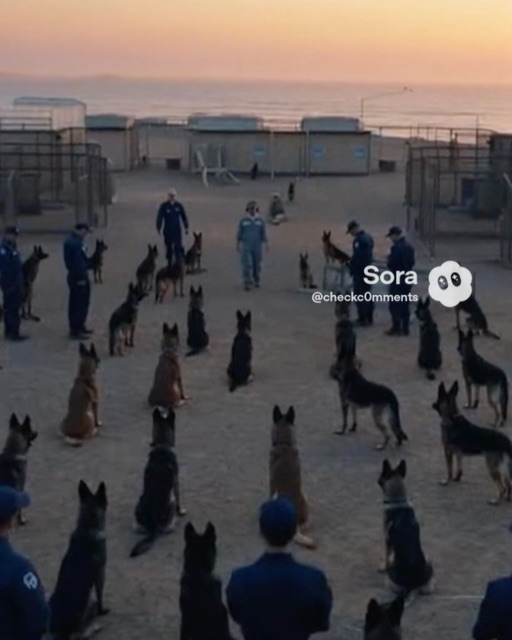
Forty-seven dogs were staring at me.
Every single one. The ones mid-sprint had stopped dead. The ones on leash had turned so hard their handlers stumbled. The ones in the detection lane abandoned the scent boxes entirely. Two shepherds who’d been locked in a dominance scuffle just… separated. Sat down. Faced me.
Their ears were forward. Not flattened—not aggressive. Forward. Alert. The way a dog looks when it hears its owner’s car three blocks away.
I froze.
A handler named Terrence—big guy, been running the Malinois unit for six years—shouted a correction. “Nero, HEEL.” Sharp. Loud. The kind of voice that snaps a military dog back to center in half a second.
Nero didn’t move.
None of them did.
Terrence tried again. Another handler joined in. Then a third. Commands flying from every direction—heel, sit, down, come, leave it—and not a single animal responded. They just sat there, locked onto me like I was the only signal in the room.
My heart was hammering so hard I could feel it in my teeth.
I didn’t know what to do. I wasn’t trained for this. I fix drains. I replace hinges. I am not a dog person. I don’t have a dog. I’ve never had a dog.
But something in my body knew what to do before my brain caught up.
I lowered my right hand. Two fingers down. Palm inward. Wrist loose.
Every dog sat.
In unison.
Perfect sits. Textbook. The kind of synchronized response handlers train for months to achieve and rarely get from more than three animals at once.
Forty-seven dogs. One gesture.
The compound went so silent I could hear the ocean.
Terrence walked toward me slowly. His face wasn’t angry anymore. It was something else. Something I couldn’t read. He stopped about four feet away and looked at me like he was seeing me for the first time.
“Who are you?” he asked.
“Maintenance,” I said. “I’m here for the gate latch.”
He shook his head. “No. Who are you? Because I’ve been handling military working dogs for fifteen years, and I have never seen anything like that. Not once. Not from anyone.”
I didn’t have an answer.
But someone else did.
An hour later, I was sitting in a windowless office in Building 2. Across from me was a woman in dress blues I’d never seen before. She had a file open on the table. My file. Except it was thicker than any maintenance worker’s file should be.
She slid a photograph across the table.
It was old. Creased. Black and white.
A woman in military fatigues, standing in a field surrounded by dogs. German Shepherds. At least thirty of them. She wasn’t holding a leash. She wasn’t giving a command. She was just standing there, and every dog was oriented toward her like she was magnetic north.
The woman in the photo looked exactly like me.
I turned it over. On the back, in faded pencil, someone had written a name, a rank, and a program designation I’d never heard of.
The officer across the table closed the file and folded her hands.
“Ms. Collins,” she said, “your mother didn’t work in maintenance.”
My mouth went dry.
“She was the architect of something we shut down in 1987. Something we were told could never resurface.” She paused. “We were wrong.”
I looked at the photograph again. Then back at her.
“What program?” I asked.
She leaned forward. Her voice dropped to barely above a whisper.
“The one your mother designed to create people exactly like you. People the dogs would always choose. No matter what.”
She opened a second file. This one was stamped in red.
I read the first line and my hands started shaking.
Because it wasn’t a program file.
It was a birth certificate.
And the name on it wasn’t Rena Collins.
The name on it was Subject Gamma.
I stared at the black ink. Subject Gamma. Not a name. A label. A piece of an experiment.
The officer’s name was Captain Rostova. She watched me, her eyes missing nothing.
“My name is Rena,” I whispered. My voice didn’t sound like my own.
“That’s the name you were given,” she corrected softly. “Not the one you were assigned.”
She began to talk. The story she told felt like it belonged to someone else, a plot from a movie I’d never watch.
The program was called Project Shepherd. Its goal was to create a human who could communicate with canines on a primal level. Not through training. Through instinct.
They didn’t want a handler. They wanted an Alpha.
My mother, Dr. Elena Volkov, was the lead scientist. A genius in genetics and animal behavior. She believed there was a latent biological key, a specific genetic sequence that could bridge the gap between man and beast.
She found it. And then she used it.
The project was controversial from the start. Taking orphaned children, altering them, raising them in controlled environments with only canine contact for their first few years.
Most of the subjects showed minor results. A slightly better rapport with animals. An intuitive sense of a dog’s mood.
But I was different. I was Subject Gamma. Her final, and only successful, creation.
Her daughter.
The word hung in the sterile air of the office. Daughter. Not a subject. A daughter.
“The project was shut down,” Captain Rostova continued. “A congressional committee deemed it unethical. A monumental overreach. Records were sealed. The children were placed in specialized foster care, their memories of the program allowed to fade.”
All except one.
“Your mother couldn’t let you go,” she said. “She saw what she had made. Not a weapon. Not an asset. She saw you.”
So my mother ran.
She took me, her three-year-old daughter who understood dogs better than people, and disappeared. She created new identities. Rena Collins. A quiet woman who worked with her hands. She built a life of invisibility.
And the safest place to hide a secret of the U.S. military?
Inside the U.S. military.
She got a maintenance contract here, at Fort Helios. She raised me in a small apartment off-base. She taught me to be quiet. To be unnoticed. To never, ever go near dogs.
I thought she was just afraid of them. I never knew she was afraid for me.
She died seven years ago. A sudden sickness that took her fast. I thought I was alone. I took over her contract because it was the only thing I knew how to do.
It was her final hiding place for me.
“We lost track of her in ’89,” Rostova said, tapping the file. “We assumed she’d left the country. We never thought to look under our own noses.”
“Why are you telling me this now?” I asked, my voice finally steady.
Rostova’s expression shifted. The professional mask hardened. “Because Project Shepherd is no longer history, Ms. Collins. You made it current events. What you did today… that’s the holy grail of military K-9 operations. A non-verbal, mass-control event.”
She leaned in again. “We want to know how you did it.”
I shook my head. “I didn’t do anything. I just… stood there.”
“Exactly.” A thin smile touched her lips. “We want to study you. To understand the mechanism. To see if it can be replicated.”
My blood ran cold. Replicated. Studied. I wasn’t Rena Collins, maintenance worker. I was Subject Gamma, a thing to be taken apart and examined.
The next few days were a blur. I was moved from my small apartment to a room on the base. A comfortable room, but a room with a guard outside the door.
I wasn’t a prisoner, they said. I was a guest.
Terrence, the handler, came to see me. He looked uncomfortable in the small, formal room.
“They’re going crazy down at the compound,” he said, not meeting my eye. “The brass. All these scientists in lab coats showing up.”
“They want to run tests,” I said flatly.
He finally looked at me. There was a deep conflict in his eyes. He was a man who followed orders, but he was also a man who understood dogs.
“The animals are different since you were there,” he said. “Quieter. Watching. It’s like they’re all waiting for something.”
He cleared his throat. “I saw the way Nero looked at you. I’ve had him since he was a pup. He’s never looked at anyone like that. Not even me.”
There was no jealousy in his voice. Only awe.
“It wasn’t about control, was it?” he asked quietly. “When you made them sit.”
I thought about it. The feeling in that moment. It wasn’t a command. It was… a request. A thought that I didn’t even know I was having. Be still. It’s okay. Be calm.
“No,” I said. “It wasn’t control.”
Captain Rostova had other ideas. She brought me to a specialized training facility a few miles inland. It was a sterile, concrete place that smelled of disinfectant.
She wanted to see it again.
They brought in five dogs, all shepherds. They were on edge, unused to the environment. Their handlers stood by nervously.
“Show us,” Rostova said from behind a pane of reinforced glass.
I stood in the center of the room. The dogs paced, whining, their eyes darting everywhere. They felt wrong. The air was wrong. Everything was wrong.
I could feel their anxiety like a physical hum in my own body.
I didn’t know what to do. The simple hand gesture felt fake now, a parlor trick.
“I can’t,” I said, my voice small.
“Try,” Rostova’s voice came through a speaker. Hard. Unyielding.
I raised my hand. I tried to replicate the gesture from the compound. Nothing. The dogs ignored me completely, their stress escalating. One started to bark, a high, frantic sound that set the others off.
The handlers moved in to regain control. The test was a failure.
I was taken back to my room. I could feel Rostova’s disappointment like a cold draft under the door.
That night, something changed. I wasn’t just a curiosity anymore. I was a disappointment. An asset that wasn’t performing. The tone of the guards outside my door became less friendly.
Two days later, Terrence showed up again. He looked worried.
“Rostova’s bringing in someone new,” he said in a low voice. “Her father was General Maddock. The man who shut down the original project. She’s been trying to prove him wrong her whole career.”
That’s when I understood. This wasn’t just professional for her. It was personal. She needed me to be the weapon her father refused to see.
“She thinks you’re holding back,” Terrence went on. “She thinks you need… motivation.”
The next morning, I was taken not to the lab, but back to the K-9 compound. But it was different. It was empty. All the dogs were gone.
Except one.
Nero, Terrence’s Malinois, was in the center of the training yard. He was alone, and he was agitated. He kept looking toward the main gate.
“A simple test,” Rostova said, standing beside me. “There is a simulated threat on the other side of that fence. We want you to send Nero to neutralize it.”
“I don’t know how,” I said, my heart starting to pound.
“I think you do,” she replied coolly. “You just need to focus.”
I looked at Nero. I could feel his distress, his conflict. He wanted to obey, to respond to the perceived threat, but something was holding him back. He was looking for Terrence. His anchor.
“Where is Terrence?” I asked.
Rostova didn’t answer. A screen flickered to life nearby. It showed a live feed of a small, concrete room.
Terrence was sitting on a chair inside.
“The ‘threat’ is a series of loud noises and flashing lights outside that room,” Rostova explained calmly. “But Nero doesn’t know that. All he’ll know is that his handler is in a room, and a threat is approaching it. We need you to give him the command to engage.”
She was manufacturing a crisis. Using the bond between a man and his dog to force my hand.
I looked at Nero. His ears were flat now. A low growl rumbled in his chest. His fear and aggression were a hot spike in my mind.
“No,” I said.
Rostova’s eyes narrowed. “This is a matter of national security, Ms. Collins. You are an asset. You will perform.”
“He’s not a tool,” I said, my voice shaking with a sudden, unfamiliar anger. “And neither am I.”
I focused on Nero. Not on commanding him. On reaching him. I didn’t push a thought of attack. I pushed a feeling.
Peace. Your friend is safe. There is no danger. Be still.
Nero stopped growling. He whined once, shook his head, and then lay down, placing his head on his paws, facing me. He let out a long sigh. The tension in the yard evaporated.
Rostova was speechless. Her perfect experiment, her leverage, had just been dismantled by a feeling.
Her face twisted into a mask of pure fury. “Fine. If you won’t be a part of the solution, you’ll be removed from the equation.”
Before I could react, an alarm blared across the base. A real one. A voice over the intercom shouted about a chemical leak in Storage Building 9. My building. The place I hauled waste drums to.
The K-9 compound was directly downwind.
Suddenly, this wasn’t a test. Handlers came running from the barracks, shouting, trying to get to the kennels. But the wind was already shifting. A faint, acrid smell touched the air.
Panic erupted. The handlers were trying to get the dogs evacuated, but the animals were already reacting to the alarms and the fear in the air. They were barking, fighting leashes, refusing to enter transport crates. It was chaos.
Rostova was frozen, her manufactured crisis replaced by a real one she had no answer for.
But I did.
I didn’t think. I just walked. I walked past her, past the frantic handlers, and into the heart of the chaos.
I didn’t say a word. I didn’t make a gesture.
I just let go.
I let go of the fear, the anger, the confusion. I let the part of me that was Subject Gamma, the part that was my mother’s legacy, come to the surface. I let the feeling I had given Nero wash over the entire compound.
We are a pack. I am here. You are safe. Follow me.
One by one, the dogs fell silent. They turned their heads. Forty-seven pairs of eyes locked onto me. They rose to their feet and began to move.
They formed a silent, orderly procession behind me. Shepherds, Malinois, Labradors, all walking calmly at my heels as if we were on a morning stroll.
The handlers stared, their mouths open. Terrence, who had been released in the confusion, just watched with tears in his eyes.
I led them away from the compound, away from the plume of gas, toward the safety of the airstrip on the far side of the base. We moved as one. A woman in faded coveralls and her pack.
An old, black car screeched to a halt in our path. An Admiral stepped out, his face grim. He was the highest-ranking officer on the base. I recognized him from his official portrait.
He looked at the column of dogs. He looked at me. His eyes weren’t angry. They were filled with a strange, ancient kind of recognition.
He looked at Rostova, who had followed us. “What is this, Captain?”
“It’s the program, sir,” she said, her voice strained. “It works. She’s the key.”
The Admiral shook his head slowly. He walked toward me, stopping a few feet away. The dogs didn’t stir.
“I was there when we shut down Project Shepherd,” he said, his voice raspy with age. “I was a young Lieutenant. I read every file. I listened to every testimony.”
He looked me right in the eye. “Dr. Volkov wasn’t trying to create a weapon. Everyone thought she was. But her final report… she said she wasn’t creating an Alpha. She was proving that empathy was a universal language.”
He glanced at the dogs, then back at me. “She wasn’t trying to give a human the ability to control dogs. She was trying to give a human the ability to understand them. To connect. We were the ones who wanted to twist it into a tool for war.”
He turned to Rostova, his voice dropping like iron. “You, like your father before you, saw only the potential for control. You both missed the entire point. You’re relieved of your duties, Captain.”
He then looked at me. For the first time, someone wasn’t looking at a maintenance worker or a science experiment. He was just looking at me.
“What do you want, Ms. Collins?” he asked.
It was the first time anyone had asked me that.
I looked at the dogs. At Nero, who sat faithfully by my side. At Terrence, who gave me a small, hopeful nod.
“I want to stay,” I said. “I want to work with them. Not to command them. To help.”
And so I did.
My name is Rena Collins. I work at the K-9 compound at Fort Helios. I don’t push a cart anymore.
I help Terrence and the other handlers build new training programs, ones based on listening to the animals, not just shouting orders at them. I help the base vets understand behavioral problems. I sit with the dogs who have come back from deployments, the ones who carry wounds you can’t see, and I offer them a quiet place to rest their heads.
I am not an asset. I am not a subject.
I am the person the dogs chose.
My mother didn’t hide me from the world; she preserved me for it. She gave me a quiet life so that when the time came, my gift wouldn’t be a shout, but a whisper. It wasn’t a power to be wielded, but a connection to be shared.
I learned that your true identity is not a name on a file or a job you perform. It’s found in the silent, trusting gaze of another living being. It’s the purpose you discover not by being what others want you to be, but by finally, truly, becoming yourself.