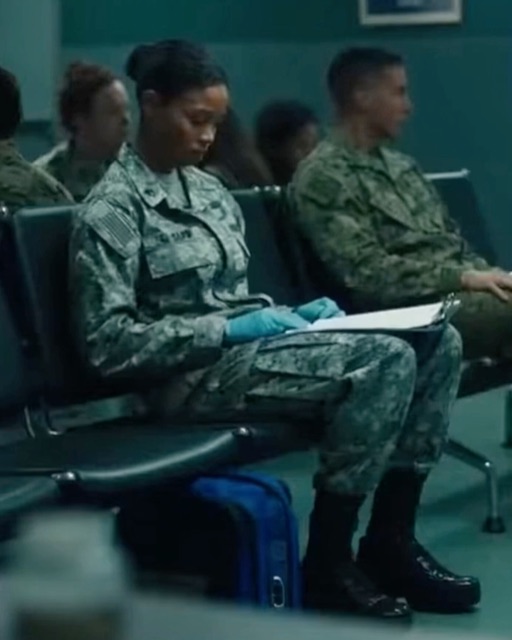
The waiting room felt like a morgue with a drip coffee pot. Forty-two men, one me. Hospital Corpsman First Class Sloan K. Barrett. Five-foot-three, hair yanked back so tight my thoughts squeaked.
I’d spent three years learning how to disappear in plain sight. Then the Navy dropped an email like a hammer: MANDATORY MED READINESS – PHYSICAL EVALUATION.
The doors hissed. I didn’t look. I felt it – air tightening, conversation dying mid-brag.
Admiral Morrison.
“Sloan.” My name in his mouth didn’t feel like mine. I stood, textbook posture, hands steady that weren’t.
“I need a word,” he said, steering me to the corner by a vending machine that sold warm soda and stale Pop-Tarts.
“You’ve dodged medical for thirty-seven months,” he murmured. “Your file reads like Swiss cheese. No teenage records. No vaccinations. You just – appear.”
“I was homeschooled, sir.” Lie. It tasted like pennies.
His gaze slid to my collar. To the place my blouse always hid. “Take the exam. Let Reynolds see it. Then we’ll talk about a hollow in West Virginia that isn’t on any map anymore… and a girl named Emily.”
Something inside me flinched so hard I saw white. “I don’t know—”
“You do. You took a round for her. And I need to know why her father is still looking for the body.”
They called my name. Cold room. Bright lights. Commander Reynolds lifted a brow like, finally.
I unbuttoned. Shirt. Undershirt.
Silence hit the floor before his pen did.
“My God,” he breathed. “That’s not surgery. That’s 7.62, kitchen-table medicine. Who patched you?”
The door opened. The Admiral looked once and went gray.
“It’s her,” he said, like a guilty prayer.
“It wasn’t a battlefield,” I heard myself say. “It was a kitchen.”
And just like that, the walls I’d bricked up for thirteen years cracked. I could smell it again—burnt coffee, bleach, wet gravel. The clock over the stove ticked like a bomb. My little brother’s cereal bowl spun on the linoleum. Somebody was shouting outside.
The doorknob rattled. The back door swung.
Boots stepped in, tracking coal dust across my mother’s clean floor. The rifle’s muzzle found my chest, and the man with it leaned forward and called me by a name I’ve never used… and when I saw his face, my heart stopped.
It was a face I’d only seen in a faded, creased photograph my mother kept in a biscuit tin. A face she’d told me to run from.
My father.
He didn’t look like a father. He looked like something carved from mine rock and fury.
His eyes, chips of cold slate, weren’t looking at me. They were looking through me, searching for something else.
“Where is she, Emily?” he growled.
That name again. The name the Admiral used. The name of my mother.
My own name, Sloan, got caught in my throat.
Behind me, I heard a tiny gasp. My little brother, Theo, all of six years old, with eyes as wide as his dropped cereal bowl. And next to him, a girl a few years older than me, with hair the color of corn silk and a terror in her eyes I recognized from the mirror.
The Admiral’s daughter, Emily. My friend.
She’d shown up on our doorstep a week before, running from a father she called a tyrant, a man who wanted to ship her off to some fancy boarding school across the ocean.
My mother, who never turned away a stray, had taken her in.
“I’m not her,” I managed to say, my voice a thin thread. I tried to make my body bigger, a shield for the two kids behind me.
My father laughed, a sound like rocks grinding together. “Don’t play games. I know you’re here. Your little girl looks just like you.”
His gaze flickered over my shoulder to Theo. My blood ran cold. He thought Theo was my son. He thought I was my own mother.
He’d been gone that long. He didn’t even recognize his own daughter.
“Get the boy,” he ordered, gesturing with the rifle. “We’re leaving.”
“No,” I said. The word was small, but it filled the whole kitchen.
I saw the flicker of surprise in his eyes. He wasn’t used to being told no.
Theo started to cry, a soft, hiccuping sound.
“Get behind me,” I whispered to him and Emily. I nudged them toward the pantry, toward the loose floorboard that led to the old root cellar. It was our secret place.
My father took a step forward. The smell of stale whiskey and damp earth rolled off him.
“I said, get the boy.”
“He’s not going with you,” I said, planting my feet. My heart was a drum against my ribs, a frantic, wild thing.
This man was a ghost, a bedtime story meant to scare me. Now he was real, and he wanted to take the only thing I had left in the world.
Emily, bless her, understood. She grabbed Theo’s hand and tugged him back, her own fear forgotten for a moment.
The floorboard creaked.
My father’s head snapped toward the sound. His eyes narrowed.
“What’s that?”
“Nothing,” I said, too quickly. “It’s an old house.”
I needed to keep his attention on me. Just a few more seconds. Just long enough for them to get down into the dark.
“You always were a liar, Emily,” he snarled, raising the rifle. The barrel was a perfect, black circle. A full stop at the end of a sentence.
I braced myself.
The blast was louder than I could have imagined. It wasn’t like in the movies. It was a physical thing, a punch that threw me backward.
I didn’t feel pain at first. Just a shocking, hot wetness spreading across my chest.
My head hit the linoleum. The spinning cereal bowl came into focus. Then the dust motes dancing in the morning light.
I heard his boots moving away. The back door slammed shut. He was gone. He thought he’d gotten what he came for.
Silence. Then a muffled sob from under the floor.
“Sloan?” Emily’s voice was a ghost.
“Go,” I rasped. Blood filled my mouth, tasting of rust. “Get Theo out. Go out the back way. Run.”
“But you—”
“Run!”
I heard scrambling, the sound of their escape. Good. That was good.
Then the darkness started to creep in from the edges of my vision.
The next thing I remember is a face, wrinkled and kind. Old Martha from down the hollow. She’d been a nurse in a war I’d only read about in books.
She smelled of mothballs and chamomile tea.
“Hold still, child,” she’d murmured, her hands surprisingly strong as she packed the wound with clean rags. “Lord have mercy, what did he do to you?”
She saved my life on that kitchen table, with a bottle of bourbon for antiseptic and a sewing needle for stitches. She was the one who said, “The man who did this will come back. You can’t be Sloan Barrett anymore.”
So I wasn’t.
I took what little money Mom had saved, took a bus as far as it would go. When I turned eighteen, I walked into a recruitment office. The Navy gave me a new life, a uniform to hide in. I became a corpsman. I learned how to fix people because I couldn’t fix myself.
Now, in this sterile exam room, it all came rushing back.
Admiral Morrison stared at the jagged, puckered scar that traversed my chest. His face was a mask of grief and something else. Guilt.
“I was a fool,” he said, his voice thick. “I was so wrapped up in my own investigation, my own anger at my daughter.”
He looked at me, his eyes pleading for an understanding I didn’t have to give.
“I was a Rear Admiral back then, assigned to a domestic task force. We were tracking a dealer moving product through those mountains. Your… your father, Caleb, was on our radar. We thought he was just a mid-level player.”
He ran a hand over his face. “My daughter, Emily, was rebelling. She hated me, hated the Navy, hated the structure. She ran away. All my intel, all my resources, pointed to her hiding out in that hollow. Hiding with you.”
Commander Reynolds had the decency to look away, giving us the illusion of privacy.
“When we found the house,” the Admiral continued, “it was empty. Blood on the floor. Signs of a struggle. We assumed Caleb had found out who she was, that he’d taken her as leverage against me. We searched for years. We never found a body. I always held out hope.”
He finally looked me in the eye. “I thought you were her. I saw your file, the West Virginia connection, the missing years. I thought you’d survived and taken a new name to hide from me, from your past. When I saw that scar… I was sure. I thought he’d shot my little girl.”
The pieces clicked into place, but they formed the wrong picture. He’d built an entire narrative around a mistake.
“Sir,” I said, and my voice was steady for the first time all day. “Your daughter’s name is Emily Morrison.”
He nodded slowly. “Yes.”
“My mother’s name,” I said, pulling my undershirt back on, covering the past, “was Emily Barrett.”
The Admiral stared at me. The color drained from his face again, leaving his skin looking like old parchment.
“The man who came to our house that day wasn’t a meth dealer you were hunting. He was Caleb Barrett. My father. He hadn’t seen me since I was a toddler. He didn’t recognize me.”
I took a breath. “He thought I was my mother. He called out her name. He was there to take his children, me and my little brother, Theo.”
“My God,” the Admiral whispered.
“Your Emily was there,” I confirmed. “She was my friend. She was scared of you, sir. Not of him. When he came in, I hid her and Theo in our root cellar. I stood between them and my father’s rifle.”
The truth hung in the air of that cold room, heavy and absolute.
“You took a bullet meant for your mother… to save my daughter?” His voice cracked.
“I took a bullet to save my brother,” I corrected him gently. “And my friend. It didn’t matter whose daughter she was.”
For a long moment, the Admiral just stood there, a powerful man completely undone by a truth he’d never considered. He had been hunting a monster, but he’d been looking in the wrong story.
He finally sank onto a small stool, the crisp uniform seeming to wilt around him. “All these years,” he said to the floor. “I blamed myself for her running away. I thought my job, my life, had put her in danger. I never once thought…”
He looked up, and the authority was gone from his eyes. In its place was a deep, profound sorrow and a sliver of gratitude that was almost painful to look at.
“What happened to him? Your father?”
“I don’t know, sir,” I said honestly. “He left me for dead. I never saw him again.”
“And your brother? Theo?”
The name was a punch to the gut. I squeezed my eyes shut. “Old Martha, the woman who patched me up, she called social services after I was gone. She told me later they’d found him hiding in the cellar. He went into the system. I was a minor, wanted for nothing, running for my life. I couldn’t go back for him. I told myself I’d find him when I was strong enough, when I had something to offer him.”
It was the shame I’d carried every single day. The secret failure that fueled every success.
The Admiral stood up. The authority was back, but it was different now. It was focused. Purposeful.
“Commander Reynolds,” he said, his voice ringing with command. “Clear my schedule for the rest of the week. Get me a secure line to the Director of Health and Human Services. And get me everything you can find on the whereabouts of a Caleb Barrett, last seen in Mingo County, West Virginia, thirteen years ago.”
He turned back to me. “Petty Officer Barrett. You are no longer hiding. Your service record is about to be updated. It will reflect the truth. And we are going to find your brother.”
The next few days were a blur. The Admiral was true to his word. He moved with the kind of speed and power I’d only ever seen from a distance.
He told me they found my father’s records. He’d died in a prison fight five years ago, serving time for an unrelated charge. A part of me that I didn’t know was still scared finally uncoiled.
Then, two days later, the Admiral called me to his office.
There was a laptop on his desk, open to a video call. A woman with familiar corn-silk hair, older now, with laugh lines around her eyes, smiled hesitantly from the screen.
“Sloan?” the real Emily Morrison asked.
Tears sprang to my eyes. “Emily.”
“My dad told me everything,” she said, her voice thick with emotion. “I… I never knew. I just ran, like you told me to. I was so scared. I thought he’d killed you. Sloan, I am so, so sorry.”
“You have nothing to be sorry for,” I told her, and I meant it.
“I do,” she insisted. “I let you carry that all by yourself. But I’m going to help fix it. I’ve already given my official statement. You saved my life.”
We talked for an hour, filling in the gaps of thirteen years. She was a painter in Oregon, married, with a daughter of her own. She had the life she was supposed to. A life I’d helped her have.
The day after that, the Admiral drove me to a plain-looking building two hours from the base. It was a group home.
My hands were shaking so badly I had to clench them in my lap.
We were led into a small, quiet room. A few minutes later, the door opened.
A young man walked in. He was tall, lanky, with my mother’s dark hair and the same wide, curious eyes I remembered. He was nineteen.
He looked from the Admiral to me, confused.
“Theo?” I whispered.
His brow furrowed. He looked at me, really looked at me, and a flicker of something ancient, something buried deep, sparked in his memory.
“Sloan?” he asked, the name sounding foreign on his tongue. “Is that… is that really you?”
I couldn’t speak. I just nodded, tears streaming down my face.
He crossed the room in two strides and wrapped his arms around me. He was all sharp angles and surprising strength, but I could feel the little six-year-old boy I’d shielded with my body.
“I thought you were dead,” he sobbed into my shoulder. “They told me you were gone.”
“I’m here,” I cried, holding him as tight as I could. “I’m here, and I’m never leaving you again.”
We stayed like that for a long time, two broken pieces of a family finally clicking back into place.
The Navy didn’t discharge me. Instead, my file was sealed and my record was decorated. The Admiral saw to it. He saw the hollow in my file not as a deception, but as a testament to survival.
The scar was no longer something I had to hide under layers of uniform. It was a map. It was the story of how I’d saved my brother and his daughter. It was proof that I had been there, that I had fought.
My life had been defined by what I ran from. My father. My past. My name. But standing there, with my brother’s arm around my shoulder, I realized I’d been running toward something all along. I was running toward this. A moment of truth. A chance to heal.
Sometimes, the deepest wounds aren’t the ones that leave a scar on your skin, but the ones that mark your soul. Hiding them doesn’t make them go away. It just gives them more power. The only way to truly be free is to face the past, to own your story, and to let the light in to all the broken places. My name is Sloan K. Barrett, and for the first time in a very long time, I was no longer hiding. I was finally home.