My father’s retirement ceremony smelled like floor wax, white roses, and money.
Not fresh money. Old money. The kind that sits in committee rooms, signs defense contracts, and pretends it has never gotten blood on its cuffs.
I sat in the back corner of the Fort Myer Officers Club ballroom with a short glass of Jim Beam and my old field jacket folded over the chair beside me. The jacket still held the faint smell of gun oil, smoke, and the dust of a valley I had spent seven years trying not to dream about.
Around me, polished officers in dress blues and women in jewel-colored gowns moved through the room with the easy confidence of people who had never had to fight to stay visible. Champagne flutes clicked. Somebody laughed too loudly near the bar. The chandeliers threw soft gold light across the room and made everything look expensive enough to be innocent.
It wasn’t.
Through the high windows behind the dais, I could see rows of white stones at Arlington catching the last pale light of evening. They looked cleaner than the people in the ballroom.
At the front of the room stood my father, Major General Richard Sterling, broad-shouldered and silver-haired, his dress uniform pressed so sharply it might have cut paper. He had one hand resting on the podium like he owned oak as a concept. The room adored him. Senators did. Defense contractors did. Think tank men with good hair and bad consciences did. My father had spent thirty-eight years building exactly the kind of face people trusted at a distance.
I knew what that face looked like up close.
I hadn’t seen him in person in almost seven years. Not since the day a plain brown envelope arrived at my apartment in Virginia and told me the Army had decided my memory was unreliable, my judgment unstable, and my career officially over. A sticky note had been clipped to the front in my father’s neat handwriting.
Vicki, this is for the best. Let it go.
I’d kept that note. Not because it meant anything to me. Because it told the truth too clearly.
Across the room, my younger sister Brenda caught my eye and smiled the way people smile when they’ve already written your part for you.
She was standing beside her husband, a lawyer with a square jaw and donor-class hair, wearing a cream dress that probably cost more than my truck. Brenda had inherited our father’s talent for looking soft while aiming sharp. She glanced at my jacket, then at my boots, then back at my face.
Still playing soldier? her expression said.
I took a sip of bourbon and let it burn.
I hadn’t come there to make a scene. I had come because I wanted to see what victory looked like from the inside. I wanted to watch him be celebrated by people who had no idea what he had buried to get there. I wanted to remind him, just by existing in the room, that some ghosts don’t stay put.
He was finishing a speech about service and sacrifice when his eyes found me.
You could feel the shift before he spoke. The room sensed something. Conversations thinned. A waiter near the side wall froze with a tray of empty glasses in both hands.
My father smiled, but only with his mouth.
“To move forward,” he said into the microphone, voice rich and warm and perfectly measured, “we must also recognize that every institution carries relics of its past.”
His gaze pinned me across eighty feet of polished floor and expensive shoes.
“Some of those relics,” he went on, “refuse to let go. They cling to failure and call it principle.”
A hush spread through the ballroom so completely I could hear the ice settle in my drink.
He lifted one hand, not quite pointing, but close enough that everyone followed the line of it straight to me.
“My daughter Victoria,” he said. “A ghost in an old jacket that still stinks of lost battles. She mistakes surviving for serving. She does not belong in a room built on progress.”
There it was. Public execution, done with a smile.
A few people laughed because powerful men teach rooms how to behave. A senator’s wife near the front pressed her lips together and looked away.
Somebody whispered, “Oh God,” under their breath. Brenda leaned toward a woman beside her and murmured, just loud enough for me to hear, “How pathetic. Still trying to play the hero.”
The thing is, shame works best when it finds soft tissue.
Mine had scarred over years ago.
I picked up my glass, took one slow swallow, and held my father’s gaze. I gave him nothing. No lowered head, no shaky mouth, no stumble toward the door. Just my face, the one he had worked so hard to erase from official memory.
His expression tightened by a fraction. Only I would have seen it. That tiny irritation when the target refuses to bleed on schedule.
Then the double doors at the back of the ballroom opened.
Not casually. Not politely. They swung wide, held by two aides in dress uniforms who snapped to attention so hard their heels cracked against the marble like gunshots.
The room turned.
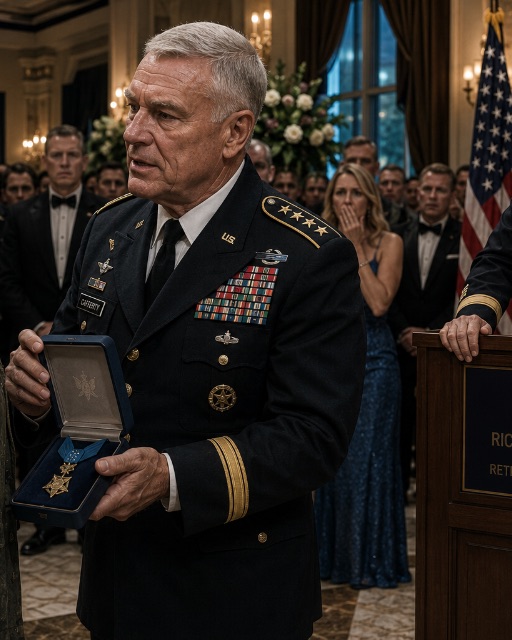
Walking through the doorway was a man I recognized from briefings I was never supposed to have attended. Four stars on each shoulder. Silver hair cropped tight. A face that looked like it had been carved from the side of a mountain and then argued with the weather for sixty years.
General Terrence “Red” Cafferty. Chairman of the Joint Chiefs until two years ago. The kind of man whose name made colonels sit up straighter from three states away.
He wasn’t on the guest list. I knew because I’d looked.
Behind him walked two more officers, each carrying a leather folio. Behind them, a woman in a dark suit I pegged immediately as DOD counsel.
The ballroom went so quiet you could hear the roses wilting.
General Cafferty didn’t look at the podium. Didn’t look at my father. He walked straight down the center aisle, boots measured and deliberate on the hardwood floor, and stopped directly in front of my back-corner chair.
He looked at me.
Then he looked at my jacket.
Then he did something that sucked every molecule of oxygen out of that room.
He saluted me.
Not a casual touch of the brow. A full, rigid, textbook salute held for three beats longer than protocol required.
“Major Frost,” he said. His voice carried like cannon fire. Every syllable hit the back wall. “I have been looking for you for three years.”
I stood. Not because I wanted to. Because my body remembered how.
“Sir,” I said.
He dropped the salute and turned to face the room. Two hundred people stared back at him like deer watching headlights negotiate a curve.
“Ladies and gentlemen,” he said, “I apologize for the interruption. But there is a matter of national record that has been suppressed for seven years, and I am not leaving this building until it is corrected.”
He nodded to one of the officers behind him. The man stepped forward, opened the leather folio, and began to read.
I heard my name. My real rank. A mission designation I hadn’t spoken aloud since the debrief that ended my career. Dates. Coordinates. The name of the valley.
And then the words: “…extraordinary heroism at the risk of her own life, above and beyond the call of duty…”
My hands started to shake. I pressed them flat against my thighs.
General Cafferty turned back to me. In his hand was a small blue box.
“This recommendation,” he said, “was submitted seven years ago. It was buried. Deliberately. By someone in this room.”
He didn’t look at my father.
He didn’t have to.
Every single person in that ballroom turned toward the podium. My father’s face had gone the color of old chalk. His hand was still on the oak, but now it looked like the oak was holding him up.
Brenda’s champagne glass slipped from her fingers and shattered on the floor. Nobody flinched. Nobody even looked.
General Cafferty opened the blue box.
Inside, on a bed of white velvet, lay a pale blue ribbon dotted with thirteen white stars. I knew what it was before my mind let me say the word. Every soldier does. You see it once in a lifetime, usually behind glass.
He leaned close enough that only I could hear him.
“What your father did to you,” he whispered, “ends tonight.”
Then he straightened, turned squarely toward the podium, and let his voice fill the ballroom like artillery rolling across a valley.
Six words. Just six.
“General Sterling. Step away from that podium.”
For a moment, nothing in that room moved.
My father’s lips parted, but no sound came out. He looked, for the first time in my entire life, like a man who had run out of script.
A senator in the front row turned slowly in his chair to stare at him. The defense contractor beside him quietly slid his phone face-down on the table, as if afraid of being photographed too close to a sinking ship.
My father tried to speak. He cleared his throat. He even attempted that practiced little chuckle he used in committee hearings when a question got too close to the truth.
“Terrence,” he said. “I think there’s been some – ”
“Step away from the podium, Richard.”
This time it wasn’t six words. It was four. And somehow they landed harder.
My father stepped away.
The DOD lawyer moved to the dais with quiet, professional speed and laid a thin manila folder on top of the speech he had been reading from. She didn’t open it. She didn’t have to. The look on his face when he saw the seal on the cover told the room everything.
General Cafferty turned back toward me. The room turned with him, like a single creature finally remembering which direction the sun rose from.
“Major Victoria Frost,” he said, using my mother’s maiden name, the name I had taken back the year I left the service. “Seven years ago, you led a twelve-person reconnaissance team into a valley you had been ordered to avoid because of intelligence you had repeatedly flagged as accurate.”
He paused.
“Intelligence that turned out to be correct. Intelligence that, had it been acted upon at the command level, would have saved forty-one American lives.”
The room held its breath.
“You disobeyed a direct order from a senior officer to remain in position. You moved your team forward. You extracted nineteen civilians and six wounded soldiers from a compound that was overrun within the hour. You were the last person out. You carried a nineteen-year-old corporal three miles on a broken ankle.”
I felt something in my chest crack open very quietly.
“You were not unstable. You were not unreliable. You were correct. And the officer whose order you defied, the officer whose career would have ended if your report had been believed, made certain that you were the one who paid for it instead.”
He turned, finally, to look at my father.
“Major General Richard Sterling. You are hereby relieved of all ceremonial duties pending an Inspector General investigation into the suppression of valor recommendations, retaliation against a subordinate officer, and conduct unbecoming. The Secretary has been informed. Your security clearance is suspended as of this moment.”
My father didn’t argue. He didn’t try to make a speech. He just stood there, looking smaller than I had ever seen him, while the woman in the dark suit gently took his elbow and guided him off the dais.
Brenda was crying. Not the soft kind. The ugly kind. Her husband had already taken three steps away from her, his phone pressed to his ear, doing what donor-class husbands do when the boat starts taking on water.
General Cafferty pinned the Medal of Honor ribbon to the lapel of my old field jacket himself.
“This jacket has seen more service than half the uniforms in this room,” he said quietly. “Wear it proud.”
The applause started slowly. One pair of hands. Then another. Then a young captain near the side wall who I didn’t know but who was crying without trying to hide it. Then the whole room, finally, all of them standing, all of them clapping, some of them probably out of guilt and some out of awe and some because they had finally been given permission to do the right thing.
I didn’t cry. Not then.
I cried later, in the parking lot, sitting in the cab of my truck with the blue ribbon resting in its box on the passenger seat and my old jacket smelling like gun oil and smoke and, somehow, like vindication.
The twist nobody saw coming, the one that I learned a week later over coffee with General Cafferty in a small diner in Alexandria, was this. The young corporal I had carried out of that valley seven years ago had grown up, finished college on the G.I. Bill, gone to law school, and taken a job in the office of the Inspector General. He had spent four years quietly tracing the paper trail of my buried commendation. He had found every fingerprint. He had handed the file to Cafferty himself.
His name was Daniel. He was the son of a single mother from Ohio who had told him, the day he enlisted, to always remember the people who carried him.
He had remembered.
My father took early retirement under terms that involved the forfeiture of significant benefits and a public letter of reprimand. Brenda’s husband filed for divorce within the month. The donor-class hair, it turned out, was loyal only to winners.
I bought a small house outside Roanoke. I started a nonprofit that helps veterans whose records have been quietly damaged by people above them. Daniel sits on the board. So does General Cafferty, who told me once over bad diner coffee that the worst injuries in the military are almost never the visible ones.
I still have the sticky note. Vicki, this is for the best. Let it go.
I keep it pinned to the corkboard above my desk. Not as a wound. As a reminder.
Because here is what I learned, sitting in that back corner of that ballroom with bourbon in my hand and my father’s contempt washing over me like dirty water.
The people who try to bury you do not get to decide whether you stay buried.
The truth has its own timing. It is patient. It waits. It walks through double doors at the exact moment it is needed, wearing four stars and carrying a blue box, and it says the six words that the people who wronged you have spent their whole lives praying it would never say.
And sometimes, the person you once carried out of a valley grows up and carries you back out of yours.
If this story moved you, if it reminded you that quiet endurance is its own kind of courage, share it with someone who needs to hear it today. Like the post, pass it along, and leave a comment about a time the truth finally caught up to the people who tried to bury it. Somebody out there is waiting for a sign that their valley has an exit too.