Fridays were theirs.
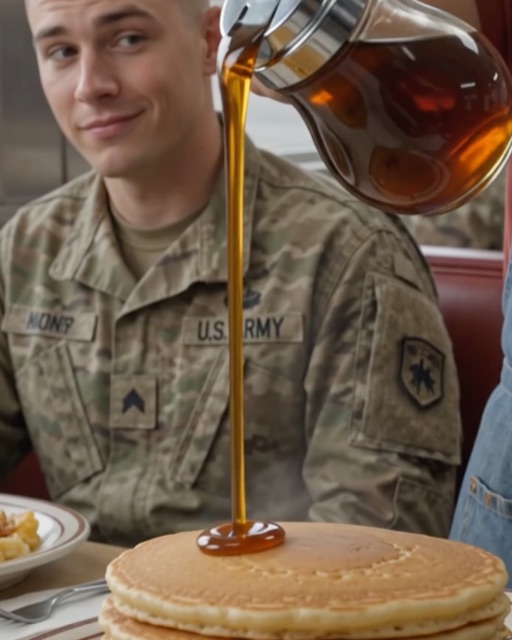
Same table by the window. Same mud on the boots. Same order: pancakes, sausage, black coffee, extra syrup.
They called me “ma’am.”
Most meant it.
One didn’t.
He was new. Baby face. Fresh patch. Smile too big for someone still learning to salute. He tapped the faded crooked-arrow on my apron.
“You know that’s not how it’s supposed to point, right?” he smirked.
His squad leader shot him a look. “Hale. Knock it off.”
He didn’t.
“People buy old Army junk and don’t even know what it means.”
My cheeks burned. I glanced down at the stitch I’d worn thin with my own fingers.
“I know what it means,” I said quietly.
He laughed. “Sure you do.”
I smiled because I’ve learned pain doesn’t have to raise its voice to outrank a boy.
“No, honey,” I said. “I was there when they drew it.”
He snorted. I walked into the kitchen before my hands started to shake. I stared at the pancake batter and breathed through red dust, radios screaming, and a kid from Ohio realizing the road on our map wasn’t there.
When I came back out with the coffee, engines rumbled to a stop outside.
Not unusual near Fort Carver.
What was unusual was the brigade commander stepping through my diner door with two command sergeants major – and a specialist carrying a glass case.
Every soldier stood so fast their chairs scraped.
The colonel didn’t look at them.
He walked straight to me.
“Lieutenant Colonel Hart?”
The syrup pitcher slipped in my hand. No one had called me that in thirty years.
The new kid – Hale – stopped smiling.
The colonel took off his cover. “Ma’am,” he said, voice steady. “The 103rd is retiring the original crooked-arrow patch today.”
My stomach dropped. “I told them not to ‘fix’ the story.”
“They didn’t fix it,” the older sergeant major muttered. “They sanitized it.”
The specialist set the glass case on the counter. Inside: the first patch. A black road. A gold shield. One arrow, crooked on purpose.
The colonel opened a battered field notebook. I knew the name before he read it.
“Staff Sergeant Curtis Palmer. Kuwait, ’91,” he said. He cleared his throat. “He wrote: ‘If Hart had followed the straight arrow, we’d all be dead. Put the wrong arrow on the patch so somebody remembers who saved us.’”
The diner went silent. You could hear the coffee drip.
Hale’s jaw worked. He looked at his own sleeve.
I shook my head.
“The arrow wasn’t crooked because I changed route,” I said, my voice steady now. “It was crooked because the original route was deliberately drawn wrong.”
The command sergeant major closed his eyes.
“And the man who signed that map?” I nodded toward the convoy. “He’s being honored at today’s retirement ceremony.”
Hale swallowed hard. The colonel’s knuckles went white around the notebook.
I reached for the program tucked under his arm, flipped to the back page, and felt my blood run cold.
And the name at the bottom of the ceremony program was General Marcus Thorne.
A ghost from a lifetime ago. A name I had buried under three decades of flipping pancakes and pouring coffee.
Seeing it in print felt like a physical blow. The air rushed out of my lungs, replaced by the ghost of grit and exhaust fumes.
Colonel Evans, the brigade commander, saw the color drain from my face.
“Ma’am? Do you know the General?”
I couldn’t speak. I could only nod.
Thirty years vanished. I wasn’t a sixty-year-old woman in a diner anymore. I was a twenty-nine-year-old lieutenant, my hair gritty with sand, the weight of a platoon on my shoulders.
And I was standing face-to-face with Captain Marcus Thorne.
He was all polish and ambition. His uniform was always a little too crisp, his boots a little too shiny for a man supposedly in the middle of a desert war.
He was in charge of our sector’s intelligence and mapping. A desk job, but a powerful one.
We clashed from the start.
I trusted my gut and the men I led. Thorne trusted doctrine and the straight lines on his maps. He saw me as a loose cannon. I saw him as a careerist who’d never tasted the dust he was sending us into.
Then came the mission. Recon deep behind enemy lines. A critical look at their positions before the main push.
Thorne briefed me himself. He unrolled the map with a flourish, his pointer stick tapping a route marked in bold red ink.
“The path is clear, Lieutenant,” he said with that infuriatingly confident smile. “Straight shot. You go in, you get the intel, you come out.”
I studied the map. Something felt wrong. Deeply wrong.
The route he’d drawn led us through a narrow wadi, a dry riverbed with steep cliffs on both sides. On a map, it was a clean line. A straight arrow.
On the ground, it was a coffin.
My staff sergeant, Curtis Palmer, a man with more time in the Army than I had on Earth, felt it too.
He stood beside me later, squinting at my copy of the map. “Ma’am,” he said, his voice a low rumble. “That valley smells bad. We go in there, we ain’t coming out.”
I spent that night going over every piece of intelligence I could get my hands on. Old terrain surveys, scout reports from weeks ago.
The official reports matched Thorne’s map. But the unofficial chatter, the whispers from patrols, told a different story. They spoke of recent enemy movement near that very valley.
It didn’t add up.
The next morning, as we prepared to move out, I made my choice.
I gathered my platoon leaders. I drew a new route on the map, a longer, harder path over a rocky plateau. A crooked path.
“We’re not going through the valley,” I told them. “We’re going over.”
The radio crackled to life almost immediately. It was Thorne. His voice was sharp, furious.
“Lieutenant Hart, what is the meaning of this deviation? You are on a direct order. You will follow the designated route.”
My heart hammered against my ribs. This was it. This was a career-ending decision. Disobeying a direct order in a combat zone.
I took a deep breath. “Captain Thorne, with all due respect, my assessment on the ground is that the designated route is a kill box. I will not lead my men into an ambush.”
“Your assessment?” he spat. “I am the intelligence officer here. Your job is to follow the arrow, Lieutenant, not to draw a new one.”
“My job,” I said, my voice colder than I knew it could be, “is to bring my men home. Hart out.”
I switched off the long-range radio.
Curtis Palmer gave me a slow, approving nod. The look on his face told me I’d made the right call.
We took the crooked path. It was grueling. The climb was brutal on the men and the vehicles. But we were hidden. We were safe.
From the top of the plateau, we looked down into the wadi.
And we saw them.
Iraqi Republican Guard tanks and infantry, dug in and concealed. They were perfectly positioned, their guns aimed at the exact entrance and exit of the valley. Waiting.
They were waiting for us.
A cold dread washed over me. This wasn’t a mistake on a map. This was deliberate. Someone had sent us there to die.
We completed our mission from our new vantage point, gathering even better intel than we would have from the valley floor. We made it back to base under the cover of darkness.
Two days later, the story of the “maverick” Lieutenant Hart who “lucked out” was already making the rounds. Thorne was spinning the narrative masterfully.
He even suggested the new unit patch himself. A crooked arrow.
He presented it as a way to honor our platoon’s “unconventional” success. No one knew it was to hide his catastrophic failure. Or something worse.
I knew I couldn’t prove it. It would be my word, a lieutenant’s gut feeling, against a captain’s perfectly documented intelligence. I was disillusioned. Tired.
I served out my time, saw the crooked-arrow patch become a quirky piece of unit lore, and then I left. I left it all behind.
I came here, opened a diner, and tried to forget. I buried Lieutenant Colonel Hart and just became Beth, the lady who served pancakes.
Until today.
Back in the diner, the smell of burnt coffee brought me back to the present.
Colonel Evans was watching me, his expression a mixture of concern and confusion. “Ma’am?”
I finally found my voice. It was thin, reedy.
“He tried to kill us,” I whispered.
Hale, the young soldier, looked like he’d been punched. “What?”
“Thorne,” I said, louder this time. “That map wasn’t an error. He sent us into that valley on purpose.”
The older command sergeant major, a man whose face was a roadmap of deployments, spoke up. “We always thought it was incompetence, ma’am. That he messed up the intel. But you’re saying it was deliberate?”
“Why?” Colonel Evans asked, his voice low and dangerous. “Why would he do that?”
This was the part I’d never told anyone. The part that had festered inside me for thirty years.
“There was another unit,” I began, my hands shaking so much I had to grip the edge of the counter. “A more… prestigious unit. Their commander was a friend of Thorne’s. They were tasked with a similar recon mission on a different axis.”
I took a shaky breath.
“Thorne wanted his friend to succeed, to get the glory. He needed a diversion. A loud, bloody one that would draw the enemy’s main force away from his friend’s area of operations.”
The pieces clicked into place on their faces. The horror dawned.
“My platoon,” I said, my voice cracking. “We were the diversion. We were meant to be the sacrifice so his friend’s unit could waltz in untouched.”
The diner was utterly silent. The only sound was the hum of the refrigerator.
Hale sank into a chair, his face pale. He looked from me to his own pristine crooked-arrow patch as if it had burned him.
“I… I’m so sorry, ma’am,” he stammered. “I had no idea.”
Colonel Evans’s face was stone. He looked at me, at the dusty glass case, at the program for the ceremony honoring a man who used American soldiers as bait.
“Proof,” he said, not as a challenge, but as a question. “Do you have any proof?”
I shook my head, a wave of despair washing over me. “It was just his map and my gut. And Curtis Palmer’s journal. Thorne buried everything else.”
The colonel stood for a long moment. He was a man caught between the story the Army told itself and the truth standing before him in a grease-stained apron.
He pulled out his phone.
“Get me General Miller,” he said into it. “Now.”
He turned to me. “The ceremony starts in an hour. We’re going.”
They found a uniform for me in the back of the command sergeant major’s vehicle. A spare service uniform. It was a little big in the shoulders, but when I put it on, something shifted inside me.
Lieutenant Colonel Hart looked back at me from the reflection in the diner window. Older, tired, but still there.
We arrived at the parade ground just as the honors were about to begin. General Marcus Thorne was on the stage, beaming, shaking hands. He looked every bit the celebrated leader. He hadn’t changed at all.
Our small group walked toward the stage. Colonel Evans, me, the two command sergeants major. Hale and his entire squad fell in behind us, a silent, determined escort.
Heads turned. The ceremony stuttered to a halt.
Thorne saw me. For a split second, his polished mask slipped. I saw a flicker of the same panic he must have felt when he heard my platoon had made it back alive.
Colonel Evans didn’t wait for an invitation. He walked up the steps to the stage and took the microphone.
“Ladies and gentlemen,” he began, his voice booming across the field. “We are here today to retire a symbol. The crooked-arrow patch. The official story is one of unconventional thinking. A cute tale about a lieutenant who went off-book.”
He turned and looked right at me.
“The real story,” he continued, “is about integrity. It’s about a leader who, facing a doctored map and a direct order, chose to save her soldiers instead of her career.”
He told them everything. He told them about the kill box, the faulty map, the radios. He read Curtis Palmer’s journal entry aloud.
A murmur went through the crowd. Thorne, on stage, was turning a blotchy red. He started to protest, calling it an outrageous slander.
“This is a fabrication!” he blustered. “This woman was a reckless officer who got lucky!”
“Is it a fabrication, General?” a new voice called out.
A major I didn’t recognize was walking toward the stage. He was tall, with the same steady eyes I remembered so well.
He was holding a dusty, tape-sealed box.
The older command sergeant major stepped forward. “General Thorne, this is Major Daniel Palmer.”
My breath caught in my throat. Curtis Palmer’s son.
“My father,” Major Palmer said, his voice ringing with conviction, “knew the truth might get buried. He told me that if the Army ever tried to ‘fix’ the story of the crooked arrow, I was to open this.”
He placed the box on the dais.
“He sent this to my mother a week after the mission. It contains his full, sworn statement. It contains transcripts of the radio traffic with Captain Thorne that he copied from the comms log. And it contains Thorne’s original, hand-annotated planning map, which my father… acquired… from the intelligence tent before it could be shredded.”
Major Palmer opened the box.
The proof was all there. Undeniable. The map. The notes in Thorne’s own handwriting outlining the “diversionary” aspect. The whole sordid, ambitious plan laid bare.
General Thorne looked like he had turned to stone. His career, his legacy, his carefully constructed lie—all of it evaporated in the bright afternoon sun.
Two military police officers quietly walked onto the stage. They didn’t put him in handcuffs. They didn’t have to. His reputation was gone forever. They simply escorted him away.
That afternoon, they didn’t retire the crooked-arrow patch.
Instead, they held a new ceremony.
They presented me with the Distinguished Service Cross I should have received thirty years ago.
The medal felt heavy in my hand. Heavier than a syrup pitcher.
After, young Specialist Hale approached me, his head bowed.
“Ma’am,” he said. “I can’t tell you how ashamed I am.”
I put my hand on his shoulder.
“Look at me, son.”
He raised his eyes. They were filled with remorse.
“That patch on your sleeve,” I said gently. “It doesn’t mean you follow orders blindly. It doesn’t mean you just trace the straight line someone else draws for you.”
I tapped the crooked arrow.
“It means you protect your own. It means you choose the hard right over the easy wrong. It means you have the courage to draw a new path when the one you’re given leads to disaster.”
I took the medal from its case and pinned it not on my own uniform, but on the faded, stitched patch on my diner apron, which one of the sergeants had brought from the diner. Right over the crooked arrow.
“True honor,” I told him, “isn’t about the shiny things you wear. It’s about the person you are, and the people you bring home.”
From that day on, Fridays were still theirs.
Same table. Same boots. Same order.
But now, when they called me “ma’am,” every single one of them meant it.
They weren’t just looking at a waitress. They were looking at a leader. And the crooked arrow on my apron was no longer a piece of Army junk.
It was a lesson. A promise. It was the story of who we are supposed to be.