“Excuse me… could you pass the salt?”
Trays clattered. Boots scraped. Somebody snorted.
I didn’t even look up from my meatloaf. “Get it yourself,” I said. “I’m not your servant.”
A couple guys chuckled. Someone lifted a phone.
She didn’t flinch. Just that little flicker in her eyes. Then, calmly: “It’s okay. I understand.”
I laughed it off. But the words followed me out of the DFAC, into the motor pool, into my rack. I stared at the ceiling and heard them again. Not weak. Not wounded. Steady. Familiar.
By lunch the next day I was back early, like a dog that heard a whistle nobody else could.
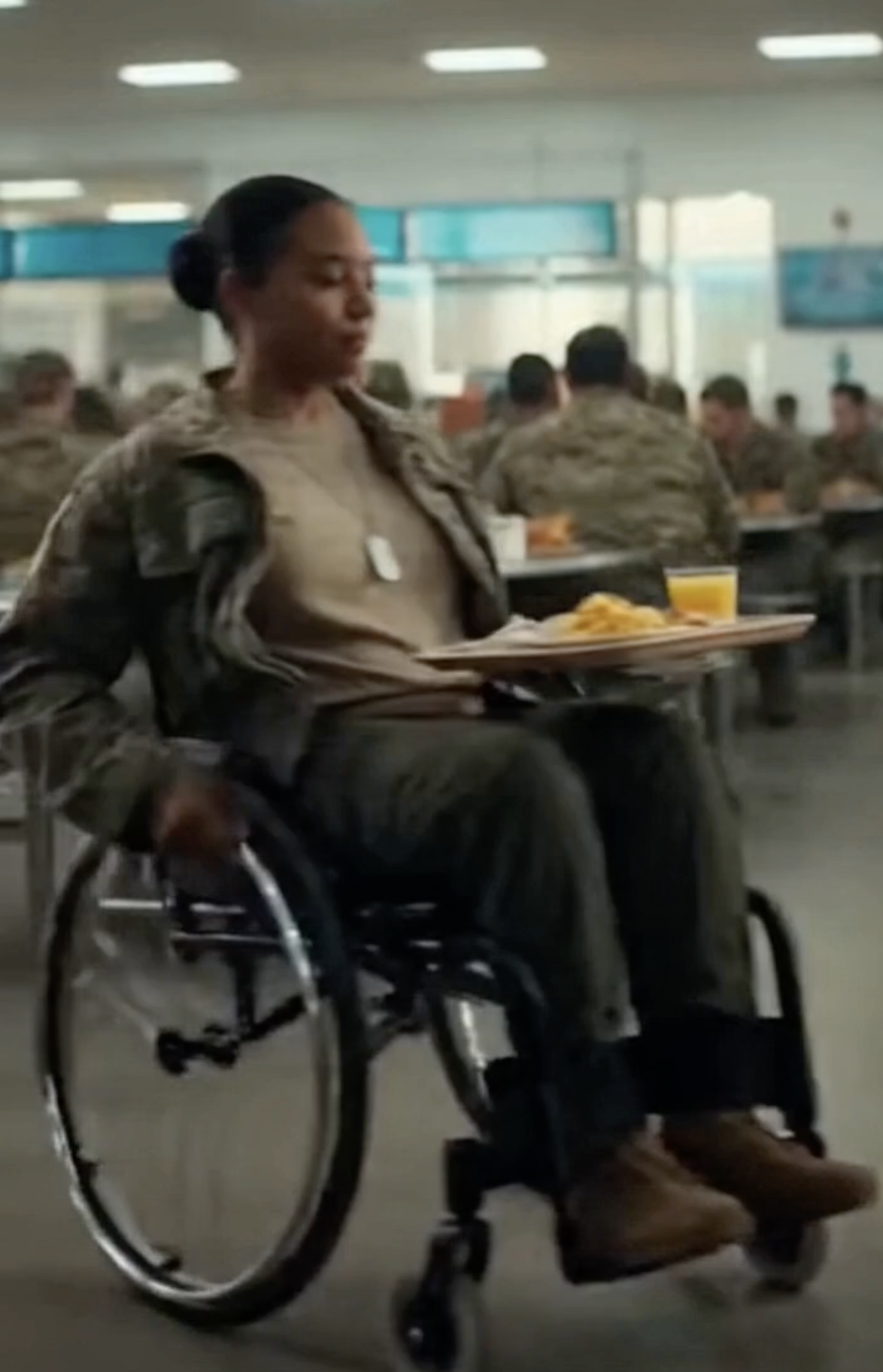
She rolled in.
Wall to her back. Eyes on the exits. Tray balanced like she’d done this a thousand times. Staff Sergeant stripes on her sleeve. Rivera.
My chest tightened. The way she moved. The way she scanned. It wasn’t pity in her voice yesterday – it was recognition. Like she knew me.
I watched her settle near the wall. My mouth went dry. A memory I’d buried for years clawed its way up.
Basic. Week two. I was sitting on cold concrete behind the barracks, shaking so hard my teeth clicked. Convinced I wasn’t cut out for any of it. Ready to quit.
A young sergeant found me in the dark. Canteen in one hand, patience in her eyes. “Breathe,” she’d said. “You’re not done yet.” Soft voice. Steel underneath. The only reason I didn’t walk.
Back in the DFAC, metal scraped as chairs moved. Rivera reached for a salt packet, glanced up, and caught me staring.
Her gaze didn’t judge. It measured. My blood ran cold.
She wheeled closer. Close enough that I could smell coffee on her breath. She set a salt packet by my tray without a word. Then she looked straight at me and said my last name exactly the way I’d heard it once in the dark, years ago.
“Brooks.”
My heart pounded in my throat. I froze.
Because the last time I heard that voice say my name, I wasn’t a specialist mouthing off in a cafeteria – I was a terrified recruit on a concrete step at 3 AM, and the person standing over me that night was… Staff Sergeant Rivera.
The world tilted. The clatter of the DFAC faded into a dull roar in my ears.
It was her. The same steady eyes. The same quiet strength that had pulled me back from the edge.
And I had mocked her. I had treated her like she was nothing.
Shame hit me like a physical blow, hot and sickening. It crawled up my neck and burned my face.
My mouth opened, but no sound came out. What could I possibly say? “Sorry I was a jerk to the person who saved my career”?
She just watched me, her expression unreadable. She wasn’t angry. She wasn’t sad. She was just… waiting.
Finally, I managed to get out a single, pathetic word. “Sergeant.”
She nodded once, a small, sharp movement. “I thought that was you, Brooks.”
“I… I didn’t recognize you,” I stammered, the excuse tasting like ash in my mouth. It was a lie, and we both knew it. I hadn’t bothered to look. I hadn’t seen a person, a soldier. I’d only seen a wheelchair.
“People change,” she said, her voice even. “Sometimes for the better. Sometimes not.”
That was it. That was the knife twisting. She wasn’t yelling, wasn’t dressing me down. She was just stating a fact, and letting me decide which category I fell into.
My buddies at the other table were silent now, watching. The phone was gone, but the damage was done. I could feel the digital ghost of my stupidity already floating through the ether.
“I’m sorry,” I said, the words feeling small and useless. “There’s no excuse. I was an idiot.”
“Yes, you were,” she agreed, without heat. “The question is, are you still?”
I looked down at my tray of half-eaten meatloaf. My appetite was gone. All I felt was a hollow pit in my stomach.
“I don’t know,” I said honestly.
She let the silence hang there for a moment. Then she pushed the salt packet an inch closer to me.
“Eat your lunch, Brooks,” she said, before turning her wheelchair and rolling away. “You’ve got a long day ahead of you.”
I watched her go, her movements precise and economical. She was a soldier. She had always been a soldier. I was the one who had forgotten what that meant.
The walk back to the barracks was the longest of my life. Every footstep echoed with my own hypocrisy.
My squad leader, Sergeant Miller, was waiting for me. He was leaning against my bunk, his arms crossed. He wasn’t smiling.
He held up his phone. And there it was. A shaky, 15-second video of me, sneering at a woman in a wheelchair. My voice, loud and ugly. “Get it yourself.”
The post had a few dozen likes and a handful of angry-face emojis.
“Care to explain this, Brooks?” Miller asked, his voice dangerously quiet.
I couldn’t meet his eyes. “No, Sergeant. I can’t.”
“You know who that is, right?” he pressed.
I nodded, my throat tight. “Staff Sergeant Rivera.”
Miller’s jaw tightened. He looked at me for a long time, and I saw a flash of something in his eyes I’d never seen before. It wasn’t just anger. It was a deep, personal disappointment.
“You have no idea,” he said, shaking his head slowly. “You have no idea what you’ve done.”
He didn’t yell. He didn’t threaten me with an Article 15, though I knew it was coming. He just turned and walked away, leaving me alone with the video of the worst version of myself.
I spent the next two days in a state of dread. I did my duties, kept my mouth shut, and waited for the hammer to fall. The video had been taken down, but the whispers followed me everywhere. People looked at me differently. I was that guy now.
I knew I had to do more than just say sorry in a crowded DFAC. I had to find her. I had to face her.
I found out she worked at the battalion S1 shop. After my shift, I stood outside the door for a full ten minutes, my heart hammering against my ribs, before I finally worked up the nerve to knock.
“Enter,” a voice called. Her voice.
I stepped inside. She was behind a desk, the wheelchair tucked neatly underneath. The office was quiet. She was alone.
She looked up from her computer, her face impassive. “Brooks. What can I do for you?”
“Sergeant, I… I wanted to apologize. Properly this time.” I stood there, stiff and awkward as a recruit on his first day.
“I heard you the first time,” she said, turning back to her screen.
“No,” I insisted. “You don’t understand. I need to…” I trailed off, fumbling for the right words. “That night. In Basic. Behind the barracks.”
Her fingers stopped typing. She slowly turned to face me again.
“I was done,” I said, the memory as clear as if it were yesterday. “I was packing my bags in my head. I was going to quit. And you… you stopped me. You told me I wasn’t done yet.”
My voice cracked. “You saved me, Sergeant. You’re the reason I’m even wearing this uniform. And I repaid you by…”
I couldn’t finish. The shame was too much.
She listened, her expression unchanging. When I was finished, she was silent for a long moment.
“I remember a scared kid on a concrete step,” she said finally. “A kid who thought he wasn’t strong enough. I told him that strength wasn’t about never falling down. It’s about how you get back up.”
She looked me straight in the eye. “The soldier I saw in the DFAC two days ago wasn’t getting up. He was kicking someone who was already down.”
Her words hit their mark. I had no defense.
“What do you want from me, Brooks?” she asked. “You want me to say it’s okay? That we can forget about it? It doesn’t work that way.”
“I know,” I said. “I don’t want you to forget it. I want to fix it. Tell me what to do.”
A flicker of something – maybe surprise—crossed her face. She studied me, as if trying to see if the offer was genuine.
“You really want to make it right?” she asked.
“Yes, Sergeant. Anything.”
She leaned back in her chair, tapping a pen against her desk. “Alright, Brooks. I’m going to take you up on that.”
She gave me an address. It was a building on the other side of the base I’d never paid much attention to. The adaptive sports center.
“Be there tomorrow. 1700 hours. Wear PTs,” she ordered. “And don’t be late.”
The next day, I walked into the gym feeling like I was facing a firing squad. The place was filled with soldiers. Some were in wheelchairs like Rivera. Others had prosthetic limbs. Some had injuries you couldn’t see.
But nobody was sitting around feeling sorry for themselves. The air was thick with the sounds of effort. Weights clanked. Basketballs thumped. People were laughing, sweating, pushing themselves and each other.
Rivera was in the middle of it all, coaching a game of wheelchair basketball. She moved with an agility and power that was breathtaking. She wasn’t a soldier in a wheelchair. She was an athlete. A leader.
She saw me standing by the door and blew her whistle. “Brooks! Get over here! You’re with Corporal Davies. He’ll show you how to set up the weight sleds.”
For the next two hours, I worked. I racked weights. I spotted for a guy with one arm who could bench press more than me. I learned how to tape a prosthetic for running.
I didn’t talk much. I just listened. I watched.
I saw a young private, a double amputee, fall while trying to climb a rope. Before I could even move to help, two of his buddies were there, helping him up, joking with him, encouraging him to try again. He did.
I saw Rivera pull aside a young woman who was struggling, speaking to her in a low, firm voice—the same voice that had spoken to me all those years ago.
This was her world. This was the world I had mocked.
I came back the next day. And the day after that.
Slowly, I started to talk to people. I learned their stories. An infantryman who lost his leg to an IED. An engineer with a traumatic brain injury from a vehicle rollover. A medic with severe PTSD.
Every single one of them was a warrior. Their battleground had changed, but their fight hadn’t stopped. And Rivera was their sergeant, just as she had been mine.
One evening, after we had cleaned up the gym, I was helping Rivera pack her gear.
“Why?” I asked her, the question that had been burning in my mind for weeks. “Why did you help me that night in Basic?”
She stopped what she was doing. “Because my Drill Sergeant did the same for me,” she said simply. “He saw something in me I didn’t see in myself. That’s the job. You don’t let a good soldier fall if you can help it.”
“But you don’t even remember my first name,” I said, a little stunned.
She smiled, a rare, genuine smile. “I didn’t need to. I just needed to see the soldier.” She paused. “So, are you going to keep showing up, Brooks?”
“Yes, Sergeant,” I said, without hesitation.
“Good,” she said. “Corporal Davies could use a permanent spotter.”
A few days later, the official word came down. I was to report to the Company Commander’s office, along with Sergeant Miller. This was it.
Captain Price was a fair man, but he didn’t tolerate indiscipline. The video had apparently made its way up the chain of command.
As I stood at attention in front of his desk, the door opened and Staff Sergeant Rivera wheeled herself in. My stomach dropped. I assumed she was there to give her statement, to seal my fate.
The Captain looked at me, his face grim. “Specialist Brooks, I’ve seen the video. I’ve read the reports. Frankly, I’m disgusted. This is not what this unit, or this Army, is about.”
I stared straight ahead. “No excuses, sir.”
“I’m looking at a recommendation for an Article 15. Reduction in rank. Loss of pay. You’d be lucky to stay in the service.”
I braced myself for the impact. I deserved it.
Then he turned to Rivera. “Staff Sergeant, I’d like your official statement.”
This was the moment. She could end my career with a few words.
Rivera wheeled forward slightly. “Sir, what Specialist Brooks did was unacceptable. It was ignorant, disrespectful, and completely out of line.”
She paused, and I held my breath.
“It was also the action of a soldier who made a serious mistake, and has been working every single day to atone for it.”
My head snapped up. I stared at her, confused.
She continued, her voice clear and steady. “For the past three weeks, Specialist Brooks has volunteered every evening at the adaptive sports center. He hasn’t missed a day. He’s put in the work. He’s shown humility and a genuine desire to learn and to change. He’s become a valuable part of our community there.”
She looked from the Captain to me. “Sir, I knew Specialist Brooks in Basic Training. I saw a soldier with potential then. I believe that soldier is still in there. Punishing him is one option. But allowing him to continue the work he’s started… I believe that’s how we make him a better soldier, and how we make this unit stronger.”
The Captain was silent, studying her, then me. Sergeant Miller, standing beside me, had a look of profound respect on his face.
Then I noticed something else. A small, faded tattoo on Miller’s forearm, mostly hidden by his sleeve. It was a set of coordinates and a date. I’d seen it a hundred times and never thought anything of it.
But I had seen a framed photo in the sports center office. A picture of Rivera, standing and smiling, with her old squad in Afghanistan. A younger Sergeant Miller was in the photo, grinning right next to her. The caption mentioned an IED attack, the date matching the one on Miller’s arm.
The pieces clicked into place with a sickening thud. The way Miller had looked at me. His raw disappointment.
It wasn’t just that I had insulted a fellow NCO. I had insulted the person who had saved his life.
The Captain finally spoke. “Your actions were still a profound embarrassment, Brooks. There will be consequences.”
He handed down his judgment. I would receive a formal letter of reprimand in my file. I would have extra duty for a month. And I was to be officially assigned to the adaptive sports center for 90 days as part of my duties.
He then addressed the other soldiers who were in the video, laughing. They received far harsher punishments. One was reduced in rank. They hadn’t shown remorse. They hadn’t tried to make things right. They had only made excuses.
After I was dismissed, I waited for Rivera outside.
“Why?” I asked her, my voice thick with emotion. “After what I did, why would you do that for me?”
She looked up at me. “I told you, Brooks. We don’t let a good soldier fall if we can help it. You just needed to be reminded how to get back up.”
She started to wheel away, then stopped. “And for the record,” she said, a small smile playing on her lips. “I did remember your first name. It’s Daniel.”
I stood there, stunned into silence, as she disappeared down the hallway.
The next 90 days changed my life. I learned more about courage and resilience in that gym than I had in my entire military career. I saw people redefine their limits every single day.
I learned that the wheelchair didn’t define Rivera. Her leadership did. Her compassion did. Her unshakeable belief in the soldiers around her did. She was still the same Sergeant who had found me on that concrete step. Her strength had never been in her legs. It had always been in her heart.
My time in the gym became more than a punishment. It became a purpose.
True strength isn’t the absence of weakness. It’s what you do with it. It’s not about how tough you are, but about how you lift up the people around you. It’s about looking past your own judgments and seeing the soldier, the person, standing in front of you. Sometimes, the person you think you’re helping ends up being the one who saves you.