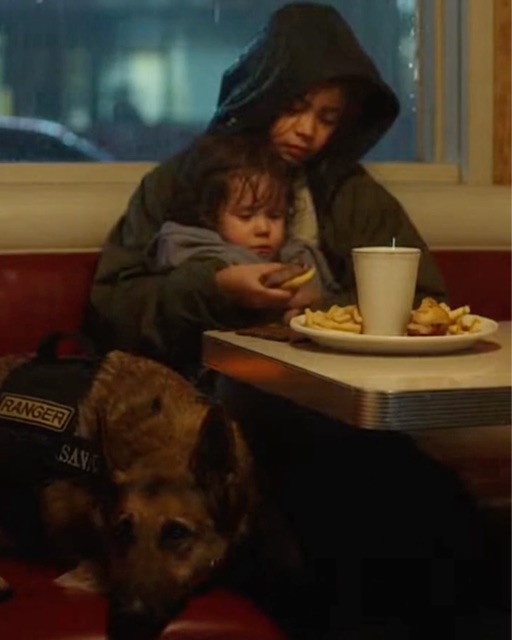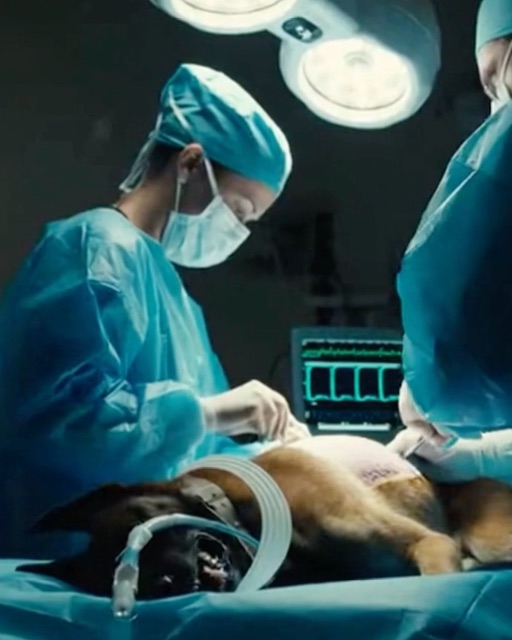
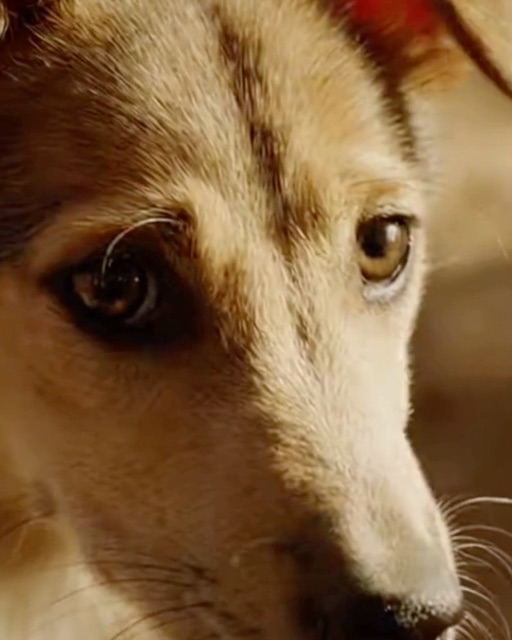
It was 1942, Darwin Air Force Base. The jungle heat was brutal, and a pack of us airmen stumbled on this scrawny six-month-old stray under a supply hut. His hind leg was shattered, bone poking through fur matted with blood and mud. He whimpered, eyes wide with pain.
The officers shrugged. “Put him down,” one barked. “We can’t waste rations on some mangy mutt during war.”
But we couldn’t. I was Leading Aircraftman Percy Westcott, and something in those pleading eyes hit me hard. We splinted his leg with scraps from the med kit, slipped him bits of our bully beef and biscuits. Named him Gunner – he was all ears and awkward paws, curling up by our bunks like he belonged.
For weeks, he was just our mascot. Chased shadows, begged for scraps, made the endless nights a little less lonely.
Then one sweltering afternoon, the base went dead quiet. Radars blank, skies empty blue. Gunner was napping in the shade when he bolted upright, ears perked.
He tore across the airfield, hackles up, staring at nothing. Then he let loose – not a bark, a howl that chilled my spine. Frantic, teeth flashing at the clouds.
“Easy, boy!” we yelled, checking the scopes. Zip. No blips for hundreds of miles.
Gunner wouldn’t quit. Pacing, growling low, like death was incoming.
Twenty minutes later, the earth trembled. Bombs whistled from the sky.
Japanese Zeros, invisible to our tech, screaming down. Gunner had heard their engines—propellers slicing air—almost an hour before we did.
It wasn’t luck. Next raid, same thing. He sensed them every time, saving dozens of us from the first blasts.
I stared at him that night, heart pounding. This wasn’t some stray. He was…
When the commander finally approved sirens based on Gunner’s alerts alone, we knew we’d adopted more than a dog. The real kicker came in the after-action reports: lives saved tallied up, and the truth hit like shrapnel.
The first report detailed the raid where Gunner had given his first warning. The numbers were stark. Forty-two men made it to the slit trenches in time, men who would have otherwise been caught out on the tarmac.
I scanned the list of names, my finger tracing the ink. And there it was. Squadron Leader Davies.
He was the very same officer who’d ordered us to put Gunner down. The man who called him a “mangy mutt.”
Davies never said a word to me about it. But I saw him the next day, walking past the mess hall. He stopped, watched Gunner chewing on a bit of leather one of the lads had given him.
He just stood there for a full minute. Then he reached into his own pocket, pulled out a piece of his rationed jerky, and tossed it near Gunner’s paws.
The dog sniffed it, then looked up at Davies, and for a second, the two of them just stared at each other. Davies gave a stiff nod, then walked away.
That was thanks enough. It was more than enough.
Gunner became my shadow after that. His leg healed, but with a permanent limp that gave his run a funny, lopsided bounce.
He’d wait for me outside the briefing hut, his tail thumping a soft rhythm against the dusty ground. He’d sleep on the floor next to my bunk, a warm, breathing weight in the dark that was more comforting than any blanket.
I found myself talking to him, telling him about home in Sussex. About the rolling green hills and the smell of rain on dry earth, things that felt a world away from the sweat and fear of Darwin.
He’d just listen, his head cocked, those intelligent brown eyes fixed on me. It was like he understood.
Of course, not everyone was a convert. Flight Lieutenant Wallace was a man who lived and died by the rulebook. He saw Gunner not as a hero, but as a violation of about a dozen military codes.
“It’s a disgrace, Westcott,” he’d say, his lip curled. “Relying on a cur’s ears instead of military-grade equipment. It’s preposterous.”
He argued that one day Gunner would get it wrong. He’d cry wolf, or stay silent, and men would die because we’d put our faith in an animal.
“What’s his range, eh?” Wallace sneered one morning as Gunner dozed in a patch of sun. “Can he detect a shift in enemy strategy? It’s a fluke, and it will end in disaster.”
The other lads told him to pipe down, but Wallace’s words were like little seeds of doubt. In the dead of night, you couldn’t help but wonder. What if he was right?
But then, a week later, Gunner would start his low growl. The siren would blare, and we’d dive for cover as the sky ripped open again.
Each time, he was right. Every single time.
His fame started to spread through the ranks. We’d get visiting pilots from other squadrons who’d ask to see him. “So that’s the four-legged radar?” they’d say, half-joking.
They’d scratch his ears and he’d lean into their hands, just a friendly dog who happened to be saving their lives.
One day, a journalist from a Sydney paper even came to do a story. He took photos of Gunner sitting by a Spitfire, looking noble.
The article called him “The Angel of Darwin.” I still have the clipping.
It was right after the journalist left that I noticed it. While he’d been taking photos, Gunner had been rolling around in the dirt near the supply hut where we’d first found him.
Something was tangled in the fur around his neck. It looked like a bit of old string.
I knelt down, gently working it free. It wasn’t string. It was a thin, rotted leather cord, almost broken through.
And hanging from it was a small, tarnished metal disc. A dog tag.
My heart hammered in my chest. I rubbed the grime off with my thumb, squinting to read the faint, hand-scratched letters.
It wasn’t easy to make out. But I could see a name, and below it, what looked like an address.
The name was “Scout.”
Not Gunner. Scout. And the address was a street in the civilian district of Darwin, a part of town that had been hit hard in the early raids.
That night, I couldn’t sleep. Who was Scout? Who had he belonged to?
A few days later, I hitched a ride into town on a supply truck. I had the tag in my pocket, the metal warm against my fingers. I told the driver the address.
“Not much left there, mate,” he said, giving me a grim look. “That whole block was flattened back in February.”
He was right. The street was a ghost of what it had been. Piles of rubble and splintered wood stood where houses used to be.
I found the lot number. It was just a foundation, choked with weeds. The skeleton of a house.
I walked through the ruins, my boots crunching on broken glass and tiles. It felt wrong to be there, like I was trespassing on a grave.
In a corner of what might have been a child’s bedroom, I found a small, soot-stained toy soldier, half-buried in the dirt. My throat tightened.
This was a home. A family had lived here. Laughed here. And now, there was nothing.
I was about to leave when my foot caught on something. I knelt and dug through the debris. It was a small, metal box, warped by heat but not broken open. A keepsake box.
I pried the lid open. Inside, there were a few faded photographs and a small stack of letters tied with a ribbon.
The first photo showed a smiling woman and a young boy, maybe seven or eight years old. In the boy’s arms, he was holding a tiny puppy. A puppy with huge ears and awkward paws.
It was him. It was Gunner. It was Scout.
I picked up the letters. They were addressed to a Corporal Thomas Riley. At Darwin Air Force Base.
The name hit me like a physical blow.
Thomas Riley.
He was the airman I replaced. The man whose bunk I slept in.
He’d been killed on a reconnaissance flight two days before I arrived. Caught on the tarmac during a surprise raid. The kind of raid that Gunner now gave us warning for.
I sank down onto a pile of bricks, my mind reeling. I read one of the letters. It was from the boy in the photo, whose name was Sam.
He wrote about his puppy, Scout. How he missed his dad, who was away at war, and how Scout was his best friend. The last letter talked about how his mum was letting Corporal Riley look after Scout for a few days, to keep him company at the base.
It all clicked into place, a horrifying, perfect mosaic of tragedy.
The raid that flattened this house, that took Sam and his mother, was the same one that killed Riley.
And Scout, or Gunner, had been at the base with Riley that day. He must have been injured in the blast, his leg shattered. Alone and terrified, he’d crawled under the nearest bit of shelter he could find—the supply hut.
He wasn’t just some stray. He was an orphan, twice over. He’d lost his family, and then he’d lost the man who was taking care of him.
He hadn’t been trying to get away from the base. He’d been trying to get back to the only person he had left. But Riley was already gone.
So he found us instead. Riley’s squadron. His mates.
The weight of it settled on me. This little dog, who had lost everything to the war, was spending every day of his life trying to stop the same thing from happening to us.
He wasn’t just a mascot. He was a guardian. He was keeping Riley’s brothers-in-arms safe. It was like he was repaying a debt to a man who was no longer there to collect it.
I returned to the base that evening in a daze. I looked at Gunner, who greeted me with his usual happy, lopsided run. I saw him differently now. I saw the hero he was, born from the worst kind of loss.
But Flight Lieutenant Wallace saw none of that. His campaign against Gunner had only grown more intense.
“The dog is a distraction!” he argued in a briefing. “We’re becoming complacent, relying on folklore! One of these days, a new model of Zero will come in with a different engine frequency, and that mutt won’t hear a thing. Then what?”
The final confrontation came on a Tuesday morning. The air was thick and heavy with fog, a soupy grey blanket that you could barely see through.
Wallace had finally convinced a higher-up to have Gunner removed from the base. He arrived at our barracks with two MPs and a wire cage.
“Westcott. Hand over the dog,” Wallace commanded, his face set like stone. “He’s being transferred to a civilian shelter. Effective immediately.”
The lads in the barracks stood up, a quiet wall of defiance. But an order was an order.
Gunner seemed to sense the tension. He whined, pressing against my leg.
I felt a cold knot of dread in my stomach. I was about to clip the lead onto his collar when he suddenly went rigid.
His head shot up. His ears swiveled like antennae. A low growl rumbled in his chest, deeper and more menacing than I had ever heard before.
Then he threw back his head and howled. It wasn’t a warning. It was a scream of pure terror. He clawed at the door, desperate, frantic, staring into the thick, impenetrable fog.
“Shut that thing up!” Wallace snapped. “It’s a nervous reaction. There’s nothing out there. The radar is clear.”
“The radar was clear every other time, sir,” I said, my voice shaking slightly. “He’s never been wrong.”
“There’s a first time for everything, Aircraftman,” Wallace retorted. “Now put him in the cage.”
I looked down at Gunner. He was trembling, but he wouldn’t stop barking at the sky. I looked at Wallace’s cold, triumphant face.
And I made a choice.
“No, sir,” I said. “I’m not going to do that.”
I ran. I grabbed the handle for the base siren and pulled it with all my might.
The deafening wail cut through the fog. For a moment, there was chaos. Men shouting, Wallace screaming my name, accusing me of insubordination.
But the training kicked in. Men poured out of the barracks, sprinting for the trenches, their faces a mixture of confusion and ingrained habit.
We waited. One minute. Two.
Wallace stood in the middle of the airfield, his face purple with rage. “You’re finished, Westcott! Court-martialed!”
And then we heard it.
A faint drone, coming from everywhere at once, muffled by the fog. A sound that grew from a hum to a roar in seconds.
The earth shook as the first bombs hit the far end of the runway. The sky, which had been empty and silent, was suddenly filled with the screams of diving planes and the thunder of explosions.
It was the biggest raid we’d ever seen. They’d used the fog as cover, a massive wave of bombers and fighters. They would have wiped us off the map.
Because of Gunner, almost everyone made it to shelter. We were battered, but we were alive.
After the raid, as the smoke cleared, no one said a word. Wallace just stared at the crater where the mess hall used to be, his face pale. He looked at Gunner, who was now sitting quietly by my side, and then he turned and walked away without another word.
We never heard him complain about the dog again.
Two days later, the Base Commander held a full formation. He called me and Gunner to the front.
He cleared his throat and read from a formal commendation. Gunner was officially awarded the rank of “Goodest Boy, First Class.”
He fastened a brand-new leather collar around Gunner’s neck. On the shiny brass tag, it said: “Gunner. RAAF.” He belonged. He was one of us, officially.
The war eventually ended. The day the news came, the base erupted in celebration. Men were laughing, crying, dreaming of home.
I had a choice to make. Go back to England, or stay.
I looked at the red earth of Australia, at the vast blue sky. I looked down at Gunner, who was leaning against my leg, his tail wagging slowly.
This was home now. For both of us.
I stayed. I got a job on a sheep station not far from Darwin. I officially adopted Gunner, or Scout, or whatever name you wanted to give him. To me, he was just my best friend.
We grew old together. We lived a quiet life, a peaceful one. Sometimes, on a clear night, he would look up at the sky, his ears perked, and I would rest my hand on his back until he settled.
Every year, on the anniversary of the February raid, I’d drive him to the Darwin war memorial. I’d find the name etched in the stone: Corporal Thomas Riley.
I’d tell Gunner stories about the brave young man who had likely been his first friend on that base. The man whose legacy he had unknowingly protected.
People say war is about hate. And maybe it is. But it’s also about the small, unexpected acts of love that shine through the darkness.
We saved a broken puppy who was meant to die. And in return, he saved us. He showed us that even in the middle of all that destruction, a little bit of kindness can be a debt that is repaid a thousand times over.
It’s the most important lesson I ever learned. That sometimes, the most wounded souls have the most love to give. And the things you rescue have a funny way of rescuing you right back.