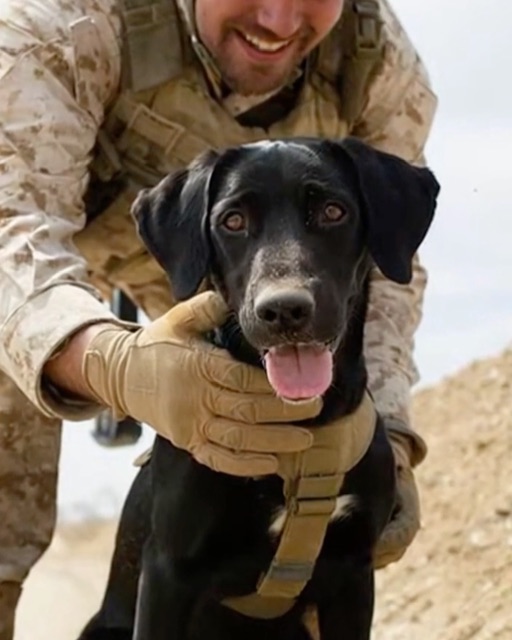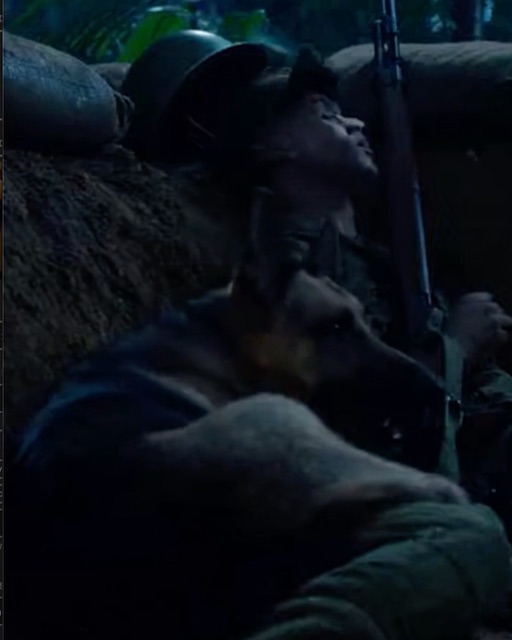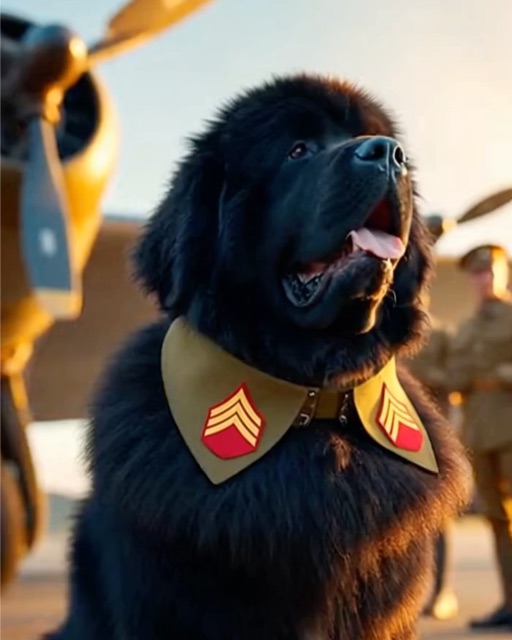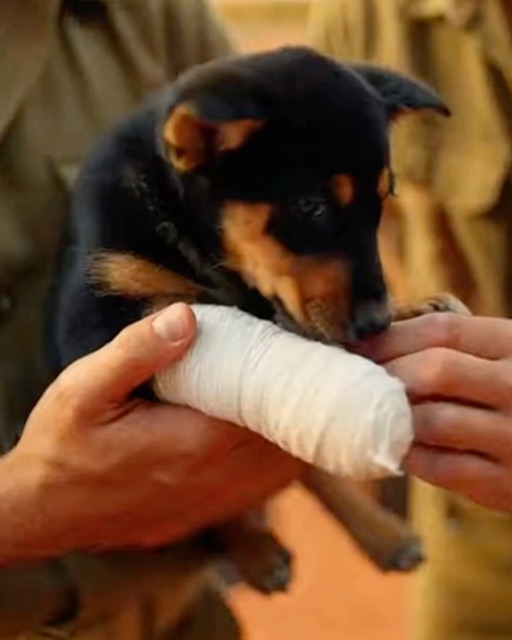
It was 1942 at the Darwin Air Force Base. The men found a starving, six-month-old stray hiding under a hut. His leg was snapped in half.
Most officers said to put him down. “He’s just another mouth to feed,” they argued.
But the soldiers couldn’t do it. They splinted his leg, shared their rations, and named him Gunner. For weeks, he was just a clumsy mascot who slept by their bunks.
Then, one quiet afternoon, everything changed.
The base was silent. The radar screens were empty. Suddenly, Gunner froze.
He ran to the center of the airfield, looked up at the clear blue sky, and began to scream. It wasn’t a playful bark. It was a warning.
“Quiet, Gunner!” the men shouted. They checked the scanners. Nothing. No planes for miles.
But Gunner wouldn’t stop. He was frantic, hackles raised, teeth bared at the clouds.
Twenty minutes later, the ground shook.
A squadron of Japanese bombers appeared out of nowhere. Gunner had heard their engines nearly an hour before human technology could detect them.
It wasn’t a fluke. It happened again. And again. Gunner wasn’t just a pet; he was a living, breathing early warning system.
The Leading Aircraftman, Percy Westcott, realized the dog was more reliable than their equipment. He made a decision that broke every military protocol in the book. He petitioned the Commander for permission to sound the official air raid siren – not based on radar, but solely on Gunner’s bark.
The Commander agreed.
The soldiers thought they had saved a helpless puppy. But when they looked back at the number of lives saved during the raids, they realized the chilling truth…
He was the one saving them.
The routine became almost sacred. Percy was Gunner’s official handler, a title he took more seriously than any military rank.
Every morning, Percy would wake to the soft thump of Gunner’s tail against his cot. They’d share a piece of toast before walking the perimeter of the airfield.
The other men treated Gunner like royalty. He got the best scraps from the mess hall and had a collection of makeshift toys crafted from rope and leather.
He was a happy dog, his once-broken leg now just a slight limp, a reminder of the life they’d given him. But when his ears twitched a certain way, the whole base held its breath.
The silence would fall first. Men would stop their card games. Mechanics would pause with wrenches in hand.
Then came Gunner’s low whine, a sound that cut through the humid air sharper than any siren. Percy would place a calming hand on his back.
“Easy, boy,” he’d murmur, his own heart starting to pound. “What do you hear?”
Gunner would trot to his spot, the very center of the dusty runway, and begin his haunting cry at the empty sky. Percy would sprint to the siren, giving it a mighty crank.
Within minutes, the base would be a flurry of motion as men scrambled for the shelters. They had faith. They had Gunner.
Not everyone saw it that way, though. Major Davies, a stern man who valued machinery over miracles, was one of the officers who had first argued to have Gunner put down.
He saw the dog as an embarrassment. An affront to military discipline and modern technology.
“This is a farce, Westcott,” he’d said one day, watching Percy praise Gunner with a pat on the head. “We’re relying on a mongrel’s whim.”
Percy stood his ground. “With respect, sir, that mongrel has been right every single time. Our radar hasn’t.”
Major Davies scoffed, his face tightening. “It’s a coincidence. A lucky streak that will run out. And when it does, men will die because you put your faith in an animal.”
The Major’s words hung in the air, a chilling prophecy that Percy tried his best to ignore. But doubt was a seed easily planted.
One sweltering Tuesday, a visiting dignitary was scheduled to arrive from Melbourne. The base was on high alert, polished and prepped.
Major Davies was in charge of the welcome. He wanted everything to be perfect, a show of military precision.
In the middle of the preparations, Gunner started his routine. A low whine, a stiff posture, a slow walk to the center of the field.
Percy felt a cold dread. He looked at the sky. It was a perfect, cloudless blue.
Gunner let out a desperate, piercing howl.
“Sound the alarm, Westcott!” someone yelled. But Major Davies stepped in front of Percy, his face like thunder.
“You will do no such thing,” the Major commanded. “We are not disrupting this visit for a stray’s hysterics. The radar is clear. That is an order.”
Percy was torn. Disobeying a direct order from a superior officer could mean a court-martial. But ignoring Gunner felt like a betrayal of every man on the base.
The men watched, frozen. They trusted the dog, but they feared the Major.
“Sir, please,” Percy pleaded. “He’s never been wrong.”
“There’s a first time for everything,” Davies snapped. “Get that dog under control, or I’ll have him put in the brig.”
He actually meant the small cell used for unruly soldiers. The thought of Gunner locked in a cage while danger approached made Percy’s blood run cold.
Reluctantly, Percy clipped a leash onto Gunner’s collar and tried to lead him away. Gunner fought him, digging his paws into the dirt, his eyes locked on the sky, whining pitifully. It broke Percy’s heart.
The men exchanged nervous glances. They went back to their duties, but the energy had shifted. The air was thick with tension.
Major Davies stood proudly as the transport plane, a C-47, began its descent. It was a perfect landing approach.
Then Gunner went absolutely wild. He broke free from Percy’s grasp, barking and spinning in circles, a tornado of pure panic.
He wasn’t just warning them. He was trying to wave the plane off.
The C-47’s wheels were just about to touch the runway when it happened. A single enemy fighter, a Japanese Zero, screamed down from the sun.
It had flown in so low and fast, using the sun’s glare as cover, that it had slipped completely under the radar’s detection range.
But Gunner had heard it.
The Zero’s machine guns ripped across the tarmac, stitching a line of dust and fire straight toward the landing C-47. The transport plane’s pilot, a hero in his own right, aborted the landing at the last possible second, pulling the nose up sharply and banking hard to escape.
The attack was over in seconds. The Zero vanished as quickly as it had appeared, leaving behind a scarred runway and a stunned silence.
No one was hurt. The dignitary was safe. But everyone knew how close it had been.
Major Davies stood pale and motionless, staring at the spot where the C-47 would have been. He had almost caused a disaster.
From that day on, no one ever questioned Gunner again. The legend of the dog with the golden ears spread through the Allied forces in the Pacific.
Major Davies, however, did not apologize. He simply avoided Percy and Gunner, his pride wounded more deeply than the runway. His resentment festered.
Months passed. The war raged on. Gunner’s warnings saved the base from at least a dozen more attacks, some small, some devastatingly large.
Percy and Gunner were inseparable. The bond between them was the heart of the base, a symbol of hope in a world of chaos.
Then came the order from high command. A new, experimental long-range radar system was being installed at Darwin. It was state-of-the-art, promising to detect enemy aircraft from hundreds of miles away.
Major Davies was put in charge of its implementation. He saw it as his chance to restore his reputation and prove that technology, not a dog’s ears, was the future of warfare.
The day the system went live, the Major called a base-wide meeting.
“As of 0800 hours, all alerts will be based on official radar telemetry,” he announced, his voice booming with renewed confidence. “The dog’s… services… will no longer be officially required.”
A murmur rippled through the soldiers. Percy felt his fists clench.
“You can’t be serious, sir,” Percy said, stepping forward. “Gunner is our best defense.”
“Your pet is a liability, Westcott,” Davies countered, his eyes cold. “We are a modern military force. This new system is foolproof. The dog is now just a mascot. Keep him confined to the barracks during duty hours.”
It was a direct challenge. Technology versus instinct. Man versus dog.
For a week, the base operated under the new rule. Gunner paced restlessly in the barracks, whining softly whenever Percy had to leave. The atmosphere on the base was grim. The men felt like they’d lost their guardian angel.
The new radar system was impressive. It picked up distant patrols and reported them with cold efficiency. Major Davies walked around with a smug look on his face.
On the eighth day, Percy was cleaning his rifle when Gunner, lying by his cot, suddenly shot to his feet.
His hackles were raised higher than Percy had ever seen. A low, guttural growl rumbled in his chest, a sound of pure menace.
He wasn’t whining at the sky. He was growling at the ground.
Percy’s heart hammered. This was different. This was new.
He rushed outside. The air was still. The radar room had reported all clear just minutes before.
Gunner ran toward the mess hall, not the airfield. He started barking frantically at the building’s foundation, scratching at the wooden planks.
A few soldiers gathered, confused. “What’s gotten into him?” one asked.
Percy didn’t know, but he trusted his friend. “Something’s wrong,” he said, his voice tight with urgency.
Just then, Major Davies stormed out of the command hut. “Westcott! I gave you a direct order to confine that animal! Get him back to the barracks now!”
“Sir, listen to him!” Percy begged. “He’s trying to tell us something!”
“He’s telling me he’s a nuisance!” Davies roared. “This is the last straw. I’m having him removed from this base permanently.”
As the Major spoke, a lone soldier stumbled out of the radar hut, his face ashen.
“Sir,” he stammered, “The new system… it’s gone dead. Complete malfunction.”
A chilling silence fell over the group. At that exact moment, Gunner’s frantic barking turned into a series of high-pitched, desperate yelps. He raced from the mess hall to the command hut, then back again, as if trying to herd the men away.
And then Percy heard it. A faint, almost imperceptible hum. It wasn’t coming from the sky.
It was coming from beneath their feet.
Before anyone could react, the ground erupted.
It wasn’t an air raid. It was a commando attack. A team of elite saboteurs had infiltrated the base by sea, their mission to plant explosives on key structures and cripple the airfield before a major aerial assault.
Gunner hadn’t heard planes. He had heard the quiet footsteps of enemy soldiers hiding under the buildings. He had smelled them.
Explosions ripped through the base. The command hut disintegrated in a ball of fire. The mess hall’s roof collapsed inward.
Chaos reigned. Men scrambled for cover, shouting in confusion and fear.
Percy was thrown to the ground by a blast. His ears rang, and smoke filled his lungs. Through the haze, he saw Major Davies, trapped under a heavy wooden beam from the collapsing mess hall porch.
Flames were licking at the dry wood around him. No one else seemed to see him.
Percy started to run toward him, but Gunner was faster. The dog, ignoring the fire and the deafening noise, shot toward the Major. He grabbed the fabric of Davies’s collar in his teeth and pulled, growling and straining with all his might.
He was trying to drag the unconscious man away from the fire.
The sight shocked Percy into action. He and two other soldiers rushed forward. Together, they managed to lift the heavy beam just enough for Percy to pull the Major free.
They dragged him to safety moments before the rest of the structure went up in a whoosh of flames.
The battle was short and brutal. The soldiers, caught by surprise but fierce in their defense of their home, managed to fight off the saboteurs.
When the dust settled, the base was in shambles. But they had held it.
They found Major Davies leaning against the wall of the infirmary, his arm in a sling and a bandage on his head. He was watching Percy gently check Gunner for injuries. The dog was singed and dirty, but otherwise unharmed.
The Major slowly walked over, his face a mixture of pain, shame, and something else Percy couldn’t quite read.
“Westcott,” he said, his voice quiet and hoarse.
Percy stood up, placing himself slightly in front of Gunner. “Sir.”
Davies looked down at the dog. Gunner looked back, not with fear or anger, but with simple, trusting eyes. He even gave a slight thump of his tail.
Tears welled in the Major’s eyes. “He… he pulled me,” he whispered, his voice cracking. “That beam… the fire… I would be dead. After everything I said. Everything I tried to do to him.”
He knelt down, wincing in pain, until he was eye-level with the dog.
“You saved my life,” he said to Gunner. “I was a fool. A proud, stubborn fool.”
The war in the Pacific eventually ended. The soldiers of Darwin Air Force Base went home, each carrying their own stories.
The question arose of what would happen to Gunner. The military, having documented his incredible abilities, wanted to transfer him to a research facility to study him.
Percy was devastated. The thought of Gunner living out his life in a lab, poked and prodded like a specimen, was unbearable.
He fought the orders, petitioned every officer he could, but it was no use. The paperwork was finalized.
The day they were scheduled to take Gunner away, Percy sat with him under the shade of a hut, saying his goodbyes.
Just then, a jeep pulled up. Major Davies stepped out, his uniform immaculate, his arm no longer in a sling.
He held a single file in his hand. He walked over and handed it to Percy.
“I pulled some strings,” Davies said. “Made a few calls to people who owe me favors. I told them his abilities were a one-time phenomenon, a wartime fluke that has since faded. I told them he was just a regular dog now.”
Percy opened the file. Inside were official discharge papers. For Gunner. And a transfer order for Percy, back home to his small town in the countryside.
“He’s not military property anymore, son,” the Major said with a small smile. “He’s your dog. He saved my life. The least I could do is save his.”
Percy looked up, speechless, tears streaming down his face. He could only nod his thanks.
Percy and Gunner lived a long, peaceful life together. Gunner never alerted to another plane. He spent his days chasing squirrels and sleeping by the fire, his leg with the slight limp a distant memory of a different life.
He wasn’t a warning system anymore. He was just a dog who had been shown kindness when he was broken and had paid it back a thousand times over.
The story teaches us a simple, profound truth. Sometimes, the greatest strength is found not in the loudest machines or the most complex technologies, but in the quiet, unassuming loyalty of a friend. It reminds us that saving one life, even that of a helpless animal, can ripple outward in ways we can never predict, saving countless others, and sometimes, even saving ourselves from our own pride and blindness. True value is often hidden, waiting for a compassionate heart to recognize it.