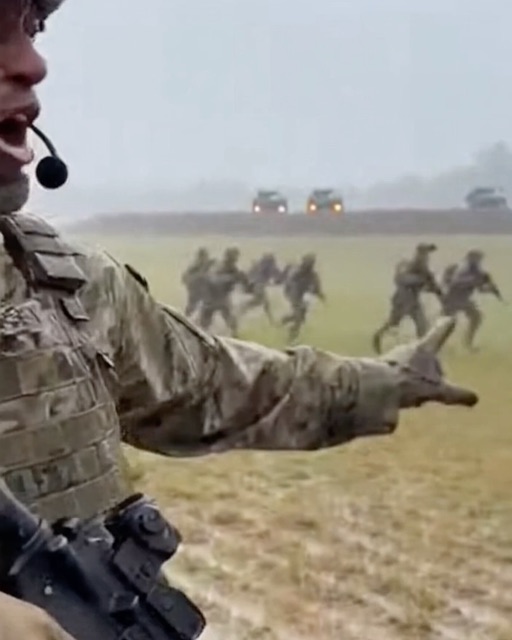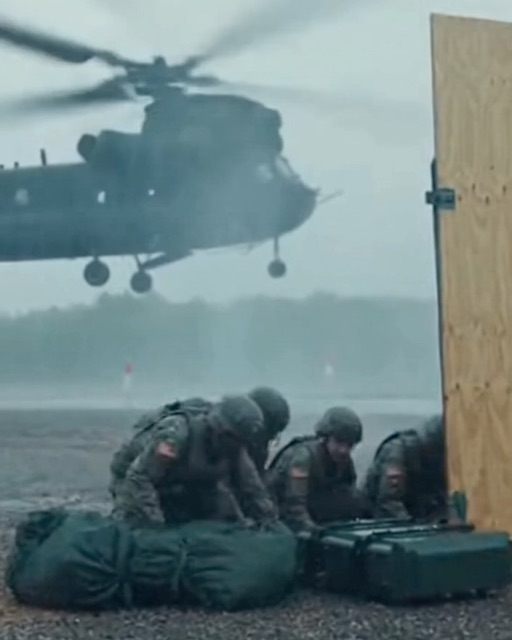
The rain was blinding, but the rotor wash made it a nightmare.
I tasted mud and aviation fuel as a plywood LZ wall buckled in the wind. I didn’t think. I just dove, shoving my two comms guys flat and taking the full crushing weight of the panel on my own shoulder.
My collarbone screamed, but there was no time. “Keep the chalk low!” I yelled, scrambling up.
That’s when I saw him. A private, completely frozen at the edge of the approach path. His eyes were wide, his body locked, blocking the rest of the squad while the chopper hovered.
I stepped right into the violent wash, grabbed him by the shoulder straps, and screamed in his face. “You aren’t watching the bird! You are loading it! Move!”
I practically threw him through the doors. Sergeant Travis hauled him in and gave me a slow, approving nod as the helicopter finally lifted off into the black sky.
We were safe.
I slumped against the bulkhead, breathing hard. The kid I shoved was shivering violently in the corner, his face completely caked in thick, brown mud.
I pulled a rag from my vest and leaned over to wipe his face so our medic could check his pupils.
But as the mud smeared away, my blood ran absolutely cold.
He wasn’t wearing our unit patch. He wasn’t even wearing an American uniform. And when I finally looked down at the dog tags hanging outside his collar, I realized exactly who I had just loaded onto our bird.
They weren’t dog tags.
It was a single, crudely stamped piece of metal on a leather cord. On it was an Arabic name and a simple line drawing of a falcon.
My heart hammered against my ribs. Travis saw the look on my face and crawled over, his expression hardening.
“What is it, Miller?” he hissed, his hand instinctively going to the sidearm on his hip.
I just pointed. I couldn’t find my voice.
The medic, Peterson, was already over us. She didn’t ask questions, just gently pushed me aside and shined a penlight in the boy’s eyes. He flinched but didn’t fight.
He looked maybe sixteen. Maybe.
His uniform was a mismatched set of local militia garb, worn and faded. The kind worn by friend and foe alike, depending on the day and who was paying more.
But the falcon on the tag. I knew that falcon.
A knot of ice formed in my gut. It was the symbol of the very people we’d just been in a firefight with. The insurgents who had pinned us down for six hours in that godforsaken village.
I had just saved one of them.
Travis swore under his breath, a low and vicious sound. “We have an EPW on our hands. Unsecured.”
The rest of the squad in the back of the chopper was starting to notice. The exhausted relief on their faces was curdling into suspicion and anger.
I held up a hand, a gesture that cost my collarbone a fresh stab of agony. “Everybody stand down.”
My voice was rough, but it was a command. They settled, but their eyes were fixed on the boy, hard and unforgiving.
The boy himself just kept shivering. His eyes, now clean of mud, were a deep, dark brown, and they were filled with a terror so profound it felt like a physical presence in the helicopter. He wasn’t looking at us with hatred. He was looking at us like a cornered animal.
“Peterson, check him for weapons,” I ordered, my mind racing.
She did a quick, professional pat-down. Nothing. No knife, no pistol, not even a spare magazine. He had nothing on him but the clothes on his back and the tag around his neck.
This didn’t make sense. An enemy soldier, caught in a firefight, with no weapon?
The flight to the FOB was the longest twenty minutes of my life. The drone of the rotors was a backdrop to the silent, simmering tension in the cabin. I could feel the questions from my men. I could feel their judgment.
I was the squad leader. I had made a call. And it looked like I had made a catastrophic mistake.
As we landed, I knew I had to take control. Before the ramp was even fully down, I was moving.
“Travis, you’re on him. Nobody touches him, nobody talks to him. Get him straight to the tactical operations center. I’ll meet you there.”
Travis nodded, his jaw tight. He grabbed the boy by the arm, not roughly, but with an unbreakable grip.
I went to find Captain Hayes. I knew this was going to be bad.
He was in the TOC, a cramped, air-conditioned plywood box that smelled of stale coffee and stress. He looked up from a map as I entered, his expression already grim.
“Miller. Report. What happened to your shoulder?”
“Took a panel during evac, sir. It’s fine. We have a situation.”
I laid it out, clean and simple. The boy. The uniform. The tag. I left out the part where I physically threw him onto the bird.
Hayes listened without interruption, his eyes boring into me. When I finished, he was silent for a long moment.
“You brought an unvetted, unidentified local national, wearing enemy insignia, onto a secure aircraft and into my FOB.”
It wasn’t a question. It was a statement of fact. A charge sheet.
“Sir, he was frozen. He wasn’t a threat. He was just a kid.”
“A kid who could have had a bomb strapped to his chest!” he shot back, his voice rising. “A kid who could be a scout for the people who just tried to kill your entire squad! What were you thinking?”
“I was thinking about getting my men out of there, sir. He was in the way.”
It was a weak excuse and we both knew it. The truth was, in that split second of chaos, I hadn’t seen an enemy. I had seen a human being in sheer panic, and my instinct was to save, not to question.
That was an instinct that could get people killed.
“He’s a prisoner of war,” Hayes said, his voice flat and cold. “We’ll have the MPs process him. He’ll be handed over to the host nation authorities in the morning.”
My stomach dropped. We all knew what that meant. The local authorities were barely in control and notoriously brutal. A young man from a rival tribe, handed over with no one to speak for him? He’d be lucky if he only got a bullet. More likely, he’d disappear into some dark prison and never be heard from again.
“Sir, with all due respect…”
“Respect?” Hayes cut me off. “Respect is following protocol, Sergeant. Respect is not compromising the safety of this entire base for a ‘feeling’. You’re lucky you’re not facing a court-martial. Now get to the aid station and get that shoulder looked at. That’s an order.”
I stood there for a second, my fists clenched. I had men in my squad who would follow me to hell and back. They trusted my judgment. And today, my judgment had created a mess that was about to get a child killed.
I went to the aid station, but my mind wasn’t on the searing pain in my shoulder. It was on the boy.
Peterson was there, stitching up another soldier’s arm. She glanced at me as the physician’s assistant started examining my collarbone.
“It’s a clean break. Nasty one,” the PA said.
“The kid,” I said to Peterson, keeping my voice low. “Did he say anything?”
She shook her head. “Not a word. Just shivering. He’s in shock, Sergeant. Real, clinical shock.”
Something about that still didn’t add up. An insurgent, even a young one, would be trained. They’d be defiant, or at least sullen. This boy was just… broken.
After they put my arm in a sling, I did something I wasn’t supposed to do. I went back to the TOC. Travis was standing guard outside a small, windowless supply room where they were holding the boy.
“Captain’s orders, Miller. No one goes in.”
“I know, Travis. I know. Just… how is he?”
Travis sighed, running a hand over his tired face. “Quiet. They gave him a bottle of water. He just holds it.”
I looked at my friend, the man who had been by my side for two tours. “I messed up, Trav.”
“You got us out of there,” he said simply. “That’s what matters.”
“Does it?” I asked. “If we leave him to be tortured and killed, what’s the point of any of it?”
He didn’t have an answer.
I couldn’t sleep. The image of the boy’s mud-caked face and terrified eyes was burned into my mind. I kept going back to the tag with the falcon. I’d seen it before.
Then it hit me. It wasn’t just on the enemy.
It was on a map.
Our informant, the one who gave us the intel for this mission, had used that symbol. His name was Tariq. A quiet, older man who ran a small shop in the village. He’d been helping us for months, giving us small but reliable tips.
He had drawn a map for us on a piece of cardboard. In the corner, where he signed his name, he had drawn a small, stylized falcon. His family’s mark, he’d said. A symbol of pride.
Tariq was our ally.
I scrambled out of my cot, my shoulder throbbing in protest, and dug through my gear. I found the map, folded in a waterproof bag. There it was. The same falcon.
The boy wasn’t an enemy. He was Tariq’s son.
My blood ran cold for the second time in twelve hours. Tariq. He hadn’t been at the rally point for extraction. We’d assumed he’d gotten clear on his own when the shooting started.
But what if he hadn’t? What if his own people, the insurgents, had found out he was talking to us?
Suddenly, the whole picture shifted. The boy wasn’t a soldier. He was a survivor. He was probably running for his life when he stumbled into our LZ. His father, our ally, was likely dead. And I had just manhandled his terrified, orphaned son and handed him over for interrogation.
I ran back to the TOC, the folded map clutched in my good hand. I didn’t care about protocol anymore. I banged on Captain Hayes’s door.
He opened it, looking furious. “Miller, I gave you an order…”
“Sir, you need to see this,” I said, pushing past him and spreading the map on his desk under the light. “The tag. It’s not an enemy symbol. It belonged to our informant.”
I explained everything. Tariq. The falcon. The boy’s lack of a weapon. His state of shock.
Hayes stared at the map, then at me. The anger in his face slowly gave way to a calculating stillness. He was a hard man, but he wasn’t stupid.
“This is a theory, Sergeant.”
“It’s the only one that makes sense, sir. Why else would he be there? Unarmed? Terrified of everyone?”
He picked up his radio handset. “Get me the interpreter. Now.”
Minutes later, a local man named Faisel was brought in. We went to the room where the boy was being held.
The boy was sitting on the floor, still holding the water bottle. He looked up at us, his eyes wide with fear as we entered.
Faisel began speaking to him gently in Pashto. The boy didn’t respond at first. He just stared. Faisel tried again, his voice soft and reassuring.
Finally, the boy whispered something. A single word.
Faisel looked at us. “He asks if we are going to kill him.”
My heart broke. I knelt down, ignoring the fire in my shoulder. I looked the boy in the eye.
“Tell him we are not,” I said to Faisel. “Tell him we are friends of Tariq.”
When Faisel translated my words, the boy’s composure finally shattered. A raw, guttural sob tore from his throat, and he began to weep, his whole body shaking.
He spoke in a torrent of words, a flood of grief and fear. Faisel listened patiently, then turned to us.
“His name is Karim,” Faisel said. “Tariq was his father. The insurgents… they found out Tariq was helping us. They came to their house this afternoon. They shot his father in front of him.”
Faisel paused, his own expression pained. “They were going to take Karim. Make him a fighter, or worse. He ran. He ran for hours, just trying to get away. He heard the helicopters and ran toward the sound. He thought it was his only chance.”
The room was silent, save for Karim’s quiet sobs.
I had shoved, screamed at, and terrified an orphaned boy who was running for his life, moments after he had watched his father be murdered for helping my country, for helping my squad.
The weight of it was crushing.
Captain Hayes looked at me, and for the first time, I saw something other than a rigid officer. I saw a man faced with a terrible moral equation.
“This changes things,” he said quietly.
But the twists weren’t over.
“There is more,” Faisel said, after speaking with Karim again. “Before they killed him, his father gave him something. He told him to protect it. To give it only to the Americans with the star on their sleeve.” He pointed to my rank insignia.
Karim slowly, hesitantly, reached into his shoe. He pulled out a small, tightly folded piece of oilcloth. His hands were trembling as he held it out to me.
I took it and carefully unfolded it. It was another hand-drawn map. But this one was different. It showed a series of tunnels and storage caches in the mountains overlooking the valley.
And on it were names.
One name stood out. It was the name of a local police chief, a man we had been working with, trusting, for over a year. A man who sat in on our security briefings.
According to this map, he was the one who had betrayed Tariq. He was the one funneling our plans and our movements to the insurgents.
The ambush we had walked into… it wasn’t bad luck. It was a setup. The police chief had sent us there to die. Tariq’s last act wasn’t just giving us intel; it was giving his son the proof that would save us all.
Captain Hayes stared at the map, his face pale. “Get me intelligence. Wake up the Colonel.”
The entire dynamic of the base shifted. Karim was no longer a prisoner. He was a key witness, a precious asset. He was moved to a private room, given food, and treated with a quiet, solemn respect.
I sat with him, with Faisel translating. I told him I was sorry. I told him his father was a hero, a man of great courage.
He just nodded, his eyes ancient with grief. He asked me one question.
“You saved me?” he asked, looking at me. “When I could not move, you pushed me.”
“Yes,” I said. “I did.”
He reached out his small, thin hand and, for just a moment, placed it on my slung arm. A gesture of forgiveness. A gesture of thanks.
In the days that followed, the intel from Tariq’s map was verified. The police chief was caught, red-handed. The caches were found, full of weapons and explosives. An entire enemy network was dismantled, and dozens, maybe hundreds, of American and local lives were saved.
Karim was the key to it all.
Captain Hayes personally handled his case. He wasn’t handed over to anyone. Calls were made. Favors were pulled. An asylum case was fast-tracked on the grounds of his father’s service and the extreme danger he was in.
Two weeks later, I stood on the tarmac, my arm still in a sling, and watched Karim board a transport plane. He was heading to a new life, to live with a distant relative who had immigrated to America years ago.
He was wearing a new set of clothes. He looked small and impossibly young. Before he walked up the ramp, he turned and looked at me.
He didn’t smile, but he gave me a slow, deliberate nod. The same kind of nod Travis had given me in the helicopter. A nod of approval. Of understanding.
As the plane disappeared into the sky, I thought about that chaotic moment at the LZ. That split-second decision made in the wind and the rain. I hadn’t been thinking about protocol or rules of engagement. I hadn’t been thinking at all.
I just saw a scared kid who needed help.
Sometimes, your gut, your heart, your most basic human instinct, knows the mission better than the command structure does. My duty as a soldier was to get my men on that chopper. But my duty as a human being was to get that boy on it, too. I just didn’t know it at the time. In the end, by fulfilling one, I accidentally fulfilled the other, and in doing so, we honored the sacrifice of a good man and saved ourselves in the process.
The world is a complicated, messy place. But sometimes, a single act of grace, even one born of violence and desperation, can make things right. It can tip the scales, balance the books, and prove that even in the heart of the storm, there is a logic to the universe. A logic that rewards looking past the uniform, past the mud on someone’s face, and seeing the person underneath.