We brought Travis home on a Tuesday. The social worker handed us a file thick with redactions and said, “He doesn’t talk. We don’t know why.”
Travis was seven, small, and clutched a dirty backpack like it held gold bars. He walked into our house and stood in the hallway, staring at his feet.
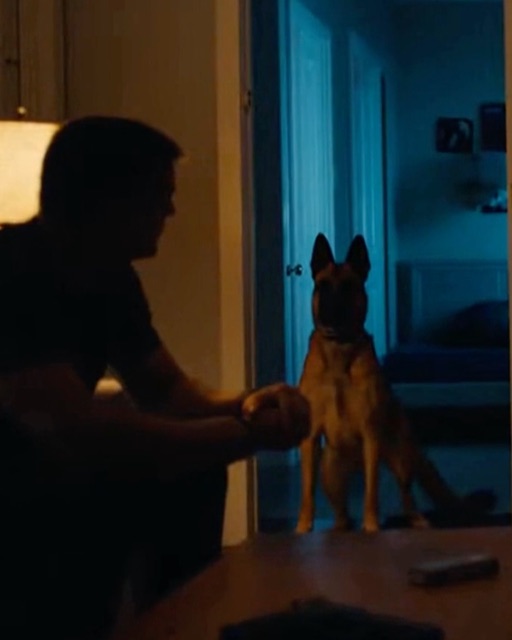
My dog, Brutus, is a retired police Malinois. He’s trained to sniff out narcotics and take down aggressive suspects. He doesn’t do “cuddles.”
But the moment Travis walked in, Brutus froze.
He didn’t bark. He walked over to the boy, sniffed his backpack, and then sat down. A hard, heavy sit. The kind he used to do when he found a stash of heroin in a suspect’s trunk.
“Good boy, Brutus,” I said, confused. “Leave it.”
Brutus didn’t move. He stared at Travis. Then, he shifted his gaze to the ceiling vent above the boy’s head.
For three nights, Brutus refused to sleep in his kennel. He lay across the threshold of Travis’s room, eyes open, watching that vent.
“He’s just protective,” my wife, Ellen, whispered. “It’s sweet.”
“It’s not sweet,” I said, watching the hair stand up on Brutus’s spine. “That’s his alert posture.”
On the fourth night, a thunderstorm rolled in. Thunder shook the house. I woke up to the sound of screaming – not from the boy, but from the dog.
I grabbed my service weapon and ran down the hall.
Brutus was in the boy’s room, launching himself at the wall. He was tearing at the drywall around the air vent, his teeth bloody, snarling like a demon.
Travis was sitting up in bed, pointing at the vent. He looked at me, his eyes wide and terrifyingly calm.
“He found us,” Travis whispered. His first words. “He’s in the tunnels.”
I pulled Brutus back and kicked the vent cover off. I shined my tactical light into the dark, dusty space between the walls.
I expected to see a rat. Maybe a raccoon.
Instead, the beam of my flashlight hit a pair of human eyes. And in the man’s hand was a polaroid photo taken… from inside our house, while we were sleeping.
My blood turned to ice. My training kicked in, a cold wave washing over the shock.
“Police! Show me your hands!” I yelled, my voice a stranger’s roar in the small room.
The eyes blinked. A skeletal hand emerged from the darkness, empty.
“Don’t shoot,” a voice rasped, thin and dry like dead leaves. “Please.”
Ellen was at the door now, her hand over her mouth. I motioned for her to take Travis and get out.
She scooped the boy into her arms, and for the first time, Travis let go of his backpack, leaving it on the bed. He just wrapped his little arms around Ellen’s neck and buried his face.
“Stay down, call 911,” I ordered, my focus entirely on the hole in the wall.
The man began to shift, a slow, agonizing crawl through the narrow space between the studs. He was emaciated, his clothes little more than rags.
He slid out of the wall and collapsed onto the floor, a pile of bones and filth. He couldn’t have weighed more than a hundred pounds.
The polaroid was still clutched in his hand. It was a picture of Ellen and me on the couch, watching TV, dated two nights ago.
The violation of it, the sheer audacity, sent a fresh surge of rage through me. Brutus felt it too, straining against my grip with a low, guttural growl that promised violence.
“Who are you?” I demanded, the barrel of my gun unwavering.
The man coughed, a wracking, painful sound. “I’m Silas.”
He looked past me, his gaze locking onto the backpack on the bed. A flicker of desperate hunger crossed his face.
“That’s mine,” he wheezed. “The boy took it.”
Sirens wailed in the distance, growing closer. The cavalry was coming.
My old partner, Detective Miller, was the first one through the door. He took one look at the scene – the shredded wall, the gaunt man on the floor, me with my gun drawn—and just shook his head.
“Mark, you can’t be retired for five minutes without finding trouble, can you?”
They took Silas into custody. He didn’t resist. He was too weak.
As they led him away, he looked back at Travis, who was peeking from behind Ellen’s legs in the hallway. “You can’t hide from me forever, boy,” Silas hissed. “It belongs to me.”
The house felt contaminated. Officers were everywhere, dusting for prints, mapping out the crawlspace. They found he’d been moving through the walls for days, maybe longer, surviving on who knows what.
They found a small nest he’d made in the attic above the garage, filled with scraps of insulation and empty water bottles. He’d been watching us. Listening to us.
Ellen and I sat at the kitchen table, wrapped in shock blankets we didn’t need, while Travis sat between us. He was finally holding his backpack again, clutching it tight.
“Travis,” Ellen said softly, her voice trembling just a little. “Can you tell us who that man is?”
Travis looked from her face to mine. He took a deep breath, like he was testing the air for the first time.
“He’s my father,” he said, the words small but clear.
The social worker had told us Travis’s parents were gone. A car accident, the file said. It was a lie, or at least, not the whole truth.
Over the next few hours, with the patience of saints and the comforting presence of Brutus at his feet, Travis began to talk. The words came out in a trickle at first, then a slow, steady stream.
His mother, Sarah, had died. But it wasn’t a car accident. It was an “illness,” he said, though his eyes told a different story.
Silas had told him that if he ever spoke about what happened, or about the backpack, he would find him. He would always find him. So Travis had stopped speaking. It was the only way he knew how to be safe.
He’d been moved between three foster homes in six months. He figured Silas had lost his trail.
But Silas had found him. He had found us.
“What’s in the bag, buddy?” I asked, gesturing to the worn canvas on his lap.
He looked down at it, then unzipped a small front pocket. He pulled out a small, leather-bound journal and a single, old-fashioned brass key.
He pushed them across the table to me.
Ellen and I exchanged a look. I opened the journal. The handwriting was neat, feminine. It was a diary. It was his mother’s.
We spent the rest of the night reading it. It painted a picture of a woman trapped, a woman in fear for her life and her son’s.
Silas wasn’t just a bad father. He was a thief. He and a partner had pulled off a heist years ago, stealing a fortune in uncut diamonds. But his partner had betrayed him and disappeared.
Silas had spent years hunting for the man and the diamonds, growing more paranoid and violent with each passing day. He was convinced Sarah knew where they were.
The last entry was chilling.
“He’s getting worse,” Sarah had written. “He thinks I helped his old partner hide the stones. He doesn’t believe me. I found something, though. A key. It was in an old coat of his partner’s. I think it’s the key. I have to get Travis out of here before he finds it. I’m putting this in Travis’s bag. If anything happens to me, this is his only chance.”
The “illness” that took his mother’s life suddenly made a terrifying kind of sense. Silas had probably killed her in his rage, looking for the diamonds or the key.
And he’d been hunting Travis ever since. Not out of fatherly love. He was hunting him for the key.
The next day, Miller called me down to the station. Silas wasn’t talking, except to demand a lawyer and the return of his “property”—the backpack.
“The guy’s a ghost, Mark,” Miller said, sliding a coffee across his desk to me. “No record of a Silas matching his description. He’s lived off the grid for years.”
“His partner,” I said. “The one from the diamond heist. Any idea who that was?”
Miller sighed. “That’s the twist. We looked into old cases matching the timeline from the journal. Found one. A high-end jewelry store heist about ten years back. The main suspect was a guy named Alistair Finch. Finch was found dead a year after the job. Case went cold. The diamonds were never recovered.”
It was a dead end. Finch was gone, and Silas wasn’t talking.
I went home feeling defeated. We had Travis, and he was safe for now, but his past was a shadow that Silas was determined to keep long.
That evening, I was sitting with Travis, helping him with a puzzle. Brutus was asleep at our feet, twitching in a dream.
Travis was quiet, but it was a comfortable quiet now, not a frightened one. He pointed to the brass key, which I’d left on the end table.
“Mommy said it opens a star,” he said simply.
A star? It didn’t make sense.
I picked up the key. It was a safe deposit box key. Standard issue, but old. It had a number stamped on it: 413. But no bank name.
“A star, buddy? Like in the sky?”
He shook his head. He got up and walked over to his backpack, pulling out the journal again. He flipped through the pages until he found a specific one.
He pointed to a small, almost unnoticeable doodle his mother had drawn in the margin. It was a tiny drawing of a compass rose, the kind you see on a map. A north star.
A North Star.
“North Star Bank,” I said aloud. It was a small, local bank downtown. It had been there for fifty years.
My heart started pounding.
I called Miller immediately. He was skeptical, but the lead was too good to ignore. It took a warrant and some legal wrangling, but two days later, we were standing in the vault of North Star Bank.
The bank manager, a portly man with a nervous sweat, led us to box 413.
Miller put the key in the lock. It turned. He slid the long metal box out and placed it on the table.
Inside, we didn’t just find diamonds.
There were stacks of them, yes, glittering under the harsh vault lights, easily worth millions. But they were sitting on top of something else.
There was a second journal. This one belonged to Alistair Finch, Silas’s partner.
And there was a notarized confession, signed by Finch just days before he died.
This was the real twist. Silas hadn’t been betrayed by his partner. He had betrayed him.
The confession laid it all out. Silas had murdered Finch to keep the entire score for himself. But Finch, suspecting he was in danger, had already hidden the diamonds and left a trail for the police, a trail that started with his journal and the key, which he had managed to give to Sarah, begging her to get it to the authorities if anything happened to him.
Sarah must have been too terrified of Silas to go to the police. She had chosen to run instead, trying to save her son.
The diamonds weren’t the real treasure in the box. The confession was. It was enough to put Silas away for life, for the murder of Alistair Finch.
We now had him for kidnapping and unlawful imprisonment of his own son, but murder was a life sentence. Justice for Finch, and for Sarah.
The case was closed. The diamonds were seized as evidence, but the state ruled that a portion would be placed in a trust for Travis, the sole heir of the victim who had helped solve the crime. He was set for life.
But that wasn’t the real reward.
The reward came in the months that followed. The transformation of our home, and of the little boy who lived in it, was the real miracle.
The first time Travis laughed, a real, deep belly laugh, it was because Brutus had tried to “herd” him away from the cookie jar. The sound echoed in the kitchen, and Ellen and I just froze, tears welling in our eyes.
He started school. He made friends. He told stories about his day, his voice growing stronger and more confident.
The backpack was retired to the back of his closet. He didn’t need it anymore. He had us.
One Saturday afternoon, I was out back, throwing a ball for Brutus. The dog, once a hardened police tool, was now just a dog, leaping and playing with pure joy.
Travis came and sat next to me on the steps.
“You know,” he said, looking at Brutus, “he’s a good boy.”
“He’s the best boy,” I agreed, ruffling the dog’s ears as he dropped the slimy ball at my feet.
Travis leaned his head against my shoulder. It was a simple gesture, but it meant the world. It meant trust. It meant home.
“He found me,” Travis said softly. “Brutus found me.”
“Yeah, he did, kiddo.”
But I knew it was more than that. The dog hadn’t just found a stash or alerted to a threat. He had sensed a silent cry for help from a little boy who had no voice.
He had sensed a kindred spirit, one who was trained to be tough but was just looking for a safe place to finally rest.
In the end, it wasn’t about the diamonds or the drama. It was about a boy who had been silenced by fear and a dog who refused to let him stay hidden. They had, in their own strange way, rescued each other.
And in doing so, they rescued us, too, teaching us that a family isn’t just something you’re born into. It’s something you build, sometimes with patience, sometimes with courage, and sometimes with the help of a very, very good dog. The greatest treasures are not the ones locked away in a vault, but the quiet moments of peace you find when the storm has finally passed.