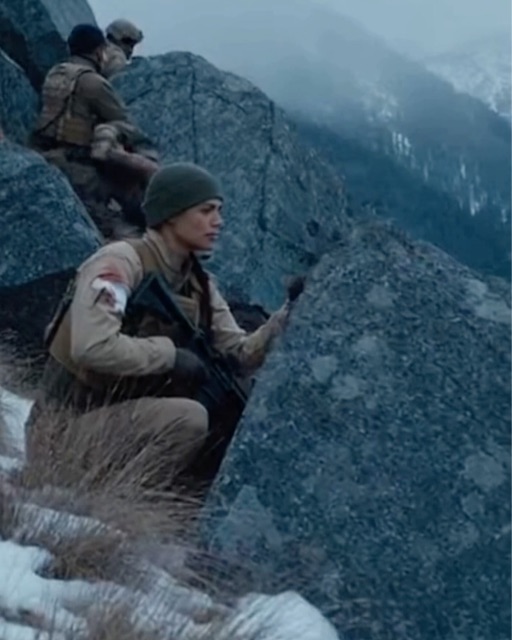
The moon made my blood look black. It soaked my sleeve, hot at first, then icy. I kept the rifle pressed into my shoulder and counted the rhythm – exhale, squeeze, cycle.
“Pressure, now!” the medic barked, hands shoving gauze into the hole near my bicep.
Rounds cracked off the rock. Someone yelled to fall back. I didn’t. If the bone held, I could still work. It held.
They’d flown me in as a “desk analyst” from Fort Meade. Eyes on screens. Words, not bullets. That was the story.
Another burst came in. I rolled, tags catching on my collar and flipping into the open air. Metal against my throat, then cold night.
The team leader’s gaze drifted from my bleeding arm to the chain at my neck. He reached out, thumb rubbing the blackened stamp until the letters cleared.
He froze.
“Say something!” the medic snapped, but nobody moved. The leader just stared at the name like it might explode. The others lowered their rifles an inch, like instinct told them to make space.
“Where’d you get those?” he whispered, not to me – like to the mountain.
I racked another round and kept the lane hot. “Focus. Left ridge. Two by the scrub.”
But he didn’t look left. He turned the tag over, blinked hard, and went pale. I watched his mouth shape a word I hadn’t heard in years, the one that gets doors opened and files sealed and men reassigned overnight.
Then he said my real name, and every face on that ridge changed at once.
“Corbin,” the team leader, Silas, said. His voice was a rasp of disbelief. “You’re Corbin.”
The gunfire seemed to die down for a moment, as if the mountain itself was holding its breath. The name hung in the air, heavy with ghost stories and redacted files.
I fired again, dropping one of the targets on the ridge. “Name’s irrelevant. The mission isn’t.”
But it was too late. The switch had been flipped. These men weren’t looking at a data analyst anymore. They were looking at a legend they thought was a myth, a bedtime story for new recruits.
“Cover us!” Silas yelled, his voice now sharp with an authority I hadn’t heard before. He wasn’t just a team leader anymore; he was a man on a new mission.
We moved like water, flowing back from the ridge to a more defensible overhang. Every movement was precise, professional. But their eyes kept finding me.
The medic, a guy named Ramirez, finally got to work on my arm properly, cinching a tourniquet with grim efficiency. He didn’t say a word, just worked, his jaw tight.
We settled into the darkness of the rock formation. The firefight had faded to sporadic, searching shots. They knew we were here, but they didn’t know where.
Silas knelt in front of me, his face illuminated by the faint glow of his comms unit. He held out his hand. “The tags.”
It wasn’t a request.
I hesitated for a second, then worked the chain over my head and dropped it into his palm. The metal felt warm from my skin.
He stared at the first tag. It had my name, my real one. The one he’d just spoken.
Then he flipped to the second one, tucked behind it. The one he’d seen first. The one that mattered.
“Marcus Thorne,” he read aloud, his voice cracking on the last name. He looked up, his eyes boring into mine. “This was my father’s.”
The quiet that followed was deeper than the silence between gunshots. It was the sound of a twenty-year-old question finding a voice.
“I know,” I said softly.
“He was declared KIA in the Zabul Province,” Silas continued, his tone clinical, like he was reading a report. “Body never recovered. You were on that op.”
It wasn’t a question. He knew. The file was sealed, but men like Silas found ways to read between the black lines.
“I was,” I confirmed.
He leaned in closer, the intensity in his gaze almost a physical force. “The official report said he was compromised holding a pass to allow his unit to escape an ambush. It said you were the only other survivor. A green kid, fresh out of selection.”
“That’s what the report said.” My arm throbbed, a dull, aching bassline to the music of this conversation.
“But that’s not the whole story, is it?” Silas whispered. “Why do you have his tags, Corbin? Why, after all these years, are you here on my team’s op, disguised as a numbers guy?”
I took a deep breath, the cold mountain air stinging my lungs. “Because the story isn’t over. And I came here to finish it.”
I told him then, the words spilling out in the dark. I told him about his father.
Marcus Thorne wasn’t just a soldier; he was a force of nature. He was the kind of man who could read terrain like a book and smell a trap on the wind. I was young, arrogant, and thought I was invincible. He knew better.
The ambush was textbook. We were funneled into a valley, and the world exploded. Our commander, a man far from the action, had pushed us forward on bad intel. Intel he’d been warned was bad.
Marcus knew it was a losing fight. He organized the retreat, a controlled, desperate withdrawal under a hail of fire. He moved from man to man, a pillar of calm in the chaos.
We were almost clear. I was providing cover fire from a rocky outcrop when my position was overwhelmed. I was hit, pinned down, and out of ammo. I was ready to die.
Then Marcus was there. He laid down a wall of lead, dragging me behind a boulder. He was bleeding from a shrapnel wound in his leg, but he smiled at me.
“Not your day, kid,” he’d said, reloading his magazine with steady hands.
He knew he couldn’t make it out. His leg was too bad, and they were closing in. He looked at me, his eyes clear and calm.
“You’re going to run,” he told me. “You’re going to run and you’re not going to look back.”
He took off his tags and pressed them into my hand. “Give these to my boy, Silas. Tell him… tell him I was proud of him.”
Then he shoved a fresh magazine into my rifle. He told me the path to take, the one that would get me out.
“He gave me covering fire,” I told Silas, my voice thick with the memory. “He drew them all to his position while I escaped. The last thing I heard was his rifle, firing until it was empty.”
Silas was silent for a long time, turning the small piece of metal over and over in his fingers. The other team members kept their distance, a silent circle of respect.
“Why didn’t you give them to me?” Silas finally asked, his voice raw. “I was fifteen. I waited. My mother waited. We never heard a word from you.”
This was the hard part. The part that had eaten at me for two decades.
“Because what he told me next,” I said, looking him straight in the eye. “He made me promise something else. He said, ‘Don’t let them lie about this.’ He knew the command would bury it, blame him or the terrain. He knew they’d protect the officer who sent us in there.”
I leaned forward, the pain in my arm a distant second to the urgency in my heart. “His last order to me wasn’t just to survive. It was to find the truth.”
So I became a ghost. I disappeared from the field. I became Corbin, the analyst from Fort Meade. I buried myself in data, in encrypted signals and redacted reports. For twenty years, I’ve been hunting the man responsible.
“General Thompson,” I said.
A flicker of recognition crossed Silas’s face. “Head of Special Operations Command.”
“The same,” I confirmed. “He was the colonel who ignored the warnings and sent your father’s team into that valley. He wrote the report that called it a heroic, unavoidable loss. He got a medal for it.”
The pieces started clicking into place for Silas. His eyes widened.
“This op,” he breathed. “The intel… it came directly from Thompson’s office.”
“It’s another setup, Silas,” I said. “Thompson is dirty. He’s been selling weapons and intel to the very insurgents we’re supposed to be fighting. This mission was designed to get rid of a rival arms dealer in the area, using your team as the muscle. And if you got wiped out? Another tragic, unavoidable loss. Another loose end tied up.”
A new kind of fury hardened Silas’s face. It wasn’t the hot anger of a firefight, but the cold, dense anger of betrayal.
“How do you know?” he asked.
“Because for twenty years, I’ve been tracing his digital shadow. This operation was the final piece of the puzzle. I had to be here, on the ground, to get the final proof.” I tapped the rugged tablet in my pouch. “While you were fighting, I was pulling data from their comms network. It’s all here. Encrypted ledgers, shipping manifests, direct communications from Thompson. Everything.”
The desk analyst story hadn’t been a complete lie. It was just the other half of the truth.
Suddenly, Silas understood everything. My presence. My fighting skill. The dog tags. It was all part of a promise made on a bloody mountainside two decades ago.
He stood up, his decision made. He was no longer just a SEAL team leader following orders. He was a son with a duty to his father’s memory.
“Alright, Corbin,” he said, his voice ringing with renewed purpose. “What’s the play?”
The play was simple, and it was beautiful. It wasn’t about revenge. It was about honor.
We couldn’t just send the data. Thompson would bury it, erase it, and probably have us all eliminated. We had to deliver it in a way that couldn’t be denied.
Using my access as an analyst, I found a back door. Thompson was scheduled for a live, secure video conference with the Secretary of Defense in a few hours. A routine briefing.
Our plan was to hijack that feed.
We moved from the overhang, not back toward exfil, but deeper into enemy territory, towards a small communications outpost I’d identified on the satellite maps. It was a risky, insane move.
The assault was poetry. Silas and his team moved with a silent lethality that was awe-inspiring. They weren’t just fighting an enemy anymore; they were fighting for the soul of their brotherhood, for a man they’d never met.
I stayed in the center of their formation, my rifle up, but my real work was on the tablet. Once they secured the comms room, I went to work, my fingers flying across the screen.
“I’m in,” I said, bypassing layers of military-grade encryption. “I have the feed.”
Silas stood over my shoulder, watching. On the screen, General Thompson’s decorated, confident face appeared. He was in his pristine office, thousands of miles away, completely unaware that his world was about to end.
“Do it,” Silas said.
I didn’t transmit the data files. That was too clinical. Instead, I patched in my own audio.
“General Thompson,” I said, my voice clear and steady.
The General’s face registered confusion, then shock. He recognized my voice, even after twenty years. I saw it in his eyes.
“This is Sergeant Corbin, sole survivor of the Zabul Province ambush,” I announced. The Secretary of Defense’s eyes widened on the other side of the split screen.
“And with me,” I continued, handing the headset to Silas, “is someone you should have spoken to a long time ago.”
Silas took the headset. He held his father’s dog tags up to the small camera on our end. The blackened metal gleamed in the light of the monitors.
“General,” Silas said, his voice shaking with controlled rage, but filled with a profound dignity. “My name is Silas Thorne. My father was Master Sergeant Marcus Thorne. And we’re here to finish his final report.”
For the next ten minutes, we laid it all out. We presented the evidence, the ledgers, the communications. I narrated the data, and Silas told the story of his father’s sacrifice and Thompson’s betrayal. We broadcasted the truth not just to the Secretary of Defense, but to every secure channel I could patch it to.
It was over. There was no denial, no escape. We watched the color drain from Thompson’s face before the feed was cut. We had won.
We slipped away into the pre-dawn light. Exfil was quiet. No one spoke. The mission was a success, but the weight of it was immense.
Back at the forward operating base, we were separated and debriefed for what felt like an eternity. Men in suits asked questions. We told them the truth. The data was undeniable.
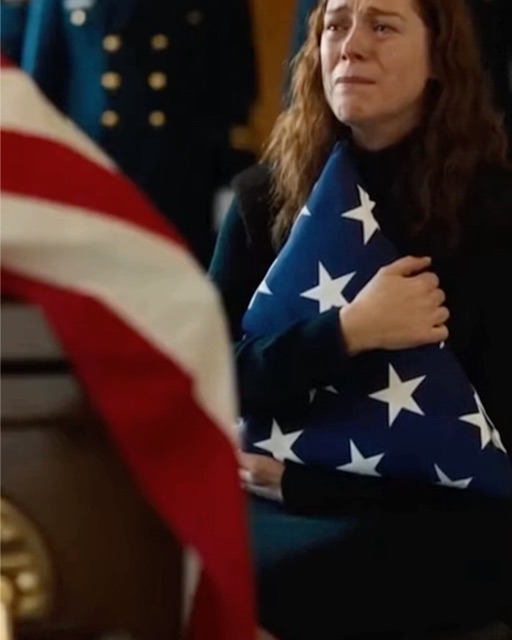
Weeks later, the news broke quietly through official channels. General Thompson was relieved of command, pending a court-martial for treason. Master Sergeant Marcus Thorne was posthumously awarded the Medal of Honor, his file amended to reflect the true nature of his sacrifice.
The last time I saw Silas, it was on a quiet tarmac stateside. He walked over to me, away from his team.
He held out his hand, the dog tags resting in his palm. “These are yours. You carried them for him.”
I shook my head. “No. I was just the delivery guy. They belong to his son.”
I took the single tag with my name on it from the chain and handed the other one back to him. The one with his father’s name.
He closed his hand around it, his knuckles white. He looked at me, and for the first time, I didn’t see a SEAL operator. I saw the fifteen-year-old boy who had finally gotten a message from his dad.
“Thank you, Corbin,” he said. “You kept your promise.”
“It was the most important mission I ever had,” I replied.
We stood there for a moment, two men bound by the legacy of a hero. My war was finally over. The weight I had carried for twenty years was gone, replaced by a quiet sense of peace.
Sometimes, a promise is heavier than any rucksack. It can take a lifetime to carry, through firefights and endless nights spent staring at a screen. But seeing the truth finally find the light, and watching a son finally receive his father’s legacy, I understood. True honor isn’t found in the stories they write about you, but in the promises you refuse to break, no matter how long it takes to keep them.