THEY LOWERED THE FLAG FOR ME AT SUNSET. BY DAWN, I WALKED BACK THROUGH THE GATE.
I was the medic they marked KIA.
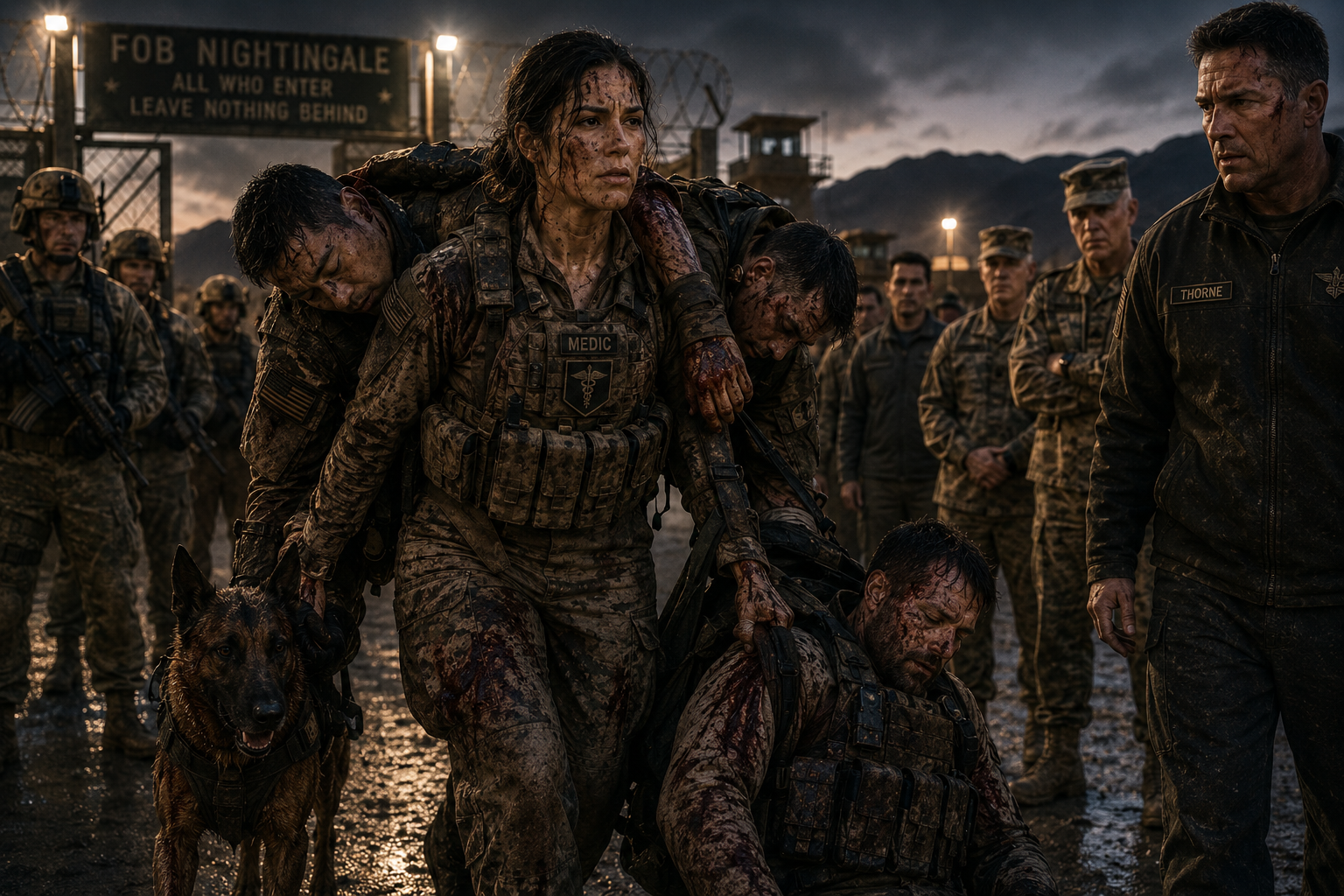
Seventy-two hours alone in the Korengal. One lieutenant across my back. A PO2 slung over my shoulders. A chief dragging by his vest, leaving a line in the dust. My K9, Rook, limping at my heel.
The mountains chewed us up. I kept their lungs working with MRE plastic and tape. I rotated a tourniquet every ninety minutes, whispering numbers to keep time when my watch died. I stitched in the dark while fighters hunted us by the sound of our breath.
They sealed the east gate.
I heard the rotors once. They turned away.
When I stepped through the wire, the base went silent. Medics swarmed the stretchers. Someone whispered my name like a ghost.
Captain Curtis Thorne pushed forward, barking for “official debrief.” He tried to talk over the blood on my hands. He tried to talk over the three men who were supposed to be dead.
“We called for extraction seventeen times,” I said. My voice came out sandpaper and nails. “You heard us.”
His jaw flexed. “Tactical no-go.”
“Then why did I hear your birds?”
The lieutenant blinked awake on the litter. “She carried me for three days,” he rasped. “Your math is wrong, Captain.”
Rook pressed into my leg. My knees shook. I didn’t sit.
I reached into my vest and pulled out a battered recorder. Sealed in tape. Red dust in every crack.
“I kept one more thing alive,” I said.
I switched my radio to command net, held the mic to the speaker, and pressed play. What came out made the Captain’s hand slip off his holster and his face go white, because the first voice on every radio wasn’t mine – it was his, saying…
“…confirming Sierra-Four is KIA. Repeat, all members of Sierra-Four are KIA. Pull back the birds. We are not risking assets for ghosts.”
The recording clicked off. The silence that followed was heavier than any explosion.
Every radio on base had broadcast his words. Every soldier, every cook, every mechanic at their post heard the order to abandon us.
Captain Thorne’s face was a mask of disbelief, then fury, then pure, undiluted panic. He looked around for an ally, for someone to back him up.
He found only a hundred pairs of accusing eyes.
“That recording is… it’s doctored,” he sputtered, finding his voice. “This medic is clearly suffering from extreme trauma. She’s delirious.”
I didn’t say a word. I just stood there, letting the dust of the men I carried settle on the ground between us.
Then, another voice cut through the tension. “Captain Thorne.”
Colonel Wallace, the base commander, pushed through the crowd. He was an older man, with lines around his eyes that spoke of long years and hard decisions. He didn’t look at Thorne. He looked at me.
“Corporal,” he said, his voice quiet but carrying immense weight. “Are you injured?”
“My men are secure, sir,” I said. It was the only answer that mattered.
He nodded slowly. He finally turned his gaze to Thorne. “Captain, you will relinquish your sidearm and report to my office. Now.”
Thorne’s mouth opened and closed like a fish. “Sir, with all due respect, this is insubordination…”
“The only thing happening right now, Captain,” the Colonel said, his voice dropping to a dangerous low, “is you following a direct order. Two of my MPs will escort you.”
Two stone-faced military police officers stepped forward. They didn’t touch Thorne, but the message was clear. His authority had evaporated into the dusty air.
As they led him away, my legs finally gave out. The world tilted, the noise of the base fading to a dull hum.
The last thing I saw before the darkness took me was Rook, my brave dog, being gently lifted by a vet tech, and the lieutenant, Marcus, trying to sit up on his stretcher, pointing at me, his eyes fierce with a loyalty I had earned in blood and miles.
I woke up in the infirmary. The sheets were clean and white, a stark contrast to the grit and grime that felt permanently etched into my skin.
An IV was taped to my arm. The low, steady beep of a heart monitor was the only sound.
For a moment, I was back in the mountains, the beep a substitute for my dead watch, counting the ninety minutes between tourniquet rotations. I jolted upright, my hand reaching for a weapon that wasn’t there.
A gentle hand on my shoulder stopped me. It was a nurse, her face kind. “Easy there, Corporal. You’re safe. You’re back.”
The words didn’t quite register. What did ‘back’ even mean?
I spent three days in that bed. My body ached in ways I didn’t know were possible. They told me I had severe dehydration, exhaustion, and a dozen deep tissue bruises. They didn’t have a name for the weight I felt in my soul.
On the second day, I had visitors.
Lieutenant Marcus was in a wheelchair, his leg in a cast. Chief Miller had his arm in a sling. PO2 David had bandages on his head but walked on his own. They wheeled and shuffled their way to my bedside. Rook trotted beside them, his limp less pronounced, a cone of shame around his head. He ignored it and immediately rested his chin on my bed, his big brown eyes fixed on me.
We didn’t talk much at first. We didn’t have to.
We just looked at each other, the survivors of Sierra-Four. The ghosts who walked home.
“Heard they’re trying to keep a lid on it,” Chief Miller said finally, breaking the silence. He was the oldest, a career Navy man who’d seen a dozen Captain Thornes in his day.
“Thorne’s lawyers are claiming the recording was made under duress,” Marcus added, his young face tight with anger. “That you’re an unreliable narrator.”
Unreliable narrator. I’d carried him on my back for fifty miles, and they were calling me unreliable.
I stroked Rook’s head. “The recorder doesn’t lie.”
“They’re saying you could have edited it. That you’re a tech wizard,” David said quietly. He was always the quiet one. “They’re trying to paint you as unstable.”
That was the twist, wasn’t it? The real one. Not the ambush, not the three days alone. It was coming home and realizing the enemy wasn’t just in the mountains. Sometimes, he was in the command tent.
“He left us there to die,” I whispered. The words tasted like ash. “Why?”
No one had an answer. The official story from Thorne was that the enemy presence was too overwhelming. A ‘tactical no-go.’ But that didn’t explain the cold finality in his voice on that recording.
Colonel Wallace visited me that evening. He stood by the window, looking out at the mountains that had almost claimed me.
“Thorne has powerful friends, Corporal. His father is a retired general,” he said, without turning around. “They’re pushing back hard. They want this to be a field inquiry, a slap on the wrist for a bad judgment call.”
My hands clenched the thin hospital blanket. “Sir, it wasn’t a bad judgment call. It was a death sentence.”
He finally turned to me. “I know. I listened to the raw tape myself. Seventeen calls for evac. Seventeen times you identified your position. Seventeen times you were met with silence until that final, damning order.”
He pulled a chair up to my bed. “So tell me. From the beginning. Off the record.”
And so I told him. I told him about the mission brief, how the intel seemed shaky from the start. A supposed weapons cache in a village that was supposed to be friendly.
I told him how the “friendlies” opened fire before we were even fifty feet inside the village perimeter. How the ambush felt too perfect, too precise.
I told him about the first few hours, pinned down, the lieutenant’s leg shattered, the chief taking shrapnel to the arm. I told him how I started making the calls for evac, my voice calm at first, then pleading.
And I told him about the silence. The chilling, absolute silence on the command net.
“He was tracking our comms,” I said, the realization dawning on me even as I spoke. “He knew we were alive every time I keyed the mic. He just kept waiting for us to go quiet for good.”
The Colonel listened, his expression unreadable. When I finished, he was quiet for a long time.
“There’s one thing I don’t understand, Corporal.”
“Sir?”
“The recorder. Why did you turn it on?”
I thought back to that moment. Pinned down, the radio silent, a feeling of dread coiling in my stomach. It wasn’t just a feeling that we were in trouble. It was a feeling that we were betrayed.
“Call it a hunch, sir,” I said. “Thorne was so eager for this mission. He personally selected our team. He said securing this cache would be a career-maker for him. When the intel turned out to be bad, I just got this feeling… this feeling that he’d rather we didn’t come back to talk about it.”
The Colonel’s eyes hardened. “A career-maker.” He stood up, the legs of the chair scraping softly on the linoleum. “Thank you, Corporal. You get some rest. Let the system work.”
But I had seen how the system worked. It sealed the gates. It called you KIA. It heard your calls and turned away.
The next week was a blur of formal interviews and medical checks. Thorne was confined to his quarters, but his presence was everywhere. Whispers in the chow hall. Soldiers who wouldn’t meet my eyes. I was no longer just a medic. I was a problem. A controversy.
The men of Sierra-Four, however, were my rock. We were a strange, broken little family. We’d eat together, limp together, and sit in silence together. They never doubted me for a second.
It was Chief Miller who found the real answer. He’d been in the service for twenty-five years. He knew people. He made calls. He drank coffee with old Master Sergeants and traded favors with clerks who had access to personnel files.
He found me by the K9 kennels, where I was helping groom Rook.
“I know why he did it,” he said, his voice low.
He told me that Captain Thorne was up for a promotion. A big one. It would take him out of the field for good and put him behind a desk at the Pentagon. It was everything he’d ever wanted.
“The promotion was contingent on his command sector being ‘clean’ for the quarter,” the Chief explained. “No major incidents. No black marks on his record.”
I stopped brushing Rook. “A team getting ambushed and wiped out isn’t a black mark?”
“Not if it’s unavoidable,” he said grimly. “A heroic last stand against overwhelming odds? That’s just a tragedy. The brass pins a medal on the flag-draped coffins and moves on. But a team getting ambushed because of bad intel that he personally vetted? A team that gets extracted, comes back, and files a report saying the Captain’s intel was garbage? That’s a career-ender.”
It all clicked into place. The bad intel. His eagerness. The silence.
“He couldn’t afford for us to come back,” I said. “He needed us to be martyrs.”
“He was rolling the dice,” the Chief nodded. “Hoping you’d all go down fighting. When you kept calling, kept surviving… you became a problem he had to solve. So he declared you KIA. He silenced you.”
The preliminary hearing was held a few days later in a sterile, windowless room. It wasn’t a court-martial, just an Article 32 hearing to determine if there was enough evidence to proceed.
Thorne was there in his crispest uniform, flanked by two lawyers in sharp suits. He looked confident, rested. He looked like a man who knew how to work the system.
His lawyer was slick. He portrayed Thorne as a decisive commander making a tough call. He painted me as a distraught, traumatized soldier whose memory couldn’t be trusted. He argued the recording was a violation of protocol.
When I took the stand, he was relentless.
“Corporal, isn’t it true you were suffering from sleep deprivation? Dehydration? Isn’t it possible you misheard things? That you conflated your fear with reality?”
“I know what I heard,” I said, my voice steady.
“And this recording,” he went on, holding up a picture of my battered device. “You expect this board to believe that in the middle of a firefight, you had the presence of mind to start recording your commanding officer? It seems… theatrical. Almost like you were trying to create evidence.”
I saw a few officers on the board nod, their faces skeptical. My heart sank. He was twisting my survival into a ploy.
Then, it was Lieutenant Marcus’s turn to testify. He was wheeled to the front of the room. He looked Thorne directly in the eye.
He recounted the ambush, the injuries, my efforts to keep them alive. He was clear, precise, and unshakable.
Thorne’s lawyer tried the same tactics. “Lieutenant, you had a serious head injury. Your memory could be compromised.”
“My memory is fine,” Marcus said calmly. “I remember the Corporal carrying me. I remember her treating my wounds. And I remember her begging for an extraction that never came.”
Then came the part I never saw coming. The twist that wasn’t about the enemy, but about us.
“But my testimony isn’t the most important thing I have to offer today,” Marcus said, looking at the board. “During my recovery, I had some downtime. And my family… well, my father is a forensic accountant. He’s very good with patterns. I asked him to, uh, consult.”
A murmur went through the room. Thorne’s lawyer shot to his feet. “Objection! This is completely irrelevant!”
“Let the Lieutenant speak,” Colonel Wallace commanded from his seat on the board.
Marcus nodded. “My father doesn’t know much about military tactics. But he knows about people who cut corners to protect their bottom line. At my request, and through proper, legal channels via a congressional inquiry my uncle helped expedite, he was granted access to Captain Thorne’s command history.”
Captain Thorne went rigid. His face, for the second time since my return, turned bone white.
“We found a pattern,” Marcus continued, his voice ringing with conviction. “Three other incidents in the last two years. A patrol that was sent into a ‘cleared’ valley and took heavy casualties. A logistics convoy that was rerouted onto a road known for IEDs. An intel specialist who was transferred out of theater just before he could file a report on inconsistent enemy assessments.”
“In every case, Captain Thorne was the officer of record. In every case, a tragic loss was declared. And in every case, Thorne received a commendation for his ‘grace under pressure’ while avoiding any negative repercussions that would have stalled his career.”
He held up a data stick. “It’s all on here. Incident reports, personnel transfers, and the sworn affidavits of two other soldiers who, until now, were too afraid to speak out. Your Honor, my medic didn’t just record a single crime. She stumbled upon the loose thread that unraveled a whole career built on the blood of soldiers he deemed expendable.”
The room was utterly silent. Thorne’s slick lawyer was speechless. Thorne himself looked like a man who had not just been caught, but completely and utterly dismantled.
He wasn’t just a coward who made one bad call. He was a predator who used his own men as stepping stones.
The Article 32 hearing ended. A full court-martial was recommended and swiftly approved. The evidence was too overwhelming. The testimony of the other soldiers Marcus had found sealed his fate.
Thorne was dishonorably discharged and sentenced to life in prison at Leavenworth. His father’s connections couldn’t save him. The system he had manipulated for so long had finally, irrevocably, turned on him.
My reward wasn’t a medal, though they gave me a Silver Star. It wasn’t the quiet promotion they offered me, which I politely turned down. I was a medic. I belonged with my soldiers.
My real reward was seeing Chief Miller, PO2 David, and Lieutenant Marcus fully recovered, standing tall at the ceremony. It was feeling Rook’s wet nose nudge my hand, his limp completely gone.
It was knowing that the truth I carried back from that mountain, heavier than any man on my shoulders, had finally seen the light of day.
They lowered the flag for me once, thinking I was a casualty of war. In a way, I was. But I walked back through that gate not as a ghost, but as a witness. The lesson I learned wasn’t about the enemy you can see, but the one you trust. True loyalty isn’t just about following orders; it’s about protecting the people you lead, even from yourself. And sometimes, the most important thing you can carry out of a fight isn’t a weapon or a wounded brother, but the simple, unvarnished truth.