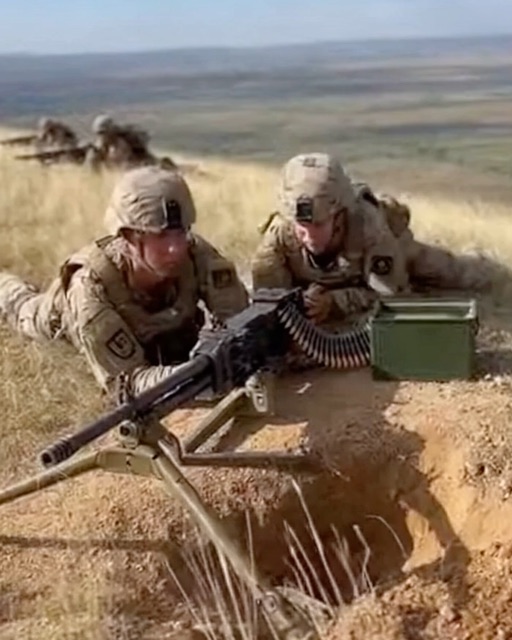
The wind was ripping across the ridge when Staff Sergeant Horvath noticed the gun team scrambling.
The tripod had sunk. The whole system was canted wrong. The beaten zone was pointing into dead space instead of the engagement area.
Specialist Dwyer, the gunner, was already sweating. His assistant, Private Kowalski, was practically wrestling the earth trying to fix the leg.
The lane window was closing.
Horvath started jogging toward them. But Sergeant First Class Mullins, the platoon sergeant, grabbed his sleeve from behind.
“Wait,” Mullins said. “Watch.”
Horvath froze.
From the tree line, three soldiers from the rifle team broke formation without being told. Corporal Thao dropped beside the tripod and started packing rocks under the sunken leg. Private First Class Beckman held the receiver steady so the barrel wouldn’t shift. Specialist Vance repositioned the ammo cans so the belt would feed clean.
No one spoke.
They just moved.
Dwyer adjusted. Breathed. Rechecked. The barrel came back on line.
The whole correction took maybe fifteen seconds.
The gun was up. The lane was covered.
Horvath exhaled. “That was close.”
Mullins didn’t respond. He just watched.
When the exercise ended, Mullins walked up to the section leader, Sergeant Terrell, who was checking the gun team’s equipment.
“Why didn’t you just tell Dwyer to fix it himself?”
Terrell looked up. His face was calm.
“Because sergeant, that gun doesn’t belong to one soldier. It belongs to the platoon.”
Mullins nodded slowly. He’d been in the Army twenty-two years. He’d seen teams fall apart over less. He’d seen soldiers let their brothers struggle because the task “wasn’t their job.”
But this.
This was something else.
Later that night, back at the patrol base, Mullins pulled Horvath aside.
“You know why I stopped you from running up there?”
Horvath shook his head.
“Because I needed to see if they’d figure it out themselves.” Mullins paused. “And they did. That’s not training. That’s culture.”
Horvath thought about it. He thought about all the times he’d seen soldiers freeze when something went wrong. Wait for orders. Wait for someone else to take the risk of making a decision.
“What do you do when they don’t figure it out?” Horvath asked.
Mullins looked toward the ridge, now dark against the sky.
“You go back to the beginning. You teach them that the weapon isn’t theirs. The mission isn’t theirs. It belongs to everyone, or it belongs to no one.”
He turned back to Horvath.
“But these ones?” He almost smiled. “These ones already know.”
Horvath nodded.
But something still nagged at him. He’d been watching the gun team all day. And he’d noticed something during that scramble on the ridge. Something no one else seemed to catch.
It was Vance.
When Vance repositioned those ammo cans, he wasn’t looking at the gun.
He was looking at Dwyer.
And his hands were shaking.
Horvath didn’t know what it meant. But three days later, when the after-action reports came in from battalion, he found out.
Vance had submitted a sworn statement that morning.
And the first line read: “I am reporting what I witnessed Specialist Dwyer do on the night of…”
Horvath’s stomach turned to ice. He read the line again.
The date Vance cited was from two weeks ago, during a night qualification range.
He folded the paper and walked straight out of the command tent, looking for Mullins.
He found the Platoon Sergeant by the maintenance bay, watching a private struggle with a stubborn lug nut on a Humvee.
“Sergeant,” Horvath said, keeping his voice low.
Mullins turned, his eyes taking in Horvath’s expression in an instant. “What’s wrong, Staff Sergeant?”
Horvath handed him the folded sheet.
Mullins read it. His face, usually a mask of calm experience, tightened at the corners of his mouth.
He read it a second time, slower.
“Get me Vance. Get me Dwyer. And get me Sergeant Terrell. My tent. Five minutes.”
Mullins’ voice was quiet, but it carried the weight of a coming storm. He didn’t ask questions. He gave orders.
Horvath found Terrell first. He explained the situation in clipped sentences.
Terrell’s face went pale. “Vance? Against Dwyer? That makes no sense.”
“That’s what the paper says.”
Next, he found Vance, sitting alone, cleaning his rifle with a meticulous, almost frantic energy.
“Platoon Sergeant wants to see you,” Horvath said.
Vance looked up, and Horvath saw a flicker of something in his eyes. It wasn’t malice. It looked like fear.
“Yes, Sergeant,” Vance said, his voice barely a whisper.
Dwyer was the last one. He was joking with Kowalski and Thao, the tension of the ridge forgotten.
When Horvath called his name, Dwyer’s smile didn’t fade. “What’s up, Sergeant?”
“Platoon Sergeant’s tent. Now.”
The smile vanished. Dwyer’s eyes darted around, as if looking for an unseen threat.
In Mullins’ tent, the air was thick enough to chew. The space was small, smelling of canvas and old coffee.
Mullins sat on a footlocker, the sworn statement held loosely in his hand.
Terrell stood by the flap. Vance and Dwyer stood in the middle, a careful foot of space between them.
They wouldn’t look at each other.
“Alright,” Mullins began, his voice soft. “I’ve got a piece of paper here. It’s an official statement. From you, Specialist Vance.”
Vance flinched but said nothing.
“It alleges,” Mullins continued, “that you witnessed Specialist Dwyer do something two weeks ago.”
Dwyer’s head snapped up. He stared at Vance, a look of utter betrayal on his face.
“What is this?” Dwyer demanded, his voice cracking. “Vance, what did you do?”
“Shut up, Dwyer,” Mullins said calmly. “It’s his turn to talk.”
All eyes turned to Vance. He was trembling now, just like he had been on the ridge.
“Specialist,” Mullins prompted. “The floor is yours. Tell me what this is about.”
Vance swallowed hard. He opened his mouth, but no sound came out.
He looked at Dwyer, then at the canvas floor.
“I… I had to,” he finally stammered. “I didn’t know what else to do.”
“Had to do what?” Terrell cut in, his voice sharp with frustration.
“He froze,” Vance whispered. The words hung in the dead air of the tent.
Dwyer stiffened as if he’d been struck.
“Two weeks ago,” Vance went on, his voice gaining a desperate strength. “On the night qual. A flare misfired. It landed short, right in front of our position.”
He took a ragged breath.
“It wasn’t a big deal. But he just… stopped. He was on the gun, and he just stared at the fire. Didn’t move. Didn’t breathe.”
Vance finally looked at Dwyer. “I had to shake you. Twice. It was only for a few seconds, but what if it hadn’t been a flare? What if it was real?”
Dwyer’s face was a mask of shame. He said nothing.
Mullins looked from one soldier to the other. “And this is what you’re reporting? That he froze for a few seconds?”
“No, Sergeant,” Vance said, shaking his head. “That’s not all.”
He looked back at Mullins. “On the ridge, three days ago. The tripod didn’t just sink into soft dirt. Dwyer kicked it.”
A collective silence fell over the tent.
Horvath’s mind reeled. He replayed the scene in his head. The scramble. The sweat on Dwyer’s face.
“He kicked it,” Vance repeated, his voice thick with emotion. “I saw him. It was subtle. He was trying to get the leg to settle, and he just… shoved it. Hard. It’s why it sank so bad. He was panicking.”
Dwyer finally broke. “That’s not true! I was fixing it!”
“No, you weren’t,” Vance shot back, tears welling in his eyes. “You were buying time. You didn’t want to fire. I saw it on your face, man. The same look as at the night range.”
Mullins held up a hand, and the tent fell silent again.
He looked at Dwyer. “Specialist. Is this true?”
Dwyer stared at the ground, his jaw clenched. He gave a tiny, almost imperceptible nod.
“Why?” Mullins asked, his voice still quiet, patient.
Dwyer looked up, his eyes pleading. “I don’t know, Sergeant. I just… I get this noise in my head. Everything gets loud, and then it gets quiet. And I can’t move.”
He looked at Vance. “I never meant to put anyone in danger.”
“So you filed a sworn statement,” Mullins said, turning his gaze back to Vance. “You know what this could do to his career? To this platoon?”
“I know,” Vance said, his voice breaking. “But what was I supposed to do? I talked to him. I told him he needed to see someone. He told me to forget it, that he was fine.”
Vance’s hands were fists at his sides. “And then I saw it happen again on that ridge. And Thao and Beckman and Kowalski… they all covered for him. We all did. We fixed the gun and acted like it was just an equipment malfunction.”
“It’s what we do,” Terrell said defensively. “We take care of our own.”
“But is that taking care of him?” Vance asked, his voice rising. “Or are we just waiting for him to get one of us killed? Or himself?”
He looked at Mullins, his expression desperate. “I went to the chaplain. I went to the medics. They all said without him admitting it, or without a formal report, their hands were tied. So I filed one. I put my name on it because… because that gun belongs to the platoon. And that means Dwyer belongs to the platoon, too. Even the broken parts of him.”
The twist wasn’t malice. It wasn’t betrayal.
It was a clumsy, desperate, rule-breaking act of loyalty.
Mullins stood up. He walked over to the sworn statement, which he’d set on a crate. He picked it up.
He looked at Vance. He looked at Dwyer, who was now openly weeping. He looked at Terrell and Horvath.
Then, he slowly and deliberately tore the paper in half.
And then in half again.
And again, until it was just a small pile of confetti in his palm.
“There is no statement,” Mullins said, his voice leaving no room for argument. “This meeting never happened.”
He let the pieces of paper fall to the floor.
“Terrell, Horvath, Vance. Out.”
The three of them filed out of the tent without a word, leaving Mullins alone with Dwyer.
Horvath stood outside, the cool night air feeling sharp in his lungs. He could hear the low murmur of Mullins’ voice from inside the tent, but couldn’t make out the words. It wasn’t yelling. It was calm.
After ten long minutes, Dwyer came out. His eyes were red, but his shoulders were less stooped. He walked over to Vance.
Vance braced himself.
Dwyer stopped in front of him. He didn’t say anything. He just pulled Vance into a hug.
“Thank you,” Dwyer sobbed into his shoulder. “I’m sorry.”
Vance just held him, patting his back.
The next morning, Mullins called a platoon formation.
“Specialist Dwyer is going on rear detachment for a while,” he announced. “He’s got some personal matters to take care of. We’re going to support him. Understood?”
“Hooah,” the platoon rumbled back.
There were no whispers. No side-long glances.
Later, Horvath found Mullins cleaning his sidearm.
“What you did back there, Platoon Sergeant…” Horvath started. “Destroying that statement. You could get in a lot of trouble for that.”
Mullins didn’t look up from his work. “What’s more important? A piece of paper, or a soldier’s life? Or the lives of the men who depend on him?”
He finally met Horvath’s eyes. “Vance broke the soldier’s code. He snitched on his brother. And he did it for all the right reasons. He did it because he understood my lesson better than I did.”
Horvath looked confused. “What do you mean?”
“I told you the weapon and the mission belong to everyone,” Mullins said, wiping a patch down the barrel. “But I left something out. The men belong to everyone, too. Their fears. Their burdens. Their secrets. Vance knew we couldn’t just patch the problem and move on. He forced us to fix the man, not just the gun.”
He paused. “He risked his career for Dwyer. That’s a different kind of courage.”
Over the next few months, things changed.
Dwyer got the help he needed. He was diagnosed with severe post-traumatic stress, stemming from an incident on his first deployment that he’d never talked about. He was eventually medically retired, with full honors.
He kept in touch with the platoon. He sent them pictures of his new life, working at a quiet state park, a genuine smile on his face.
Vance wasn’t ostracized. He was respected. The men understood, in that unspoken way soldiers do, that he had made a hard choice to save one of their own. His bond with the platoon became stronger than ever.
The platoon itself became legendary. Their cohesion was unbreakable. They moved with an instinct that other units could only dream of, built not just on training, but on a deep, unconditional trust.
One evening, long after, Horvath was the Platoon Sergeant now. He stood on a ridge, watching a new gun team scramble.
A young Staff Sergeant jogged up to him, ready to intervene.
“Wait,” Horvath said, putting a hand on his sleeve. “Watch.”
He watched as a rifleman broke off and helped steady the tripod. He saw the team leader instinctively reposition the ammo.
They figured it out. Together.
Horvath smiled.
Sometimes, the most important part of a weapon system isn’t the steel or the brass. It’s the hands that steady it. And sometimes, the heaviest thing a soldier carries isn’t his pack or his rifle. It’s his brother. The real test of a team isn’t how they perform when things go right, but how they lift each other up when everything goes wrong. It’s a simple lesson, but one that is written on the heart of every great unit: it all belongs to everyone, or it belongs to no one.