The light slid across the canvas at the wrong angle. Too slow. Too low. Not ours.
I felt my pulse climb into my throat.
“Ten mikes. Wheels up,” Byron at comms murmured, calm as a metronome.
Most days I’m the woman in the container. I keep the lights soft, the meds labeled, the blood warm, the coffee strong. I’m Brooke Aldridge. The flag over the door hangs where the air barely moves. It’s not for show.
Earlier, I’d said one thing and one thing only: “We need a backup route. If the plan shifts, we still get people to this door.”
Senior Chief Wade Voss studied me like he was going to argue. He didn’t.
“Then give me one.”
So I did. Simple and ugly. A pickup point out of the sight lines. A phrase that turns the base quiet without panic. He wrote it down. He used it.
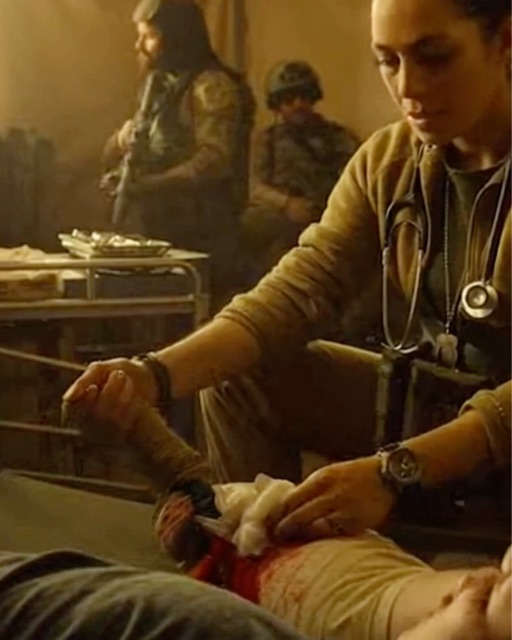
Now the bay was a heartbeat of hands and gloves. I could hear the sterile pack crack. Casey, my medic-in-training, stayed at my shoulder.
“Stay with me,” he told the patient, voice steady. “You’re good. You’re okay.”
Then the air changed. I can’t explain it except my skin knew before my eyes did. Footfalls outside. Not ours. Too light. Too quick.
“Brooke?” Casey whispered.
I didn’t raise my voice. I lifted one finger. Every movement in the tent thinned to a whisper. Heads turned. Hands froze – without dropping.
“Byron,” I said, even. “Activate Lantern.”
His chair scraped once. A click. The hum in the room got tighter, like it sucked in a breath and held it.
Voss glanced at me. Then his eyes dropped to my wrist. The small band I’d stopped noticing years ago. The colors. The emblem.
My blood ran cold.
He didn’t look at my face. He stared at my hand like it was a loaded secret.
Outside, a shadow crossed the flap. Another. The light paused. Someone listened.
Voss stepped closer, close enough that I could see the tiny tear in the corner of his eye from desert dust he never wiped. He breathed in like he already knew.
“Ma’am,” he said, voice barely there. Not a question. A recognition that made my jaw lock.
Casey looked between us, confused. “What is Lantern? What are we – ”
Before I could answer, the radio cracked so hard it felt like it snapped the room in half. A single word hissed through the speaker. Not a call for a nurse. Not a med code.
It was my old name.
And the green light on the handset blinked like an eye, waiting.
The name was Sparrow. A lifetime ago, that was me.
It hung in the air, a ghost in the static. My past wasn’t just knocking; it was kicking the door down.
Casey’s face was a mask of confusion. He knew Brooke Aldridge, the nurse who could find a vein in the dark and calm a screaming soldier with a quiet word. He didn’t know the other person.
The person who invented Lantern.
“Lantern isn’t a medical protocol,” I said, my voice low and tight, meant only for Casey and Voss. “It’s a silent alarm.”
“An alarm for what?” Casey breathed.
“For when the people outside the door aren’t the ones who are supposed to be there.”
Voss finally looked at my face. There was no surprise in his eyes, only a deep, weary confirmation. “I saw you on the manifest six months ago. Hoped I was wrong.”
“You were never wrong, Chief,” I murmured.
The flap of the tent was pulled back. Not ripped or rushed. It was a deliberate, professional movement.
Two figures stepped inside. They didn’t wear the dusty, tired fatigues of our unit. Their gear was clean, black, and state-of-the-art. They moved with a liquid silence that made the hair on my arms stand up.
They were not the enemy. They were something far more complicated.
The lead figure, a man with pale eyes that missed nothing, scanned the room. His gaze passed over the patient, over Casey, over Voss, and then it landed on me.
It stayed there.
“Sparrow,” he said. The voice from the radio. It wasn’t a question.
I gave a short, sharp nod. The identity of Brooke Aldridge felt like a costume I was suddenly shedding.
“We need to go,” he said. “Now.”
“I have a patient,” I stated flatly, gesturing to the man on the gurney. His vitals were stable but fragile.
“The patient comes,” the man replied without hesitation. “Everyone in this tent comes. Our orders are specific.”
My mind raced. Orders from whom? Why now?
“Who sent you?” Voss asked, stepping forward slightly, positioning himself between me and the newcomers. It was a protective gesture, and it almost made me smile.
The man’s eyes flicked to Voss. “You’re Senior Chief Wade Voss. You served in the Kandahar province, FOB Cerebus. 2012.”
Voss stiffened. “That’s right.”
“Then you know the answer,” the man said. “You were there for Operation Sundown.”
Voss’s face went pale under his tan. He looked from the man back to me, and the last piece of the puzzle clicked into place for him. “Sundown,” he whispered. “That was your protocol.”
I closed my eyes for a second. Operation Sundown. A mission gone so wrong it had become a cautionary tale whispered to trainees. A mission where a voice on the comms, a strategist no one ever saw, had navigated three separate teams out of a collapsed valley with zero casualties.
That voice was mine.
“The base is compromised,” the man in black said, pulling me back to the present. “This isn’t a localized threat. It’s a full-scale, coordinated attack. It begins in seven minutes.”
Byron spun in his chair. “Comms are clear. There’s no chatter, no warnings.”
“There won’t be,” the man said. “The breach is internal. The perimeter is already a ghost.”
A cold dread washed over me. He was telling the truth. The slow light, the quiet footsteps—it wasn’t a small patrol. It was a silent takeover.
“Why us?” I asked, my voice sharp. “Why this tent?”
“Because you’re in it,” he answered simply. “And because you created the only way out.”
He nodded toward the small, laminated map I’d drawn for Voss earlier. My simple, ugly backup route.
“General Maddox sends his regards,” the man added. “He said to tell you he never forgot the favor.”
Maddox. A young Captain back then. Pinned down, out of options, with a wounded man he refused to leave. I had bent a dozen rules and broken three direct orders to guide him to an alternate extraction point, a dry riverbed I’d noticed on a satellite image.
It had cost me my career. I’d been quietly and unceremoniously discharged, my contributions buried under layers of official reports. I had become a nurse to find a quieter way to save people.
I thought I had buried Sparrow for good. But it seemed she had saved someone who climbed high enough to remember.
“Casey,” I said, my tone shifting. The nurse was gone. The strategist was back. “Pack a secondary transfusion kit and a chest tube set. Lightweight. Go.”
He stared for a second, then nodded and moved with a new urgency.
“Voss,” I turned to the Chief. “You know my methods. I need you to be my eyes on the right flank.”
He didn’t hesitate. “Understood, Ma’am.”
The “Ma’am” still felt foreign, but there was no time to dwell on it.
The man in black, whose name I learned was Kael, pointed to his partner. “This is Ren. We have a vehicle staged at your rally point. It’s armored, but it’s not a tank. We move fast and we move quiet.”
“The patient is on a ventilator,” I said, thinking aloud. “We’ll need to switch to a portable unit. It’ll be loud.”
“We have a sound baffle for it,” Ren, a woman with a calm demeanor, said. She was already unpacking a piece of equipment that looked like a complex foam shell.
We worked in a blur of controlled motion. Casey and I prepped the patient for transport, securing lines, swapping monitors. Kael’s team directed the transfer to a lighter, more mobile gurney. Byron was wiping his comms station, destroying any sensitive data.
Every move was precise. Every sound was muffled. The tent, which minutes before had been a sanctuary of healing, was now the staging ground for an escape.
“Three minutes,” Kael announced quietly.
We were ready. The patient, a young soldier named Peters who had been hit by shrapnel, was secured. His eyes were open, filled with a mixture of fear and trust. I gave his arm a light squeeze.
“We’re just going for a little ride, Peters,” I said, my voice back to its nursing calm. “You just rest.”
Voss took point at the tent flap, peering out into the gathering dark. “Path is clear for now. But the air… it feels wrong.”
I knew what he meant. The usual hum of the base generator was gone. The distant shouts and clatter of a living, breathing outpost had vanished. It was a silence that screamed danger.
“Let’s move,” I ordered.
We slipped out of the tent like ghosts. The path I had chosen was a service route, a muddy track used by water trucks and garbage details. It was unlit and offered the best cover, running along the back of the maintenance sheds.
The sky was a deep, starless violet. No moon. A small mercy.
We moved in a tight formation. Voss and Kael in front, Ren and I on either side of the gurney, and Casey and Byron pulling up the rear. The only sounds were the soft squelch of our boots in the mud and the muffled, rhythmic puff of the portable ventilator.
We passed the back of the mess hall. I could see through a grimy window that the lights were still on, but the room was empty. Plates of food sat half-eaten on the tables. It was like a scene from a nightmare, a place abandoned in a hurry.
A dog started barking somewhere on the base, a frantic, terrified sound that was cut off abruptly.
My heart hammered against my ribs.
“Contact, one hundred meters,” Voss whispered, his voice tight in our ears through the comms Kael had given us. “Two of them. Not ours.”
We froze, melting into the shadows of a large generator. I peered around the edge. Two figures stood silhouetted against the faint glow of the distant command tent. They were holding rifles I didn’t recognize, speaking in low voices.
They were between us and our route.
“I can take them,” Kael murmured, his hand already on his sidearm.
“No,” I whispered back. “A single shot will bring the whole hive down on us. We wait.”
We waited. The seconds stretched into an eternity. The two men outside seemed to be arguing about something, gesturing vaguely towards our position. My mind was a whirlwind of calculations. Angles, distances, options.
Then, Casey stumbled.
It was a small thing. A loose rock, a moment of inattention. His foot slipped, and he knocked over a stack of empty fuel cans with a clatter that sounded as loud as a grenade in the suffocating silence.
The two enemy soldiers snapped their heads in our direction.
My blood turned to ice.
“Move!” Kael hissed, raising his weapon.
But I knew it was too late. They were raising their own rifles. We were caught. Exposed.
In that split second, Voss did something I never would have expected. He broke from our cover and sprinted in the opposite direction, back towards the mess hall.
“Hey!” he yelled, firing his pistol into the air. “Over here!”
The two soldiers, startled, immediately swung their attention and their weapons toward him. It was a textbook diversion. A selfless, stupid, heroic act.
They opened fire, the sound ripping the night apart.
“Go, now!” Voss shouted over the gunfire.
Kael didn’t need to be told twice. He grabbed the front of the gurney, and we surged forward, using the precious seconds Voss had bought us. We ran, Casey pushing from behind with all his might, his face pale with shock.
We cleared the danger zone and ducked behind a row of concrete barriers just as a sickening sound reached us—the thud of bullets hitting a body, and then silence.
There was no time to grieve. There was no time to think. We just had to keep moving.
“He saved us,” Casey choked out, tears streaming down his face.
“Yes, he did,” I said, my voice hard as stone. “Now we make it count.”
We pushed on, the sounds of an awakening enemy camp rising behind us. Shouts, engines starting, the dreaded sweep of searchlights cutting through the darkness.
Our destination was a dilapidated comms tower at the far edge of the base, a relic from a previous occupation. It was our designated pickup point.
We reached the base of the tower, a skeleton of rusted metal. It was eerily quiet here.
“Helo is two mikes out,” Ren reported, her voice calm as ever.
Suddenly, a spotlight beam swept over us, pinning us in its harsh white glare. We were caught. A truck engine roared to life nearby, its headlights blinding us.
Figures started to spill out of the truck, shouting, weapons raised. We were outnumbered. Hopelessly trapped.
Kael and Ren took defensive positions, but I knew it was futile. This was the end of the line.
And then I saw him.
A figure emerged from the shadows near the truck. He was limping heavily, his arm clutched to his side, but he was upright. It was Voss.
He wasn’t alone. He had his hands up, and behind him were two more figures—our own men, soldiers I recognized from the motor pool. They looked terrified, but they were standing.
The enemy soldiers were focused on Voss. He was shouting something at them, drawing all their attention, a lone, wounded lion holding off the pack. He had found other survivors. He had led the enemy right to us, but he had also brought us the slimmest of chances.
The distant thwump-thwump-thwump of a helicopter grew louder.
“The patient first!” I yelled.
Kael and I lifted Peters as the chopper, a sleek black machine with no markings, descended towards us, kicking up a storm of dust and sand. We scrambled aboard, the noise deafening.
Ren and Casey were right behind us. I turned back, my hand outstretched. “Voss!”
He saw me. He pushed the two soldiers from the motor pool towards the helicopter. “Get on!”
He gave us one last look, a small, tired smile on his face. Then he turned to face the advancing enemy, raising his empty pistol.
It was a final act of defiance. A final gift of time.
Kael grabbed my arm and pulled me inside as the ramp began to rise. “We can’t wait!”
The helicopter lifted off, banking sharply. Below us, the base erupted in flashes of gunfire. I watched until I couldn’t see him anymore.
We flew in silence for a long time, the darkness of the desert stretching out below. The young soldier, Peters, was stable. The two men from the motor pool were in shock but unharmed. Casey was staring at his hands, replaying his mistake over and over in his mind.
I went to him and placed a hand on his shoulder. “That wasn’t your fault, Casey. It was war. And in war, good people make sacrifices.”
Later, Kael sat down across from me.
“General Maddox wanted me to give you this,” he said, handing me a small, sealed envelope.
I opened it. Inside was a single sheet of paper. The handwriting was neat, precise.
“Sparrow,” it began. “I never got to thank you for that day in the valley. You taught me that sometimes the right path isn’t the one on the map. I’m a General now, but I’ve never forgotten the lesson. I kept track of you. I owed you a life. It seems tonight, I got to repay a fraction of the debt for myself and for the man you saved with me. His name was Sergeant Voss. Wade’s father. He retired a year later, and told his son stories about a ghost on the radio who saved his entire team. It seems saving a Voss is a family tradition for you. Welcome back, Brooke.”
I read it twice, the words blurring. Wade Voss hadn’t just recognized a protocol. He had grown up hearing about me. His sacrifice wasn’t just for his unit. It was personal.
I looked out the window of the helicopter at the endless night. I had spent years trying to be just a nurse, to quiet the part of me that was a strategist, a soldier. I thought they were two different people, one who saves and one who fights.
But I was wrong. They were the same person. They were both me. You don’t get to choose which parts of yourself you use to help people. You just use what you have. My mind, which saw routes and angles, and my hands, which could start an IV or hold a hand, were part of the same whole.
The quiet nurse hadn’t disappeared. She had just used a different set of skills to get her patient to safety. Wade Voss knew that. And now, so did I. The greatest plans, the most complex strategies, mean nothing without the simple, human desire to save one another. That was the real lesson. It’s a lesson that costs a great deal, but it’s the only one that’s worth a thing in the end.