I was twenty-six, serving in the 75th Ranger Regiment, and I walked into every room like I owned it.
O’Malley’s was no different.
The guys and I were three beers deep when some gray-haired man at the end of the bar muttered something about “real conditioning” and “what discipline used to look like.”
I turned around. He was maybe seventy. Flannel shirt. Reading glasses. Nursing a whiskey like he had all night.
I laughed. Loud enough for him to hear.
“You want to test that theory, old timer?”
The bar got quiet.
He looked up. No anger. No offense. Just… nothing.
“Push-ups to failure,” I said. “Loser buys the round.”
He didn’t answer right away. Just folded his glasses and set them on the bar.
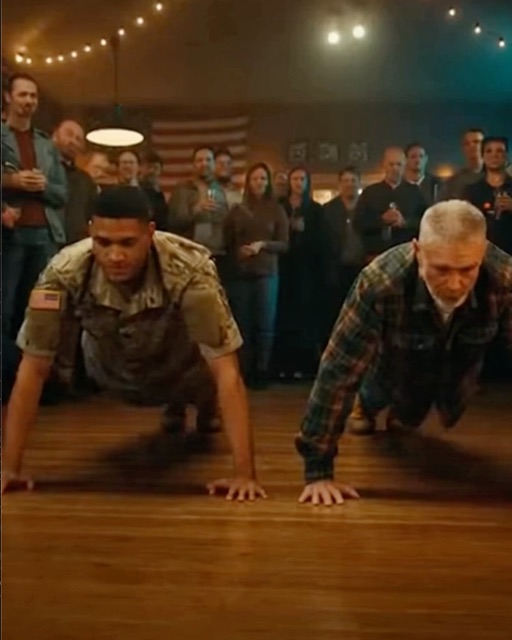
I hit the floor first. Fast reps. Clean form. My buddies counted out loud. Sixty. Seventy. Eighty.
My arms were screaming by the end. I pushed through eighty-four before my chest gave out.
I stood up grinning. Slapped my hands together like I’d just won something.
Then Carl – someone called him Carl – lowered himself to the floor.
No warmup. No stretch.
He just started.
Slow. Controlled. Like a metronome.
One. Two. Three.
By fifty, nobody was talking.
By eighty, I stopped smiling.
By one hundred, someone whispered, “Holy hell.”
He kept going.
One-ten. One-twenty. One-twenty-five.
When he stood up, he wasn’t even breathing hard.
He rolled down his sleeves, picked up his whiskey, and said, “Looks like this one’s on you.”
My mouth was dry.
Then he adjusted his cuff, and I saw it.
A faded tattoo on the inside of his wrist.
Old ink. Barely visible under the wrinkled skin.
But I recognized it instantly.
My stomach dropped.
Because that symbol wasn’t just military.
It was the insignia of the Studies and Observation Group. MACV-SOG.
A ghost unit. Legends from a war that ended before I was even born.
These were the men who ran classified, cross-border operations in Vietnam, Laos, and Cambodia. Their missions were so secret they were deniable. Their survival rate was abysmal.
The guys who wrote the book on special operations. My own Ranger training was built on the foundation they had laid with blood and sweat in some godforsaken jungle.
My bravado evaporated. It was replaced by a cold, heavy shame.
I felt like a kid who’d just challenged a ghost to a footrace.
My buddies, Tom and David, were just confused. They saw me go pale, but they didn’t know the symbol. To them, I’d just lost a bar bet to a surprisingly fit old man.
To me, I had just disrespected a living piece of history.
I walked to the bar, my boots suddenly feeling too loud on the wooden floor. I ordered a round for my table and one more whiskey for Carl.
“Keep the change,” I told the bartender.
He just nodded, a strange, knowing look in his eyes. He seemed younger than Carl, maybe in his forties, but he had an old soul’s weariness about him.
I carried the whiskey over to Carl’s corner. He looked up from his drink, his expression unchanged.
“My apologies, sir,” I said, my voice low and earnest. “I was out of line.”
I set the drink down in front of him.
He just stared at it for a moment, then back at me. “The boy learns.”
It wasn’t a question. It was a statement.
“I recognized the tattoo,” I said, gesturing awkwardly toward his wrist. “SOG.”
He didn’t flinch. He just took a slow sip of his new whiskey. The silence stretched, and it was more intimidating than any drill sergeant’s tirade.
“Sit,” he finally said, nodding to the empty stool beside him.
I sat. My friends watched from our table, their conversation dying down to a murmur.
“What’s your name, son?”
“Sam. Sergeant Sam Peterson.”
“Ranger,” he said, not as a question, but as if he was tasting the word. “Good unit. Tough boys.”
“Not tough enough, apparently,” I tried to joke, but the words fell flat.
He gave a small, almost imperceptible smile. It didn’t quite reach his eyes. “Strength isn’t about how many times you can push the ground away.”
He looked at his hands, turning them over as if seeing them for the first time. They were knotted with arthritis, the skin thin as paper, but they were steady.
“It’s about how much weight you can carry when the ground is all you have left.”
I didn’t know what to say to that. So I just listened.
The bartender came over and topped off Carl’s glass without being asked. He put a hand on the old man’s shoulder.
“You gonna tell him about Danny, Carl?” the bartender asked softly.
Carl closed his eyes for a second. “Maybe. Maybe the kid needs to hear it.”
He looked at me. “This here is Mike. His father served with me.”
My world tilted a little more. The quiet bartender wasn’t just an observer. He was part of this story.
“My dad was Danny,” Mike said, his voice thick with an emotion he’d clearly carried for decades. “He didn’t come back.”
The weight in the room became unbearable. The jukebox in the corner might as well have been on the moon.
“Your father,” Carl said to Mike, but he was looking at me, “was the strongest man I ever knew. And he could barely do fifty push-ups on a good day.”
I felt my face flush with a deeper shame.
“We were on a long-range reconnaissance patrol,” Carl began, his voice dropping to a near whisper, as if the jungle was still listening. “Spike Team Dakota. Six of us. Me, Danny, and four Montagnard tribesmen. Our ‘Yards were the real deal. Born and raised in that hell.”
“Our mission was to bug a trail deep in Laos. We were supposed to be in and out in seventy-two hours. Simple, on paper.”
He took another sip.
“Nothing was ever simple over there.”
“On the second night, the world fell apart. A North Vietnamese Army battalion stumbled on our position. Not a platoon, not a company. A full battalion. Six hundred men against six.”
I tried to imagine it. The odds weren’t just bad; they were impossible. It was a death sentence.
“We ran,” he said, with no shame in his voice. “Running was what we did best. We were ghosts, supposed to slip through the cracks. But they had us. They were running patrols in a grid pattern. We were caught in the box.”
“For two days, we moved. No sleep. Barely any water. Every snap of a twig, every bird call, could’ve been the end. We could smell them. Hear them. They were always just out of sight.”
“Danny was our radio operator. Carried the PRC-25 on his back. That thing was our only lifeline to a world that didn’t even officially know we existed.”
He paused, swirling the amber liquid in his glass.
“On the third day, they cornered us on a ridge. No cover to speak of, just elephant grass and a few sorry-looking trees. The firefight was… loud. That’s all I remember about the start of it. Just noise. Like the world was tearing itself in half.”
Mike, the bartender, leaned against the bar, his arms crossed. He’d probably heard this story a hundred times, but he listened like it was the first.
“We were getting chewed up,” Carl continued. “Two of our ‘Yards went down in the first few minutes. Then I got hit.”
He pointed to a puckered scar just below his collarbone, one I hadn’t noticed before.
“Took a round through the shoulder. Dropped me like a sack of rocks. I couldn’t lift my rifle. I thought that was it.”
“But Danny… Mike’s dad… he crawled through that grass, bullets cutting the air over his head, and he dragged me behind a small berm. He patched me up as best he could while still firing his CAR-15 with one hand.”
“He got on the radio, calling for an emergency extraction. He was calm. You’ve never heard a man so calm in the face of certain death. He gave our coordinates, described the enemy force, everything by the book.”
“The voice on the other end said a Spectre gunship was on its way, but it was twenty minutes out. In that kind of fight, twenty minutes is a lifetime. It’s ten lifetimes.”
I held my breath, completely lost in his story. My friends at the table had gone silent, leaning in to listen from a respectful distance.
“The NVA started to probe our position, trying to flank us. We were down to three men who could fight. Danny, me with one good arm, and our last remaining ‘Yard, a brave man named Y-Sum.”
“Danny knew we couldn’t hold. Not for twenty minutes. He looked at me, and I saw something in his eyes. It wasn’t fear. It was… a decision.”
“‘Keep their heads down,’ he told me. Then he took the radio off his back.”
“He crawled to the edge of our little patch of cover. He set the handset next to him, keyed the mic, and he just started talking. Not to the command chopper. He started talking to his wife. To Mike’s mom.”
Mike wiped at his eye with the back of his hand, trying to hide it.
“‘Tell Susan I love her,’ he’d say into the radio, loud enough for the NVA to hear. ‘Tell my boy I’m proud of him.’ He was drawing their fire. Making himself the biggest target on that whole damn ridge.”
“But it wasn’t enough. They were still advancing. So he did something else.”
Carl stopped and took a long, shaky breath. This was the hard part.
“He propped himself up on his elbows. And he started doing push-ups.”
My blood ran cold.
“Right there,” Carl whispered, his gaze a thousand miles away. “In the middle of it all. He started doing push-ups. Slow. Deliberate. Just like the ones I did here tonight.”
“One. Two. Three.”
“The NVA soldiers, they were confused. They’d never seen anything like it. This American, refusing to die, refusing to hide. This lone soldier doing exercises while his world ended. It was so insane, some of them actually stopped firing.”
“It was a challenge. A final act of defiance. He was telling them, ‘You can kill me, but you will never, ever break me.’”
“That’s the conditioning I was talking about,” Carl said, looking me dead in the eye. “It’s not in the muscles. It’s in the soul.”
“He did twenty-seven push-ups before a machine gun opened up on him. He bought us the time we needed. Just a few minutes. But it was enough.”
“The Spectre arrived right after. It laid down a wall of fire that saved me and Y-Sum. They pulled us out on ropes because the chopper couldn’t land.”
“I was the last one to see him. Lying there. He’d given everything.”
The bar was completely silent now. The only sound was the hum of the beer cooler.
Carl looked down at his wrist, at the faded SOG tattoo.
“Every day since I got back, I do one hundred and twenty-five. Every single morning. Twenty-seven for Danny. The rest are for the other men I couldn’t bring home over the years.”
“They’re not for strength. They’re for remembering. Each one is a name. Each one is a promise that I won’t forget.”
He finally looked back at me, and his eyes were clear. The nothingness I saw before was now filled with a profound, quiet sorrow.
“So when you challenged me, son, you weren’t challenging an old man. You were challenging the memory of my friends. You were challenging their sacrifice.”
I couldn’t speak. The lump in my throat was too big. All the pride I’d walked in with, all my arrogance, was gone. I felt small. Humbled in a way that no amount of training had ever made me feel.
I finally found my voice. “Sir… I… there’s nothing I can say.”
“There’s something you can do,” he said. He slid his empty whiskey glass toward me. “You can finish buying that round. And you can sit here and listen. That’s how we keep them alive. By telling the stories.”
I nodded, signaling to Mike for another round for all of us. He brought them over, and for the next hour, Carl talked.
He didn’t talk about glory or heroics. He talked about the quiet moments. The jokes they told in the rain. The taste of lukewarm C-rations. The letters from home they’d read to each other. He talked about Danny’s terrible singing and Y-Sum’s incredible tracking skills.
He painted a picture not of super-soldiers, but of human beings. Frightened, brave, ordinary men who were asked to do extraordinary things.
When he was done, he stood up slowly. “It’s getting late.”
Mike came from behind the bar and gave him a one-armed hug. “See you next week, Carl.”
“See you next week, son.”
Carl turned to me. He put his steady, wrinkled hand on my shoulder. “You’re a good soldier, Sam. Just remember why you do it. It’s not for you. It’s for the man next to you.”
And then he was gone.
I sat there for a long time, staring at the empty stool.
My friends came over. Tom clapped me on the back. “You okay, man?”
I just nodded. I wasn’t okay. But I knew I would be. I was different now. The foundation of my world had been shaken and then rebuilt on something stronger.
That night changed the course of my career. I was still a Ranger. I was still proud. But the arrogance was gone, replaced by a quiet humility. I started listening more than I talked. I started looking for the strength in the quiet guys, the ones who didn’t brag. I learned that the loudest man in the room is often the weakest.
True strength isn’t about the size of your arms or the number on your chest. It’s about the weight of the promises you keep and the memories you carry. It’s the quiet, unseen discipline that gets you through the darkest nights.
It’s the understanding that the toughest battles are often fought not on a battlefield, but within the silent confines of a person’s heart, remembered one slow, deliberate push-up at a time.