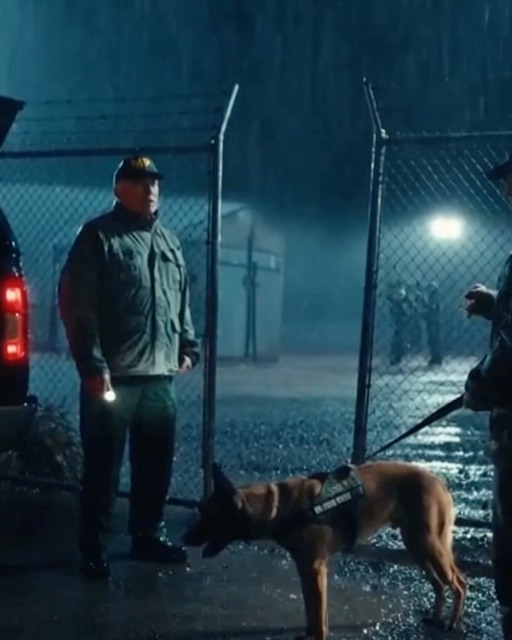
The outer motor pool fence had taken a hit in the storm. Chain-link peeled back like skin from bone. Water pooled in craters across the gravel.
I was just there to help. Thirty-one years retired, but when they called asking for extra hands, I grabbed my boots. Old habits.
The military working dog was doing its job – clearing corners, checking shadows. Standard post-storm protocol. Then it locked up near the gap between the fence and an abandoned generator shed.
The handler figured trespass trail.
I watched the dog’s posture. The way its weight shifted forward. The way it wasn’t tracking – it was pointing.
“Not a trail,” I said. “A stash.”
I didn’t wait for permission. I ducked through the gap and circled the shed, flashlight low to the ground.
The dog beat me to the back foundation. Started clawing where the runoff had washed the dirt away. Something metallic caught my beam.
Green. Wrapped in black tape. I knew what it was before I touched it.
Emergency field evidence packaging. The kind we used when something had to be logged before it could disappear.
My hands shook as I cut it open.
Inside: a folded American flag patch. An old patrol route photo. A K9 leash snap hook. And a handwritten statement.
The handler aimed his light over my shoulder.
I read it out loud. My voice didn’t sound like my own.
Dog hit the fence line because the transfer happened inside the perimeter, not outside it.
The storm noise vanished. Or maybe I just stopped hearing it.
Because I recognized that snap hook.
It belonged to my patrol dog. The one I had in ’94. The one I was handling the night an evidence vehicle supposedly vanished off-post.
They told me the vehicle left the installation. That it was hijacked on the highway. That there was nothing to investigate on our end.
I believed them for thirty years.
The military working dog stepped back from the canister. Its ears went flat. It turned toward the generator shed door.
I lifted my flashlight.
The padlock was rusted orange. Hadn’t been opened in years.
But water was still running down its face.
Fresh water.
Someone had touched it. Recently.
I reached for my radio.
It was already dead.
Then I heard boots in the gravel behind me. And a voice I hadn’t heard since 1994 said…
“You were never meant to find that, Arthur.”
The rain was starting up again, a soft hiss on the gravel. I didn’t need to turn around. Some voices are etched into your memory, filed away with the smell of wet asphalt and burnt coffee.
Sergeant Barnes. My old shift supervisor. The man who signed off on the report that closed the case.
I stood up slowly, my knees cracking a protest. My hand stayed on the canister, a cold, solid piece of the past.
I turned.
He looked older, of course. We all did. The years had carved deeper lines into his face and stolen most of the color from his hair. But the eyes were the same. Tired. Weighed down by something I never had a name for.
Until now.
“Barnes,” I said. My voice was steady. I was surprised by that.
He wasn’t wearing a uniform. Just a rain jacket and work pants, like any other civilian contractor. He looked like he belonged here. He looked like he had never left.
The young handler, a Corporal whose name I didn’t know, took a half-step back. His hand drifted toward his sidearm.
“Easy, son,” Barnes said, his voice soft but carrying an old authority that made the young man hesitate. “We’re all friends here.”
My gaze dropped to the canister, then back to him. “Friends don’t lie to each other for thirty years.”
A flicker of something—pain, regret—crossed his face. It was gone in an instant.
“Some lies are told to protect people, Arthur. You know that.”
“Who were you protecting, Barnes? The report said the van was hijacked on Interstate 15. Said it was a professional job.”
“The report said what it needed to say.”
I held up the canister. The snap hook inside rattled. It was a sound that echoed across three decades. A sound only I could truly hear.
“This says otherwise. This says it happened right here. On our shift. On our watch.”
I remembered that night. The chaos. The conflicting reports. Barnes had been the calm center of the storm, directing units, taking statements. He’d personally debriefed me.
He asked about my patrol route. About anything unusual I’d seen. I told him Kaiser had alerted on a maintenance truck near this very motor pool. He’d been insistent, barking and pulling at his leash.
Barnes had told me to log it as a false alert. “Probably a raccoon in the engine block,” he’d said, clapping me on the shoulder. “Good boy, Kaiser. But stand down.”
I trusted him. He was my Sergeant. So I stood down.
Now, standing in the rain, the bitter taste of that trust filled my mouth.
“Why, Barnes?” I asked, the question feeling small and hollow in the open air. “What was in that van that was worth all this?”
He took a step closer. The young handler tensed again.
“It wasn’t about what was in it,” Barnes said, his eyes pleading with me. “It was about who it pointed to.”
“Who?”
He just shook his head. “A man who was on his way up. A man who was important to this base. To the whole force. Colonel Matthews.”
The name landed like a punch. Colonel Matthews. He’d been the Base Commander. A hard-nosed, by-the-book officer destined for stars. And he got them. Last I heard, he was a retired three-star General, sitting on the board of some big defense contractor.
“Matthews?” I said, incredulous. “What did he have to do with it?”
“He was running a shadow supply chain,” Barnes said, the words coming out in a rush, as if a dam had finally broken. “Skimming parts, fuel, ordnance. Selling it off. The evidence in that van, it didn’t just suggest it. It proved it. Ledgers. Signed manifests. Everything.”
It made a sick kind of sense. The way the investigation was shut down so fast. The way it was pushed off-post, out of military jurisdiction. It was all about containment.
“So you covered for him,” I said. It wasn’t a question.
“He had something on me, Arthur. From a long time ago. A mistake I made as a young airman. Something that would have ruined me. My career, my family, everything.”
He looked away, toward the rusted generator shed. “He told me to make it disappear. He said if I did, my mistake would disappear too. He gave me a choice that wasn’t a choice.”
“So you buried it,” I said, gesturing with the canister. “You buried the truth.”
“I couldn’t destroy it,” he whispered, his voice cracking. “I couldn’t. I owed the uniform more than that. I took the original statement from the driver before they… before they were ‘transferred’ to a base in Alaska the next day. I swapped this snap hook for the one on Kaiser’s leash when you weren’t looking. I knew you, Arthur. I knew you’d never forget your dog.”
The twist of the knife was sharp. He had used my loyalty, my bond with my partner, as a component in his lie.
“I thought… I thought one day I might have the courage to bring it forward. I buried it here as a kind of insurance. A promise to myself that it wasn’t gone forever.”
The young Corporal finally found his voice. “Sir, I… my radio is working again. I need to call this in.”
Barnes looked at him, then at me. There was no menace in his eyes. Only a profound, soul-deep weariness.
“It’s okay, son,” he said. “It’s time.”
Then came the twist I never saw coming.
“I didn’t come here tonight to keep it buried, Arthur,” Barnes said, looking me straight in the eye. “I came here to dig it up.”
I stared at him, confused. “What are you talking about?”
“General Matthews passed away two weeks ago,” he said quietly. “Heart attack. It was in the national news. The leverage he had on me died with him. I’ve been living with this weight for thirty years. I’m sixty-eight years old. I couldn’t carry it to my own grave.”
He pointed toward the disturbed earth. “The storm just beat me to it. I was standing right here, trying to get that rusted lock off the shed to grab a shovel, when you and the dog team rolled up. I hid behind the shed.”
My mind reeled. He wasn’t here as a threat. He was here as a penitent. He hadn’t come to silence me. He had come to finally speak.
The water running down the padlock. It wasn’t from the rain. It was from the oil he’d been trying to use on it.
The dead radio. Maybe it wasn’t him. Maybe it was just the storm. Or maybe he did jam it, not to ambush me, but to buy himself a few minutes to get the canister before anyone else found him here.
The pieces rearranged themselves in my head. He wasn’t a villain caught in the act. He was a man who had made a terrible compromise decades ago and had chosen this rainy night to finally try and make it right.
“Why didn’t you just go to the OSI? To the IG?” I asked.
“And say what? ‘Thirty years ago I helped a future General cover up a crime because he was blackmailing me?’ Who would believe that without proof? I needed this,” he said, nodding at the canister in my hand. “This was the only thing that made my story true.”
The sound of approaching vehicles grew louder. The Corporal had made the call. Red and blue lights began to flash against the low, dark clouds, painting the wet gravel in strobing colors.
Barnes didn’t run. He just stood there, shoulders slumped, a man finally surrendering to a battle he’d been fighting with himself for half his life.
“Arthur,” he said, his voice low. “I’m sorry. About your dog. About Kaiser. You logged his alert. You did your job. I was the one who failed him. I failed you both.”
Security Forces vehicles skidded to a stop, doors flying open. Young, serious-faced MPs in tactical gear took up positions, weapons at a low ready.
“It’s alright,” their Sergeant yelled. “Everybody stay where you are!”
Barnes raised his hands slowly, not in fear, but in resignation.
“It’s over,” he said to me. “Thank you.”
I didn’t understand. “Thank me for what?”
“For finding it,” he said, a sad smile touching his lips. “You finally took the choice out of my hands.”
The investigation that followed was like a slow-motion earthquake, shaking foundations that had been thought solid for decades. Barnes gave a full confession, holding nothing back. The canister, with its handwritten statement and the physical link to my dog, was undeniable.
Forensics matched the handwriting. They dredged up old transfer orders for the evidence van’s drivers. They found financial records that showed a pattern of wealth for the late General Matthews that far exceeded his military pay.
The story was pieced together, a mosaic of corruption and coercion. Matthews had been a king on his own little fiefdom, and Barnes had been one of the serfs forced to protect the castle.
Barnes was charged, of course. Obstruction of justice. Falsifying a federal report. But his full cooperation, his clear remorse, and the circumstances of the blackmail thirty years prior led to a lenient sentence. House arrest and community service. He lost his pension, but he seemed to gain something far more valuable.
When I saw him at the hearings, the weight in his eyes was gone. He looked like a man who could finally breathe.
The rewarding conclusion wasn’t the fall of a decorated General’s reputation. It wasn’t even about seeing Barnes brought to justice. It was quieter than that.
A few months later, the base command held a small, informal ceremony at the Military Working Dog kennels. They were dedicating a new training field. They invited me.
The young Corporal, Finch, was there. He shook my hand firmly.
“You taught me something that night, sir,” he said. “To trust the dog, always. But also to listen to the old guys.”
I just smiled. “The dogs are usually smarter than we are.”
The Base Commander, a sharp-faced Colonel, said a few words. He spoke about honor, integrity, and the long memory of the uniform. Then he called me forward.
He presented me with a small, framed shadow box. Inside, cleaned and polished, was the snap hook. Kaiser’s snap hook. Beside it was a new American flag patch and a brass plate.
The plate read: “For K9 Kaiser and MP Arthur Mills. Loyalty has no expiration date.”
My throat felt tight. I just nodded, unable to speak.
After the ceremony, I walked to the small memorial garden behind the kennels. A place for handlers to remember their partners. Each stone was a name, a set of dates, and the simple words, “A Faithful Friend.”
I found the one I was looking for. “K9 Kaiser. End of Watch 1996.”
He’d served two more years with me after that night, a loyal and fearless partner to the very end. He never knew the role he played, or the truth he had tried so hard to show me. He was just doing his job.
I knelt down, the damp earth cold through my trousers. I propped the shadow box against his memorial stone. The polished snap hook gleamed, a tiny piece of metal that carried the weight of thirty years of silence.
The real lesson wasn’t about the grand scales of justice or the fall of powerful men. It was simpler. It was about a promise. The one a handler makes to his dog, and the one we all should make to ourselves.
The truth might get buried. It might get covered by mud, and rust, and the weight of years. But it doesn’t die. It just waits. It waits for a storm to wash the dirt away, for an honest soul to pick it up, and for the courage to finally bring it into the light. It’s never, ever too late to do the right thing.