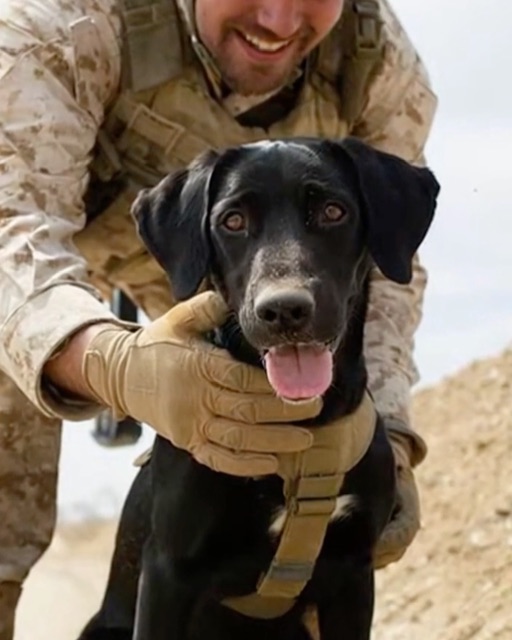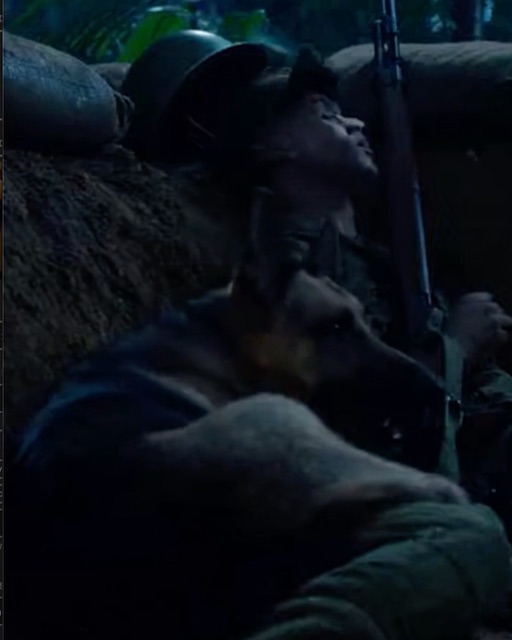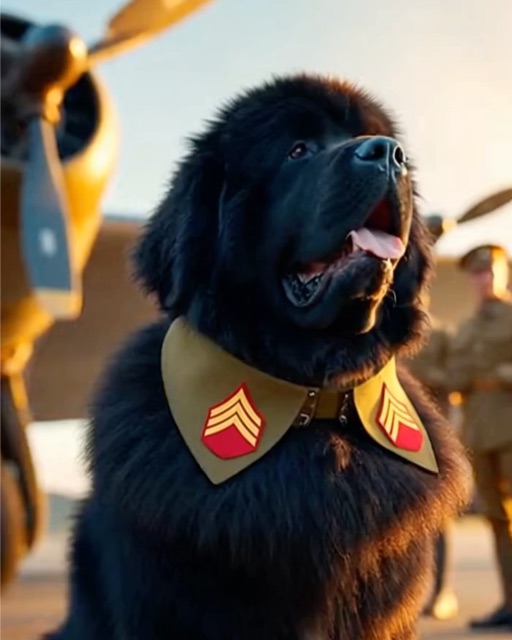
They called him “Pal.” He was just a massive, clumsy Newfoundland dog that a family gave up because he was too big for the house. The soldiers of the Royal Rifles took him in, renamed him Gander, and “promoted” him to Sergeant just for a laugh. He was a mascot. A pet.
Then they got shipped to Hong Kong.
The laughter died instantly. The fighting was brutal. The men were pinned down, terrified and outnumbered. But Gander didn’t hide. Twice, he charged the enemy lines, forcing them back. The soldiers couldn’t believe their eyes.
Then, disaster struck. A live grenade landed right in the middle of a group of wounded Canadian boys. They were trapped. They closed their eyes, waiting for the end.
But the blast didn’t kill them.
Because Sergeant Gander didn’t run away. He looked at the grenade, then at his men, and did the one thing no human would ever dare to do.
He didn’t hesitate for a single second.
With a low growl that wasn’t of anger, but of sheer determination, he lunged forward.
His massive jaws, which had so gently carried stray birds back to the men, clamped around the cold, hard metal of the grenade. It was a strange and terrible sight.
One of the wounded men, a private named Fred, tried to yell, but only a dry croak came out. He reached a hand out, as if he could somehow pull the dog back from the brink.
Gander met his eyes for a fleeting moment. In that deep, brown gaze, Fred saw not the panic of an animal, but a profound and silent understanding. A sense of purpose.
Then Gander turned.
He didn’t run toward the safety of the trenches. He didn’t run back the way he came. He ran directly away from the huddled group of soldiers, his powerful legs churning through the mud and debris.
He was carrying death away from them.
The men watched, frozen in a state of suspended disbelief. It was all happening in slow motion, a terrible ballet of sacrifice.
He made it about thirty yards.
The world erupted in a flash of white-hot light and a deafening roar that ripped through the air. The ground shook violently, and shrapnel whizzed past where the men lay.
Then, there was silence.
A thick, heavy silence, broken only by the distant pop of rifle fire and the ringing in their ears.
Where the great black dog had been, there was now just a smoking crater in the scarred earth.
Fred lay there, his face pressed into the mud, his body trembling not from the cold, but from the shock of what he had just witnessed. He could feel hot tears mixing with the grime on his cheeks.
Their joke. Their mascot. Their Sergeant Gander was gone.
The shock of the act galvanized the remaining soldiers. The enemy, perhaps startled by the unexpected blast, hesitated in their advance. That hesitation was all the platoon needed.
They found a strength they didn’t know they possessed. They fought with a fury born of grief and gratitude. They fought for the boys Gander had saved. They fought for the dog who had taught them the meaning of bravery.
But it wasn’t enough. The numbers were too great.
By nightfall, the survivors of the Royal Rifles, including Fred and the men Gander had saved, were taken as prisoners of war.
The years that followed were a blur of misery and starvation in the POW camp. Hope was a currency more valuable than food, and it was in desperately short supply.
The men withered. Their bodies grew thin and their eyes became hollow.
Yet, the story of Sergeant Gander did not fade. It became a legend.
On the darkest nights, when the despair was a physical weight, the older soldiers would tell the new prisoners about the massive Newfoundland who saved them. They spoke of his goofy, clumsy nature. They talked about his “promotion.”
And they always ended with the grenade.
The story was a flicker of light in an endless darkness. It was a reminder that courage and loyalty existed, even when the world seemed to have forgotten them.
Fred told the story more than anyone. He was the keeper of the flame. He owed his life to that dog, and he would not let his memory die in the mud and filth of the camp.
One of the men in his barracks was Corporal Miller, a hard, cynical man who had always viewed Gander as a nuisance. Miller had complained about the dog’s food rations and the space he took up.
Miller was one of the men Gander had saved.
He never spoke of it. But Fred would often see him staring at the fence, his jaw tight, a look of profound shame in his eyes. He, too, owed his life to the dog he had dismissed. The debt sat on his soul like a stone.
When the war finally ended and the prisoners were liberated, they were ghosts of their former selves. They returned home to a world that had moved on, to families who barely recognized them.
Fred tried to readjust. He got a job at the local post office, married a kind woman, and tried to build a normal life.
But the war had left scars that no one could see. He was quiet, distant. He rarely smiled. At night, he would dream of the flash, the roar, and the empty space where a hero used to be.
He felt an unpayable debt. A medal had been awarded to Gander posthumously, the Dickin Medal, the highest honor for an animal in combat. But it felt hollow. A piece of metal couldn’t capture the soul of the friend he had lost.
Years passed. Fred was now in his late fifties, his hair graying at the temples. His life was calm, but a piece of him was still trapped in Hong Kong.
One day, while sorting through an old footlocker, he found a faded photograph. It was a picture of the platoon before they shipped out. In the center of the group, sitting proudly with a soldier’s cap cocked on his head, was Gander.
Fred stared at the photo, and a resolve hardened within him. He had to do more.
He remembered the name of the town in Newfoundland where Gander had come from. He remembered the soldiers talking about the family who had given him up because he was “too big.”
He needed to find them. He needed to tell them who their dog truly was.
He took a leave of absence from his job, telling his wife he was going on a fishing trip. He bought a train ticket and then a ferry pass, traveling across the country to the rugged, windswept coast of Newfoundland.
The town was small, a collection of colorful houses huddled against the gray Atlantic. It felt like stepping back in time.
After asking around at the local store, he was directed to a small, weathered house at the edge of the village. He knocked on the door, his heart pounding in his chest.
An old man with kind, watery eyes answered. Fred introduced himself and explained why he was there. He pulled out the tattered photograph.
“I knew a dog named Pal once,” Fred said, his voice thick with emotion. “We called him Gander.”
The old man, whose name was Arthur, stared at the picture. His wife, Mary, came to the door, wiping her hands on an apron. She gasped when she saw the dog.
Fred spent the next hour in their small, warm kitchen, telling them everything. He told them about Gander’s bravery, his two charges against the enemy, and finally, the story of the grenade.
When he finished, Mary was openly weeping, and Arthur was staring at his hands on the table, his face a mask of sorrow.
“We told everyone we gave him up,” Arthur said, his voice raspy. “It was a lie to save our pride.”
This was the first twist Fred had not expected.
“We didn’t give him up,” Arthur confessed. “We sold him. The war was coming, I’d lost my work on the boats. We couldn’t afford to feed a dog his size. A recruiter offered us fifty dollars for him, for the regiment’s mascot.”
He looked up, and the shame in his eyes was a physical thing. “Fifty dollars. We sold a hero for fifty dollars. It’s haunted me every day of my life.”
Fred felt a wave of sympathy, not anger. He saw not greed, but desperation. The war had made victims of everyone.
“You need to know,” Fred said softly. “He was loved. He was one of us. He was the best of us.”
Mary, through her tears, looked at Fred. “But that’s not the end of his story, son. Not his whole story here.”
She stood up and went to a small wooden chest in the corner. She returned with a small, sepia-toned photograph of her own.
It was a picture of Gander as a younger dog, standing next to a pretty, dark-haired teenage girl.
“Before the soldiers took him, Pal… he was quite the rogue,” Mary said, a small smile touching her lips for the first time. “He was in love with a collie down the lane named Bess.”
Fred looked at her, confused.
“Just before he left,” Mary continued, “we had a surprise. Bess had a litter of puppies. They all had their mother’s looks, except for one. One was the spitting image of his father. Big, black, and clumsy as a newborn moose.”
Fred’s breath caught in his throat.
“We couldn’t keep him, but we couldn’t get rid of him either,” Arthur added. “So we gave him to the girl in the picture, Eliza. She loved Pal more than anyone. She was heartbroken when he left. We thought it was only right that she have a piece of him to keep.”
Fred’s mind was racing. It couldn’t be possible. After all these years.
“Is she… is Eliza still here?” he asked, his voice barely a whisper.
Mary nodded. “She never left. Married a fisherman. Lives just over the hill.”
A few minutes later, Fred was walking with Arthur up a grassy slope, the salty wind whipping at his coat. He felt a nervous energy he hadn’t felt in decades.
They arrived at a neat little cottage with a well-tended garden. A woman was hanging laundry on a line, her back to them. She had graying hair, but the same frame as the girl in the picture.
“Eliza!” Arthur called out.
She turned, a questioning look on her face. Then, a huge, black dog with a thick coat and a noble head trotted out from behind the house, letting out a deep, friendly “woof.”
Fred stopped dead in his tracks.
It was like seeing a ghost. The dog was older, his muzzle flecked with gray, but the resemblance was uncanny. The same massive paws. The same gentle, intelligent eyes.
“This man knew your dog’s father,” Arthur said gently.
Eliza’s eyes widened. She looked at Fred, then at the photograph in his hand, and she understood.
Fred slowly knelt, his old knees protesting. The big dog trotted over to him, cautious but curious. He sniffed Fred’s outstretched hand, then looked him right in the eye.
In that moment, the years melted away. Fred wasn’t a weary, middle-aged postal worker. He was a young soldier again, looking into the eyes of his best friend.
The dog gave a soft whine and licked Fred’s cheek.
The dam inside him finally broke. Decades of grief, guilt, and unspoken gratitude came pouring out in silent, shaking sobs. He wrapped his arms around the dog’s thick neck and held on, burying his face in its fur.
The dog didn’t pull away. He simply stood there, solid and reassuring, letting this stranger release the pain of a lifetime.
Eliza told him the dog’s name was Skipper. And he was the father and grandfather to a half-dozen other big, black dogs in the village. Gander’s line had not ended in that crater in Hong Kong. It had endured.
Fred stayed in the village for a week. He spent every day with Skipper, walking the rocky shores and telling Eliza stories about her dog’s heroic father. For the first time since the war, he felt a sense of peace. The debt felt… lighter.
When he returned home, he was a different man. The grayness was gone from his world. He smiled more. He talked more. His wife said it was like having her husband back from the war, truly back, for the first time.
He wrote a long letter to Corporal Miller, who he had tracked down living a quiet life as a carpenter. He told him everything about the family, the sale, and Gander’s son.
A month later, a package arrived for Eliza in Newfoundland. It was from Miller. Inside was a check for a substantial amount of money, enough to ensure Skipper and his descendants would be cared for for years to come. The note was simple.
“A debt repaid. For Sergeant Gander.”
Miller had also established a fund in his hometown to support a local animal shelter, a fund that would go on to save thousands of abandoned animals. The dog he once resented had not only saved his life, but had also redeemed his soul.
True heroism isn’t just a single act of bravery; it’s a legacy that ripples outward, touching lives in ways we can never predict. Gander’s story didn’t end with a bang on the battlefield. It lived on in the quiet loyalty of his son, in the peace of a haunted soldier, and in the redemption of a cynical man. It’s a powerful reminder that the greatest among us often walk on four legs, and that the purest love is one that is willing to lay down its life for a friend, creating a legacy of courage that never truly fades away.