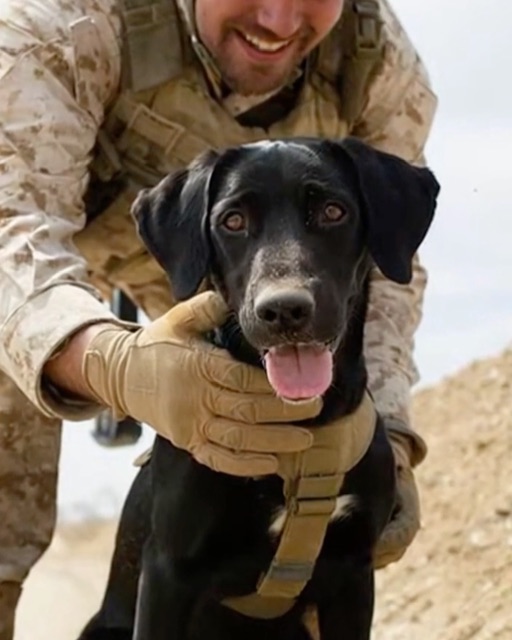
I was deployed to Afghanistan with the Royal Army Veterinary Corps. My partner wasn’t a sharpshooter or a medic. He was a black Lab-Spaniel mix named Treo.
One sweltering afternoon in August 2008, we were walking straight into a kill zone. Suddenly, Treo froze. His tail went stiff.
I signaled the unit to halt.
Buried right beside us was a “daisy chain” – a massive network of IEDs wired together to wipe out the entire platoon. Treo had just saved dozens of lives. A month later, he did it again.
But the moment that made my blood run cold came later.
Our intelligence officers pulled me aside. They had intercepted enemy radio traffic. The insurgents weren’t talking about our tanks or our air support. They were whispering frantically about “The Black Dog.”
They had put a bounty on his head.
Treo wasn’t just a nuisance to them; he was a force of nature they couldn’t stop.
He survived the war. He retired to my couch, trading bomb detection for belly rubs. But when he passed away in 2015, we didn’t just bury him with his favorite toy.
We opened the casket one last time to place an item on his chest that is usually reserved for the bravest humans on earth.
That item was the culmination of a story that didn’t end when we left the dust of Helmand Province. In many ways, the real war began when we came home.
Coming back to England was like stepping onto another planet. The colours were too bright, the sounds too loud. Everything was soft and safe, yet I’d never felt more on edge.
Treo felt it too.
A car backfiring down the street would send him into a low crouch, ears pinned back. He’d scan the rooftops, just like he was trained to do, looking for threats that weren’t there.
We were two soldiers home from a war that nobody here could understand.
The Army offered me counseling. I tried it once. The therapist was a kind woman who’d never heard a shot fired in anger. She couldn’t grasp the bond I had with my dog.
To her, Treo was a pet. To me, he was the other half of my soul. He was the one who had kept me alive.
We settled into a small cottage in Lincolnshire. It had a big garden where Treo could run. We found a new routine.
Our patrols were now quiet walks through dewy fields at sunrise. Our enemy combatants were squirrels and the occasional postman.
Slowly, the tension in his shoulders began to ease. He started acting more like a dog and less like a soldier. He’d chase a tennis ball with goofy abandon, his tongue lolling out.
And slowly, watching him heal, I began to heal too.
His quiet presence beside me on the couch was better than any therapy. He’d rest his heavy head on my lap, and the familiar, warm weight of him was an anchor in the storm of my memories.
We were famous for a little while. The papers called him “Treo the Hero Dog.” We did a few interviews. People would stop us in the village to shake my hand and give Treo a pat.
He loved the attention, soaking up every scratch behind the ears. I just wanted to be left alone.
The bounty, the whispers about “The Black Dog,” felt like a ghost from another life. A story I’d tell myself to remember how brave my partner was. I never thought that ghost would follow us home.
It started subtly. So subtly, I thought I was losing my mind.
A feeling of being watched on our morning walks. A twig snapping in the woods just a little too deliberately.
I told myself it was the PTSD. Hypervigilance. My brain was still wired for the battlefield.
Treo knew better.
He started getting tense on our walks again. His tail would drop, and a low growl would rumble in his chest, directed at nothing I could see. He’d press himself against my leg, a furry black shield.
One evening, I was taking the rubbish out. Treo was at the back door, watching me. He suddenly let out a sharp, savage bark and bolted past me into the garden.
He ran straight to the back fence, barking furiously at the darkness beyond the hedge.
My blood ran cold. It was his operational bark. The one he used when he was certain of a threat.
I grabbed a heavy Maglite from the kitchen and went to the fence. I shone the beam into the woods. Nothing. Just leaves rustling in the wind.
But the ground near the fence was disturbed. A single, muddy footprint that wasn’t mine. It was deep, as if someone had been standing there for a long time. Watching.
The police came. They were polite but dismissive. “Probably just some kids, mate,” the officer said with a reassuring smile. “Or a poacher.”
I didn’t believe it. My instincts, honed by years in a war zone, were screaming at me. And more importantly, Treo’s instincts were screaming.
I started checking the locks three, four times a night. I slept with the Maglite by my bed. Treo slept on the floor beside me, a silent, black shadow, waking at the slightest sound.
The peace we had fought so hard to find was being stolen from us, bit by bit.
A few weeks later, the real terror began. I came home from the shops to find the back gate wide open. I always locked it. Always.
My heart hammered against my ribs. “Treo!” I yelled, my voice cracking.
Silence.
I ran inside, my mind flashing with horrific images. The house was empty. My boy was gone.
Panic, cold and absolute, seized me. I was about to call the police, the army, anyone, when I heard a faint whimpering from the garden shed.
The door was latched from the outside.
I fumbled with the latch and threw the door open. Treo was huddled in the corner, shaking. He wasn’t physically hurt, but he was terrified. Someone had locked him in there.
They had been in my garden. They had touched my dog.
This wasn’t kids. This was a message.
That night, I sat in the dark with Treo, a cricket bat in my hands. Every creak of the old cottage made me jump. I felt like I was back in Sangin, waiting for an attack that could come from any direction at any moment.
I started digging. I called in favors from old army mates, guys in intelligence. I asked them to look into any known insurgents who might have resettled in the UK.
It was a long shot. A crazy, paranoid theory.
My friends thought I was losing it. “Mark, you’re home now,” one of them told me gently over the phone. “The war is over.”
But it wasn’t.
The confirmation came a week later in a plain brown envelope with no return address. Inside was a single, grainy photograph.
It was a picture of Treo, taken from a distance, with a red circle drawn around his head.
Underneath it, a single word was written in shaky Arabic script.
Kutta.
Dog.
My contact in intelligence called me that same day. His voice was grim. “We found something, Mark. A man named Fareed. He was a low-level Taliban commander in the very sector you and Treo operated in.”
My knuckles went white as I gripped the phone.
“His entire cell was dismantled because of an IED find,” my friend continued. “A ‘daisy chain’ find, specifically. His brother was killed in the subsequent raid. He blamed ‘The Black Dog’ for it. He swore a blood oath.”
I felt the floor drop out from under me. “Where is he?”
“That’s the thing, Mark. He claimed asylum in the UK three years ago. He lives less than twenty miles from you.”
The ghost had a name.
The war hadn’t ended. It had just changed its location. The bounty on Treo’s head was still active, not for money, but for revenge.
I went to the police with the photo. They took it more seriously this time. They put a watch on Fareed’s house. They told me to be careful.
But I knew men like Fareed. They were patient. They were shadows. A police car parked down the street wouldn’t deter a man on a mission of vengeance.
The next few months were a living hell. We lived in a self-imposed prison. No more long walks in the fields. Just quick trips into the garden, with me standing guard, my eyes scanning the tree line.
Treo was fading. He was getting old, his muzzle flecked with grey. The constant stress was wearing him down. The light in his eyes was dimming. He had survived a war only to be hunted in his own home.
The guilt was eating me alive.
One rainy November night, it happened.
The power went out. The whole street went dark.
Treo, who had been dozing by the fire, was instantly on his feet. A low, guttural growl started deep in his chest. He stood between me and the back door, his body rigid.
I grabbed the heaviest thing I could find – a cast iron poker from the fireplace. My heart was a frantic drum against my ribs.
Then, the sound. The sickening crunch of glass breaking from the kitchen window.
My training took over. “Treo, with me!” I whispered. We moved silently from the living room, hugging the wall.
A figure was climbing through the broken window. A tall, thin man silhouetted against the rainy night. I could see the glint of a long knife in his hand.
It was Fareed.
He saw me. His eyes were filled with a burning hatred that transcended language and borders. He started moving towards me.
But he didn’t count on Treo.
My old, tired, grey-muzzled dog launched himself through the air. He wasn’t the young, powerful dog from Afghanistan anymore, but his heart was the same. He was pure, unadulterated loyalty in motion.
He hit Fareed in the chest, a blur of black fur and teeth. The man screamed, surprised by the ferocity of the attack. They went down in a tangle of limbs and snarling.
The knife clattered across the floor.
I was on Fareed in a second, the poker raised. But the fight was already over.
Fareed was scrambling backwards, terror in his eyes, trying to get away from the dog. He crab-walked to the broken window and hauled himself out, disappearing into the night.
Sirens wailed in the distance. A neighbor must have heard the glass break.
I turned to Treo. “Good boy,” I choked out. “Good boy.”
He was standing, but his tail wasn’t wagging. He took a shaky step towards me and then collapsed onto the kitchen floor.
There was a dark, spreading stain on his side.
In the chaos, in his desperate lunge to save me, the knife had caught him.
The hours that followed were a blur. The vet’s office. The sterile smell. The quiet, sympathetic words. The wound was deep. He was old. He was tired.
He had saved my life one last time.
We brought him home the next day. The vet said to make him comfortable. We both knew what that meant.
He lay on his favorite blanket by the fire. I didn’t leave his side. I talked to him for hours, telling him stories of our time together, reminding him of all the lives he saved, of all the good he did.
I told him he was the bravest soldier I ever knew.
He passed away peacefully that evening, his head in my lap, my hand on his chest, feeling his last, faint heartbeat.
The silence in the cottage was deafening.
The police caught Fareed trying to leave the country. The story of what happened came out. The bounty. The stalking. The final act of bravery.
It wasn’t just a local news story this time. It went national. It touched a nerve in the country. The story of a war hero, hounded to his final days, who gave his life to protect his friend.
A few weeks later, I got a call from a high-ranking officer at the Ministry of Defence. He’d served in Afghanistan. He’d heard about Treo’s daisy chain find. He now knew how Treo’s story ended.
He told me, his voice thick with emotion, that a group of decorated officers were petitioning the Queen. They argued that Treo’s lifetime of service, his courage under fire, and his final, ultimate sacrifice were worthy of the nation’s highest honor.
It was unprecedented. It was unheard of. But the story of The Black Dog had captured the heart of a nation.
The petition was granted.
And so, we came to that final day. His casket was draped in a Union Jack. A small group of us were gathered – my family and the soldiers from our old platoon. The men whose lives he had saved.
I stepped forward and opened the casket for the last time. Treo looked so peaceful, as if he were just sleeping. His favorite worn-out tennis ball was tucked beside him.
In my hands, I held a small, bronze cross, attached to a crimson ribbon.
The Victoria Cross.
It is awarded for valor “in the presence of the enemy.” Treo had been in the presence of the enemy his whole life, right up until his very last breath.
With trembling hands, I placed the medal on his chest. It lay there, stark and heavy, against his black fur.
A symbol of supreme courage, resting on the heart of the most courageous soul I have ever known.
He wasn’t just a good boy. He was the best of us.
Bravery doesn’t see species. It only sees heart. And his was the biggest I ever knew. Loyalty, I learned, isn’t something you command. It’s a gift, the most precious one a soul can give, and it is offered freely by those with the purest of hearts, whether they walk on two legs or four.