
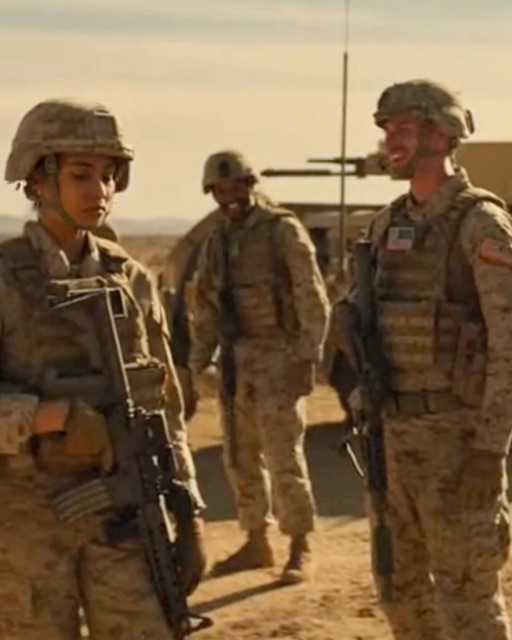
“THE “TRAINEE” WHISPERED A CALL SIGN – AND AN ENTIRE PLATOON WENT SILENT
The first burst snapped over our heads at 4:30 AM. Sand peppered my face. Someone screamed, “Ridge! Ridge!” We dropped behind packs that wouldn’t stop a paper cut.
Everyone spun north.
Everyone except her.
She stood there, small as a shadow, turning south like she was listening to something only she could hear.
“Private, eyes up – north!” our lieutenant barked.
She didn’t even blink. Just lifted the radio and said, calm as a surgeon, “Desert Serpent has locked target.”
My blood ran cold.
That name wasn’t a joke. It was a ghost. A legend you told at midnight. A sniper who never missed – and who died three years ago in a convoy fire, closed casket, honor guard and all.
“Callaway, what are you doing?” someone yelled.
She pointed into the empty dark. “That’s a distraction. Real push hits south in ninety.”
Laughter. Cursing. Then Keating flicked his thermal. He froze. “Uh… four signatures. Fast. One heavy.”
RPG.
Too close. Too late.
Callaway brought up her rifle. No scope. No fuss. One breath. She fired.
The figure with the tube folded like a marionette. The others stuttered, confused. Our line snapped alive.
“Who the hell are you?” our lieutenant whispered.
She keyed the open channel again, voice flat. “Desert Serpent to all stations. Threat one neutralized. Adjust for sweep.”
The radio answered with a voice I’d only heard at award ceremonies. Smooth. Collected. “Copy, Serpent. Took you long enough.”
Every spine around me turned to ice. That was our battalion commander.
Panic surged through my throat. We held the south and pushed. I reached the downed gunner first, hands shaking, and rolled him over.
When I saw the patch on his sleeve—the one that shouldn’t be on an enemy at all—my heart slammed so hard I thought I’d pass out…”
It wasn’t a ragged militia symbol or the black flag we’d trained to spot in briefs. It was a subdued American flag in reverse, crisp Velcro, and beneath it a familiar tan arrowhead with our battalion’s motto ghosted across it.
He had our patch where it should never be.
For a second I thought I’d made a mistake and shot our own man, and my stomach lurched so hard I thought I’d vomit right there in the sand. Then I caught the smell of cheap foreign fuel clinging to his vest, and I saw the cut-down boots and the glove with the trigger finger sewn different.
Contractor gear. Not ours, not issued.
“Hands!” Torres shouted as he covered the other shapes sprinting for the scrub. “Hands now or we light you up!”
They didn’t turn around. They hit the ground together like they’d practiced it, and one of them yelled something in English over his shoulder that didn’t sound like any code we were given. “Blue Nine, Blue Nine!”
Callaway didn’t hesitate. She moved past me, low and smooth, and put two rounds into the dirt in front of the runner’s boots, precise like she was cutting rope with a razor. He froze like a rabbit who just saw the hawk’s shadow.
Our lieutenant swore, as if he’d only just realized south was very, very real. “Pivot two! Keating, get eyes on the ridge to the east and call it in!”
Keating swallowed hard but did as he was told, and his voice shook less than mine would have. “Four heat signatures north of the mesquite at 165, one heavier by twenty pounds, bearing shifting west.”
“Copy,” Callaway said, almost to herself. “But that one’s not moving with the group.”
She lunged left so fast I actually missed seeing her pick up the fallen RPG tube. She flipped it with her boot and jammed it under a rock like she’d done it a hundred times, then got back on her rifle without looking.
The battalion commander’s voice came again, crisp and careful, like he was talking inside a glass church. “Serpent, confirm RoE and positive ID, over.”
“Confirmed,” she said, and I watched the runner with the American patch look up at her like he knew her voice already and hated it.
He put his hands up slow, but there was a muzzle under his armpit tied to his sling, and I could see his forearm tense like he was about to gamble everything on one stupid move. The kind you make when you know something worse is waiting behind you.
My throat worked and I found my voice where the fear had been. “Don’t, man,” I said, and I didn’t even know who I was to him just then, just a shape in the dark with a rifle. “Don’t be that guy.”
He blinked like maybe he hadn’t expected kindness, and his muscles uncoiled by degrees, and I could finally breathe again. The others were face down in the dirt now, hands dead still behind their heads, boots spread.
We zip-tied them and dragged them back behind our thin line of rocks and rucks, and the dark started to gray with that mean pre-dawn haze that makes every bad thing look a little worse. The air smelled like hot metal and old dust.
The guy with our patch was moaning, and I could see where Callaway had hit him, high outside bicep, torn clean but not messy, a shot that would scare your soul out and spare your arm. Or maybe vice versa.
He squinted at me and then up at her as I tried to stop the bleeding with a gauze he probably didn’t deserve, and he said her name or something like it real quiet, like a prayer you don’t believe in anymore. “Serp—”
She shook her head tiny, almost tired. “Don’t,” she said. “Not tonight.”
Our medic slid in like a ghost and shouldered me aside gentle, and I let him because I was shaking, and because the world had gotten very strange very fast. I looked at that patch again and tried to make sense out of nonsense.
Then I saw the one underneath it, the edge of it peeking out from where Velcro lifted with his frantic movement. It wasn’t our battalion at all, not really, though he’d slapped our arrow over it to fool the eye.
It was a private security crest I’d seen once on a contractor’s truck back at the gate, a hawk with a crown and a motto in Latin that sounded like a dare. It had been banned on our side of the wire six months ago for cutting corners and “losses” that never got explained.
It shouldn’t have been here either.
“Radio,” Callaway said without looking up. “QRF this grid, medevac two, and we need someone with a camera and a head for details.”
The lieutenant looked at her like this was his show, and something in her calm made him put his chin down and let it be anyway. “Corporal Naylor,” he said, turning to the one guy in our platoon who kept a notebook like it might save us one day. “You’re up.”
Naylor slid in with his cheap point-and-shoot and eyes that had seen worse than this, and he did what he always did when the rest of us were scared—he got small and useful and invisible as he clicked. He took the patch, the boots, the glove, the zip ties, the tube, the dirt, the way the wind had scuffed the ground where they’d come from.
A convoy of tan trucks glowed like ghosts through the gray as the QRF rolled in from the main road, and the first sergeant we all avoided even in daylight climbed out of the lead with a look that said he’d slept last in a different life. He took one look at Callaway and his eyes did something I had never seen before.
They softened before they went hard again.
“Private,” he said, like each letter was a judgment. “You and me, we’re going to have a very quiet talk when this stops being a war zone for five minutes.”
She nodded like she already knew the words he’d say. “Roger, Top.”
The battalion commander’s voice wasn’t on the open net anymore, but I could feel him anyway, like the range itself was wired through his headset and back to us. The QRF took the detainees with hands that were firm and careful, the kind you use when you know that anyone could be anything in the wrong light.
We held the line south for another full sixty before the last shapes faded from Keating’s thermal and the world decided this wasn’t the morning it swallowed us whole. Then the sun came up cruel and bright, and we saw what the dark had been hiding.
Tire tracks, shallow and fresh, cutting from the service road into the scrub and back again, like someone sure of himself had done it too often. The tracks led toward the motor pool’s far gate, the one no one used because you had to sign three logs and kiss two rings to open it.
Naylor got on his belly and blew the dust off a small glinting thing that wasn’t natural. He held up a broken piece of a license plate bracket, the cheap aftermarket kind you buy online with no questions asked.
He flipped it in the light and whistled. “Nevada tag,” he said. “Rental.”
The first sergeant swore in a way that had nothing to do with us and everything to do with a list in his head that had just grown teeth. He looked at Callaway again and then at our lieutenant.
“Get your people some water and shut them up,” he said to the LT with a voice that made even my bones stand straighter. “No one talks about any of this on any net that isn’t mine, the BC’s, or hers.”
“Her who?” our LT asked, but he didn’t ask it hard.
“Serpent,” the first sergeant said, not looking our way when he said it like maybe if he didn’t, the myth wouldn’t notice him back. “Go get some shade.”
We pulled back to where the ridge threw a strip of cool on the sand, and I sat there with sweat drying to a salt map on my face and looked at Callaway like maybe her silhouette would make sense if I stared hard enough. She lit a cigarette with hands that didn’t shake, then thought better and crushed it out, and somehow that told me more than if she’d smoked it.
Keating leaned back on his elbows, the thermal finally quiet at his side, and he said what all of us were thinking and none of us wanted to own. “You knew,” he said.
She didn’t pretend otherwise. “I knew someone would try tonight,” she said. “Didn’t know they’d be dumb enough to wear our patch.”
“Who are you,” I asked, and I didn’t mean rank or name.
She looked at me like that was a fair thing to ask and maybe a decent thing to answer. “I’m a private,” she said, and her mouth twitched like a joke had almost escaped. “Just like my file says.”
Keating snorted, and Torres threw a pebble that bounced off her boot, and we would have laughed any other day because we were all so tired. Instead we shut up, like we’d just been told a secret and we were holding it with both hands.
Two hours later they marched us back to the company CP and split us like cards. Half went to clean weapons, half to med checks, and Callaway went somewhere else with the first sergeant and a captain I’d never seen before with a beard you shouldn’t have in garrison.
I didn’t see her again until that night by the laundry trailer when the desert went cold so fast your bones ached. She stood there like she’d been part of the concrete all day, and when I walked by with a bag of filth, she nodded like we were neighbors.
“You good?” she asked, like she cared in a way that would cost her something.
“I keep seeing that patch,” I said, because if you say what hurts, sometimes it stops pressing so hard on your ribs. “I keep thinking we shot one of ours.”
“We didn’t,” she said, and there wasn’t a crack in her voice I could wedge a doubt into. “He wore it to buy himself a second, maybe two.”
“Why the hell,” I started, and then stopped, because there were too many “whys” for one breath. “Who were they?”
She leaned back against the cinderblock and sighed like she hadn’t let herself all day. “Contractors,” she said. “Not the kind we like to think we have.”
“That patch under the patch,” I said, and she nodded.
“Crown Hawk,” she said. “If you ask them, they haven’t been on this side of the fence since winter.”
I rubbed my forehead and felt grit grind under my skin, and suddenly this base I walked every day felt like a house where the back door had been open for weeks. “How long,” I asked.
She looked past me into the shadows where laundry steam sighed into the night. “Long enough for someone to believe they could get away with it until the end,” she said. “Long enough for the right person to get tired of losing and call me.”
“Call you,” I repeated, and the word rolled around like it belonged to someone older, bigger, dead.
She looked at me then, straight, and I saw the thing I hadn’t been able to name all day in her eyes. They were old eyes in a young face, not tired so much as used to the dark.
“Desert Serpent wasn’t a person,” she said softly. “Not only.”
I waited, because I wasn’t going to press a ghost if it wanted to stand there quiet.
“It’s a net,” she said after a minute, and her voice had the flattest parts of our commander’s in it. “A quiet one no one briefs to a room, because rooms have ears that shouldn’t hear.”
My mouth opened and then closed again, and I felt stupid for a second that I’d been afraid of a name the way you’re afraid of thunder. “Then why the myth,” I asked.
She smiled without teeth, a fast little flash that had no joy in it. “Because it makes people careful,” she said. “Because it makes the ones who want to be cowboys wear their vests tighter.”
“You said something else,” I said, and my voice was low because the night likes whispers. “You said like you knew him.”
She didn’t pretend not to hear the him I’d put in it. “He was real,” she said. “The first one.”
My skin prickled like the temperature had dropped ten degrees in a breath. “He died in a convoy fire,” I said before I could stop myself.
Her shoulders lifted and fell like a weight had settled there when she was a kid and never left. “He did,” she said. “But all the stuff before he did still happened.”
I didn’t know what to say to that, and maybe there wasn’t anything that would have done any good to say. We stood there quiet while someone’s sock fell off a line and a dog barked twice out by the wire like he’d seen a ghost too.
“Today,” she said, and she looked at her hands like they were someone else’s for a second. “Today wasn’t the plan.”
I believed her, and it both helped and didn’t. “What was?”
“Follow the trail,” she said. “Let them think we’re as blind as they hope we are.”
“And then,” I asked.
“And then close the door,” she said. “Quiet.”
I thought about the way she’d moved, like she knew every pebble by name, and the way our commander had said her name on the net like it burned his mouth. “He knew you,” I said.
She laughed once, short and low. “He knows who he can call when he needs a mess cleaned up without a parade,” she said. “You don’t get to be a commander unless you’ve got a list like that.”
Something tugged at me like a small mean thought that wanted air. “So he knew they were going to hit us,” I said, and I wanted to hear her say no because I liked sleeping sometimes.
She tilted her head, and I watched her decide between a soft lie and a hard piece of truth. “He knew someone would try someone,” she said. “This wasn’t supposed to be your someone.”
“Whose,” I started, and then my voice bit down on the word because I wasn’t sure I wanted it.
She spared me the ask. “We had a unit staged two miles west with blanks and miles gear and a whole speech about lessons learned,” she said. “We were going to be there, waiting, when Crown Hawk tried to cut through the training lane like they’ve been doing.”
I could feel my heartbeat in my ears, and my words came out like they’d been scraped on a rough surface. “They came early.”
She nodded once. “Because someone told them we were going to be somewhere we weren’t.”
I saw our first sergeant’s face in the light of the dawn and the way the tendons in his neck had jumped under his skin. “Inside,” I whispered, and my voice tasted like pennies.
She didn’t make me say it louder. “Inside,” she said back.
Later, much later than we should have, I learned that the someone wore a motor pool badge and liked to play cards with the night shift and had kids who drew him pictures that curled on a corkboard above his bunk. He’d told himself no one would get hurt because they knew what they were doing.
He’d told himself a lot of things.
He was already gone by the time the first sergeant knocked on his door that afternoon, his bunk stripped and his boots missing, and that was a different kind of terror than the morning’s because it had a shape you could imagine bumping into at the milk fridge.
They found his truck three days later out past the county line with the plates gone and the steering column chewed, and the print on the mirror smudged enough to be a dare. He went to ground like he’d practiced it and that hurt more than if he’d panicked, because practice means time and time means you meant it.
The command kept us busy in that way that feels like kindness and punishment at the same time. We cleaned our rifles and ran the range and did combatives in the dirt until my fingers shook while I ate, and no one said Desert Serpent out loud.
Callaway didn’t stand on any platforms, didn’t shake any hands, didn’t pin anything on her chest. She did her laundry and bought a toothbrush from the PX and sat alone on a bench behind the gym where most people don’t smoke.
I brought her coffee like a bribe the day after the blue-on-not-blue started to make wide circles in the rumor pool, and she took it like I’d offered her a truce instead of caffeine. We drank it watching a maintenance crew argue about a flatbed’s brake line.
“You could wear something for this,” I said after a while, and the words felt small next to what she’d done, and I hated that the Army sometimes makes you ask for the thing your bones say you already earned.
She shook her head with a stubborn gentleness that made my throat ache. “Not this,” she said. “Not when our patch was on his arm.”
I stared at the steam from my cup until it went thin and the coffee went cold, and then I said a thing I’d learned from watching her without realizing it. “Fair.”
Two weeks slid by like a boot leaves a line in dust, and Crown Hawk’s trucks stopped queuing at the gate in the afternoons, and someone in an office far away wrote a memo with all the words you use when you’re firing people who know where the bodies aren’t buried because there aren’t supposed to be any. The base scuttle said the commander had gone up to Brigade and come back with a look that didn’t change even when the S-3 made a joke.
The motor pool got new locks and new logs and a face scan no one had the patience for on the first day and everyone was glad for by the end of the week. I saw our first sergeant once outside the S-2 shop, and he looked at me like he was carrying a length of steel he couldn’t put down and wouldn’t ask help with, and I looked back like I could see it but couldn’t touch it.
Keating stopped by my rack one night and held up a deck of cards with a smug grin and said, “You in?” and for the first time since 4:30 AM that morning, I laughed for real. We dealt in the dark with our red lens on and talked about stupid things like motor oil and which coffee tasted less like dirt, and no one said the name we didn’t say.
One morning, weeks after the tracks had been erased by wind and time like the desert forgives even when it shouldn’t, the battalion commander called a formation. We stood on the parade ground with our boots lined up on half-dead grass and the sun trying to make us sweat out what we’d kept.
He talked about readiness and proud and mission like he always did, and I watched for a glance at her that never quite came. Then he did a thing I didn’t expect at all, and if it had been anyone else I would’ve thought it was grandstanding.
He took off his cover and just said sorry.
He didn’t say why or for what, not directly, because there were cameras and there were careers and there were men and women in other units with eyes on this base now. He just said sorry like a man who knows his name will be in the footnote and doesn’t know if it will read hero or idiot yet.
We were dismissed with that sorry still heavy on our sleeves, and I found Callaway in the shade of a drone of a eucalyptus by the chow hall. She looked at me like I’d just asked her a question by standing there.
“You should know,” she said before I could pick words. “He didn’t throw you under anything.”
“I didn’t think he did,” I said, and she nodded like the honesty cost less than we’d thought.
“He’s leaving,” she said in the same voice you use when you tell your family that a thing happened and it’s not good or bad, just a thing. “He’ll retire early and say it was time.”
“Because of this,” I asked, and my insides twisted a little because I didn’t hate the man even if I was mad at him.
“Because he’s tired,” she said simply. “Because he did enough math to know that one more ‘sorry’ is a roof too heavy to sleep under.”
I didn’t say good and I didn’t say bad, because both would have been wrong and right in ways that would keep me up. We stood there quiet instead, and a kid from Alpha dropped a tray and we jumped like we were new again.
That afternoon, CID grabbed the motor pool guy by the elbow at a pawnshop three towns over where he was trying to sell a torque wrench with a stamped serial number and a tag from our bay still zip-tied. He didn’t fight, and he didn’t cry, and the only time his face changed was when the man behind the counter stopped looking at him like a buddy and started looking at him like a TV show.
He pled, and he wrote things down, and he handed over names like they were parts he’d had in a bin. Crown Hawk had a supervisor who liked to talk big about making your own paycheck out of the desert, and two drivers who thought old diesel was as good as cash if you weren’t picky.
None of them had meant for us to take fire.
The man who had pulled the trigger first had been the one who bled in our dust, and he’d done it because he’d seen his world in greedy little pieces and not in the line between right and wrong that your parents try to give you and hope you keep. He had a mother in Yuma and a court date in two weeks for something stupid and small, and he would have told it all if he hadn’t run into our tiny private with a steady hand.
There was a hearing and no cameras and a truth that landed like a clean cut and not a bruise for once, and it hurt some and it healed some. Callaway didn’t go to any of it because she wasn’t on paper in any of it, and sometimes justice looks like that and you have to make your peace.
On a Thursday near sunset, a man I didn’t know from Brigade came to the company area with an envelope and a look that said he liked doing his job for once. He asked for Private Callaway and pulled her aside and said words that would have made a different kind of soldier puff up and get loud.
She took the envelope like it might bite, then tucked it in her pocket and went back to doing inventory on a crate of night observation devices like she didn’t have new lines in her story. Later that night on the bench behind the gym, I asked her what the white envelope had held.
“A letter,” she said, eyes on her boots. “From a family I didn’t know needed to write me one.”
She didn’t say what it said, and I didn’t push, because sometimes letters are for holding, not reading out loud to people who weren’t supposed to be in the story at all. She smiled a little then, a real one that made the corner of her right eye crinkle, and I realized for the first time she was younger than the smallest voice in my head had been saying.
Weeks turned to months, and the desert went from trying to cook us to trying to freeze us overnight, and our orders shifted from maybe to yes for a rotation I’ll tell my kids about when they’re old enough to not ask me if I was scared. Callaway went with us like a part you forget is there because it always works until the day you need it.
She never used the radio voice like that again where I could hear it, and I learned not to say the name out loud even when I told the story quiet in the back of a deuce with wind in my teeth. She shot a qualification so clean it made the range officer write her name down twice to make sure he hadn’t double-counted, and she put her laundry in the machine and took it out like the rest of us.
On a cold night with a sky so sharp it felt like it might cut, she sat on a crate and told me about a boy who walked behind a man in a tan uniform once and learned to move his feet without sound. She said the man taught him to shoot apples off fence posts for pennies and then taught him to shoot paper circles for nothing and then taught him where not to point the barrel ever.
She said the boy turned into a man who turned into a ghost, and that ghost had taught her there are some names you keep not because they belong to you but because they ask you to be better than you want to be when you’re tired. She said the ghost was real, and he died, and that both things could be true and still leave you with a job.
I don’t know if she believed in karma or luck or the way small good things add up and outrun a big bad one by inches, but I watched a kind of fairness slide back into our days after that. The guy in supply who always hoarded socks started putting an extra pair in the boxes labeled Small with a smiley face, and the mess sergeant who used to skip us if we were late saved us eggs once in a while like he knew mornings had teeth.
We didn’t speak about that dawn much anymore by the time our boots hit different sand across an ocean, but sometimes you don’t need to. Sometimes the thing that changed you hangs quiet over your shoulder while you lace up and you don’t turn to look because you don’t have to.
One night in another desert with a moon that looked like an old coin, I woke up to the radio breathing in my ear with a sound that used to mean I was about to be very awake. I rolled out of my bag and looked for her before I realized I didn’t need to, because she was already where she needed to be, and the night was listening better than we were.
Nothing happened that night beyond a goat wandering into our wire and two bored men arguing about who made the best tea, and the next morning I felt grateful for once for boring. I went to find Callaway to tell her that dumb thing people say when they think luck is a thing you can measure, and she beat me to it.
“Boring is how you win,” she said before I could open my mouth. “It just doesn’t make a story you can tell without lying.”
I laughed then, a small surprised sound in a quiet tent, and she grinned back like she could still laugh too. We went and did our checks and our lists and our nothing that added up to everything, and the day slid by without asking me to be brave.
Months later, home again where the dirt tastes like our dirt and the sky knows our name, I saw Callaway on the sidewalk outside the admin building with a bag in one hand and a set of orders in the other. She’d put in for a different kind of duty, one that would keep her close to a range with apples on fence posts and no convoys at all.
We hugged in the awkward way people like us do, like we think we’re made of heavier things than we are and might break each other if we squeeze. She smiled a last time and said, “You listen next time you hear the weird thing, okay?”
“I will,” I said, and then because it was finally the right moment, I stuck my hand out and we shook like the friends we hadn’t let ourselves admit we were. “And I’ll tell the others to listen too.”
She lifted the bag, and I watched her walk away small as a shadow, and I realized then what the morning had really been about for me. It wasn’t ghosts or contraband diesel or letters in white envelopes.
It was the proof that the person you least expect to save you might have been training to do exactly that all along, and that sometimes the right voice in the radio sounds like someone you’d overlook at chow. It was the lesson that quiet isn’t empty, and that legends don’t have to be dead to be useful.
We went back to our lives and our drills and our jokes about coffee, and I found a way to live with the patch I’d seen and the way my heart had stopped and started again after. I carried it like a stone in my pocket, not heavy enough to drag me down, just enough to remind me there are holes in fences and people with hands to fix them.
If you’re reading this and you find yourself in a place where someone small turns the wrong way and tells you to listen, don’t laugh first. Don’t talk over them just because you can.
There’s a reason their voice is calm when yours is running laps around your skull. There’s a reason someone put them where you could hear them even if no one told you why.
We’re all carrying something someone else forgot to pick up, and sometimes the load you didn’t know you had to carry is the one that makes you stand up straighter for a long time. The morning we met Desert Serpent for real was the morning I learned to trust the quiet as much as the loud, and I won’t unlearn it, not ever.
So if this story hit you somewhere honest, pass it to someone who talks over people for a living and ask them to share and like it too, because one day they might need to remember to listen before they shout.



