I didn’t come to Fort Carson to make waves.
I came because my wife, Martha, was gone. Because my pension barely covered the rent on our quiet little house. Because the silence at home was louder than mortars.
So I volunteered. Supply. Stickers on boxes. Binders stacked straight. The kind of work no one claps for.
I was fine being invisible.
Until Lieutenant Carver decided to make me a lesson.
“See this gentleman?” he said to a room of fresh recruits, motioning at me like a caution sign. “This is what happens when you don’t advance. You end up handing out folders at sixty-two.”
A few nervous laughs. Eyes darted to see if it was safe to join in.
I kept my head down. My hands didn’t shake. But something old and heavy moved behind my ribs.
I finished stacking the binders and walked out. I pressed my back to the cool cinder block wall in the hallway. I counted my breaths, just like I used to. One. Two. Three.
My phone buzzed in my pocket.
Unknown number. A 703 area code. Virginia. The Pentagon.
I answered.
“Hartley.” A clipped woman’s voice. It was familiar enough to straighten my spine before my brain caught up.
“General,” I said, my own voice a bit raspy.
“You’re at Fort Carson,” she said. It wasn’t a question. “They’re running the new intake program.”
“Yes, ma’am.”
“I need you in that room,” she said. “Not as a supply volunteer. As an instructor.”
“General, with all due respect, that program isn’t ready for live instruction – ”
“It is if you’re the one standing in front of them.”
Click.
I stared at the wall for six long seconds. Then I walked back in.
Carver’s posture had changed. His shoulders were in. His eyes tracked me like I’d changed shape right there in the hallway. “What was that call about, sir?” he asked, the “sir” a sudden, clumsy addition.
I looked past him, at the young faces of the recruits. “You ever lose someone in the field because somebody didn’t listen, Lieutenant?” I asked.
He swallowed hard. “No, sir.”
“Good,” I said, my voice quiet but carrying across the room. “Then today you’re going to learn why men like me don’t forget.”
Colonel Driscoll filled the doorway. No knock. No smile. Just presence. “Hartley. Briefing room. Now.”
Forty-four steps. I counted each one. The squeak of my old boots on the polished floor was the only sound.
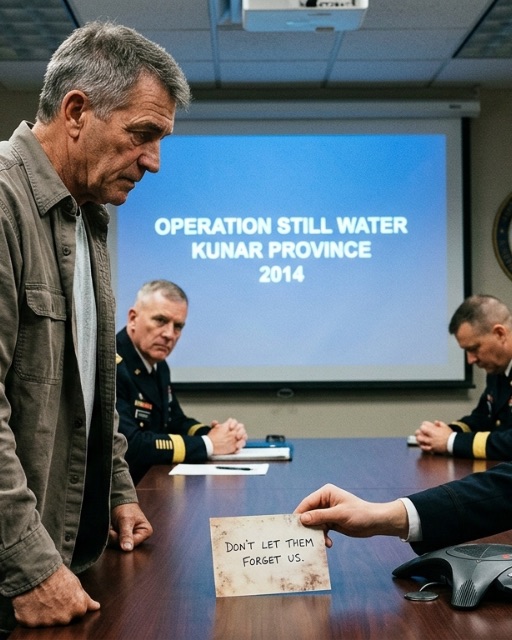
Inside: a long table, six officers, and a projector humming blue. On the screen was a mission I hadn’t seen in nine years.
Operation STILL WATER. Kunar Province. 2014.
My blood went cold.
“Sit down, Sergeant Major,” Driscoll said quietly.
I didn’t. Because at the far end of the table sat a captain I’d never met – but I knew that face. He had the same strong jaw. The same deep-set eyes. The last time I saw those features, they were on a twenty-three-year-old staff sergeant bleeding out in my arms on a dusty mountain road near Asadabad.
The captain slid a worn photograph across the table.
It was of me. Younger, dirt-streaked, carrying his father’s body to the medevac bird.
“My mother said you’d never come back to the Army,” the young captain said, his voice calm and steady. “She said it broke you.”
“She was right,” I said, the words feeling like gravel in my throat.
He flipped the photo over. Five words were scrawled in a dead man’s handwriting: Don’t let them forget us.
The speaker on the conference table crackled to life. General Price’s voice filled the room, sharp and clear.
“Sergeant Major Hartley,” she said. “We didn’t bury STILL WATER because of what went wrong. We buried it because of what you did after. And the people who ordered you to never speak of it again are sitting in that room with you.”
Every officer at the table suddenly found the ceiling tiles or their own knuckles very interesting.
Except one.
The captain—Captain Allen—looked straight at me. “So tell me, Sergeant Major… which one of them gave the order to leave my father behind?”
My heart pounded a frantic rhythm against my ribs. I knew the name. I knew the face.
I reached for the after-action report on the table. My finger, scarred and weathered, pressed down on the signature line at the bottom of a key addendum. I looked at the man sitting two seats to my left. He was a major now. Major Kent. Back then, he was a brand-new captain, our commanding officer in the field.
“It was Captain Kent,” I said. The room went absolutely still.
Major Kent’s face went pale, then red. “That’s a lie. Sergeant Hartley is misremembering. The situation was chaotic.”
“I remember it perfectly,” I said, my voice low. “I remember the sun hitting the rocks. I remember the sound of the rounds kicking up dust around Staff Sergeant Allen.”
I turned to the young Captain Allen. “Your father didn’t die instantly. He was providing cover fire so the rest of us could pull back to a more defensible position.”
“The official report said he was KIA on first contact,” Allen said, his jaw tight.
“The official report was a fiction,” I said. “Your dad saved three men that day. Pinned down, he took a round to his leg. He was alive, and he was talking. He was asking for us to come back for him.”
I looked at Major Kent again. “We were ready to go. We had them suppressed. We had a window. But Captain Kent got on the radio and called it. He said Allen was a lost cause. He ordered us to retreat to the extraction point and leave him.”
“It was a tactical decision!” Kent sputtered, his composure cracking. “We would have lost the whole squad going back for one man!”
“That’s what you told yourself,” I said. “But we both know the real reason. You panicked. The intel you’d vouched for was bad. We walked into a trap you were told to avoid. Leaving Sergeant Allen was about leaving the evidence of your mistake on that mountain.”
The silence that followed was heavy with the weight of nine years.
Captain Allen stared at Kent, his expression unreadable. “My father’s last words on the radio were clear. ‘I’m still in the fight.’ That was scrubbed from the record.”
“How do you know that?” Kent asked, his eyes wide with alarm.
General Price’s voice cut in from the speaker. “Because Captain Allen has spent the last five years of his military career pulling every string he could to get the original comms logs. They weren’t scrubbed, Major. They were just buried.”
She continued, her voice like ice. “Sergeant Major Hartley, tell them what you did next.”
I took a breath. “I disobeyed the order. I told my fire team to cover me. I went back alone. By the time I got to him, it was too late. He was gone.”
I looked at his son. “He held on as long as he could. I think he was waiting. He wrote that note on the back of your picture… the one you carry now. He gave it to me just before…”
I trailed off. The memory was still sharp, still painful.
“I carried your father’s body five kilometers to the LZ,” I finished. “When we got back to base, Captain Kent wrote me up for insubordination and filed a report that my actions had endangered the unit. They gave me a choice: sign a non-disclosure agreement and accept a quiet retirement, or face a court-martial that would disgrace my twenty-five years of service.”
“I was protecting the integrity of the mission!” Kent insisted weakly.
“No,” General Price’s voice boomed from the speaker, making everyone flinch. “You were protecting your career. And the general you reported to decided your career was more valuable than Sergeant Major Hartley’s honor and a gold star family’s truth.”
Another officer at the table, a portly man with a graying mustache, shifted uncomfortably. He had been Kent’s commanding officer’s aide at the time. He knew. They all knew something.
“This is history,” Kent said desperately. “Why bring this up now?”
“Because history is repeating itself, Major,” the General said. “Two weeks ago, you signed off on intelligence for an upcoming operation in the Horn of Africa. Operation IRON SPEAR.”
The projector screen switched from the STILL WATER file to a new one. Maps, troop positions, target information.
“Our analysts flagged it,” she went on. “The source, the patterns, the profile of the intel… it’s identical to the source that fed you the bad information for STILL WATER. It’s a compromised asset, designed to lure our forces into another kill box.”
A cold dread filled the room. This wasn’t just about the past. It was about the future.
“You were warned, Major Kent. Twice. But you pushed it forward anyway. You called the intel ‘rock solid,’ just as you did nine years ago,” General Price stated. “You were about to send another team of soldiers into a meat grinder because you are incapable of admitting a mistake.”
Kent sank back in his chair, defeated. The bravado was gone, replaced by the hollow look of a man who had been caught.
“I… I didn’t see the parallel,” he mumbled.
“Sergeant Major Hartley saw it from a thousand miles away, from a supply closet, from a binder he was labeling,” General Price retorted. “When I heard you were at Fort Carson, Hartley, I knew you were the only one who could make them understand. You were the ground truth that got buried.”
This was the twist. This wasn’t about correcting a single injustice. It was about preventing a catastrophe. My ghost from the past had returned not to haunt me, but to save others.
Colonel Driscoll stood up. “Major Kent, you are relieved of your command, effective immediately. Military police are waiting for you outside.”
Kent didn’t even look up as two MPs entered the room and stood behind his chair. His career was over in the same quiet, sterile room where he had ended Sergeant Allen’s legacy.
After Kent was escorted out, the room was quiet for a long moment.
General Price spoke again, her voice softer now. “Sergeant Major, the gag order is lifted. The Army officially apologizes. We’re amending the report for Operation STILL WATER. Staff Sergeant David Allen will be awarded the Silver Star, posthumously, for his valor. You will be there to present it to his family.”
Tears welled in my eyes for the first time in years. It wasn’t just about the medal. It was about the truth finally seeing the light of day.
Captain Allen stood and walked over to me. He put the old photograph back in my hand. He looked at the younger me, carrying his father.
“He told me in his last letter that if anything ever happened, there was a Sergeant Major Hartley who knew how to do the right thing, no matter the cost,” he said, his voice thick with emotion. “He said you were the best leader he ever knew.”
My hand trembled as I took the picture. I had carried his father’s body. For nine years, I had carried the weight of the secret. Now, it was lifted.
“Your father was a hero,” I managed to say.
“You both were,” he corrected me.
The meeting concluded. The other officers filed out, some giving me a nod of respect that felt foreign after so long. Only Driscoll, Captain Allen, and I remained.
“General Price also authorized a new position,” Driscoll said, a small smile on his face. “Senior Enlisted Advisor for the new recruit integration program. She wants the person who knows the true cost of leadership teaching the next generation.”
He looked at me. “The post is yours, if you want it, Sergeant Major. It’s time you came back home.”
I looked at Captain Allen, then at the picture in my hand. My little house was just a building full of quiet rooms. This was my home.
“I accept,” I said.
A week later, I stood in front of that same room of fresh recruits. Lieutenant Carver was there, too, standing in the back, his posture now one of genuine respect.
I wasn’t holding binders. I was holding the amended after-action report for Operation STILL WATER.
“My name is Sergeant Major Hartley,” I began. “Today, we’re not going to talk about tactics or regulations. We’re going to talk about a man named Staff Sergeant David Allen. We’re going to talk about what it means to lead, what it means to follow, and why you never, ever leave someone behind.”
The silence in my life was finally gone. It was replaced by the voices of young soldiers, eager to learn. It was replaced by a purpose I thought I had lost forever on a mountain in Afghanistan.
Sometimes, the greatest battles aren’t fought with guns, but for the truth. And sometimes, the quietest, most forgotten voices are the ones we need to hear the most. True honor isn’t found in the rank on your collar, but in the integrity you carry in your heart, and in the promises you refuse to break.