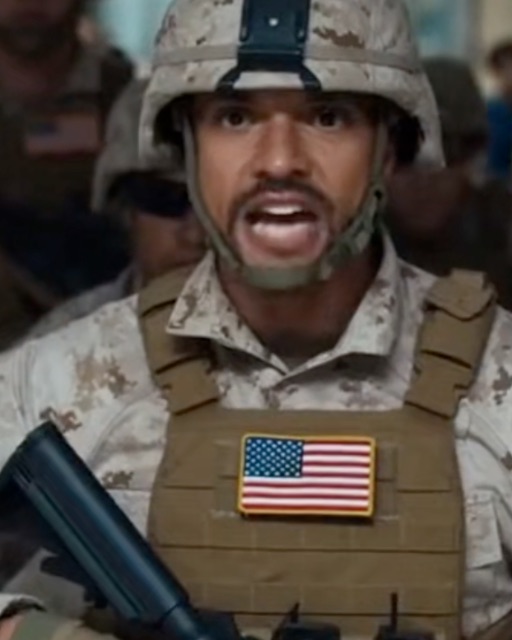
The automatic doors didn’t open fast enough. A Marine booted them off their tracks.
“Secure the perimeter!”
Dr. Prescott rushed forward, face purple with rage. “This is a hospital, not a battlefield! You can’t just barge in here! I am the Chief of Surgery!”
The lead officer, a massive man with a scar running down his jaw, didn’t even blink. He walked right past the doctor, straight to the back corner where Clara was emptying a trash bin.
“We found him, Ma’am,” the officer said, his voice shaking. “We need Angel Six.”
The room went dead silent. The nurses stopped typing. Dr. Prescott froze.
Clara – quiet, limping Clara – slowly took off her rubber gloves. She didn’t look like a tired nurse’s aide anymore. She looked like a weapon.
“Is he alive?” she asked, her voice ice cold.
“Barely,” the officer replied. “He says he won’t let anyone operate but you.”
Dr. Prescott laughed nervously, stepping between them. “Her? She’s a nurse’s aide! She cleans bedpans! She can’t even walk straight!”
The officer turned to Prescott. “She walks like that because she jumped on a grenade to save a platoon in Fallujah.”
He handed Clara a headset. She put it on and walked toward the chopper, her limp suddenly gone, replaced by a combat stride.
As the rotors spun up, Dr. Prescott saw a file fall out of the officer’s tactical bag. He picked it up.
He opened the first page.
He didn’t just see Clara’s real rank. He saw the photo of the “patient” she was going to save.
And when he realized who it was, he dropped the file, his own legs giving out from under him. The crisp white pages scattered across the grimy floor of the emergency bay.
It was his son. It was Daniel.
The world tilted on its axis, the roar of the helicopter blades fading into a dull, sickening hum in his ears. His son, who he hadn’t spoken to in two years after a bitter argument about his enlistment.
“My son,” he whispered, the words tasting like ash. “That’s my son!”
The lead officer, Gunnery Sergeant Reyes, turned back at the sound of Prescott’s choked cry. He saw the doctor on his knees, clutching the photo.
His scarred face softened with something that looked like pity. “I’m sorry you had to find out this way, sir.”
Prescott scrambled to his feet, a wild, desperate energy seizing him. “I’m coming with you. He’s my son, and I’m the best surgeon in this state.”
Reyes blocked his path, a wall of unmoving muscle. “Negative, sir. The patient requested Angel Six specifically.”
“Angel Six is a janitor I hired three months ago!” Prescott screamed, his voice cracking. “She mops floors! My son’s life is on the line!”
Clara paused at the chopper’s ramp, turning her head slightly. The setting sun caught her face, and for the first time, Prescott saw the age in her eyes, the exhaustion etched into her features.
“He’s right, Gunny,” she said, her voice clear and calm over the wind. “Let his father come.”
Reyes hesitated, then gave a sharp nod. “Get on board, Doctor. Now.”
Prescott didn’t need to be told twice. He scrambled into the belly of the Black Hawk, the force of the rotors nearly knocking him over.
The inside of the chopper was a blur of high-tech medical equipment and grim-faced Marines. Clara was already strapped in, her headset on, speaking in a clipped, professional language he barely recognized.
“Give me vitals, now. What’s the entry, what’s the exit? I need blood type, pressure, and a full workup on my tablet before we even land.”
She wasn’t Clara the aide anymore. She was a commander. She was in charge.
Prescott sat opposite her, his heart hammering against his ribs. He looked at the woman he’d dismissed, the woman he’d barely acknowledged with more than a grunt.
He remembered scolding her for being too slow mopping the hallway outside the OR. He remembered mocking her limp with the other surgeons in the break room.
Shame, hot and acidic, burned its way up his throat.
Reyes leaned over, shouting to be heard over the engine. “You should know, Doc. She didn’t just jump on a grenade.”
“She was the surgeon who put herself back together afterwards in a field tent because the other medics were down,” he continued. “They call her Angel Six because she was the sixth member of a five-man recon team that got ambushed. She was the only one who came back.”
Prescott stared at his own hands, the hands of a celebrated surgeon, suddenly feeling useless and small. He had built his entire identity on his skill, his intellect, his superiority.
And it was all a lie. He had been blind.
Clara’s tablet lit up with Daniel’s medical chart. Prescott leaned forward, his medical instincts kicking in despite the personal horror of the situation.
The injuries were catastrophic. Multiple gunshot wounds to the abdomen, massive internal bleeding, a collapsed lung.
“He won’t survive the flight to a proper hospital,” Prescott said, his voice hollow. “No one could survive that.”
Clara looked up from the screen, her gaze meeting his for the first time. There was no pity in her eyes, no “I told you so.” There was only focus.
“Then it’s a good thing we’re not going to a proper hospital,” she said. “We’re taking the hospital to him.”
The chopper landed with a jolt on the roof of an unassuming warehouse in the industrial district. The doors slid open to reveal a fully functional, state-of-the-art mobile surgical suite.
This was a black site. A place that didn’t exist.
They rushed inside. And there, on a table, surrounded by corpsmen fighting to keep him alive, was Daniel. He was pale, broken, and so terribly young.
Prescott felt his breath catch. He wanted to run to his son, to hold his hand, to tell him he was sorry. But he was frozen.
Clara was not. She was already scrubbing in, her movements economical and precise.
“Get me three units of O-neg, run a full spectrum antibiotic, and prepare for a thoracotomy and an exploratory laparotomy,” she commanded. “I want vitals on that screen every fifteen seconds.”
The medical team, a well-oiled machine of military medics, moved instantly.
“Dr. Prescott,” Clara said, not looking at him. “You can assist or you can get out. But if you stay, you are my assistant. You follow my orders. Understood?”
He swallowed his pride. It felt like swallowing glass. “Understood.”
He scrubbed in next to her, the familiar ritual a small comfort in the chaos. For the next four hours, he witnessed a master at work.
Clara’s hands, which he’d only ever seen holding a mop handle, moved with a speed and confidence that defied belief. She was not just a surgeon; she was an artist, a warrior fighting a battle for his son’s life.
She navigated the shredded landscape of Daniel’s insides, clamping bleeders, repairing torn organs, and removing shrapnel with an almost supernatural intuition.
Prescott did as he was told. He held retractors. He suctioned. He was a nurse’s aide.
And he saw what a fool he had been. He had measured a person’s worth by their job title, by the straightness of their walk. He had looked at Clara and seen a slow, simple woman.
He had failed to see the hero standing right in front of him.
At one point, Daniel’s heart stopped. The long, terrible tone of the flatline filled the room.
“Charging to 200,” a corpsman yelled.
Prescott’s own heart seized. “He’s gone.”
“No, he’s not,” Clara said, her voice a steel whip. “Clear!”
The paddles shocked Daniel’s body. Nothing.
“Again. 300.”
Prescott watched, helpless, as the woman he disdained refused to give up on the son he had all but abandoned.
“Clear!”
A beat of silence. Then, a blip on the monitor. Faint, but there.
A ragged, collective sigh of relief went through the room.
Clara didn’t pause. “He’s back. Let’s keep him that way. Scalpel.”
Six hours later, it was over. The last stitch was in place. Daniel was alive, his vitals weak but stable.
Clara stepped back from the table, her entire body seeming to sag. She finally looked her age. She finally looked tired.
She pulled off her bloody gloves and walked out of the surgical suite.
Prescott followed her. He found her on the roof, staring out at the city lights.
The silence stretched between them, thick with everything unsaid.
“Why?” Prescott finally asked, his voice raw. “You’re one of the most decorated combat surgeons alive. Your file… it reads like a legend. Why were you working as a janitor in my hospital?”
Clara took a deep breath, the cold night air seeming to steady her. “Because of him,” she said softly, nodding back toward the surgical suite. “Because of Daniel.”
Prescott was confused. “You know my son?”
“I never met him in person,” she said. “But I knew his commanding officer, a man I served with. He called me a few months ago. He was worried about Daniel.”
She turned to face him, her expression unreadable. “He said Daniel was a good Marine, but he was reckless, angry. He said the anger came from his father, a big-shot surgeon who thought his son wasn’t good enough.”
Each word was a punch to Prescott’s gut.
“Daniel was getting into trouble on his leave,” Clara continued. “Picking fights, drinking too much. His CO was afraid he’d throw his life away before he even got a chance to live it. He asked me if I could… keep an eye on him. From a distance.”
The pieces clicked into place with horrifying clarity.
“I was trying to be quiet, to live a normal life after everything,” she said. “But I owed his CO my life. So, I took the job at your hospital. It was the easiest way to be close, to watch, to make sure he didn’t end up in your morgue.”
She had been protecting his son. All this time, the quiet woman mopping the floors had been a guardian angel in disguise, sent to watch over the boy he had pushed away.
“I saw you,” Prescott whispered, the memory dawning on him. “There was a night Daniel showed up in the ER after a bar fight. You were there, cleaning the floors. You watched him until I stitched him up and he left.”
“I was there every time,” she confirmed.
The weight of his arrogance, his ignorance, his failure as a father, crashed down on him. He had been so proud of his perfect, sterile world, and he had been completely blind to the real, messy, heroic life happening in his own hallways.
He finally broke. Tears streamed down the face of the great Dr. Prescott.
“I’m sorry,” he choked out. “For how I treated you. For what I said. For everything.”
Clara just nodded. There was no malice in her, no victory. Only a deep, profound weariness.
“Just be a father to your son, Doctor,” she said. “That’s all he ever wanted.”
Weeks turned into months. Daniel began the long, painful road to recovery.
Dr. Prescott was by his side every single day. He wasn’t the Chief of Surgery. He was just a dad, reading to his son, helping him with his physical therapy, and slowly, carefully, rebuilding the bridge he had burned.
They talked. For the first time, they really talked. Daniel spoke of the pressure he felt, the anger he held. Prescott spoke of his fear, his pride, and his deep regret.
The hospital changed, too. Dr. Prescott was a different man. He knew every janitor’s name. He treated the aides with the same respect he gave his fellow surgeons. He listened more than he spoke.
He had learned that a person’s value isn’t on a name tag or in a bank account. It’s in their character, in the quiet sacrifices they make when no one is watching.
One afternoon, he found Clara sitting by the lake in the city park. She was no longer in a janitor’s uniform, but simple jeans and a sweater. The limp was back, a gentle reminder of the price she had paid.
He sat down beside her. “He’s going to walk again,” Prescott said. “They say he’ll make a full recovery.”
“I know,” Clara replied, a small smile touching her lips. “He’s strong. Like his father.”
Prescott shook his head. “He’s strong because of people like you.”
He offered her a job, a real one. Co-chief of surgery, a research grant, anything she wanted.
She politely declined. “That’s not my life anymore, Doctor. I’m just Clara now.”
She was happy with her quiet life, with her anonymity. She hadn’t done it for glory or recognition. She had done it because it was the right thing to do.
As he left her there, feeding the ducks, Prescott finally understood the true nature of strength. It wasn’t about being the loudest voice in the room or having the most important title.
True strength was the quiet courage to do what’s right, the humility to serve without needing applause, and the grace to see the hero in the person you least expect. It was a lesson he had learned in the most painful way possible, a lesson delivered by the woman they called “slow.” And it had saved not just his son’s life, but his own.