“Answer the question, Sergeant – unless you’re too scared to say it out loud.”
Major General Trevor Banks smiled like he’d already won.
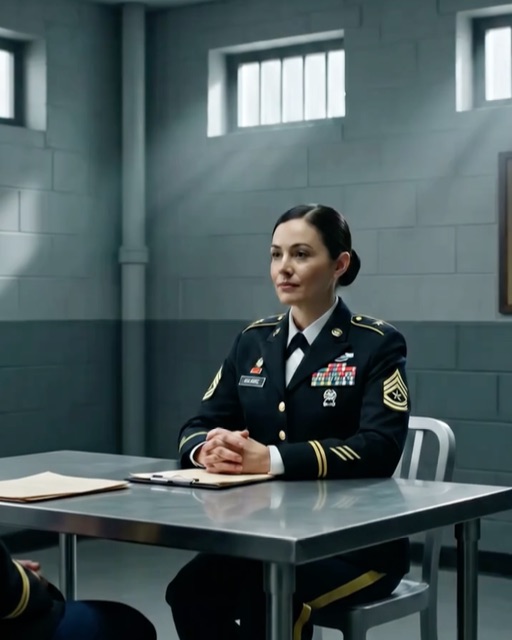
I sat across from him at the metal table, hands folded, shoulders square, hair scraped into a bun that gave me a headache hours ago. The fluorescent lights bleached everyone to paper. A line of officers watched like they’d paid for front-row seats.
“Careful, sir,” I said, voice low. “You may not like the answer.”
A couple chairs creaked.
“You’re signals, right?” Banks chuckled into the mic. “Targeting. Systems. Not exactly a battlefield legend.”
A thin laugh rolled through the room.
“How many kills you got, Sergeant? One? Maybe two?”
I held his eyes. “Fifty-one.”
Silence. The court reporter stopped typing. Someone actually swallowed loud enough to hear it. A colonel’s little smirk slid right off his face.
“No,” Banks said.
I didn’t move.
“That’s impossible.”
Still nothing.
He leaned in. “You expect us to believe a support specialist has fifty-one confirmed kills?”
“No, sir,” I said. “I expect you to ask why those kills are classified.”
The air got heavy. Like the room inhaled and forgot how to let go.
Three weeks earlier I’d filed a report – falsified target intel during a covert op in Eastern Europe. Officially, the mission was perfect. Unofficially, twelve civilians died because someone changed coordinates after verification.
So they called me insubordinate. Unstable. Dragged me in to break me.
“Let’s discuss Operation Night Glass,” Banks said, opening a folder he clearly hadn’t read.
“I wasn’t listed as field,” I said.
“Not cleared to engage.”
“Behind a console.”
“Then explain fifty-one.”
“Comms were jammed. Drone control hijacked. Only live line left was a maintenance satellite routed through my station.” My voice was steady; my heart wasn’t. “I identified hostile positions manually. Redirected defensive fire with emergency protocols. Fifty-one enemy down. Six Americans made it home.”
A young major blinked at me like I’d spoken another language.
“And why,” Banks said, tapping the folder, “would no one here know that?”
“Because someone buried it.”
He laughed once, brittle. “You’re suggesting a conspiracy?”
“I’m stating a record.”
“There is no record.”
I looked at the red camera light in the corner. “There is now.”
Banks flinched. Just a flicker.
“Sir, may I ask you something?”
“No.”
“Why did you alter the civilian grid at 0351 on March 14?”
The room didn’t gasp. It tightened. Every uniform drew in.
“That is not—”
“Original coordinates cleared at 0347 through my station. Revised from your terminal four minutes later. Twelve civilians dead. One buried correction.”
He slammed the table. I didn’t blink.
“This hearing is about YOUR conduct!”
“No, sir,” I said quietly. “It’s about yours. It just took you forty minutes to realize.”
Folders closed. The JAG officer in back stood.
I reached under my chair and put a flash drive on the table. “Satellite logs. Unaltered timestamps. Original coordinates. And the authorization code used to change them.” I nudged it forward. “That code belongs to one person in this room.”
I didn’t look at him. I didn’t have to.
The JAG walked up, picked it up, turned it over. His face went white.
Black marker on the label. Not “Night Glass.” Not “Coordinates.”
Just two words that meant he wasn’t just losing his rank. He was losing his freedom.
The label read: “ANNA’S LIST.”
Major General Banks stopped breathing. It wasn’t just a pause; it was a total system failure.
The JAG officer, a man named Major Caldwell who hadn’t said a word until now, held up the flash drive. His eyes were not on me, but locked on Banks.
“General,” Caldwell said, his voice cutting through the dead air. “Who is Anna?”
Banks tried to speak, but only a dry, clicking sound came out. His face, once so smug and commanding, had crumpled like a paper bag.
Sweat beaded on his forehead, catching the sterile light.
“This is absurd,” he finally managed to rasp, looking around for allies. He found only averted eyes and stone-cold faces.
The colonels and majors who were smirking minutes ago now looked like they wanted to crawl under the table. They were just spectators, but they were in the same room as treason. That was a stain that didn’t wash out easily.
“Seal the room,” Caldwell ordered the guards at the door. “No one leaves. Confiscate all personal electronics.”
The guards, suddenly rigid with purpose, moved with a speed I hadn’t seen all day.
The disciplinary hearing against Sergeant Katherine O’Malley was over. The court-martial of Major General Trevor Banks was just beginning.
Caldwell walked back to the table and plugged the flash drive into a secured laptop his aide brought forward. He didn’t ask for my permission. He didn’t need it.
He clicked a few times. A single file appeared on the screen. It wasn’t a document or a spreadsheet.
It was an audio file.
“Sergeant,” Caldwell said, still not looking at me. “Do you want to explain what we’re about to hear?”
“No, Major,” I said. “I think the General should do that.”
All eyes swung back to Banks. He looked like a cornered animal. His uniform, so crisp and perfect, now seemed two sizes too big for him.
“It’s a fabrication,” he hissed. “Doctored. This Sergeant is mentally unstable. We have reports.”
“The reports you solicited after I filed my initial intelligence query?” I asked softly.
He flinched again, a bigger one this time. A full-body jerk.
Caldwell played the file.
A voice filled the room, crackling with static but clear enough to understand. It was Banks.
“The package must be neutralized,” his voice said. “I don’t care about the collateral. The apartment building on Elm Street. Confirm.”
A second voice, heavily accented, replied. “Confirmed. The asset known as Anna will be eliminated. The payment will be transferred upon visual confirmation.”
A collective intake of breath. This was so much worse than falsified coordinates. This was murder for hire.
“The primary team is still en route,” Banks’s voice continued on the recording. “You have a fifteen-minute window before they arrive. Make it look like a tragic mistake.”
The recording ended.
The silence that followed was heavier than a tombstone.
“Anna,” Caldwell said, his voice dangerously low, “wasn’t just a civilian. She was our asset.”
He knew. Of course he knew. This went higher than a disciplinary hearing. This was counterintelligence.
“She was a journalist compiling a list,” I added, my voice sounding distant to my own ears. “A list of corrupt officials, both local and foreign, who were skimming funds from aid packages and selling military intel.”
I finally looked directly at Banks. His eyes were wide with a terror that was almost pitiful.
“Her mistake was telling her handler she was close to identifying a high-ranking American officer on that list.” I let that hang in the air. “She never got to say the name.”
Banks’s chair scraped as he shoved himself back from the table. “Lies! All of it!”
“Is it?” Caldwell countered, his eyes scanning a document that had just materialized on the laptop screen from the drive. “It seems ‘Anna’s List’ also includes encrypted financial records. Offshore accounts.”
He looked up. “One of which received a deposit of two hundred thousand dollars on March 14th. The same day Operation Night Glass took place.”
The court reporter was typing again, her fingers flying across the keys, documenting the implosion of a man’s life.
“How did you get this recording, Sergeant?” Caldwell asked. The question wasn’t an accusation. It was a genuine inquiry.
I took a deep breath, the first one that felt like it reached my lungs all day. “General Banks is right about one thing. I’m signals. I work with systems.”
I explained how after the mission, I couldn’t let go of the twelve civilian deaths. It felt wrong. The coordinate change was too clean, too deliberate.
“So I started digging in my off-hours. I ran a diagnostic on the General’s terminal logs, looking for any trace of the correction he buried.”
“I found a ghost signature. A tiny data packet that piggybacked on the coordinate change command.”
Banks had been sloppy. He thought no one would ever look. He thought I was just a nobody behind a screen.
“It was a VOIP call, heavily encrypted, routed through a burner satellite. He must have thought it was untraceable.”
A young lieutenant in the back shook his head in disbelief.
“But he used a military network to launch it,” I continued. “Even for a second, it left a fingerprint. I spent two weeks isolating and decrypting that packet.”
What I didn’t tell them was that those two weeks were the worst of my life. I barely slept. I ate cold rations at my desk. I risked my own career and freedom with every keystroke.
I felt like I was drowning in secrets.
“And the fifty-one kills?” Caldwell prompted gently.
“They weren’t the target,” I said, my throat tightening. “They were the janitors. A private mercenary team hired to eliminate the American spec ops team that was supposed to extract Anna.”
I paused. “When the comms went down, I knew it was a coordinated attack. The drone hijack, the jamming… it was a trap. I saw them moving in on our guys’ position.”
“I bypassed the local drone controls and hard-linked into a defensive weapons satellite. It’s an emergency protocol that’s never supposed to be used. I didn’t have authorization.”
“I became the eye in the sky for a team I couldn’t talk to. I guided their fire. I took out the enemy ambush. Fifty-one times.”
One of the colonels, a man who had looked at me with disdain earlier, now just stared at his hands on the table. He looked ashamed.
“The six soldiers who made it out,” I finished. “They never knew who was helping them. The report just said ‘system malfunction and subsequent friendly fire success’.”
“It wasn’t a malfunction,” I said. “It was me.”
Banks started to laugh then, a broken, unhinged sound. “You see? She’s admitting it! She broke protocol! She acted without authority!”
Caldwell looked at him with pure ice in his eyes. “She saved six American lives, General. What did you do?”
Banks’s laughter died on his lips.
That’s when the other truth came out. The part that gave me the courage to walk into this room. I wasn’t entirely alone.
“I didn’t find all of this by myself,” I admitted.
Caldwell raised an eyebrow. “Oh?”
“One of the soldiers who survived, Master Sergeant Ben Wallace, was the team leader. He was on the ground. He knew the extraction point for Anna was compromised before they even got there.”
Wallace was a legend. Twenty years in. A ghost who could walk through walls. He felt it in his gut that something was wrong.
“After he was debriefed, he contacted me through a secure channel. He didn’t trust the official report either.”
We had never met in person. We were just two voices on an encrypted line, two people who believed the truth was worth fighting for.
“He’s the one who told me Anna was the real target,” I said. “He’s the one who got me her real name. The official file just listed her as ‘Asset C-7’.”
“He did his own digging on his end, talking to contacts on the ground. He’s the one who found out about the list. Together, we pieced it together.”
It wasn’t just my fight. It was ours. Knowing he had my back was the only thing that kept me going when the threats started.
The anonymous emails. The sudden internal investigations into my performance. The whispers that I was cracking under pressure.
It was all Banks, trying to discredit me before I could find anything solid.
“Master Sergeant Wallace is waiting outside this room, Major,” I said. “He has a sworn statement corroborating everything on that drive. And a few things that aren’t.”
Caldwell nodded slowly. The last piece of the puzzle had just snapped into place.
He stood up and walked over to Banks. He didn’t yell. He didn’t posture. He just spoke with a quiet finality that was more terrifying than any shout.
“Major General Trevor Banks, you are hereby stripped of your command. You are under arrest on suspicion of murder, conspiracy, and high treason.”
He unclipped the two stars from Banks’s collar and dropped them on the table. They made a small, pathetic clinking sound.
The guards moved in and pulled a stunned, vacant-looking Trevor Banks to his feet. His reign was over in the space of a single heartbeat.
As they led him away, his eyes met mine one last time. There was no anger. No hatred. Just a hollow, empty recognition.
He had underestimated the nobody.
The room cleared out quickly after that. The officers filed out, not looking at me, not looking at each other. They just wanted to be gone.
Finally, it was just me and Major Caldwell. The laptop was closed. The flash drive was secured in an evidence bag.
“Sergeant O’Malley,” he said, his tone professional but not unkind. “You understand that this will be a classified proceeding.”
“I understand, sir,” I replied.
“Your actions, while heroic, were… unorthodox.” He paused. “There will be a commendation. A very quiet one. And a promotion.”
I had expected that. They had to reward me, but they also had to control the narrative.
“With all due respect, Major,” I said, standing up. “I don’t want them.”
He looked surprised. “Excuse me?”
“I just want to do my job. The real one. Not this.” I gestured around the sterile, cold room.
“I’m putting in my papers for an honorable discharge.”
Caldwell studied my face for a long moment. He was looking for signs of anger, or bitterness. He wouldn’t find any.
I was just tired. And I was done.
“You’re sure?” he asked.
“I am, sir,” I said. “I did what I had to do. I made sure the truth came out. My part in this is over.”
My part was to give Anna a voice when hers was silenced. It wasn’t to climb a ladder or collect medals.
He finally nodded. “I understand. Your record will reflect your valor, Sergeant. I’ll see to it personally.”
“Thank you, sir.”
I walked out of that room, leaving my bun, my headache, and my uniform behind. Waiting in the hallway was a man who was shorter than I expected, with kind eyes and a grip of steel when he shook my hand.
“Sergeant O’Malley,” he said. “I’m Ben Wallace. You saved my life.”
“You helped me save mine, Master Sergeant,” I replied.
We didn’t say much else. We didn’t need to.
A month later, I was sitting in a small diner a thousand miles away from any military base. The coffee was hot, and the seat was comfortable. I wore jeans and a simple t-shirt. My hair was down.
The bell on the door jingled, and Ben Wallace slid into the booth across from me. He was in civilian clothes, too.
“Heard you got out,” he said with a small smile.
“Couldn’t stay,” I said simply. “Time for something else.”
“Me too,” he said, surprising me. “Twenty years is enough. I’m going to go see my sister in Oregon. Help her fix up her house.”
We sat in comfortable silence for a moment, two veterans of a war no one would ever know about.
“Banks got life,” he said quietly. “No parole. They buried him so deep he’ll never see sunlight again.”
“Good,” I said. It wasn’t about revenge. It was about justice. For Anna. For the eleven other civilians. For the integrity of the uniform we had both worn.
“What they’ll never know,” Ben said, leaning forward slightly, “is how you really did it. How you found that VOIP call.”
I smiled a little. That was my final secret. The one I didn’t even tell Caldwell.
The system hadn’t just flagged the call. It had flagged it because Banks used a specific override code. A code he thought was his and his alone.
But it wasn’t. It was the emergency access code assigned to my late father, a signals legend himself, who had helped design the system two decades ago. Banks had been his protégé and had stolen the code after my father passed away, thinking it was a forgotten relic.
My father had taught it to me when I was a kid, as a memory game. He called it his “master key.”
When I saw that code in the log, I didn’t just see a clue. I saw a ghost. I saw my father pointing me in the right direction.
“I had a little help from my family,” I told Ben.
He nodded, accepting the answer without needing more. Some things didn’t need to be explained.
We finished our coffee and stood to leave. He paid the bill before I could argue.
“You know, Kate,” he said, using my first name for the first time. “Most people think courage is about running into a fight. But sometimes, it’s just about being the one person in a quiet room who refuses to back down.”
He was right. I was never a battlefield legend. I was just a sergeant in a chair.
But in that chair, I moved mountains. I brought a giant to his knees. I fought for the truth with the only weapons I had: my knowledge, my conviction, and a simple flash drive.
My reward wasn’t a medal. It was this. The quiet freedom of a morning coffee, the peace of a clear conscience, and the knowledge that one person, even a perceived “nobody,” can make a difference.
You just have to be brave enough to plug in the drive.