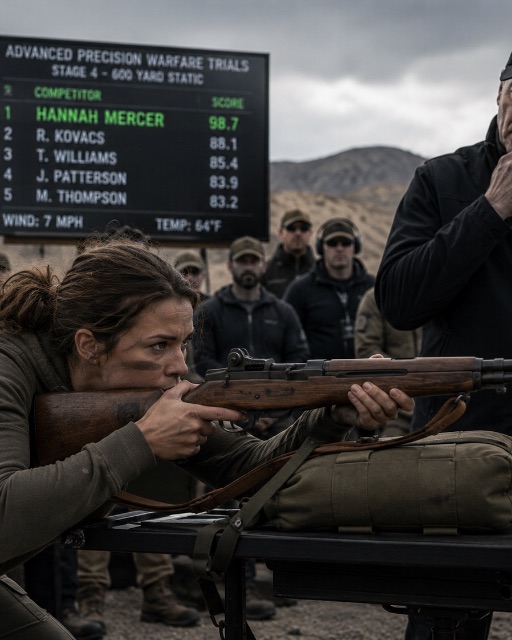
“They gave her that rifle as a joke.”
That was what people said the moment Hannah Mercer stepped onto the range.
She was the first woman ever cleared to compete in the Advanced Precision Warfare Trials – a competition known for breaking egos and building legends. The best marksmen in the country had arrived with rifles that looked like they belonged in a laboratory: precision-machined platforms fitted with ballistic computers, thermal optics, laser rangefinders, and scopes worth more than most vehicles.
Hannah arrived with a worn canvas rifle bag.
And silence.
The kind of silence that made people uncomfortable.
Inside that bag was an old M14 – her father’s rifle. Daniel Mercer. A name that barely lived anywhere except in old paperwork and fading family memory. The rifle showed its age. The walnut stock was scarred. The finish dulled by time. And the mounted scope?
Useless.
When Hannah tested it on the practice line, the image flickered, drifted, then died completely. A few competitors noticed. One of them—a guy named Rodney Sharpe with $40,000 worth of gear on his rail—laughed loud enough for the whole line to hear.
She didn’t respond.
She simply removed the scope, set it aside, and locked the rifle back into position—iron sights only.
To everyone else, it looked like defeat.
To her, it felt like coming home.
Her father had taught her differently. No shortcuts. No reliance on gear. Just fundamentals—breathing, control, patience, reading the wind before it spoke. He used to say that tools could assist, but they could never replace the person behind them.
“A rifle only tells the truth,” he had told her once, his calloused hand steadying her ten-year-old grip on the stock. “It’s the shooter who decides what to do with it.”
Daniel Mercer had disappeared when Hannah was fourteen. No funeral. No body. Just two men in dress uniforms at the front door and a mother who stopped speaking for six weeks.
The first event was a six-hundred-yard static course.
Clean conditions. Predictable wind. The kind of stage designed to favor advanced optics.
Hannah took her time.
She blocked out the noise.
One shot at a time.
When the targets were checked, her grouping sat tighter than several competitors running full systems. Tighter than Rodney’s. Tighter than everyone in her lane.
The laughter stopped.
The range didn’t get loud.
It got quiet.
That was when things started to shift.
Not openly. Not directly. But enough.
She realized later that she had missed a scheduled practice window—one that everyone else had somehow known about. Then her ammunition count came up short. Two boxes gone. No explanation. No witnesses. Her gear bag had been moved from where she’d left it, unzipped, contents rearranged in a way she hadn’t done.
No one said anything.
No one offered help.
A range official named Terrence Voss shrugged when she reported it. “Rounds get miscounted all the time. You sure you didn’t shoot through them on the practice line?”
She was sure.
Hannah recalculated. Adjusted her round allocation for the remaining stages. Tightened her margins.
Moved forward.
The moving-target stage separated shooters from pretenders.
Targets appeared briefly—running silhouettes, sliding figures, narrow exposure windows that required more than just skill. They required timing. Prediction. Instinct.
Most shooters tracked targets, chasing them with their crosshairs, trying to catch up.
Hannah didn’t chase targets.
She anticipated them.
She’d place her sights where the target was going to be, wait a half-breath, and squeeze.
Nine hits out of ten.
No hesitation. No wasted motion.
The one miss was a target that appeared for less than 0.8 seconds. Nobody else hit it either.
By then, people weren’t laughing anymore.
They were watching.
Rodney Sharpe had gone quiet. He was still near the top of the leaderboard, but the gap was thinner than his ego could handle. He kept glancing at Hannah between stages with an expression caught somewhere between disbelief and something uglier.
Then the storm hit.
Fast.
Hard.
Wind tore across the range at thirty-plus knots, knocking out electronic systems, scrambling readings, turning expensive equipment into dead weight.
Ballistic computers failed.
Optics lost clarity in the driving rain.
Laser systems misfired or returned garbage data.
The advantage vanished.
One by one, shooters started missing. Wide. Low. Some couldn’t even get stable readings. A competitor named Douglas Wyatt—three-time finalist—threw his rangefinder on the ground and walked off the line.
But Hannah didn’t lose anything.
She had never depended on it.
While others recalibrated and struggled, she settled into what she already knew.
Breath.
Sight.
Control.
Shot.
The wind was vicious and inconsistent, but she read it the way her father taught her—watching the grass at the midpoint, feeling the gusts against the left side of her neck, timing her shots between pulses.
Three hits. Then four. Then five.
By the final stage, the narrative had changed.
She wasn’t an outsider anymore.
She was the variable no one could account for.
The one problem no one could solve.
And then—
Something else happened.
The chief range officer—a man named Colonel Boyd Prewitt, who had overseen these trials for eleven years, who had seen every kind of shooter, every kind of weapon, every kind of failure and triumph this range could produce—stepped closer as Hannah prepared for her final relay.
His eyes weren’t on her.
They were on the rifle.
On the worn walnut stock.
On a small, nearly invisible marking carved into the wood just above the grip. Three notches and a symbol she’d always assumed was her father’s personal touch. Something he’d carved for luck, maybe. She’d never asked. By the time she was old enough to ask, he was gone.
Colonel Prewitt’s expression changed.
Completely.
He went pale. His hand came up slowly, like he wanted to touch the stock but couldn’t bring himself to.
“Where did you get this rifle?” His voice was low. Controlled. But she could hear it—something underneath the authority.
Fear.
“It was my father’s,” Hannah said.
“Daniel Mercer.”
Prewitt’s jaw tightened. He looked at her—really looked at her—for the first time.
“I know who Daniel Mercer was.”
The way he said was made her stomach drop.
Because that rifle—
Wasn’t just old.
It was known.
That marking on the stock wasn’t decoration. It was an operational identifier. One that was never supposed to leave a classified vault, let alone show up at a public competition in the hands of a dead man’s daughter.
And suddenly, the competition wasn’t just about accuracy anymore.
It was about history.
About a name that wasn’t supposed to surface again.
About a man who had disappeared into classified reports and unanswered questions—and a family that was told just enough to stop asking.
Colonel Prewitt pulled out his phone. His hand was shaking. He made one call. Spoke four words: “The Mercer rifle surfaced.”
Then he looked back at Hannah.
“You need to finish this stage,” he said quietly. “You need to win. And then you need to come with me. Because what your father left inside that rifle—”
He stopped himself.
Looked around at the other officials. The competitors. The cameras.
“Finish the stage, Ms. Mercer.”
Hannah’s hands were steady. They’d always been steady. But her heart was hammering in a way it hadn’t since the day those two men showed up at her mother’s door.
She shouldered the M14.
Settled her breathing.
And took the shot.
The ping of steel from a thousand yards away echoed through the silent rain. A perfect center hit. The crowd erupted, a wave of sound that finally broke through her concentration. She had won.
But she felt no joy. Only a deep, chilling sense of dread.
Colonel Prewitt waited until the cameras were off her, until the handshakes and back-pats had subsided. He led her away from the range, not towards the awards tent, but to a small, windowless office in the main complex. Two armed guards stood outside the door.
He gestured for her to sit. He remained standing, pacing the small room.
“The men who came to your house,” he started, his voice tight. “They told your mother your father was presumed dead. Killed in a training accident. Correct?”
Hannah nodded, her throat dry.
“It was a lie,” Prewitt said flatly. “Daniel Mercer was never in a training accident. He was the most careful operator I ever knew. He was part of a unit that doesn’t exist. It was called Ghostfire.”
He paused, studying her face. “Ghostfire was our answer to an inconvenient truth: technology fails. In deep cover situations, a man with a digital footprint is a dead man. Daniel and his team were analog operators in a digital world. They relied on fundamentals. Just like you.”
He looked at the M14 she had propped against the wall.
“That’s not a standard-issue rifle. It’s one of three Ghostfire prototypes. It’s not broken. The scope didn’t just fail. It was designed to fail if anyone other than your father tried to use it without knowing the protocol.”
Hannah stared at him, confused. “What protocol?”
“The protocol was to trust the iron sights,” Prewitt said. “Your father believed anyone who couldn’t hit a target without a computer helping them was a liability. He set that test himself. You passed.”
The pieces started to click into place, but they formed a picture she didn’t understand. “Why would he do that? And how did I get this rifle?”
“We assumed it was lost when he disappeared,” Prewitt continued, ignoring her last question. “His last mission went bad. Very bad. The official report said he turned. That he betrayed his team and sold intelligence to a rival agency.”
Hannah shot to her feet. “No. Not my father.”
“I never believed it either,” Prewitt said softly. “Daniel was my friend. He was betrayed by someone on the inside. Someone who wanted what he had—his position, his access, his legacy. The evidence against him was too clean, too perfect. He was declared a traitor, and his name was erased.”
A cold realization washed over Hannah. The snickering. The sabotage. It wasn’t just professional jealousy.
“The missing ammunition,” she whispered. “The practice schedule. Terrence Voss.”
Prewitt nodded slowly. “Voss was just a pawn. He was taking orders. There are people here who recognized that rifle. People who didn’t want you to succeed because they were terrified of what it might mean.”
“Who?” she demanded.
Prewitt’s gaze was heavy. “Rodney Sharpe. Does his last name mean anything to you?”
Hannah shook her head.
“His father is General Alistair Sharpe. After your father was declared a traitor, Alistair took over the Ghostfire project. He shut it down. Claimed it was obsolete. Then he used the research to build a billion-dollar private contracting firm with the very government he was supposed to be serving. A firm that specialized in high-tech warfare solutions.”
Alistair Sharpe. The other man on Daniel’s team. The one who survived the ‘failed’ mission and returned a hero.
“Did you know?” Hannah asked, her voice shaking with rage. “Did you know all this time?”
“I suspected,” Prewitt admitted. “But I had no proof. Alistair buried everything. And Daniel… Daniel was a ghost. Until today.”
He walked over to the M14. With a surgeon’s precision, he pressed two of the scars on the walnut stock in a specific sequence. Then he twisted the base of the grip. A tiny, almost invisible seam appeared. The butt plate of the rifle popped open, revealing a hidden compartment.
It wasn’t a joke. It wasn’t a broken rifle.
It was a message in a bottle.
Inside the hollowed-out stock was a small, oilskin pouch. Prewitt carefully emptied its contents onto the desk: a single, encrypted data chip and a small, folded piece of paper. The paper was worn, the creases soft from years of being hidden.
It was a letter. In her father’s handwriting.
Hannah unfolded it with trembling hands.
‘My dearest Hannah,’ it began.
‘If you are reading this, it means I failed to come home, but you did not fail me. I hope you got this rifle not from a man in a uniform, but from the place I told you about. Our place. Under the loose stone by the creek where we used to fish. I put it there before I left, just in case. They told you I was a traitor. It’s a lie. Alistair sold us out. He set me up to take the fall for a deal he made.’
Hannah gasped. The rifle. Her mother had given it to her before the competition, telling her she’d found it in the back of the old garage. But that was a lie. Her mother had known where to get it all along. She was protecting him. Protecting the secret.
The letter continued. ‘I couldn’t come back. Not without putting you and your mother in danger. Alistair is a powerful man. He has eyes everywhere. So I had to wait. I had to trust that the daughter I raised would one day be strong enough, and skilled enough, to do what I could not. I knew this competition was monitored. I knew they would see the rifle. It was my only way to send a signal.’
‘The chip has everything. The proof of Alistair’s treason. The bank records, the communications. Everything needed to clear my name. But you can’t just hand it to anyone, Hannah. You can only trust one man: Boyd Prewitt. If he is still there, he will know what to do. He was the only one who questioned the official story.’
‘I am so sorry I had to put this burden on you. I have watched you from a distance all these years. I saw you practice with this rifle until your hands bled. I saw the woman you became—strong, honorable, and a better shot than I ever was. You didn’t just win a competition today. You won my freedom.’
‘Be brave. Be true. I love you.’
‘Dad.’
Tears streamed down Hannah’s face as she clutched the letter. He was alive. All this time, he was alive and watching over her. The years of loneliness, of feeling abandoned, of carrying the secret shame of a father presumed dead—it all melted away, replaced by a fierce, burning purpose.
Prewitt cleared his throat, his own eyes misty. “It seems your father was always one step ahead.”
He picked up the data chip. “General Sharpe is here today. He’s the guest of honor at the awards ceremony. He likes to rub his success in everyone’s face.”
A plan formed in Prewitt’s eyes. A dangerous, audacious plan. “He doesn’t know we have this. He thinks his pawn, Voss, stopped you. He thinks his son’s victory would be the final insult to your family’s name.”
“What do we do?” Hannah asked, her voice now firm.
“We give him his award,” Prewitt said with a grim smile. “Right in front of everyone.”
The awards ceremony was held in a large banquet hall, filled with military brass, sponsors, and competitors. General Alistair Sharpe, a handsome, decorated man with cold, calculating eyes, stood at the podium. He was an icon in the defense world.
Rodney Sharpe sat in the front row, smug and expectant, basking in his father’s powerful glow. He had placed second, a result that infuriated him but was still respectable. He kept shooting venomous looks at Hannah, who sat quietly near the back with Colonel Prewitt.
The General finished his long-winded speech about the future of warfare being technology. “It is about giving our soldiers the best gear money can buy,” he declared. “The age of the simple rifleman is over.”
Then he announced the winner. “And now, the winner of the Advanced Precision Warfare Trials… Ms. Hannah Mercer.”
A polite, slightly confused applause rippled through the room. Hannah walked to the stage. She shook the General’s hand. His grip was firm, but his eyes were like ice. He saw her, but he didn’t truly see a person. He saw an anomaly, an inconvenience.
As she accepted the trophy, Colonel Prewitt stepped up to the podium. “General, if I may have a word.”
Prewitt, as the chief range officer, commanded respect. The room fell silent.
“We have one more award to give out this evening,” Prewitt announced, his voice booming through the microphone. “It’s a special honor. One for lifetime achievement in the service of one’s country… and one’s self.”
He looked directly at General Sharpe. “General, you spoke of technology. But we were just reminded today that a person’s character can’t be bought. That truth, like a well-aimed shot, always finds its target.”
On the large screens behind the stage, which had been showing highlights from the competition, the image suddenly switched. It was a bank statement. An offshore account with millions of dollars deposited by a foreign weapons manufacturer.
The name on the account was Alistair Sharpe.
The room went dead silent. The General’s face turned ashen.
“What is the meaning of this?” he sputtered.
“It’s from an old friend,” Prewitt said calmly, as more documents flashed on the screen—encrypted emails, flight manifests, audio logs of Sharpe making a deal to sell Ghostfire intelligence. “He wanted you to know that he cleared his name. Daniel Mercer.”
At the mention of the name, Alistair Sharpe stumbled backwards as if he’d been shot. Rodney jumped to his feet, his face a mask of confusion and horror.
“This is falsified! It’s slander!” Sharpe roared.
But it was too late. Two military police officers were already walking toward the stage. Terrence Voss, the range official, was being escorted into the hall in handcuffs. He was pointing a shaking finger at the General.
The truth had landed.
The empire built on lies and betrayal crumbled in a matter of seconds.
Hannah stood holding her trophy, watching the man who had destroyed her family be brought to justice. She felt no hatred. Only a profound sense of peace. Her father was free.
Months later, Hannah stood by that same creek where she used to fish with her dad. She wasn’t holding a rifle. She was holding a cup of coffee.
She heard a twig snap behind her.
She turned.
A man stood there. He was older, his hair grayer, his face lined with the harshness of a life lived in the shadows. But his eyes… they were the same eyes she saw in the mirror every morning.
He didn’t run to her. He didn’t say a word. He just stood there, his own eyes filling with tears.
“Hi, Dad,” she said, her voice catching.
“Hi, kiddo,” Daniel Mercer replied, a lifetime of sorrow and pride in his voice. “I knew you could do it.”
True strength isn’t found in the tools you carry, but in the character you build. It’s a legacy passed down through love, forged in integrity, and revealed when it matters most. You can’t buy it, you can’t fake it, and in the end, it is the only thing that truly wins.