“He’s going to eat you alive, Barbie,” Master Chief Miller laughed, tossing me the keys to Kennel 4. “You have 72 hours. If you can’t leash him, we put him down. And you go back to a desk job.”
The other SEALs snickered. They were betting on how fast I’d run.
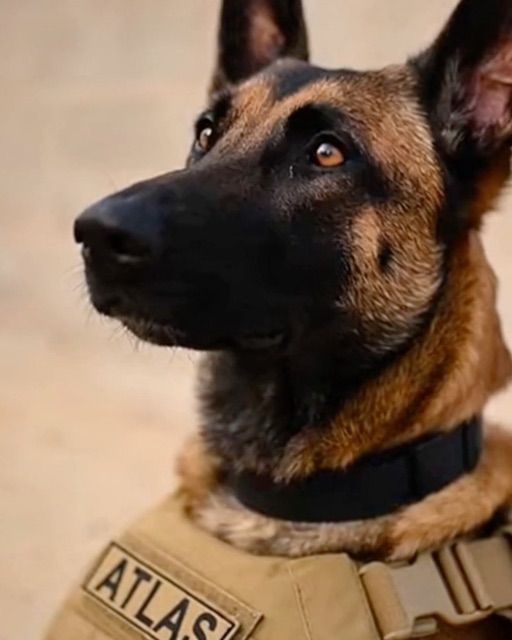
Inside the cage, a 90-pound Belgian Malinois named “Reaper” was throwing himself against the bars. He was slated for euthanasia. “Uncontrollable aggression,” his file said.
I didn’t flinch. I took the keys.
“Watch out, he bites!” Miller yelled as I opened the gate.
Reaper lunged. The room went silent. Miller reached for his sidearm.
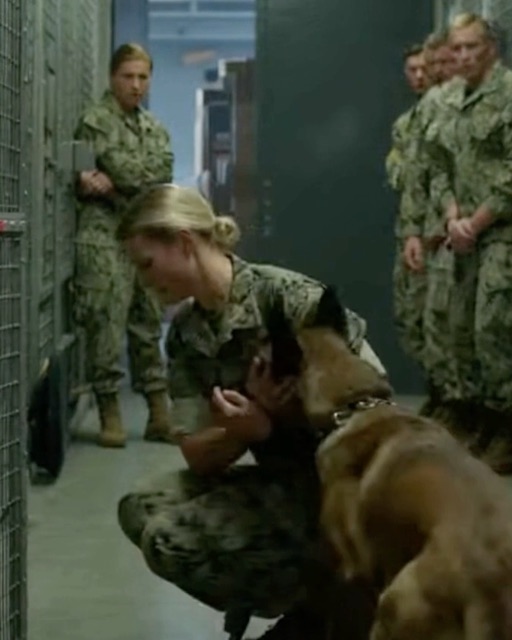
But I didn’t back down. I just dropped to my knees and whispered a single phrase in German: “Schatten, platz.”
The “monster” didn’t tear my throat out. He froze mid-air. His ears went back. He let out a low whine that sounded like a sob, and buried his massive head in my chest, licking the tears from my face.
I looked up at the Master Chief. His jaw was on the floor.
“How the hell did you do that?” he stammered. “That dog has rejected five top handlers.”
I scratched the dog behind the ears, right over the jagged scar I stitched up myself six years ago in my father’s garage.
“He didn’t reject me,” I said, my voice shaking with rage. “Because he’s not government property, sir.”
I pulled a crumpled photo from my pocket and slammed it against the glass for them to see.
“He’s my dog.”
The photo showed a smiling teenager with braces, me at sixteen. On my lap was a lanky Malinois puppy, all ears and paws, chewing on my sleeve. Standing behind us with a proud hand on my shoulder was my father, his old K9 unit shirt faded but unmistakable.
“His name isn’t Reaper,” I said, my voice thick with emotion as I hugged the big dog tighter. “It’s Schatten. It means Shadow in German.”
Miller squinted at the photo, then back at me, then at the dog now nuzzling my neck like a giant lapdog. The other men were silent, their mocking smirks replaced with pure confusion.
“That’s impossible,” Miller finally managed, his voice a low growl. “This dog was found as a stray two years ago near a highway pile-up. No tags, no chip. He was feral.”
“There was a crash,” I whispered, the memory still a sharp, jagged piece of glass in my mind. “My dad and I were driving to a training seminar. A truck blew a tire and crossed the median.”
I didn’t have to close my eyes to see it. The screech of metal, the world tumbling, the shattering of glass.
“I woke up in the hospital. My dad… he didn’t make it.”
A tear I hadn’t realized was forming slipped down my cheek and landed on Schatten’s fur. He whined again, a soft, empathetic sound.
“When I was able to ask, they told me Schatten must have been thrown from the car. They searched, but they never found him. I thought he was gone forever. I thought I’d lost them both that day.”
I looked up, my gaze locking onto Miller’s. “He wasn’t feral. He was lost and grieving his pack, just like I was.”
The Master Chief was a man carved from granite, not known for sentiment. He crossed his thick arms, his expression unreadable.
“A nice story, candidate. But it doesn’t change the facts. This animal has injured two trainers and failed every single assessment. He’s a liability.”
“He’s not a liability,” I shot back, standing up slowly, Schatten staying right at my heel. “He’s a product of trauma. You put him in a cage, surrounded by strangers shouting commands he doesn’t know, and you call him the monster?”
“We use standard English commands,” another handler, a man named Peters, chimed in defensively.
“My father was a K9 handler in Germany before he moved to the States,” I explained. “He trained Schatten from birth using German commands. He doesn’t understand what you’re yelling at him. He just hears aggression.”
Miller was silent for a long moment. I could see the gears turning in his head. He was looking for an angle, a way to dismiss me without looking like a complete fool.
“Alright,” he said finally. “You say he’s your dog. You say he’s trained. Prove it.”
My heart hammered in my chest. “How?”
“The Gauntlet. Tomorrow at 0800. It’s the final evaluation course for our most advanced dogs. Scent tracking, obstacle navigation, and bite work under simulated fire.”
A cold dread washed over me. The Gauntlet was legendary for its difficulty. Even seasoned K9 teams sometimes failed.
“No dog that has been labeled for euthanasia has ever run the Gauntlet,” Peters protested. “It’s a waste of resources.”
“She says he’s a trained K9,” Miller said, his eyes never leaving mine. “This is his chance to prove it. He passes, you both get a provisional spot on the team. He fails any part of it… and the original order stands.”
He meant euthanasia. He was giving me a single thread of hope, but tying it to an impossible task.
“And you, candidate,” Miller added, a cruel edge to his voice. “You’ll be right there with him. No body armor. Just you and your ‘Shadow’.”
He was setting us up to fail in the most spectacular way possible. He wanted to break me, to prove that this “Barbie” didn’t belong here.
“We’ll be there, sir,” I said, my voice steady despite the fear coiling in my stomach.
They left me in the kennel with him. The heavy metal door slammed shut, leaving us in the quiet hum of the fluorescent lights. I sank to the floor, and Schatten immediately rested his head on my lap, his brown eyes looking into mine with an intelligence and understanding I had missed more than I could say.
“Hey, boy,” I whispered, stroking his head. “Es tut mir so leid. I’m so sorry I lost you.”
He licked my hand, a silent forgiveness. For the next few hours, we just reconnected. I checked him over, finding his paws were raw and his coat was dull. He was underweight. They hadn’t been treating an asset; they’d been managing a problem.
I spoke to him only in German, in the soft, encouraging tones my father had always used. I saw the tension leave his body. The “Reaper” persona melted away, leaving behind the loyal, brilliant dog I knew. He was my Schatten. He was home.
That night, I didn’t sleep in the barracks. I stayed there on the cold concrete floor of the kennel, with my best friend’s 90-pound body curled up beside me. For the first time in six years, I didn’t feel completely alone.
The next morning, the entire K9 unit was there to watch. The air was thick with skepticism. Miller stood on the observation deck, arms crossed, face like a thundercloud.
The Gauntlet was even more intimidating in person. It was a sprawling course of concrete, mud, and steel, designed to simulate an urban combat zone. There were tunnels to crawl through, walls to scale, and the smell of gunpowder already hung in the air.
I had no gear except for a simple training leash and a bite sleeve for the final exercise. I was exposed. We were exposed.
“You ready, boy?” I murmured to Schatten, scratching his favorite spot behind the ears. He leaned into me, his body alert but calm. He trusted me. That was all that mattered.
“Course is live!” Miller’s voice boomed over the speakers.
The first test was scent tracking. An instructor had run a winding path through the course an hour earlier, leaving a trail to a hidden package.
I presented Schatten with a piece of the instructor’s cloth. “Schatten, such!” I commanded. Find it.
He lowered his nose to the ground, sniffing intently for a moment before taking off. He moved with a fluid grace I hadn’t seen since we were teenagers running through the woods behind our house. He navigated the turns perfectly, ignoring the stale scents of other dogs and the oil and grime of the course. Within minutes, he was sitting patiently beside a hidden ammo box, wagging his tail.
Phase one complete. A few of the handlers exchanged surprised glances.
Next was the obstacle course. A ten-foot wall, a narrow balance beam, and a long, dark tunnel. This was designed to test a dog’s courage and physical ability.
“Hopp!” I commanded for the wall, and he scaled it effortlessly. “Voraus!” I sent him over the beam, and he trotted across without a hint of hesitation.
The tunnel was the real test. Many dogs, especially those with trauma, balked at enclosed spaces. I could see him hesitate for a fraction of a second at the dark opening.
I dropped to my knee. “Ich bin hier,” I said softly. I’m here. “Komm.”
That was all he needed. He plunged into the darkness and emerged on the other side a few seconds later, shaking dust from his fur.
We were flying through the course. My confidence swelled with every completed task. We weren’t just passing; we were excelling. The snickering from the crowd had long since stopped, replaced by a stunned silence.
Finally, it was time for the last test: aggression control and bite work. A handler in a padded suit, the “decoy,” would play a hostile combatant. Schatten’s job was to engage on command, hold until ordered to release, and ignore all distractions, including simulated gunfire.
This was what Miller was waiting for. This was where he expected the “killer” to come out, to lose control and prove him right.
The decoy came onto the field, acting aggressive, yelling in English. Schatten stood his ground, a low growl rumbling in his chest, but he looked to me, waiting for the command. The first round of simulated gunfire erupted from the speakers. He didn’t even flinch.
“Pass auf!” I yelled, the command to guard and hold.
He launched himself, not with chaotic rage, but with disciplined precision. He latched onto the decoy’s protected arm, his bite firm and controlled. The decoy thrashed and struggled, but Schatten held on, his body a coiled spring of focused energy.
“Aus!” I shouted. The release command.
And just like we had practiced a thousand times in our backyard, he let go instantly. He backed away and sat at my side, panting but perfectly calm. He had done it. He had done it all perfectly.
A slow smile spread across my face. I looked up at the observation deck, ready to see Miller’s expression of defeat.
But he wasn’t looking at me. His face was pale, his eyes wide with horror, fixed on something above the course.
That’s when I heard the creaking sound, followed by a sharp, metallic snap.
One of the heavy cargo nets used for training, suspended by a steel cable from a crane high above the field, had come loose. A gust of wind had caught it, and the rusty anchoring bolt had finally given way. The net, weighing hundreds of pounds, was swinging directly towards the observation deck.
It was swinging directly towards Master Chief Miller.
People screamed. Everyone was frozen, watching it happen in slow motion.
Everyone but Schatten.
Before I could even process what was happening, he was moving. He wasn’t responding to a command. He was responding to instinct. The instinct to protect.
He covered the thirty yards to the base of the observation deck in a blur of black and tan fur. He leapt, scrabbling up the side of the wooden structure with an agility I didn’t know he possessed. He reached the deck just as the net was about to slam into it.
He didn’t try to stop it. He threw his entire body against Miller’s legs, knocking the much larger man backwards, away from the railing.
The cargo net smashed into the exact spot where Miller had been standing, splintering the wood and tearing the railing from its posts.
Silence.
Then, a low whimper.
Schatten had pushed Miller clear, but the edge of the swinging net had caught him across his back. He lay on the deck, struggling to get up, his back leg twisted at an unnatural angle.
Forgetting everything, I ran. I scrambled up the ladder to the deck, my heart in my throat. Miller was already on his knees beside Schatten, his hands hovering, unsure of what to do.
“Don’t move him,” I said, my voice surprisingly calm. I gently ran my hands over my dog’s body, assessing the damage. His leg was broken, but he was alive. He licked my hand weakly, his eyes full of pain but also trust.
The base medic came running, and we carefully loaded Schatten onto a stretcher. As they carried him away, Miller finally stood up and faced me. The arrogance was gone, replaced by something I had never seen in him before: shame.
“I served with your father,” he said, his voice quiet and raspy. “In an overseas unit, before he moved to the States.”
I was stunned into silence.
“There was an incident,” he continued, not looking at me. “A bomb-sniffing dog, one of our best. Your father’s partner. We were clearing a building, and the dog signaled an IED. But your dad hesitated. He trusted his dog’s life over protocol. He went in to pull the dog back. The bomb went off.”
He finally met my gaze. “The dog was killed. Your father was injured. I thought… I always thought his emotional connection was a weakness. A liability that cost us a valuable asset and nearly a man.”
It all clicked into place. His hostility towards me, his dismissal of my bond with Schatten, his constant use of the word “liability.” He wasn’t just being a jerk. He was trying to prevent a history he misunderstood from repeating itself.
“You’re wrong,” I said softly. “My dad told me that story. The dog signaled, but then it moved towards a secondary trigger wire. My dad didn’t go in to save his dog. He went in to stop his dog from tripping the second wire, which would have brought the whole building down on the rest of the team. On you.”
I saw the flicker of realization in his eyes. “He didn’t see the dog as an asset you could lose. He saw him as a partner you protect. That bond, the one you called a liability, is the reason you’re alive, sir.”
He stood there, the weight of a twenty-year-old mistake finally crashing down on him.
Schatten’s leg was set, and he was on strict bed rest for eight weeks, but he was going to make a full recovery. They set him up in a private room, not a kennel, and the other handlers who had once jeered at me now brought him toys and special treats. They started calling him Shadow.
The day Schatten was cleared for light duty, Master Chief Miller called me into his office. A new personnel file was sitting on his desk.
“Ava Thorne and K9 Shadow,” it read. “Active Duty.”
“He saved my life,” Miller said simply. “He proved what kind of dog he is. And you proved what kind of handler you are. The kind your father was.”
He slid a patch across the desk. It was an official SEAL K9 unit patch.
“Welcome to the team, Thorne.”
As I walked out of his office and back to my partner, I realized our story wasn’t just about a girl finding her lost dog. It was about how the deepest scars, on both people and animals, don’t have to be endpoints. They are proof of survival. Our bond wasn’t a liability; it was our greatest strength. It was a legacy of love and trust, passed down from a father to his daughter, and to the brave dog who was never just property, but a member of our family.