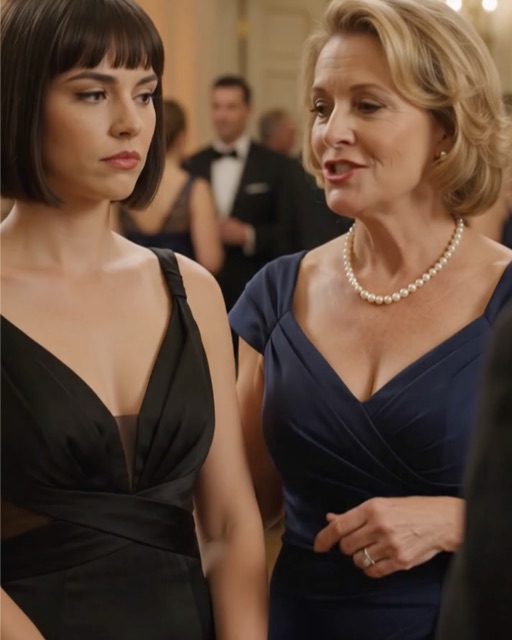
At my cousin’s hospital fundraiser, my aunt patted my arm and told the table, “She’s just a nurse.”
Not cruelly.
Worse. Casually.
Like that was the ceiling of my life.
My cousin, the golden-boy surgeon, smirked into his champagne and fixed nothing.
Then the director tapped his glass.
He thanked the donors.
The board.
The surgical team.
And then he said my name.
Not “nurse.”
“Doctor. Trauma systems architect. Chief of emergency response design.”
My cousin’s glass wobbled. My shoulders finally dropped.
The director pointed to the screen. “The hurricane protocol that saved 312 patients? She built it.” Then he turned to my aunt. “Ma’am, your niece didn’t assist the system. She built it.”
After the gala, in the humming-blue light of the parking garage, my uncle stopped me. His hands shook as he pressed a brittle bracelet into my palm.
It was my mother’s.
From the night she died.
He swallowed. “Your aunt hid the real cause. It would’ve crushed your cousin’s career.”
My throat burned. I opened the old discharge file he shoved at me. A folded note fell out – my mother’s handwriting, slanted and stern: She sees what others miss. Let her become exactly what they fear.
I didn’t sleep.
I reopened the case the family had buried. I followed the timestamps. The drug logs. The badge swipes that shouldn’t have matched.
By morning, my cousin’s name was peeled off the surgical wing.
Two hours later, security was called – on my aunt.
We met in the compliance office. My heart pounded so loud I could hear it in my molars. She wouldn’t sit. She kept talking about “misunderstandings” and “mixed-up charts.”
The investigator slid a tablet across the table. “This is from the night your mother died,” he said. “2:17 a.m.”
He hit play.
The hallway camera showed a figure at the nurses’ station, back turned, head down. A hand reached into the chart rack. Another camera angle flickered—elevator doors, a swipe, a reflection in the steel.
He tapped the screen to pause, zoomed in, and my blood ran cold.
The still showed an outstretched hand slipping off a hospital bracelet—and the ring on that hand was one I knew by heart.
It was my aunt’s wedding ring. The one she’d twisted on her finger just last night while calling me “just a nurse.”
The investigator didn’t need to say her name. The heavy gold and ostentatious diamond cluster screamed it from the grainy photo.
My aunt Eleanor let out a sound like a punctured tire. A long, hissing defeat.
She finally sank into the chair beside her. Her face, usually a mask of smug composure, had crumbled into a hundred tiny fractures.
“Eleanor,” the investigator said, his voice gentle but firm. “We also have the badge swipe logs for the medication room. A badge assigned to you was used to access the disposal unit at 2:21 a.m.”
“I was there visiting,” she stammered, the lie thin and brittle. “I might have… I might have swiped the wrong card. It was a confusing night.”
I finally found my voice. It came out quiet, a steel wire in the tense room. “You’re not medical staff. You had no card to swipe.”
Her eyes darted to mine, filled with a desperate, venomous plea. It was a look that said, ‘Don’t do this to us. To the family.’
The investigator continued, unphased. “The bracelet your husband just returned to your niece… it was logged as ‘destroyed per patient request’ in the file. But a hand, wearing this ring, removed it from your sister’s wrist.”
He swiped the screen. A new image appeared. The digital signature on the altered medication order.
It was my cousin Mark’s.
My aunt let out a sob. “It was a mistake! A simple mistake!”
“Which one?” I asked, my voice shaking now. “The medication? The chart? The cover-up that lasted fifteen years?”
“He was exhausted!” she shrieked, pointing a trembling finger at the tablet, as if Mark himself were trapped inside it. “They had him on a thirty-six-hour shift! He was a resident, trying to impress everyone. He was a hero!”
The pieces clicked into place, not with a satisfying snap, but with the sickening grind of rusted metal. The hurricane protocol I designed had a specific section on staff fatigue—because tired people make deadly mistakes.
“So he made a mistake,” I said, looking not at her, but at the investigator. “And you fixed it.”
“I saved him!” she cried, tears streaming down her face, carving paths through her expensive foundation. “I saved his career! My son, the surgeon! What was I supposed to do, let them ruin him because he was overworked? Your mother would have understood!”
The rage that erupted in my chest was so hot it was silent. My mother would have understood? My mother, who wrote that fierce note, who saw the world in black and white, who believed in consequences.
The investigator cleared his throat. “Eleanor, tampering with a medical chart, falsifying records… that’s a felony. Obstruction of justice is another.”
She just kept weeping, chanting her son’s name under her breath, a mantra of misplaced sacrifice.
After she was escorted out by a lawyer her husband had called, I sat alone in the quiet office. The investigator gave me a glass of water.
“You built the system that caught this,” he said softly. “The detailed badge tracking, the cross-referenced time stamps on the pharmacy logs. It was all there. We just never had a reason to look this closely.”
I nodded, numb. I had designed the perfect trap, never dreaming it would be my own family I would catch in it.
That evening, I found my uncle Arthur sitting in his car in the hospital parking garage, right where he’d given me the bracelet. The engine was off. He just stared at the concrete wall ahead.
I tapped on the window. He flinched, then unlocked the door.
I slid into the passenger seat. The silence was heavy with everything we weren’t saying.
“Why now, Arthur?” I asked, turning my mother’s brittle bracelet over in my hands. “Why after all this time?”
He stared at his own hands, calloused and trembling on the steering wheel. “Every year it got harder, Sarah. Every time Eleanor bragged about Mark, every time she dismissed you… it was like swallowing glass.”
He took a shaky breath. “Last night, at that gala… I watched you. Standing there while the director finally told the world who you are. And I looked at Eleanor, and she was just annoyed. Annoyed that your light was threatening to outshine her son’s.”
“And Mark,” he continued, his voice cracking. “He wasn’t proud of you. He was scared. I saw it in his eyes. The same fear I’ve seen for fifteen years.”
He finally looked at me. His eyes were full of a deep, old shame. “I was a coward. I let her run our lives. I let her bury your mother’s truth because I was afraid of losing the life she’d built for us. The big house, the club memberships… the surgeon for a son.”
“I realized last night,” he said, “that we hadn’t saved Mark. We had broken him. And we had betrayed you and your mother in the worst possible way.”
He reached into the glove compartment and pulled out a thick envelope. “This is everything I remember. Times, conversations, things I overheard. I wrote it down years ago, in case I ever found my courage.”
He pushed it into my hands. “She thinks she was protecting him. But all she did was teach him that consequences are for other people. That’s no way to live.”
The next day, I called Mark.
He picked up on the first ring, his voice tight. “They took my credentials. I can’t get on the floor.”
“I know,” I said. “Meet me at the old coffee shop near grandma’s house. One hour.”
He was already there when I arrived, hunched over a black coffee. The ‘golden boy’ looked tarnished. Dark circles under his eyes, a tremor in his hand as he lifted the cup.
I sat down without ordering. For a long moment, we just looked at each other. The cousins who used to build forts in the living room.
“She told me you knew,” he finally rasped.
“I know what Mom told you to do,” I said. “I don’t know what you did.”
He let out a humorless laugh. “What I did? I did exactly what she told me. I kept my mouth shut. I let her ‘handle it.’ I went to medical school. I became the man she wanted me to be.”
He leaned forward, his voice dropping to a conspiratorial whisper. “Do you have any idea what it’s like? To walk these halls every day, a big-shot surgeon, knowing you’re a complete fraud? Knowing you killed your own aunt?”
The words hung in the air between us. Killed. He said it.
“It was an allergy,” he said, his eyes glassy with memory. “A newly documented reaction to a common sedative. The dosage I gave was standard, but for her, it was fatal. It suppressed her respiratory system. By the time we caught it, it was too late.”
“I panicked,” he admitted. “I was standing there, looking at the chart, at my order. It was my name. My signature. My mistake.”
“Then my mother showed up. She took one look at my face, at the chaos, and she understood. She pulled me into a supply closet.”
He looked away, shame radiating off him in waves. “‘Let me fix this,’ she said. ‘Your life is just beginning. Hers is over.’ So she fixed it. She took the chart. She disposed of the IV bag. She coached me on what to say. She made it look like a simple, unavoidable cardiac event.”
“And you let her,” I said. It wasn’t an accusation. It was a statement of fact.
“I let her,” he agreed, nodding slowly. “I was twenty-two years old, and I was a coward. I wanted to be a surgeon more than I wanted to be a good man.”
He looked up, and for the first time, I saw a flicker of the boy I used to know. “The smirk last night? At the gala? I wasn’t laughing at you, Sarah. I was trying not to throw up. Seeing you up there… you earned every bit of it. You did the work. You never took a shortcut. And I’m just… a ghost. A ghost in a lab coat my mother bought for me.”
He reached across the table and pushed his own envelope toward me. It was a formal, typed confession. Signed and dated.
“It’s the full story,” he said. “Including the hospital’s policy on resident hours. I was at hour thirty-four when I wrote that order. They knew it was dangerous. They did it anyway. They’re culpable too.”
“What will you do?” I asked.
He shrugged, a weight seeming to lift from him. “Whatever comes next. For the first time in fifteen years, I’m not scared of it.”
Armed with my aunt’s confession, my cousin’s statement, and my uncle’s notes, I requested a meeting with the hospital director and the entire executive board.
They sat there, a line of expensive suits, looking uncomfortable.
I didn’t show them the videos. I didn’t talk about my family’s drama.
I opened my laptop and projected my findings onto the large screen. Not about a death, but about a system.
“At the time of my mother’s death,” I began, my voice clear and steady, “the average surgical resident at this hospital worked ninety-seven hours a week. They were permitted less than five hours of continuous sleep. This wasn’t an exception; it was the culture.”
I presented charts and data. Statistics on medical errors correlated with staff fatigue. The science was undeniable.
“My cousin made a mistake,” I said, looking each board member in the eye. “A fatal one. And my aunt committed a felony to cover that mistake. They will face the consequences for their actions. Mark is surrendering his medical license. My aunt is facing criminal charges.”
A murmur went through the room.
“But their crime was hiding a symptom of a larger disease,” I continued, clicking to a new slide. “A system that prioritizes billing hours and prestige over patient safety and staff well-being. A system that makes mistakes like this not just possible, but inevitable.”
I looked at the director who had introduced me so proudly at the gala. “My mother died because of a failure in the system. The same kind of failure my work is designed to prevent.”
Then I laid out my proposal. The ‘Sarah Protocol,’ they would later call it. A complete overhaul of resident scheduling. Mandatory rest periods. Anonymous reporting channels for staff who feel pressured to work when exhausted. A non-punitive review process for errors designed to find system failures, not scapegoats.
I was weaponizing my expertise, just as my mother had hoped. I was becoming what they should fear: a system architect who saw all the flaws they’d tried to paint over.
They had no choice but to agree. My case was airtight, and the threat of the full story hitting the news was a powerful motivator.
The changes were implemented. Not just at our hospital, but eventually, as a model for others across the state.
My cousin Mark, stripped of his license, went back to school. He got a degree in public health and now works for a non-profit advocating for medical ethics and physicians’ mental health. We talk sometimes. It’s awkward, but it’s real.
My aunt Eleanor was convicted of obstruction and served a year of house arrest. The public shame was a far greater prison for her. My uncle divorced her. He lives a quiet life now, volunteering, trying to balance the scales of his life.
As for me, I’m still at the hospital. I lead the team that implements and refines these new safety protocols.
Sometimes, when I walk the halls, I feel my mother’s presence. I hold the brittle, plastic bracelet in my pocket—not as a reminder of the tragedy, but as a symbol of the truth.
They still introduce me, but it’s different now. No one calls me “just a nurse.” They call me Doctor. They call me Chief. They call me the woman who rebuilt a broken system.
My title is not about prestige. It’s a promise. A promise that I will always see what others miss. And a promise that I will never, ever stop fixing what is broken. That is the truest way to honor the woman who saw it in me first.