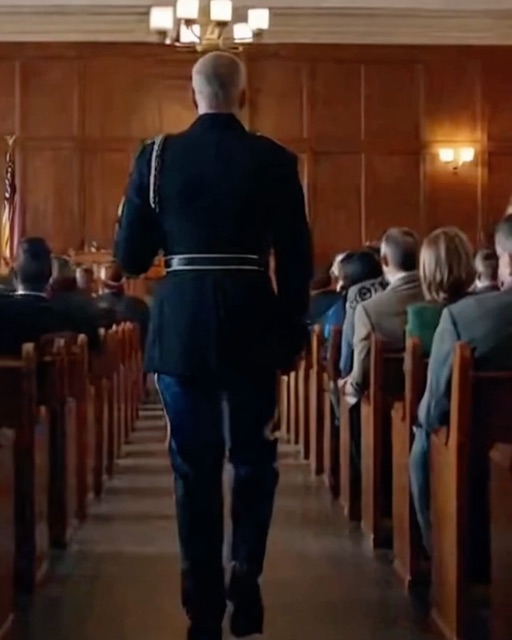
I walked into the packed courtroom in my full official Army dress blues. Every conversation instantly stopped.
The county wanted to demolish our town’s oldest veterans’ memorial to expand a parking garage. The planners called it “necessary progress.” I called it a disgrace.
The judge noticed my medals immediately. “You chose to appear in uniform today,” she said.
“Yes, Your Honor,” I replied. “Because if this court is deciding whether soldiers still deserve visible honor, then the uniform belongs in the room.”
The arrogant county attorney, Craig, rolled his eyes. He paced around the room, talking about budgets, traffic flow, and relocating the statue “with dignity.”
Then, he pulled out his smoking gun.
He slapped a faded black-and-white photograph onto the projector.
“Your Honor,” Craig smirked. “This photo proves the monument was moved to this random lot in 1985. It has no historical tie to this specific dirt. It’s just a piece of concrete. It can be moved again.”
I stared at the massive screen. My blood ran cold.
I stepped out of the witness box and walked right up to the projected image. My chest grew tight. I didn’t just recognize the photograph. I knew exactly what day it was taken.
I turned to the smug attorney, then looked up at the judge.
“That’s not a random lot,” I said, my voice echoing in the dead-silent room. “And that monument isn’t just a piece of concrete.”
I pointed to the freshly dug earth in the bottom corner of the picture, and told the entire courtroom what was actually buried underneath it.
“That freshly turned soil isn’t from construction,” I began, my voice steady but firm. “It’s from a burial.”
A quiet gasp rippled through the gallery. Craig scoffed loudly.
“A burial? Your Honor, this is a desperate, theatrical attempt to stall the inevitable.”
Judge Miller held up a hand, her gaze fixed on me. “Let him finish, Mr. Craig.”
“In 1985, when the town council moved the monument from the old town square, a group of us veterans oversaw the process,” I explained. “We weren’t happy about it, but we were promised this spot would be its final resting place. We made them put it in writing.”
I continued, “But we did more than that. We wanted to make sure no one ever forgot the promise. So we buried a time capsule right at the base of the monument.”
Craig let out a short, derisive laugh. “A time capsule? With some old newspapers and a baseball card? This is irrelevant.”
“It’s more than that,” I said, my eyes locking with his. “We put our promises in that box. We put our memories in it. We put things in there to remind the future what that ground means.”
The judge leaned forward, intrigued. “What exactly is in this capsule, Sergeant?”
“Documents, Your Honor. The original deed transfer specifically designating this land for the memorial in perpetuity. And letters. Letters from soldiers who never came home, entrusted to us by their families.”
The room was utterly silent now. The weight of my words seemed to settle over everyone.
“And one more thing,” I added, my voice cracking just a little. “We placed the last American flag that flew over our base in Da Nang. Folded by men who saw their friends die for it.”
Craig looked shaken for the first time, but he recovered quickly. “A touching story, Sergeant, but it’s just a story. You have no proof this box even exists.”
“Then let us dig,” I challenged him directly. “Give us twenty-four hours. If we find nothing, you can build your parking garage. But if we find it, you leave that memorial alone. Forever.”
The entire courtroom seemed to be holding its breath. All eyes were on Judge Miller.
She looked from me to Craig, her expression unreadable. She tapped her pen on her desk for a long, agonizing minute.
“Mr. Craig,” she said finally. “The county’s argument rests on this land having no specific historical significance.”
“That’s correct, Your Honor,” he said, regaining his swagger. “It’s just a plot of land.”
“Sergeant Hammond is claiming otherwise,” she countered. “He is claiming there is tangible, historical evidence buried on site. Evidence directly tied to the monument’s purpose.”
She made her decision. “I am issuing a temporary stay of demolition for forty-eight hours. You have until noon on Friday to provide this court with proof of your claim, Sergeant. If you fail, the original order stands.”
“Court is adjourned,” she said, striking her gavel.
The moment the gavel fell, the room erupted. People swarmed me, clapping me on the back, shaking my hand. But I only had eyes for Craig.
He was stuffing his papers into his briefcase, his face a mask of fury. He shot me a look that was pure venom. He thought he’d won, and I had just snatched it away, if only for a moment.
I didn’t waste any time. I walked out of the courthouse and made a call. Within an hour, a small group of us were gathered at the memorial.
There was Bill, a Navy Seabee who could build or fix anything. There was Maria, an Air Force medic who was the most organized person I knew. And there was young Thomas, a Marine just back from Afghanistan, quiet but with a fire in his eyes.
“Heard you made a scene, Arthur,” Bill said with a grin, unloading shovels from his truck.
“I just told the truth,” I said. “Now we have to prove it.”
We stood before the bronze statue of a lone soldier, his head bowed. The grass around its base was neatly trimmed, but the chain-link fence the county had erected made it look like a prison.
“So, where do we start?” Thomas asked, looking at the concrete base.
I walked over to the photograph I had requested from the court clerk. It was the same one Craig had used. I pointed to the bottom corner.
“Right there,” I said. “I remember a large oak tree that stood about twenty feet from this spot. Its shadow fell right here at three in the afternoon. We buried the box at three o’clock on a Tuesday. I know exactly where it is.”
We started digging. The work was hard. The ground was packed tight after nearly four decades. We worked in shifts, the sun beating down on us.
By evening, we had a sizeable hole, but still nothing. Doubt started to creep in.
“You sure about this, Arthur?” Bill asked, wiping sweat from his brow. “Memories can get fuzzy.”
“I’m sure,” I said, more to convince myself than him.
Just then, a black sedan pulled up. Craig got out, accompanied by a man in a hard hat.
“Evening, gentlemen,” Craig said, his tone dripping with sarcasm. “Just checking on the ‘archaeological dig.’ This is the city inspector. He needs to make sure you’re not undermining the monument’s foundation.”
The inspector walked around, making notes on a clipboard. He told us our hole was too close to the concrete and that we had to stop immediately until a structural engineer could assess it in the morning.
“You can’t do this!” Maria exclaimed. “You’re just trying to run out the clock!”
“Rules are rules,” Craig said with a cold smile. “See you in court on Friday. Or rather, I won’t. I’ll be at the groundbreaking.”
He got back in his car and drove away, leaving us standing there in defeat. Our forty-eight hours were ticking away, and we were legally barred from digging.
We sat on the grass, the half-dug hole mocking us. The hope that had filled the courtroom now felt like a distant memory.
“He’s going to win,” Thomas said quietly, kicking at a clump of dirt. “They always win.”
“No,” I said, a new idea forming in my mind. An idea born of desperation. “Not yet.”
I looked at Bill. “You were a Seabee. You know about ground-penetrating radar, right?”
A slow grin spread across Bill’s face. “I know a guy. Works for a utility company. Owes me a favor.”
An hour later, under the cover of darkness, a beat-up van with “Johnson Plumbing & Utilities” on the side pulled up. A man got out with a machine that looked like a high-tech lawnmower.
“Bill, you’re going to get me fired,” the man whispered, but he was smiling.
He ran the machine over the area I’d pointed out. We watched the small screen, our hearts pounding. For minutes, it was just static and lines representing rocks and roots.
Then, a clear, rectangular shape appeared on the screen. It was perfect.
“Bingo,” the man said. “About four feet down. Definitely metal.”
We couldn’t dig, but we had our proof. The next morning, I was back at the courthouse with the radar images. I filed an emergency motion.
Judge Miller was not pleased to be back in court a day early, but she listened. I presented the images.
“Your Honor, this is proof,” I said. “The county attorney used city ordinances to obstruct a court order. We have evidence of a metal box, exactly where I said it would be.”
Craig was furious. He argued it could be anything – an old pipe, a piece of scrap metal.
“There’s only one way to find out,” the judge said, her patience clearly gone. “I am amending my order. A city engineering crew, under my direct supervision, will excavate that site. Immediately.”
She looked at Craig. “And you will stay away from it until they are finished.”
We all went back to the memorial. This time, a proper crew was there with a small backhoe. A crowd had gathered – reporters, townspeople, other veterans.
The backhoe carefully scraped away layers of dirt. After about an hour, the operator stopped. A man jumped into the hole with a shovel.
Then we heard it. The unmistakable sound of metal scraping against metal.
A cheer went up from the crowd. Two men lifted a rusted, army-green footlocker out of the ground. It was exactly as I remembered.
They placed it on a folding table. The hinges were rusted shut. Bill came forward with a pair of bolt cutters and snapped the old padlock.
With a groan of protest, the lid opened.
A musty smell of old paper and canvas filled the air. On top was the folded flag, preserved in a plastic bag. Underneath it was a stack of documents and a bundle of letters tied with a faded ribbon.
The court clerk, who was there to verify everything, carefully lifted out the top document. He read it aloud.
“Deed of Trust, dated October 23rd, 1985. The parcel of land known as Lot 7B is hereby entrusted to the care of the Veterans Association of Northwood County for the sole and perpetual purpose of maintaining a public memorial…”
It was our smoking gun. The crowd roared. I saw Craig, standing at the edge of the crowd, his face pale.
But there was more. The clerk picked up the bundle of letters. I knew what they were, but seeing them again after all these years sent a shiver down my spine.
“These appear to be personal correspondence,” the clerk said, handling them with reverence.
“Read one,” someone in the crowd shouted. “Let us hear a voice from the past.”
The clerk hesitated, then looked at me. I nodded. He carefully untied the ribbon and chose a letter from the top of the pile.
He began to read. “My Dearest Sarah,” the letter started. “If you are reading this, it means I didn’t make it home. I don’t have much time, but I need to tell you some things. I need you to tell our son…”
The clerk’s voice faltered. He looked at the bottom of the page.
“It’s signed… Private First Class Daniel Coleman.”
My heart stopped. I looked over at Craig. His full name was Craig Coleman.
He was frozen, his face ashen. He looked like he’d seen a ghost. The smug, arrogant lawyer was gone, replaced by a man utterly lost.
The clerk continued reading the letter. It was a beautiful, heartbreaking message from a young soldier to a wife he would never see again and a son he would never meet. He wrote about his hopes for his son, that he would grow up to be a good and honorable man. He wrote that he wasn’t a hero, just a boy who did his duty.
When the letter was finished, you could hear people in the crowd openly weeping. The silence was profound.
Craig stumbled forward, his eyes locked on the letter in the clerk’s hand.
“My mother…” he whispered, his voice hoarse. “She told me he left us. She said he was a coward who ran away.”
He looked at me, his eyes pleading for an answer. “Was he…?”
“Your father was one of the bravest men in our platoon,” I said softly. “He was killed pulling another soldier to safety. He was awarded the Silver Star for it. Posthumously.”
I walked over to the footlocker and reached inside, past the letters. My fingers found a small, velvet-covered box. I opened it and pulled out the medal.
I held it out to him. The silver star gleamed in the sunlight.
Craig stared at it, his whole body trembling. He didn’t take it. He just sank to his knees on the grass, in front of the memorial dedicated to men like the father he never knew, and he broke down.
The next day in court was a formality. Craig, looking like a different person entirely, withdrew the county’s motion. He apologized to me, to the court, and to the veterans of our town.
The story didn’t end there.
Craig used his own money to have the memorial professionally restored. He paid to have the grounds landscaped, with beautiful gardens and a new walkway. He also funded a small on-site museum to house the contents of the time capsule.
The centerpiece of that museum is a letter from a young soldier, placed next to a Silver Star.
Craig and I became unlikely friends. He started volunteering at the local VFW, listening to the stories of the men and women there. He told me that for his whole life, he’d felt a void, an anger he couldn’t explain. He had tried to fill it with success and ambition, by tearing down the old to make way for the new.
But it turned out that what he was really trying to tear down was a piece of himself. He had to dig into the past to finally find his foundation.
Sometimes, we think progress means paving over what came before. We see old monuments and memorials as relics, obstacles to a shinier future.
But those stones and statues aren’t just for the dead. They’re for the living. They are anchors, reminders of the promises we’ve made and the sacrifices that bought us our today. They don’t block the path forward; they are the foundation upon which that path is built.
And sometimes, the most important thing you can unearth isn’t a treasure or a secret, but a truth that allows a son to finally, after a lifetime of misunderstanding, be proud of his father.