
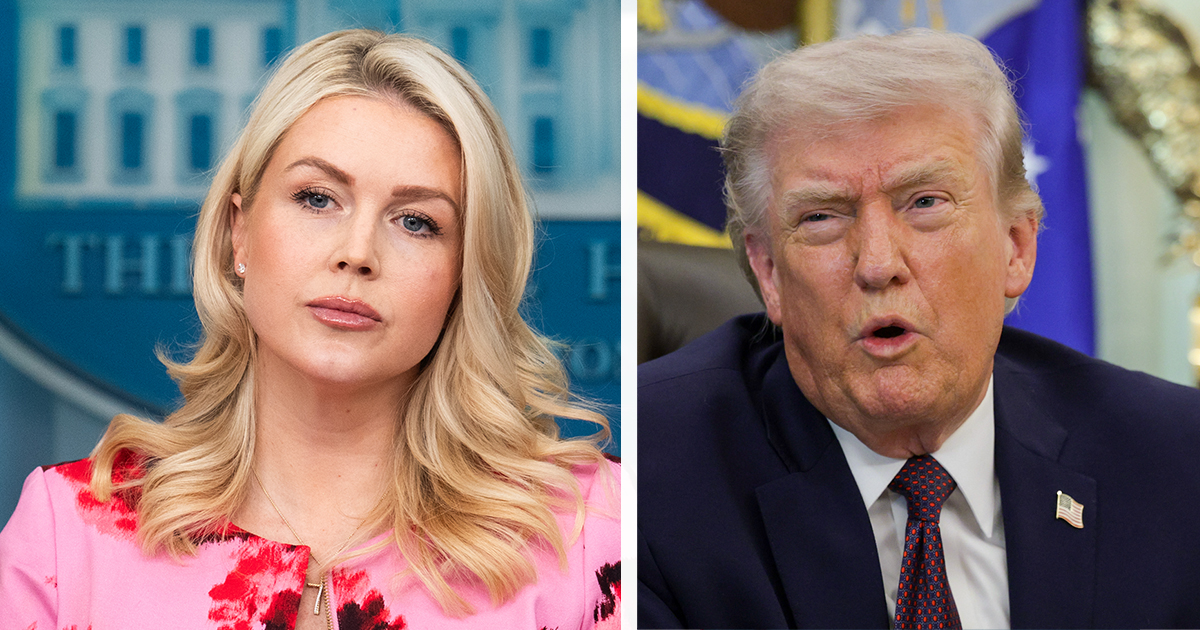
In a moment that turned heads and raised eyebrows, President Donald Trump used a Tuesday press conference in the Oval Office to air fresh grievances about how he is portrayed in the media, and along the way he lobbed a pointed joke at his own White House Press Secretary, Karoline Leavitt. What began as a familiar complaint about negative coverage suddenly shifted when he looked toward Leavitt and called her “terrible,” a remark he then softened almost immediately. The exchange was brief but unmistakable, and it quickly became the most discussed snippet of the day’s remarks.
For anyone who has watched Trump over the years, the pattern is recognizable. He criticizes the media forcefully, uses a splash of humor with a sharp edge, and then pivots to reassurance. The president’s comment had that signature rhythm: a sting followed by a shrug and a smile. Whether one views the moment as pure jest or as a window into real frustration, the light jab at Leavitt gave fuel to ongoing talk about tensions behind the scenes and whether the press office is meeting Trump’s sky-high expectations.
The setup: complaints about coverage and a sudden jab
The exchange unfolded as the president discussed what he described as overwhelmingly negative press. He said he received “93 percent bad publicity,” and added that some estimates put it even higher, “between 93 and 97.” This kind of statistic has long featured in his commentary about bias in major newsrooms, which he often frames as intent on undercutting his administration’s message and achievements. On Tuesday, that familiar criticism took a more personal turn.
Turning toward Karoline Leavitt, he suggested playfully, and with a bluntness that drew a mix of chuckles and sharp intakes of breath, that perhaps her performance as press secretary was to blame for the gloomy headlines. “A person that gets 97 percent — maybe Karoline’s doing a poor job, I don’t know,” he said, before adding, “You’re doing a terrible job.” A beat later, his tone softened, and he offered reassurance that cut against any notion of a shake-up. “Should we keep her? I think we’ll keep her.”
For those in the room, the message was twofold. First, Trump wanted it clear that he believes the deck is stacked against him in the press. Second, he was willing to make light of the situation, even at the expense of a close aide whose daily work is to deliver his views from the briefing podium. It was a quip intended to be humorous, but it also revealed a strand of frustration that has defined his dealings with the media since his earliest days in national politics.
Who Karoline Leavitt is and why her role matters
The position of White House Press Secretary is among the most visible and challenging jobs in any administration. The person in that role becomes the face and voice of the president outside of formal speeches and official statements. They brief reporters, parry questions, correct the record, and clarify policy. In other words, when the cameras click on and the microphones are live, the press secretary stands in for the president and the full weight of the administration.
Karoline Leavitt has been steady at the podium and in the press room, handling tough questions while defending and explaining the president’s decisions and priorities. Her workday is a steady stream of preparation, message-shaping, and rapid response. In that light, even a teasing public critique from the president is bound to echo well beyond the Oval Office walls. It invites speculation about internal dynamics, strategy debates, and whether the communications approach is hitting the mark the president wants.
That is why Tuesday’s remark landed so loudly. To long-time observers, it looked like one of those familiar Trump moments in which humor and bluntness blur, and only later does the lasting meaning come into focus. The president’s quick reassurance that “we’ll keep her” signaled that the comment was not meant to announce any change. Still, it confirmed the long-circulating whispers that he continues to feel beleaguered by coverage and remains impatient for a sharper, more favorable narrative to take hold.
Trump’s long-running friction with the press
Since his first campaign, Trump has framed media organizations as unfair, biased, or downright hostile. He has frequently used the term “fake” to describe coverage he disputes. On Tuesday, he returned to these themes with vigor, saying “All they do is hit Trump,” and describing broadcasters as “an arm of the Democratic Party.” The words were familiar, but their delivery, paired with the aside to his press secretary, gave them a fresh jolt of attention.
He also suggested there could be consequences for what he perceives as slanted coverage. “They’re licensed. They’re not allowed to do that,” he said, and then added, “I would think maybe their licenses should be taken away.” Comments like these are sure to spark debate. Supporters may hear a call for accountability; critics view it as an overreach and a threat to press freedom. Regardless of where one lands, the remarks leave no doubt about how sharply the president sees the divide between his administration and major news outlets.
Joke or judgment? How to hear the “terrible job” line
There is no question the comment about Leavitt was delivered with a joking lilt. Yet humor, especially in political life, often carries a kernel of truth. People who know Trump’s style recognize that he frequently uses a wry aside to underline a serious point. Here, that point seems clear enough: the president is dissatisfied with how frequently negative coverage appears, and he wants his spokespeople to break through more forcefully.
In workplaces everywhere, a boss’s offhand remark can echo long after the meeting ends. In the White House, those echoes become headlines. That is not simply because of the personalities involved. It is because the job of a press secretary is directly tied to public perception. If the story is negative, people naturally wonder whether the spokesperson’s strategy, delivery, or preparation needs to change. The president’s jest, therefore, did more than raise a laugh. It put a spotlight on the nerve center of messaging and raised fresh questions about how the administration plans to shape the broader conversation.
Understanding the media licensing comment
Trump’s suggestion that broadcasters could face licensing consequences is not new to those who have followed his critiques. Television stations operate under licenses, and networks rely on distribution that ultimately depends on licensed airwaves and carriage. The legal landscape around those licenses is complex, and any real move on that front would be a long, thorny, and heavily scrutinized process. Still, when a president raises the possibility, even as a rhetorical flourish, it resonates.
For viewers at home, this talk of licenses can be confusing. The main takeaway is that the president feels broadcasters should be held to standards he sees as fair and factual. He argues that when coverage crosses certain lines, there ought to be consequences. Others argue that the press must be free to investigate, criticize, and even take a harsh tone without fear of government reprisal. That tug-of-war is not new in American life, and it is one reason such comments quickly become a constitutional conversation as much as a political one.
The press secretary’s daily balancing act
Beyond the headlines, consider what Karoline Leavitt’s job looks like on a typical day. She has to anticipate the hardest questions before they are asked, gather accurate information from agencies with different priorities, and present a clear, calm message under bright lights. She must measure each word, because even a small misstep can define the day’s narrative and ripple across the world in minutes. That is before accounting for unexpected developments, breaking news, or a late-afternoon briefing that extends into the evening.
With that workload in mind, the president’s quip can be read as the kind of teasing common to high-pressure teams. In such environments, humor can be a release valve. At the same time, it reminds everyone involved that the standard is exacting and the stakes are high. The reality is both things can be true at once. Leavitt can be secure in her role, as Trump implied when he said “I think we’ll keep her,” and the team can still feel the constant push to win each daily news cycle.
Why this moment caught fire
What made Tuesday’s exchange reverberate beyond the room is the way it intersected with standing narratives. For supporters of the president, the media has long appeared to lean negative on anything Trump-related, and the numbers he cited fit neatly into that perception. For critics, the suggestion of license removal confirms fears about pressure on the free press. For political watchers more broadly, the aside to Leavitt feels like a candid, unscripted glimpse into a White House consumed with the challenge of wrangling the media spotlight.
Because the president’s relationship with the press has been combative for years, even a light-hearted jab becomes newsy. It functions as a shorthand for the larger, ongoing conflict: an administration pressing hard to reshape coverage, and newsrooms asserting their independence while scrutinizing every move. The Oval Office backdrop only amplified the moment’s symbolism. From that storied room, every sentence carries more weight.
Reading between the lines without overreading
It is easy to overinterpret a single sentence, especially one delivered with a grin. Yet it is also fair to note what the comment tells us. First, the president remains deeply engaged with, and clearly frustrated by, media portrayals of his tenure. Second, he expects the press operation to wage that fight vigorously. Third, he is not signaling a change at the top of his press shop, at least not now. The line “I think we’ll keep her” was not tossed off by accident. It was a bookend meant to close the subject for the day.
In a city where personnel shifts are currency and rumors spread in an instant, that reassurance matters. It dampens speculation that a shake-up is imminent. It also clarifies that, however severe the president’s tone may sound in a single excerpt, he sees value in Leavitt’s work and intends for her to continue at the helm. If there are adjustments to be made, they are more likely to be about tactics, timing, and emphasis rather than about who occupies the podium.
Looking back to look ahead
American presidents have often sparred with the press. From the earliest days of the republic to the modern era, chief executives have complained of bias, inaccuracies, and headlines they considered unfair. What is different today is the speed and saturation of coverage. News breaks across television, websites, and social media simultaneously, creating a 24-hour conversation that can feel both relentless and fragmented. In that environment, a single remark can ricochet rapidly and generate a narrative that lasts for days.
That is exactly what happened here. An exchange that lasted seconds became a centerpiece of the day’s political discussion. For the administration, it is a reminder that every public moment has multiple audiences: the reporters in the room, viewers at home, and the ever-present whirl of commentary that follows. For the press office, it underscores the need to prepare not just for questions, but for the optics and aftershocks of even light-hearted asides.
What it means for the days ahead
Expect this episode to sharpen attention on messaging from the White House briefing room. Reporters will listen a bit more closely for tonal shifts, signs of strategy changes, or new lines of argument aimed at challenging negative coverage. Supporters will watch for evidence that the communications team is finding fresh ways to break through. Critics will keep an ear out for any renewed talk of licensing and media penalties, ready to counter it with arguments about free expression.
For Karoline Leavitt, the path forward is clear and demanding. She will likely do what effective press secretaries always do after a headline-grabbing moment: recalibrate, refine, and return to the podium steady as ever. Her task is not to erase tension but to manage it, to channel the president’s priorities into messages that can withstand tough questioning, and to keep the daily briefings focused on policy and outcomes rather than on interpersonal intrigue.
The bottom line
In the span of a few sentences, President Trump revisited three of his most familiar themes: that media coverage of his presidency skews sharply negative, that he is not afraid to needle even close allies to make a point, and that he believes broadcasters should be held to standards he views as fair and accurate. His aside to Karoline Leavitt, calling her “terrible” before promptly saying she would stay on, confirmed what many already suspected about the dynamic inside his communications shop. There is humor, there is pressure, and there is an unending drive to turn the narrative in his favor.
Whether one takes the comment as a cutting joke or a candid critique with a smile, the meaning is much the same. The president expects a fierce, unflagging effort to win the battle for public opinion, and he is ready to say so out loud. Leavitt remains in the job, the media debate rages on, and the country is left to sort through the competing claims and counterclaims that define this era. For now, the headline is simple: a moment of Oval Office banter that echoed far beyond the room, offering a clear glimpse of the administration’s stance toward the press and the high bar set for those tasked with shaping its message.



