With three officers surrounding me, my whole world shrank to the attack dog just inches away. The handler shouted the command, but the animal just stared, a low whimper escaping its throat. It knew my secret. It knew who I was.
It all feels like a dream now, a nightmare you can’t wake from.
The sun was warm on my face. A perfect, quiet afternoon. The kind of day that makes you forget the world can be anything but peaceful. My old boy, Max, was resting his head on my knee, his tail giving a lazy thump against the bench every now and then.
For a moment, everything was right. Just an old soldier and his dog, watching the world go by.
These days, my hands shake. It’s just a thing they do. Comes with the territory, I guess. With the years. With the things you’ve seen. My faded green jacket felt heavy on my shoulders, not from its weight, but from the memories stitched into its seams.
It’s a shield, that old jacket. A reminder of a time when the world was much louder, when danger was real. A time I thought I had left behind.
I never imagined that feeling would find me here, in the middle of a city park on a Tuesday.
Then I heard the sirens.
They sliced through the calm like a blade. Three police cars screeched to a halt. Officers stepped out, not with the easy gait of a routine patrol, but with a grim purpose that made my blood run cold. Their eyes were hard, unblinking.
And they were walking toward me.
My heart hammered against my ribs. Max felt it, his body stiffening as a low growl rumbled in his chest. He sensed my fear before I even understood it myself.
“Sir,” one of them called out, his voice stern. “Stay exactly where you are.”
My own voice trembled when I answered. “Is something wrong, officer?”
He didn’t reply. His eyes were like chips of ice. They weren’t looking at a person; they were looking at a target. Beside him, a K-9 officer held the leash of a large German Shepherd. A magnificent, powerful animal. Every muscle was coiled tight, ready.
They said someone matching my description had assaulted a young man. Me? I hadn’t moved from this bench since morning. It was impossible. A mistake.
But they weren’t interested in my story.
Fear flickered through me – not of being arrested, but of the misunderstanding. Of how quickly things could spiral. It was a feeling I knew all too well, a ghost from a past I fought every day to forget.
“Stand up. Slowly,” the lead officer interrupted.
I pushed myself up, my old joints protesting. My hands were raised, a gesture of peace. Max stood with me, pressing his body against my leg, a furry, trembling shield.
“Move the dog aside,” the officer barked.
“I can’t,” I whispered. “He’s just trying to protect me.”
The tension snapped. The police K-9, Titan, began to bark, pulling on its leash, sensing the conflict. The lead officer’s face hardened, his patience gone.
He pointed a finger straight at me. A gesture I hadn’t seen since the battlefield.
Then came the order that shattered my world. A command so shocking, so final, it sucked the air from my lungs.
“Titan, attack! Take him down!”
A collective gasp echoed across the park. The dog lunged. A blur of black and tan, hurtling toward me. I closed my eyes. Max barked frantically, trying to stand between us. I braced myself for the searing pain, for the inevitable.
But it never came.
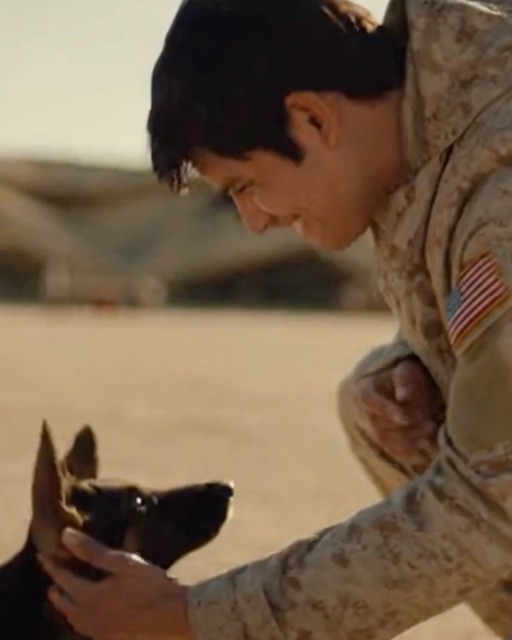
I felt a gentle pressure against my trembling hand. I opened my eyes. The great police dog had stopped. He was just… standing there. His head was lowered, and he was nudging my palm with his nose, letting out a soft, confused whimper.
He was staring at me with eyes that held a flicker of something impossible. Something I hadn’t seen in a lifetime.
A memory.
The handler screamed the command again. Then a third time. Titan didn’t move. He sat down at my feet, pressed his weight into my shins, and let out the quietest cry I’ve ever heard from a dog.
I looked at the tag on his collar. My hands stopped shaking for the first time in years.
Because stamped into that metal, right under his badge number, was a kennel code I’d recognize anywhere. A code from Fort Bragg. From my unit.
I didn’t train Titan. But I trained the dog who trained him. And that lineage carries something no handler can override – a protocol I embedded seventeen years ago. A protocol that was only ever triggered by one thing.
The handler’s face went white. He yanked the leash. “What’s wrong with this dog?”
I looked him dead in the eye. My voice didn’t shake this time.
“Nothing’s wrong with him. He’s doing exactly what he was trained to do.”
The lead officer stepped forward. “And what’s that?”
I reached into my jacket. All three officers drew their weapons. But I didn’t pull out a knife. I didn’t pull out a gun.
I pulled out a card. Faded. Laminated. Military-issued.
The lead officer snatched it from my hand. He read it once. Read it twice. Then his face went through something I can only describe as a man watching his career end in real time.
Because that card didn’t just prove my identity. It proved that the “assault victim” who called in the report was the same person whose name appeared in a sealed internal affairs file – a file connected to three fabricated arrests, two planted weapons, and one officer in that very unit who was about to be exposed.
The lead officer, Miller, looked up from the card. His eyes were wide with a frantic, cornered panic. He tried to compose himself, to regain control of a scene that had completely slipped from his grasp.
“This is irrelevant,” he blustered, shoving the card into his pocket. “You are under investigation.”
I held his gaze. “My name is Arthur Finch. And that card makes me very relevant.”
The K-9 handler, a younger man named Reed, was staring at his dog, then at me, then back at his dog. Confusion was warring with years of training on his face.
“What protocol?” Reed asked, his voice barely a whisper. “He’s not responding to my stand-down command.”
“It’s not a stand-down,” I explained, my voice steady and clear. “It’s a recognition protocol. A Non-Threat Identifier.”
I looked at Titan, who was still sitting faithfully at my feet, his gaze fixed on me. “His sire was a dog named Ares. I trained Ares. We used a specific linseed oil compound to treat our leather gear. It has a unique scent.”
The memory was so clear. Mixing the oil in a small tin, the smell of it on my hands, on my clothes, on everything.
“The scent is faint, but it’s soaked into this old jacket,” I said. “It’s a scent he was trained from birth to associate with a friendly handler. It tells him the person is not a threat, no matter what command is given.”
It was a fail-safe. A way to prevent a dog from being turned on one of its own in the chaos of a mission.
Miller sneered. “That’s a nice story, old man. Now you’re coming with us.”
He took a step toward me.
Before anyone could react, Titan moved. He didn’t lunge. He didn’t bark aggressively. He simply rose to his feet and placed his body squarely between me and Officer Miller. A low, definitive growl rumbled deep in his chest.
It was not a threat of attack. It was a statement. A line being drawn.
Reed, his handler, just stood there, his mouth agape. He was holding the leash to a dog that was now actively disobeying a superior officer to protect a homeless man.
The third officer, a rookie I hadn’t paid much attention to, slowly lowered his weapon. His name tag read Shaw. His eyes darted between Miller’s furious face and my calm one. He was putting the pieces together.
“Sir,” Shaw said to Miller, his voice hesitant but firm. “Maybe we should wait for the sergeant.”
“You’ll do what I say, Shaw!” Miller roared, his composure completely gone. He was losing control and he knew it. The handful of park-goers who had stopped to watch were now filming with their phones.
“This man,” Miller spat, pointing a trembling finger at me, “is a suspect. And this dog is defective!”
“The dog is not defective,” I said quietly. “He’s loyal. There’s a difference.”
Miller turned his rage on me. “You think you’re clever? You’re nothing. Just another vagrant.”
He reached for my arm to haul me up.
The instant his fingers touched the sleeve of my jacket, Titan’s growl intensified into a sharp, warning bark. It was the sound of a final notice being given.
Reed instinctively pulled back on the leash, but the dog held his ground like a statue of fur and muscle. He was protecting me. His partner.
“I said, what is the name of the victim?” I asked, my voice rising slightly, cutting through the tension.
Miller froze. His hand was still hovering near my arm.
“Let’s hear it,” I pressed. “Say his name.”
The park was silent except for the chirping of birds and the low hum of distant traffic. Everyone was waiting.
Miller’s jaw worked, but no sound came out. He knew. He knew that saying the name out loud would be the final nail in his coffin.
“His name is Donovan Price,” I said for him. I saw Officer Shaw flinch, a flicker of recognition in his eyes. He had heard that name before.
“And Donovan Price is your nephew, isn’t he, Officer Miller?”
A collective gasp went through the small crowd of onlookers. Miller’s face turned a blotchy, furious red. The lie was completely stripped bare.
“That’s it,” he snarled, pulling his sidearm from its holster. “You’re under arrest for obstructing justice and assaulting an officer!”
He wasn’t pointing it at me. He was pointing it at Titan.
“Put that dog down, Reed, or I will!”
Reed’s face went pale with horror. “Sir, you can’t!”
But Miller was beyond reason. He was a trapped animal, about to do something he could never take back. Max, my brave old boy, started barking wildly from the bench, sensing the shift from tension to true danger.
Just as Miller’s finger tightened on the trigger, Officer Shaw stepped between them. He drew his own weapon and aimed it at the ground, a clear signal of de-escalation, but his body was a shield for the dog.
“No, sir,” Shaw said, his voice ringing with newfound authority. “We’re not doing that.”
He spoke into his shoulder radio, his eyes never leaving Miller. “Dispatch, this is Officer Shaw. We have a Code Four at Millwood Park. Officer in distress. Send Captain Rostova. Immediately.”
It was a bold move. A career-ending move if he was wrong. But I could see in his young, determined face that he knew he wasn’t.
Miller looked at Shaw as if he’d just been stabbed in the back. The betrayal in his eyes was absolute. His whole world of threats and intimidation had just crumbled under the integrity of a rookie.
The next ten minutes felt like ten years. Miller stood there, weapon still raised. Shaw stood his ground, a human barrier. Reed was trying to gently coax Titan, who refused to budge from my side. And I just stood there, with Max whimpering behind me, watching it all unfold.
Then, another siren cut through the air. This one was different. Less frantic, more commanding. A black sedan pulled up to the curb, and a woman with sharp eyes and a captain’s insignia on her collar stepped out.
Captain Eva Rostova.
She took in the scene with a single, sweeping glance: Miller’s gun, Shaw’s defensive stance, the confused handler, and the magnificent K-9 sitting calmly at the feet of a man in a tattered army jacket.
Her eyes finally landed on me.
“Arthur Finch?” she asked. Her voice was calm, but carried an unmistakable weight of authority.
“Yes, Captain,” I said.
She nodded slowly, her gaze moving to the ID card still clutched in Miller’s hand. “Officer Miller, give me the card and holster your weapon. That’s an order.”
For a second, I thought he might refuse. But something in her tone broke his final thread of defiance. He slowly lowered his gun, his shoulders slumping in defeat. He handed her my ID without a word.
Rostova looked at it, then back at me. “I led the internal affairs investigation into your department’s K-9 program fifteen years ago. You consulted. You designed the ethical obedience protocols.”
“I did,” I confirmed.
“And you filed a report,” she continued, “warning that certain training shortcuts and handler temperaments could lead to a catastrophic failure of protocol. You specifically mentioned a young, aggressive officer.”
She looked straight at Miller. “His name was Daniel Miller.”
The circle was now complete. This wasn’t just a random act of corruption. It was personal. Miller had held a grudge for years, and seeing me, helpless and homeless, was a chance for him to finally settle an old score.
Captain Rostova turned to Shaw. “Officer, tell me what happened.”
Shaw gave a clear, concise report. He mentioned the assault claim, Titan’s refusal to attack, my explanation of the protocol, and Miller’s final, desperate threat. He left nothing out.
When he was done, Rostova looked at Miller with an expression of pure ice. “Officer Miller, you are relieved of duty. Hand your badge and weapon to Officer Shaw. You will be escorted to the precinct for questioning.”
Miller said nothing. He was a hollowed-out man. He moved like a puppet, handing over the symbols of a career he had just destroyed.
Rostova then turned her attention to me. Her expression softened.
“Mr. Finch,” she said, her voice filled with a respect I hadn’t heard in decades. “On behalf of this department, I am profoundly sorry.”
The words hung in the air. For the first time all day, I felt the shaking return to my hands, not from fear, but from the release of a pressure I had been carrying for years.
In the weeks that followed, the whole story came out. Donovan Price confessed to making dozens of false reports for his uncle. Miller had been running a scheme to harass and intimidate the city’s homeless population, driving them out of parks and public spaces. The internal affairs file was reopened, and with my testimony, Miller’s entire corrupt enterprise was brought down.
But the story didn’t end there.
Captain Rostova called me a few days later. The city, deeply embarrassed, had arranged for me to be placed in a housing program for veterans. I had a small, clean apartment with a warm bed. Max had a new bowl and a soft rug to sleep on.
Then she told me about Titan. Officer Reed had officially requested that the dog be retired from service. He said Titan’s ultimate loyalty was no longer to the force, but to the man he had defied orders to protect. The department agreed.
“He’s a hero, Arthur,” Rostova said over the phone. “And heroes deserve a good retirement.”
There was a pause. I held my breath.
“The thing is,” she continued, “we need to find a home for him. A home with someone who understands him. Someone he trusts.”
Tears welled in my eyes. I couldn’t speak. I just nodded, as if she could see me.
Two days later, Officer Reed and Captain Rostova brought Titan to my new apartment. The moment he saw me, his tail began to thump against the doorframe. He walked right in, nudged my hand, and then laid down next to Max’s rug as if he had always lived there.
Today, my hands don’t shake as much. My old green jacket hangs in the closet, a relic of a past I no longer have to wear as a shield. I have a purpose again. I’ve been working with Captain Rostova as a volunteer consultant, helping rebuild the K-9 unit’s training program from the ground up, centering it on the very protocols Miller tried to erase.
Sometimes, in the quiet of the evening, I sit in my armchair with my two dogs at my feet. Max, my steadfast old friend, and Titan, the powerful guardian who saw through the rags and the grime to the man I used to be. The man I am again.
It turns out that the things we build with integrity, the seeds of goodness and loyalty we plant, never truly die. They can lie dormant for years, buried under hardship and neglect, but they are never gone. And in your darkest hour, they might just grow back to save you. What you put into the world has a way of finding its way back to you when you need it most.