
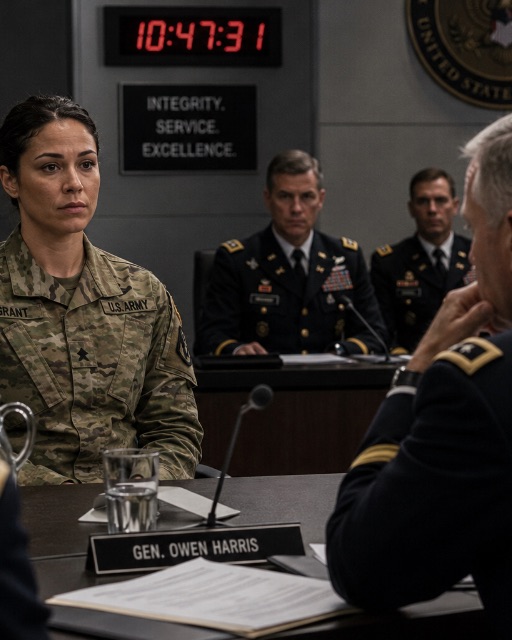
The room was built to break people, but Staff Sergeant Lila Grant had already been broken once – and rebuilt into something far more dangerous.
“Answer the question, Sergeant – unless you’re too scared to say it out loud.”
General Owen Harris smiled as he said it.
Across the long metal table, Lila sat perfectly still, hands folded, shoulders square, dark hair pinned into a tight military bun. The fluorescent lights above turned every face pale and hard. Behind Harris, officers watched like spectators at an execution.
Lila lifted her eyes.
“Be careful, sir,” she said softly. “You may not like the answer.”
A few men shifted.
Harris chuckled into the microphone. “You’re an analyst, right? Signals, targeting, systems. Let’s not pretend you’re some battlefield legend.”
A thin laugh moved through the room.
Then Harris leaned forward.
“How many kills do you actually have, Sergeant? One? Maybe two?”
Lila looked straight at him.
“Fifty-one.”
The room died.
The court reporter stopped typing. One military police officer turned his head. A colonel’s smirk vanished like someone had wiped it away.
Harris blinked. “No.”
Lila said nothing.
“That’s impossible.”
Still nothing.
The general’s smile hardened. “You expect this board to believe a support specialist has fifty-one confirmed kills?”
“No, sir,” Lila said. “I expect this board to ask why those kills were classified.”
A silence heavier than fear settled over the room.
Harris’s fingers tightened on the folder before him. “Careful.”
Lila tilted her head slightly. “That word again.”
The hearing had begun as punishment.
Three weeks earlier, Lila had filed a report accusing senior command at Fort Briar of falsifying target intelligence during a covert operation in Eastern Europe. According to official records, the mission had been a success. According to Lila, twelve civilians had died because someone changed coordinates after verification.
Nobody wanted that report alive.
So Harris had dragged her into a disciplinary proceeding, accused her of insubordination, unauthorized access, and “emotional instability under pressure.”
But Lila had come prepared.
Harris opened the folder. “Let’s talk about Operation Night Glass.”
Several officers stiffened.
Lila’s expression did not change.
Harris smiled again, but now it was forced. “You were not listed as field personnel.”
“No, sir.”
“You were not cleared to engage.”
“No, sir.”
“You were behind a console.”
“Yes, sir.”
“Then explain fifty-one.”
Lila inhaled slowly.
“Night Glass was compromised before deployment. The extraction team walked into an ambush. Comms were jammed. Drone control was hijacked. The only open system left was a maintenance satellite feed routed through my station.”
Harris’s jaw flexed.
“I identified hostile positions manually,” Lila continued. “I redirected defensive fire using emergency targeting protocols. Fifty-one enemy combatants were neutralized. Six American soldiers came home.”
A young major at the side table stared at her.
Harris said, “And why would no one here know that?”
“Because someone buried it.”
The words landed like a blade.
Harris laughed once. “You’re suggesting a conspiracy?”
“I’m stating a record.”
“There is no record.”
Lila looked toward the camera in the corner. “There is now.”
For the first time, Harris glanced at the red recording light.
Then Lila said, “Sir, may I ask you something?”
“No.”
She asked anyway.
“Why did you alter the civilian grid coordinates on March 14?”
The room didn’t gasp. It contracted. Like every person in uniform pulled inward at once.
Harris’s face went the color of old cement.
“That is not – ”
“Grid reference Tango-Delta-Niner,” Lila said. “Original coordinates cleared through my station at 0347. Revised coordinates logged from your terminal at 0351. Four minutes. Twelve dead civilians. One buried correction.”
Harris slammed the table. “This hearing is about YOUR conduct, Sergeant!”
Lila didn’t flinch. She didn’t blink.
“No, sir,” she said quietly. “This hearing is about yours. It just took you forty minutes to realize it.”
The colonel to Harris’s left slowly closed his folder.
The JAG officer in the back stood up.
Harris looked left. Then right. Every ally in the room had turned to stone.
Lila reached beneath her chair and placed a single flash drive on the table.
“Satellite logs. Unaltered timestamps. Original coordinates. And the authorization code used to change them.”
She slid it toward the center of the table.
“That code is assigned to one person in this room.”
She didn’t look at Harris.
She didn’t have to.
The JAG officer walked forward. Harris opened his mouth. Nothing came out.
Lila stood. Straightened her uniform. Looked directly into the camera.
“For the record,” she said, “I was never the one on trial.”
She turned toward the door.
Behind her, the JAG officer picked up the flash drive, turned it over in his hand, and read the label written in black marker.
His face went white.
It didn’t say “Night Glass.” It didn’t say “Grid Coordinates.”
It said something else entirely. Two words that changed everything. Two words that meant Harris wasn’t just going to lose his rank.
He was going to lose his freedom.
The label read “Ainsley’s Fund.”
The JAG officer, Colonel Davies, looked from the drive to the crumbling general. He knew that name. Ainsley was Harris’s daughter.
Davies’s blood ran cold. This wasn’t about a battlefield error. This was about money.
Lila opened the door without looking back.
Two military police officers stood outside, ready to escort her to a holding cell. They looked at her, then past her into the room, where the atmosphere had shifted from a hearing to a funeral.
A young Lieutenant, Marcus Thorne, stepped forward. “Sergeant Grant. I’ll take it from here.”
The MPs, confused but sensing a change in command, nodded and stepped aside.
Thorne didn’t look at her with pity or suspicion. He looked at her with something like awe.
“This way, Sergeant,” he said quietly, leading her down a different corridor, away from the cells.
They walked in silence through the sterile hallways of the administrative building. The hum of the ventilation system was the only sound.
“They won’t touch you now,” Thorne said finally.
“It’s not over,” Lila replied, her voice flat. She felt drained, not victorious. The adrenaline was gone, leaving only a deep, profound weariness.
Thorne stopped at a window overlooking the base. “That flash drive. ‘Ainsley’s Fund.’ What is that?”
Lila looked out at the manicured lawns and concrete buildings, a world of order built on secrets.
“It’s a ghost,” she said. “A ghost in the machine.”
She had first found it months ago, a tiny anomaly in the data streams. An encrypted financial channel disguised as routine supply chain traffic. It was a masterpiece of deception.
No one else had noticed. No one else was looking.
But Lila’s job wasn’t just to see data; it was to understand its story. And this story smelled wrong.
She had followed the trail in her spare time, nights and weekends, peeling back layers of code. The trail led from a defense contractor to an offshore account, and then back to a series of encrypted orders that seemed to benefit certain private security firms.
Firms that always seemed to be in the right place to clean up after a mission went sideways.
The fund was named after Harris’s daughter, Ainsley. A bit of sentimental ego that would be his undoing.
“The coordinates,” Thorne said, connecting the dots. “The target they were supposed to hit…”
“Was a rival of one of his paid contractors,” Lila finished. “The real target was a man about to blow the whistle on the entire scheme.”
“The civilians…” Thorne’s voice was barely a whisper.
“Were a distraction. A tragedy to bury a murder. Harris moved the strike zone to an abandoned apartment block. Except it wasn’t abandoned.”
Thorne leaned his head against the cool glass. “My God.”
Lila’s mind went back five years, to a different mentor. Captain Eva Rostova. A brilliant analyst who had taught Lila how to see the ghosts in the machine.
Eva had gotten close to something once. She’d spoken of irregularities, of whispers of a “shadow network” within high command.
Then, suddenly, Eva was gone. A quiet discharge for “conduct unbecoming,” her career and reputation destroyed overnight. Harris had signed the final order.
Lila hadn’t understood then. Now she did. Eva had found the edge of this conspiracy, and Harris had cut her loose before she could find the center.
This wasn’t just for twelve civilians. This was for Eva, too.
“Why you, Thorne?” Lila asked, turning to him. “Why are you helping me?”
Thorne looked away, his jaw tight. “You remember Operation Night Glass, Sergeant?”
“I was there,” she said.
“I know. So was I. I was one of the six men you saved.”
Lila stared at him. She remembered the faces from the intel photos, but not well enough. He was younger then, thinner, his face etched with the terror of the ambush.
“You pulled a miracle out of thin air that day,” he said. “When your report came across my desk for processing, I buried it. Just like I was ordered to.”
Shame colored his words.
“But I made a copy first,” he confessed. “I owed you that. I owed it to the truth. When Harris started this hearing, I forwarded my copy to Colonel Davies in the JAG corps.”
So, she hadn’t been entirely alone. The thought was a small comfort, a single candle in a vast darkness.
“Thank you, Lieutenant,” she said, and for the first time, her voice held a hint of warmth.
The next few days were a blur of silent containment. Lila was moved to comfortable but secure quarters. She wasn’t a prisoner, but she wasn’t free.
The base was crawling with investigators. Harris was formally detained. Several other senior officers were relieved of their commands. The conspiracy was deeper than even Lila had known.
One evening, there was a knock on her door. It was Colonel Davies.
He looked tired, older than he had in the hearing room.
“Sergeant Grant,” he said, stepping inside. “The investigation is… extensive. Harris is cooperating in exchange for a plea.”
“Good,” Lila said simply.
Davies hesitated. “We uncovered the full scope of ‘Ainsley’s Fund.’ Arms dealing, selling intel, kickbacks. It’s one of the worst corruption scandals in decades.”
He paused, looking at her with a strange intensity. “But we found something else. Something connected to Night Glass.”
Lila felt a knot tighten in her stomach.
“One of the men in that ambush,” Davies said carefully. “The one who supposedly tripped the wire and started it all. He didn’t trip it. He was paid to.”
The room felt suddenly cold.
“Someone on the inside of the team purposefully led them into the trap. Harris’s network wanted the special forces team eliminated. They were getting too close to his arms-running routes.”
Davies slid a photograph across the table. It was a file photo of one of the six men Lila had saved.
A man she ached to remember. Sergeant Ben Carter. He was smiling in the photo, confident and handsome.
“He was on Harris’s payroll,” Davies said. “He was supposed to die with the rest of them, a loose end tied up. Your intervention complicated things.”
Lila sank into a chair. She hadn’t just saved soldiers. She had saved a traitor. The thought was sickening.
“After you saved him,” Davies continued, “Carter knew you were a threat. An analyst who could perform miracles was a danger. He was the one who pushed Harris to bury your after-action report and classify your involvement.”
He was protecting himself.
“There’s more,” Davies said, his voice grim. “Lieutenant Thorne isn’t the only one who made a copy of your report on the civilian casualties.”
Davies explained that when her new report came out, Carter knew she was getting close to the truth again. He had approached Thorne, trying to persuade him to help discredit Lila.
Thorne had refused.
And two nights ago, Lieutenant Thorne’s car had been run off the road.
Lila’s heart stopped. “Is he…?”
“He’s in the hospital. Critical, but stable,” Davies said gently. “He left a message for you. He said to tell you he paid his debt.”
The room spun. The quiet Lieutenant who had guided her out of the hearing room, who had kept a copy of her report, had nearly paid for it with his life.
Carter had been apprehended trying to flee the country.
The weight of it all pressed down on Lila. Her fifty-one kills felt different now. Some were enemies. And one, at least, had been a teammate trying to kill the others. Her actions had saved lives, but they had also prolonged a threat, allowing it to fester and hurt more people.
The world wasn’t black and white. It was a thousand shades of gray.
A month later, it was finally over. The courts martial were finished. Harris was sentenced to life in a military prison. Carter received a similar fate. Over a dozen other careers ended in disgrace.
The military, eager to reclaim the narrative, wanted to make Lila Grant a hero.
She stood in a general’s office, not unlike the one where Harris had once reigned. This general, a woman named Peterson, was different. Her eyes were sharp but kind.
“The board has recommended you for the Distinguished Service Medal, Sergeant,” Peterson said. “For your actions during Night Glass and for your integrity in exposing the corruption.”
She slid a box across her desk. Inside, the medal gleamed.
“They have also approved a commission. You can write your own ticket. Any post you want.”
Lila looked at the medal. It was a beautiful object, a symbol of honor. But it felt hollow.
“Ma’am,” Lila began, her voice steady. “I can’t accept this.”
Peterson raised an eyebrow.
“The work I did… it wasn’t for a medal. It was to correct a record. To honor a truth that had been buried.”
She thought of Eva Rostova, her career in ruins. She thought of Lieutenant Thorne in a hospital bed, paying for her safety. She thought of the twelve civilians whose names no one would ever celebrate.
“There was another analyst, ma’am. Captain Eva Rostova. She saw the start of this years ago, and they broke her for it. If there is a medal to be given, it belongs to her.”
Peterson listened, her expression unreadable.
“As for the commission,” Lila continued, “I appreciate the offer. But my fight is over. I don’t belong behind a console anymore, sending orders that change lives I’ll never see.”
“What will you do?” Peterson asked.
“I’m a data analyst, ma’am. I find patterns. I find people who are lost in the noise.” Lila thought for a moment. “I think… I think I want to find people who are just plain lost.”
Lila submitted her resignation the next day.
Six months later, she opened a small office in a quiet town. It was just her, a few computers, and a sign on the door: “The Rostova Initiative.”
She used her skills not for targeting, but for finding. She located missing persons for desperate families, tracked down stolen assets for small businesses, and volunteered her time helping humanitarian groups analyze satellite data to predict refugee flows.
She was still a weapon. But now, she was a shield.
One afternoon, her office door opened. It was Marcus Thorne, walking without a limp, a slight scar over his eyebrow the only reminder of his ordeal.
He smiled. “Heard you might need a hand.”
Lila smiled back, a genuine, unburdened smile. “I just might.”
She had learned that true strength wasn’t about the power you could wield over others. It wasn’t about confirmed kills or battlefield victories.
It was about the quiet, unwavering courage to do what is right, even when you are sitting all alone in a room built to break you. It was about seeing the truth in the noise and having the guts to give it a voice, no matter the cost.
Some weapons are meant to destroy. But the most powerful ones are meant to rebuild.



