
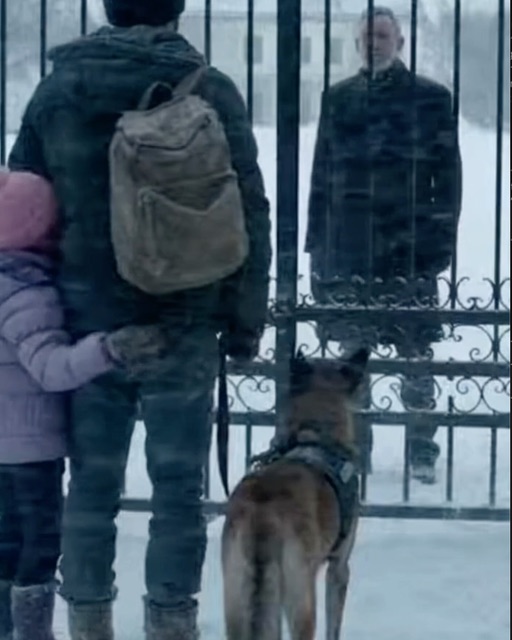
Three weeks after Hannah’s funeral, her dad, Vernon, slammed the gates in our faces.
“No money, no home? You’re not dragging my grandkids down,” he sneered from his mansion porch, as six-year-old Brooke and Kyle shivered against my legs in the snow.
Thor, my retired military Malinois, growled low the whole time, hackles up.
We ended up at the crumbling farmhouse I’d inherited years ago.
No heat, busted windows, wind screaming like a demon.
That first night, we huddled under blankets on the moldy floor, kids finally asleep.
But Thor wouldn’t settle.
He circled one warped spot in the living room, sniffing hard, whining, pawing the boards like his life depended on it.
I’ve seen him ignore IEDs overseas.
He doesn’t freak for nothing.
I grabbed a flashlight.
The board was loose.
Thor stared at me, eyes locked, as I wedged my fingers under…
My stomach dropped when I saw what was staring back from the dirt.
It was a pair of glass eyes, set in the faded, painted face of a porcelain doll.
My breath hitched, a cold knot forming in my gut.
For a second, I thought it was something much worse.
Thor whined again, nudging my hand with his nose, urging me on.
I worked my fingers deeper, prying the stubborn wood.
The board groaned and then gave way with a splintering crack.
Beneath it, nestled in the dark, cool earth, was a small, tin box, rusted at the corners.
The doll had been placed carefully on top, a tiny, forgotten guardian.
My hands were shaking, from the cold, from the adrenaline.
I lifted the box out.
It was heavier than it looked.
Thor sat back on his haunches, his tail giving a single, satisfied thump against the floor.
He seemed to say, “See? I told you.”
I carried it over to our small nest of blankets, the kids stirring but not waking.
The latch was rusted shut.
I found a bent screwdriver in a drawer full of mouse droppings and managed to pop it open.
The contents were wrapped in what looked like old, yellowed oilcloth.
I carefully unfolded the brittle material.
My heart hammered against my ribs.
Inside were stacks of old bills, bound with twine.
They weren’t modern notes.
These were old silver certificates, Federal Reserve notes from the forties and fifties.
I counted one stack.
It was a thousand dollars.
There had to be at least twenty stacks.
Twenty thousand dollars.
To a man who had less than forty dollars to his name, it felt like a king’s ransom.
It was enough.
It was enough for a generator, for plywood to cover the windows, for food that wasn’t just bread and canned beans.
It was enough to give my kids a flicker of warmth in this frozen nightmare.
Beneath the money was something else.
A bundle of letters, tied with a faded blue ribbon.
And under the letters, a single, folded document.
A deed.
I tucked the money safely back into the box and hid it.
The immediate priority was my children.
The next morning, I left Thor on guard and took the kids into town.
The old pickup truck I owned barely started, but it did.
We went to the hardware store first.
I bought a small generator, a space heater, sheets of thick plywood, and a staple gun.
Then, the grocery store.
The look on Brooke’s face when I put a carton of chocolate milk in the cart was worth every penny.
We bought warm socks, thick sweaters, and new blankets.
We feasted that night on hot soup and grilled cheese sandwiches.
The little space heater fought bravely against the cold, and for the first time in days, my children fell asleep without their teeth chattering.
I sat by the weak light of a battery-powered lantern, the old house groaning around us, and finally opened the letters.
The handwriting was a beautiful, elegant script.
They were from my grandfather, Arthur, to my grandmother, Eleanor.
I had never known them.
They passed long before I was born.
He wrote to her while he was away, working on some project out of state.
He spoke of his love for her, of his dreams for the farm.
He talked about the land, how it was the only real thing a man could own.
Then, the tone of the letters began to change.
He mentioned a man, a “business partner” named Silas.
Silas was helping him secure a loan to expand the farm.
Silas was charming, full of big ideas.
My grandmother, it seemed, didn’t trust him.
Arthur wrote, “Eleanor, my love, you worry too much. Silas is a friend. He sees the potential here, just as I do. Together, we will build an empire from this soil.”
As I read on, my blood ran cold.
Arthur described signing papers.
Silas had assured him it was just collateral for the loan.
A small, less-fertile parcel of the land.
The parcel on the eastern ridge, the one with the best view.
A few letters later, the despair was palpable.
The loan had mysteriously fallen through.
The papers he signed weren’t for collateral.
They were a bill of sale.
Silas had stolen the best part of his land for a pittance.
The final letter was short, filled with shame and regret.
“He has ruined me, Eleanor. He has taken our future. His name is Silas Blackwood.”
Blackwood.
The name hit me like a physical blow.
Vernon’s last name was Blackwood.
Silas Blackwood was Vernon’s father.
The empire Vernon was so proud of, the mansion he sneered at me from, was built on land stolen from my family.
My grandfather’s shame and heartbreak were buried right here, under the floor of the house he lost.
I unfolded the deed I’d found in the box.
It was the original deed to the entire property, including the eastern ridge.
It was dated, signed, and notarized long before the fraudulent sale my grandfather had described.
This was the proof.
The truth.
The next few weeks were a blur of quiet, determined work.
I used the money to make the farmhouse a home.
I hired a local handyman to help me fix the heating and replace the broken windows.
We patched the roof and scrubbed away the mold.
Slowly, the house started to breathe again.
It started to feel like ours.
The kids began to smile more.
Brooke helped me plant a small winter garden in a cold frame.
Kyle followed Thor everywhere, the big dog letting the little boy clamber all over him.
I found a lawyer in the next county over, a man named Mr. Gable.
He was old, with kind eyes and a sharp mind.
He looked at the deed, then at the letters, his expression growing more and more grim.
“This is an original title deed,” he said, his voice a low rumble.
“And these letters… they provide a narrative. A powerful one.”
He explained the legal complexities.
Statutes of limitation were a problem, but fraud changed the equation.
“Vernon Blackwood is a powerful man in this state,” Mr. Gable warned me.
“He will fight this with everything he has.”
“I know,” I said. “But my kids have been through enough. This isn’t about revenge. It’s about what’s right.”
Word must have gotten back to Vernon that I hadn’t simply disappeared into poverty.
A county inspector showed up one day, a clipboard in his hand and a sour look on his face.
He cited a dozen minor infractions, threatening to condemn the property.
It was a clear attempt at intimidation.
But thanks to the repairs, I was already up to code on most of them.
Mr. Gable made a few phone calls, and the inspector never came back.
Vernon had underestimated me.
He thought I was just some broke soldier his daughter had married.
He didn’t know I had my grandfather’s resilience in my blood.
Finally, the day came.
Mr. Gable arranged a meeting.
It was to be held at a neutral location: his quiet, book-lined office.
I walked in wearing my best clean shirt and work boots.
Vernon was already there, flanked by two expensive-looking lawyers in sharp suits.
He looked at me with pure contempt.
“What is this nonsense?” he boomed. “Trying to extort me?”
I didn’t say a word.
I just sat down opposite him.
Mr. Gable began, laying out the story calmly and methodically.
He presented a copy of the original deed.
He read excerpts from my grandfather’s letters.
He spoke of a man named Silas Blackwood and a fraudulent land transfer.
I watched Vernon’s face.
The smug arrogance slowly began to curdle.
His lawyers whispered furiously to him, but he waved them away.
His face, normally florid and ruddy, had gone pale.
“These are lies,” he stammered, but his voice lacked conviction. “Forgeries.”
“We can have the paper and ink dated, Vernon,” Mr. Gable said softly. “We can have handwriting experts examine the letters. We can subpoena the original land registry records, which I suspect will show some… irregularities around the time of the transfer. The story is here. And it’s a very compelling story for a jury. Or a newspaper.”
The mention of the newspaper was the final straw.
Vernon’s entire identity was built on his reputation, his family’s legacy.
A legacy, we now all knew, that was built on theft.
He stared at me, his eyes searching mine for something.
Maybe he expected to see triumph, or hatred.
But I just felt a deep, weary sadness.
Sadness for my grandfather.
Sadness for Hannah, who never knew the truth about her family.
Sadness for this broken, angry man in front of me.
“What do you want?” he finally whispered, his voice raspy.
“I don’t want your house,” I said, my own voice quiet but steady. “I don’t want your money. We’re doing just fine in my family’s home.”
I slid a piece of paper across the table.
It was a proposal Mr. Gable and I had drawn up.
“That’s for Brooke and Kyle,” I said. “It’s a trust. For their education, for their future. It’s the future that was stolen from my family, and it’s what they are owed.”
His lawyers read it, their eyebrows shooting up.
It was a significant amount, but for a man of Vernon’s wealth, it was manageable.
It would not ruin him financially.
But it would wound his pride, and that, I knew, was a far deeper cut.
“And one more thing,” I added. “You’re going to stay away from us. You’re going to let my kids grow up in peace.”
Vernon stared at the proposal for a long time.
The fight had gone out of him.
He looked smaller, older.
He just nodded, and his lawyer picked up a pen.
We walked out of that office into the crisp winter air, and I felt like I could finally breathe.
It wasn’t a victory celebration.
It was a quiet restoration of balance.
We spent the next year turning the farmhouse into a real home.
With the first payment from the trust, I was able to hire a proper crew to restore the place fully.
We kept the old charm, the stone fireplace, the wide plank floors.
But now it was warm, safe, and filled with light.
We built a tire swing on the old oak tree out back.
Brooke and Kyle’s laughter became the new soundtrack of the house.
One sunny afternoon, I was out in the yard, watching the kids chase Thor through the tall grass.
The old farmhouse stood proudly behind them, no longer a symbol of rock bottom, but a testament to our resilience.
I thought about the box under the floorboards.
It wasn’t just money my grandfather had left.
It was a legacy of truth.
He couldn’t fight back, but he left the tools for a future generation to do so.
He left the story.
True wealth isn’t found in mansions or bank accounts.
It’s found in the foundations of the home you build, in the integrity you pass down to your children.
It’s in the quiet dignity of doing what’s right, even when it’s hard.
Sometimes, you have to dig through the dirt of the past to find the truth that will set your future free.
My kids were safe.
They were happy.
And we were finally, truly home.



