
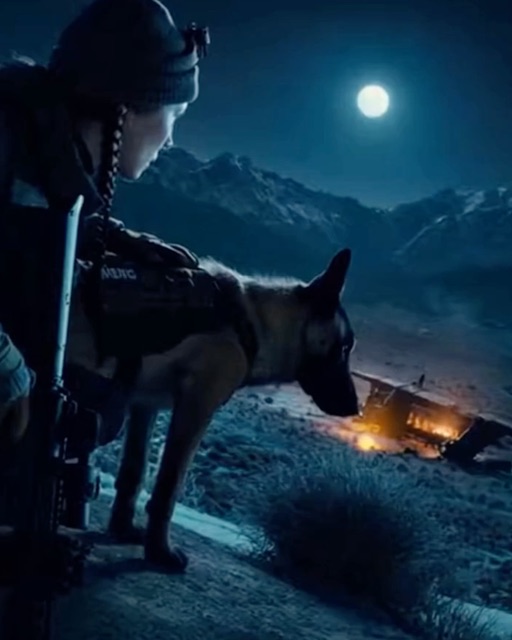
I found Rusty at the shelter, a scarred shepherd who wouldn’t even look at the other dogs.
The tag said “former police K9, retired after trauma.”
A fifty-dollar adoption fee. Done.
My mother-in-law Brenda hated him on sight.
“Filthy beast,” she’d mutter. “He’ll attack the grandkids.”
She demanded I take him back.
She’d sneak him treats laced with who-knows-what when I wasn’t looking.
Rusty just ignored her, but his intelligent eyes followed her every move.
Last night at family dinner, she finally snapped.
She grabbed his collar with a cruel tug.
“Out, you mongrel!” she hissed, trying to drag him toward the door.
Rusty bared his teeth, a deep, warning rumble building in his chest.
I stepped in quick, putting my hand on her arm.
I leaned down and whispered a two-word phrase I’d found in his file, “Shadow lock.”
Instantly, Rusty sat flat on the floor. His ears perked, his body went rigid, waiting for my next order like a stone statue.
Brenda froze, her hand still outstretched in the air.
“How… how the hell did you know that?” she stammered, her face pale.
I didn’t answer with words.
I pulled the worn adoption papers from my purse and slid them across the dinner table.
Her eyes darted down the page, scanning the formal text.
She stopped at the line for the original handler’s name.
Her brother, Sergeant Robert Miller, listed as KIA five years ago.
Her coffee mug slipped from her trembling fingers.
It shattered on the hardwood floor, the sound echoing in the dead silence of the room.
“But he’s been dead,” she whispered, her voice cracking. “Unless…”
Behind her, reflected in the dark glass of the patio door, a man stepped from the shadows of the garden, very much alive.
My husband Mark dropped his fork. It clattered loudly on his plate.
“Uncle Rob?” he breathed out, his voice filled with disbelief.
The man in the garden slid the door open and stepped inside.
He was older now, his face lined with things I couldn’t imagine, but it was him.
The same square jaw and kind eyes from the faded photo in Rusty’s file.
Brenda swayed on her feet, looking like she was about to faint.
“No,” she said, shaking her head. “We held a funeral. We buried an empty casket.”
Robert’s eyes found hers. They were full of a sadness that seemed ancient.
“I’m sorry, Bren,” he said, his voice raspy. “I never had a choice.”
Rusty whined softly, a conflicted sound torn from his throat.
He looked from me to the man he hadn’t seen in five long years.
His tail gave a single, uncertain thump against the floor.
Robert took a step toward him, then stopped himself.
He looked at me, a silent question in his eyes.
I gave a small nod. “It’s okay.”
Robert knelt down slowly, not wanting to spook the dog he once knew so well.
“Hey, Shadow,” he said softly, using the dog’s old service name. “Hey, my boy.”
Rusty crawled forward, inch by inch, and nudged Robert’s hand with his wet nose.
Then he returned to my side, pressing his body against my leg, a clear statement of his new loyalty.
A small, sad smile touched Robert’s lips. “He’s a good dog. You’ve taken good care of him.”
Mark finally found his voice, standing up from the table. “What is going on? We mourned you! Mom and Dad died thinking you were gone!”
The accusation hung heavy in the air.
Brenda was still staring, her mind clearly struggling to catch up with reality.
“The mission was compromised,” Robert explained, his gaze shifting to his sister. “They needed everyone to believe I was dead. Especially the people we were after.”
He had been deep undercover in a cartel operation.
Things had gone wrong. Horribly wrong.
His death was his only escape, his only protection.
It was also the only way to protect his family from retaliation.
“I couldn’t call. I couldn’t write,” he said, his voice strained. “Any contact would have been a death sentence for all of you.”
He’d been living as a ghost for five years.
New name, new life, always looking over his shoulder.
The case had finally closed a few months ago. The major players were all behind bars or gone.
He was finally free.
“The first thing I did was look for him,” Robert said, nodding toward Rusty. “My partner.”
He had tracked him through the K9 retirement network.
He found him at the county shelter, listed as a difficult case due to trauma.
“I was there the day you adopted him,” he admitted, looking at me. “I watched from my car.”
He wanted to make sure Rusty went to a good home before he approached.
He’d followed us. He’d watched me work with Rusty, saw the patience and the kindness.
He saw the broken dog start to heal.
“I was going to wait a little longer,” he said. “Give you both more time.”
“But tonight… I saw my sister grab his collar. I couldn’t let that happen.”
The spell of shock finally broke for Brenda.
It wasn’t relief that washed over her face, but a wave of pure, unadulterated rage.
“You let me grieve for five years!” she screamed, her voice raw with pain. “You let me fall apart!”
She pointed a shaking finger at Rusty.
“And you,” she spat at the dog. “I hated you from the moment I saw you.”
I flinched, instinctively putting my hand on Rusty’s head.
“Why, Mom?” Mark asked, his own face a mask of confusion and hurt. “He’s just a dog.”
“He’s not just a dog!” Brenda cried, tears streaming down her face now. “He’s the reason Rob died!”
The room went silent again.
Robert’s face hardened. “What are you talking about, Brenda?”
“The report,” she sobbed. “The official military report they gave me. It said there was an ambush.”
She recited the words as if they were burned into her memory.
“It said the K9 unit hesitated. It said his hesitation cost you your life.”
My heart broke. For her. For Rusty.
For five years, she had been living with a lie.
She wasn’t just a cruel mother-in-law who hated dogs.
She was a grieving sister who blamed this animal for the death of her beloved brother.
Every time she looked at Rusty, she didn’t see a dog.
She saw a failure. A reminder of her loss.
Her attempts to get rid of him, the laced treats, the constant hostility – it was all born from a place of profound, twisted pain.
She was trying to banish the ghost that haunted her house.
Robert stepped forward and gently took her by the shoulders.
“Brenda, listen to me. Look at me,” he commanded softly. “That report was a lie.”
He waited until her tear-filled eyes met his.
“It was all a fabrication to sell the story, to make my death believable.”
“That’s not what happened that day,” he continued, his voice low and serious.
He told us the real story.
They were ambushed, just like the report said.
A sniper had him pinned down, a clean shot.
“I was dead to rights, Bren. There was no way out.”
“Then Shadow did something I never trained him to do. He broke command.”
He launched himself not at the enemy, but directly at Robert.
He knocked Robert off his feet, taking him out of the sniper’s line of sight.
The bullet that was meant for Robert’s heart tore through Rusty’s side instead.
“He didn’t hesitate,” Robert said, his voice thick with emotion. “He took a bullet for me. He saved my life.”
He gently turned Rusty so Brenda could see.
There, on the dog’s ribs, was a patch of missing fur and a long, jagged scar that I had always assumed came from abuse.
It was the entry wound.
The foundation of Brenda’s five-year-old anger crumbled into dust.
She let out a sound that was half-sob, half-gasp.
She looked at the calm, silent dog she had terrorized.
The hero she had called a mongrel.
She slowly sank to her knees in front of him.
“Oh, God,” she whispered, her hand hovering over his scarred fur, afraid to touch him. “What have I done?”
Rusty looked at her, then licked her trembling hand.
And then Brenda broke completely, wrapping her arms around the dog’s neck and weeping into his fur.
It was an ugly, painful sound of a heart shattering and healing all at once.
The days that followed were strange and fragile.
Robert stayed with us, sleeping on the couch.
He and Brenda talked for hours, unspooling five years of lost time, of pain and of lies.
Mark and I gave them space, taking Rusty for long walks in the park.
There was the question of what to do about Rusty.
I knew the right thing to do was offer him back to Robert.
One evening, I found Robert sitting on the back porch, watching Rusty chase a firefly.
“He’s your dog, Robert,” I said quietly. “You should take him.”
He turned to look at me, a grateful but tired smile on his face.
“He was my partner,” he corrected gently. “We went through hell together. But he’s not my dog anymore.”
He explained that he had nothing. No house, no job, no real identity yet.
He was starting from scratch.
“And look at him,” Robert said, gesturing to Rusty, who was now snoozing contentedly on the grass. “He’s home. He chose you.”
“You healed the parts of him that I couldn’t. You gave him a life after the war.”
He wouldn’t take him back.
But he did ask if he could still be his Uncle Rob.
Brenda’s transformation was slow, but it was real.
She started by throwing out the cheap, mystery-meat treats she’d bought.
The next day, she came over with a bag of the most expensive, organic salmon bites from the pet boutique.
She didn’t hand it to me.
She knelt down and offered one to Rusty herself.
He took it from her gently.
A week later, she asked if she could join me on his morning walk.
We walked in silence for a while, the only sound our footsteps and Rusty’s happy panting.
“I’m so sorry,” she said finally, not looking at me. “For everything. For how I treated you. For how I treated him.”
“I know,” I said. “It’s okay.”
And it was.
My husband, Mark, had his own quiet reckoning with his mother.
He set boundaries for the first time in his life, telling her that while he understood her pain, her behavior had been unacceptable.
He told her he loved her, and that they could move forward, but things had to be different.
She listened, and she agreed.
Six months later, our backyard was filled with the smell of barbecue and the sound of laughter.
Robert was showing Mark a picture on his phone. He’d gotten a job as a consultant, helping to train new K9 units.
He was rebuilding his life, piece by piece.
Across the lawn, Brenda was sitting on the grass.
She threw a worn tennis ball, and Rusty, now sleek and happy, bounded after it.
He brought it back and dropped it right in her lap, his tail wagging furiously.
She laughed, a real, genuine laugh, and ruffled the fur on his head.
He nudged her hand, and she absentmindedly stroked his ears, the two of them perfectly at peace.
I watched them all, this strange, broken family that was slowly knitting itself back together.
It struck me then that Rusty was more than just a dog.
He was a catalyst.
He was the living, breathing proof that you could survive the unthinkable.
He brought a man back from the dead, and in doing so, he healed a family that had been poisoned by a lie.
I went to the shelter that day to save a dog.
But in the end, I think he was the one who saved all of us.
Life has a funny way of delivering lessons when you least expect them.
We often build entire worlds based on what we think we know, nursing grudges and pain rooted in misunderstanding.
But sometimes, all it takes is one moment of truth to shatter that world and build a better one in its place.
A rescue animal isn’t just looking for a second chance for themselves.
More often than not, they bring that second chance to you, a quiet, four-legged reminder that compassion can heal any wound, and love can bridge any distance, even the one between the living and the dead.



