
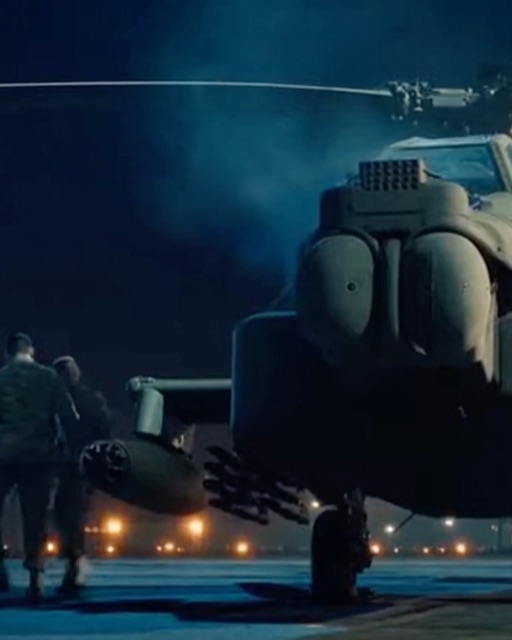
They told us the Apache was done. Cooked. The blast had ripped through every circuit board, melted the avionics, turned the core into a paperweight. Three senior techs walked away shaking their heads. “Scrap it,” they said. “Write the report.”
But I stayed behind. Because I saw her.
Staff Sergeant Jolene Reddick. Maintenance platoon, 4th Aviation. Everyone called her “Patch” – not because she wore one, but because she’d patched things back together that had no business flying again.
She wasn’t even assigned to our bird that night. Her shift ended four hours ago. But there she was, kneeling on the tarmac at 0200, grease already up to her elbows, pressing her palm flat against the airframe like she was checking a pulse.
I heard her whisper something. I thought she was praying.
She wasn’t.
“I hear you,” she said. To the helicopter.
I almost laughed. Almost.
Then she started pulling panels I didn’t even know existed. Bypassed the main harness. Rerouted through a junction box nobody had opened since the thing rolled off the line in ’09. She worked for six hours straight. Didn’t eat. Didn’t drink water. Didn’t talk to anyone.
At 0813, the turbines screamed to life.
The whole line froze. Wrenches dropped. Somebody said a word I can’t repeat in mixed company. Our crew chief, Darrell Fisk – twenty-two years in, three deployments, seen everything – just stood there with his mouth open like a kid watching a magic trick.
Command wanted answers. Colonel Brannigan himself walked down to the flight line, which he never did. Never.
“Reddick, how did you bring that aircraft back?”
She wiped her hands on a rag. Didn’t stand at attention. Didn’t even look up right away.
“Machines don’t break, sir,” she said. “People do.”
Brannigan stared at her. “What’s that supposed to mean?”
She finally looked him in the eye. And something about her face changed. Like she wasn’t talking about the helicopter anymore.
“It means the bird wasn’t the thing that quit, sir.”
The Colonel opened his mouth. Closed it. Opened it again.
Because three days earlier, he’d signed the order grounding Wolfpack Alpha. Not for mechanical failure. For morale. Two pilots had refused to fly. A gunner had walked off the line. The whole unit was falling apart after what happened at the valley – the ambush nobody was supposed to talk about.
Jolene wasn’t fixing the Apache.
She was sending a message.
And it worked. Because by that afternoon, every single crew member from Wolfpack Alpha was back on the flight line. Nobody ordered them. Nobody gave a speech. They just showed up. One by one. Like something pulled them there.
I asked her later, when it was just us and the quiet hum of generators. “How’d you really know what was wrong with it?”
She lit a cigarette. Took a long drag. Looked out at the bird sitting on the pad, rotors still, like it was sleeping.
“My brother built those junction boxes,” she said. “Before he shipped out. Before Korengal.”
She didn’t finish the sentence.
I didn’t push.
But the next morning, I found something taped inside the panel she’d opened. A photograph, sun-bleached and cracked. A young guy in ACUs, grinning, holding a wrench. On the back, in faded Sharpie, it read:
“For whoever finds this – she still flies. Keep her loud. — SPC T. Reddick, 2008”
I brought it to Jolene. She took one look at it and her whole body went still. She hadn’t known it was there.
Her brother died fourteen years ago. She’d been fixing his helicopters ever since.
But that’s not the part that haunts me.
The part that haunts me is what Colonel Brannigan did after he left the flight line that day. He went straight to his office, closed the door, and made one phone call. I know because I was walking past when I heard him say a name I recognized.
It was Jolene’s name. But he wasn’t talking to anyone in our chain of command.
He was talking to the VA. And what he said made me stop dead in my tracks.
“She’s been listed as deceased since 2019,” he said. “So who the hell is on my flight line?”
I looked back toward the tarmac. Jolene was gone. Her tools were gone. The only thing left was the rag she’d been holding — folded neatly on the wing, with a single sentence written on it in black marker.
I walked over and read it. My hands started shaking.
It said: “Keep her loud.”
The same words as her brother. My blood ran cold.
I snatched the rag and shoved it in my pocket. My mind was a whirlwind, trying to connect dots that refused to line up. A ghost? A mistake in the records?
I felt like I was losing my grip.
The next few days were strange. Wolfpack Alpha was back in the air, flying with a renewed fire. The pilots walked with a purpose I hadn’t seen since before the ambush. The ground crew worked with a quiet intensity.
It was all because of her. Because of what she did.
But nobody talked about it. Nobody mentioned Jolene Reddick by name.
It was like everyone had collectively agreed to accept the miracle without questioning it. Questioning it might make it disappear.
I couldn’t let it go.
I found Darrell Fisk by the coffee machine, his eyes heavy with exhaustion but alert. He was nursing a mug like it held the secrets of the universe.
“Chief,” I started, trying to sound casual. “You ever see anything like that? With Sergeant Reddick?”
He took a slow sip. He looked at me for a long time, his gaze weighing me.
“I’ve been on a lot of flight lines, son,” he said, his voice a low rumble. “Seen things that’d make a preacher cuss.”
He paused, swirling his coffee. “I’ve seen mechanics talk to their birds. I’ve seen pilots pray to them.”
“And what about Reddick?” I pressed, my voice barely a whisper.
Fisk set his mug down with a soft click. “Patch is different. She doesn’t talk to the machines. She listens.”
He leaned in a little closer. “There are some people who leave a piece of themselves in the things they build. In the things they love. Her brother was one of ’em.”
“And her?”
“She just knows where to find the pieces,” he said, and walked away, leaving me with more questions than answers.
That night, I couldn’t sleep. The Colonel’s words echoed in my head. “Listed as deceased since 2019.” I had to know.
I went to the maintenance logs office. It was a dusty room filled with metal filing cabinets and the smell of old paper. I told the clerk I was double-checking some part numbers for an after-action report. A lie, but a plausible one.
He grunted and went back to his crossword puzzle.
I pulled the logs for the last five years. My heart pounded against my ribs as I flipped through the pages, looking for a signature.
J. Reddick. J. Reddick. There it was, over and over again. Her scrawled initials on work orders for engine swaps, rotor alignments, hydraulics checks.
Then I got to the 2019 files. I kept turning the pages. 2020. 2021.
Her signature was still there.
On work orders dated months, even years, after the VA said she was gone.
It made no sense. How could a dead woman sign out a torque wrench?
I felt a chill that had nothing to do with the air conditioning. I put the files back, my mind reeling. Was this some kind of elaborate cover-up? Or was I witnessing something far stranger?
The legend of Patch grew quietly. A generator that had been dead for a year sputtered to life one morning. A faulty landing gear that had stumped three teams of engineers suddenly worked flawlessly.
Whenever something impossible happened, you’d find a single, clean rag left behind. Sometimes folded on a toolbox, sometimes tucked into a panel.
No one saw her come or go. She was just… there when she was needed.
Colonel Brannigan never mentioned his phone call. He walked with a new weight on his shoulders. He’d watch the Apaches take off, and his eyes would scan the flight line, as if searching for someone who wasn’t on any roster.
He knew. He had to know. But like the rest of us, he said nothing. To acknowledge it would be to break the spell.
The unit was healed. The pilots of Wolfpack Alpha flew with a confidence that bordered on supernatural. They said it felt like their birds were looking out for them, whispering warnings about wind shear or a sticky actuator before it became a problem.
They were talking about Jolene. I knew they were.
The real test came a month later. A sandstorm, a real monster, rolled in from the west with no warning. It swallowed the sky in a brown-black curtain.
Wolfpack Alpha was out on a critical extraction. Two birds, Alpha One and Alpha Two, escorting a medevac. They were trying to beat the storm home.
We all gathered in the command tent, listening to the comms crackle with static. The wind howled outside, throwing sand against the canvas like handfuls of gravel.
“Command, this is Alpha One. We’ve lost visual on the deck. Flying on instruments,” the pilot’s voice was tight with tension.
“Roger, Alpha One. We’re tracking you. Bring ’em home,” Brannigan said, his voice calm, betraying none of the fear we all felt.
Then, the call we all dreaded.
“Mayday, Mayday! This is Alpha Two. We have a catastrophic hydraulics failure! Cyclic is non-responsive! I can’t hold her!” a young pilot, Lieutenant Evans, yelled over the radio.
The tent went silent. A hydraulics failure in a storm like this was a death sentence.
Brannigan grabbed the mic. “Talk to me, Evans. What are your readings?”
“They’re all over the place, sir! Red lines everywhere! She’s gonna tear herself apart!”
Panic was creeping into his voice. We could all hear it. He was a good pilot, but he was young.
I stood there, helpless, a knot of ice in my stomach.
And then I felt it. A stillness beside me. A faint scent of grease and cigarette smoke.
I didn’t turn my head. I didn’t have to.
A voice, calm and clear, spoke in my mind. Not through my ears, but directly into my thoughts. It was her voice. Jolene’s.
“Tell him to ignore the main bus. It’s a false reading from the sensor. The pump is fine.”
My mouth went dry. I was frozen.
“Tell him now,” the voice insisted, patient but firm. “The backup accumulator is still charged. He needs to reroute through the auxiliary manifold. Panel 3B, left of his seat. Flip the red-guarded switch.”
I stared at the radio, my heart hammering. Was I losing my mind?
Colonel Brannigan was trying to talk Evans through emergency procedures, but the kid was too panicked to listen.
“Do it,” the voice in my head said. “He hasn’t trained for this. The manual is wrong. My brother found the flaw.”
That was it. I grabbed a spare headset and pushed my way to the comms panel.
“Alpha Two, this is Maintenance,” I said, my voice shaking slightly. “Listen to me, Evans. Your gauges are lying.”
“Who is this?” the pilot screamed.
“Doesn’t matter. Find panel 3B to your left. There’s a red-guarded switch. Flip it now!” I shouted, relaying her words exactly.
The Colonel turned and stared at me, his eyes wide with disbelief and something else… recognition.
“There’s no procedure for that!” the co-pilot yelled over the comms. “It’ll bypass the safeties!”
“The safeties are what’s killing you!” I shot back. “Trust me! Flip the switch!”
There was a moment of static-filled silence. An eternity. We all held our breath.
Then, we heard a click over the radio.
Another second of silence.
“I have… I have control,” Evans stammered. “Sir, I have control of the aircraft.”
A collective sigh of relief washed through the tent. Men were patting each other on the back, wiping sweat from their foreheads.
I leaned back against the tent wall, my legs feeling like jelly. The presence was gone. The scent of smoke had faded.
I looked at Colonel Brannigan. He was staring right at me, his expression unreadable. He knew. He knew that knowledge didn’t come from me.
An hour later, both birds landed safely as the storm began to break. Lieutenant Evans, looking pale but alive, walked straight into the command tent and found me.
“How did you know?” he asked, his voice full of awe. “That switch isn’t in any manual. It’s not on any checklist.”
I just shook my head. “Just a hunch,” I lied. “Glad you’re okay.”
He knew it was more than a hunch, but he didn’t press. He just nodded, a deep, profound respect in his eyes.
Later that night, the Colonel called me to his office. I walked in expecting to be court-martialed for interfering with comms.
He was sitting at his desk, a single manila folder in front of him. He motioned for me to sit.
“I’m not going to ask you what happened in there today,” he said quietly. “Because I think I already know.”
He pushed the folder across the desk. It was Staff Sergeant Jolene Reddick’s service record.
“I spent the last month making calls,” he continued. “Pulling strings. Turns out, the VA made a mistake. A clerical error. Two soldiers with the same last name in the same theater. A mix-up with the paperwork after a chaotic event.”
He tapped the folder. “Staff Sergeant Reddick was listed as wounded in action, but she was very much alive. She was transferred to a long-term care facility stateside. She never fully recovered from her injuries.”
He looked me straight in the eye. “She passed away from complications three days ago. At the exact time Wolfpack Alpha was bringing that broken bird back to life on our flight line.”
My breath caught in my throat. So she was… gone. For real this time.
The Colonel saw the look on my face. “But a person isn’t just a name in a file, are they? They’re the work they do. The people they save. The legacy they leave behind.”
He stood up and walked to the window, looking out at the flight line where the Apaches sat under the floodlights.
“Her official record will be corrected. It will state that she served with distinction until the day she died,” he said. “As for the rest… that stays here. On this base. With us.”
He turned back to me. “Some things are more important than reports and regulations. The soul of a unit is one of them. She gave us ours back.”
He picked up a clean, folded rag from his desk. It hadn’t been there a moment ago.
“Whatever, or whoever, she is,” he said softly, “she belongs here. She’s one of ours.”
I left his office that night with a sense of peace I hadn’t felt in a long time. I didn’t need to understand it anymore.
Jolene Reddick wasn’t a ghost. She was a presence. A promise. The promise her brother made when he scrawled “she still flies” on the back of a photograph. She was the unwavering spirit of every mechanic who ever poured their soul into a machine to keep a pilot safe.
We never saw her again, not in the flesh. But she was never really gone.
You can still feel her on the line late at night, in the quiet hum of a perfectly tuned engine, in the crisp snap of a socket wrench. And every now and then, when a bird comes home with more holes than airframe, the crew will find a single, clean rag sitting on the dash.
A silent reminder that some people never leave their post. They just find a different way to keep watch. They remind us that the things we build and the love we put into them echo long after we’re gone. And that sometimes, a little faith in the impossible is the only thing that can patch a broken soul back together and get it flying again.



