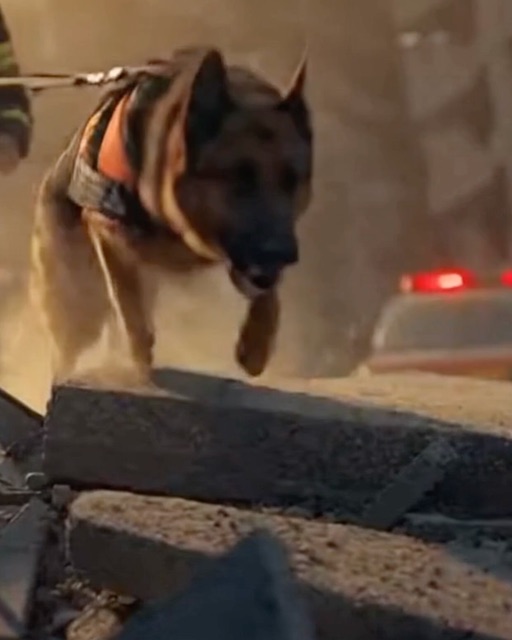
The rubble was shifting. “Greg, get him out of there! The structure is unstable!” the chief yelled over the radio. We had cleared the sector. Three survivors found. It was a miracle we got that many.
I pulled on the lead. “Let’s go, Champ!”
But Champ didn’t move. He just dropped. His legs gave out. He laid his head on the jagged concrete, right in the dust.
I thought his heart had finally stopped from the exhaustion. I thought I’d lost him.
I ran back, ignoring the falling debris, and fell to my knees beside him. I grabbed his harness to lift him. “Good boy,” I whispered. “We’re done. You can rest now.”
But he didn’t relax. He whined and pressed his nose harder into a tiny crack in the slab he was laying on. He wasn’t resting.
I froze. I knew that body language.
I leaned down, placing my ear next to his snout. And through the noise of the sirens and the crumbling building, I heard a sound that stopped my heart cold.
I looked at the Chief, waved my arms frantically, and pointed at the ground. Because right under Champ’s chin, I saw a tiny scrap of pink fabric. It was the corner of a baby’s blanket.
Chief Miller’s voice crackled on the radio, full of static and frustration. “Greg, what is it? Acknowledge! We are evacuating now!”
I couldn’t form words. I just kept pointing, my hand shaking.
Champ whined again, a low, urgent sound that cut through the chaos. He nudged the crack with his nose, telling me, no, begging me to look closer.
Then I heard it clearly. A faint, impossibly small cry. It was thinner than a kitten’s mew, a sound so fragile it felt like the world should stop spinning just to hear it.
“A baby!” I screamed into my radio. “Chief, there’s a baby down here!”
Silence. For a full three seconds, the only sound was the groan of twisting metal above us.
“Hold your position,” Miller said, his voice now tight with a new kind of tension. “Heavy rescue team, back to Greg’s position. Now! Move!”
The world blurred into a controlled frenzy. The heavy rescue team, guys built like refrigerators, swarmed the area with pry bars and hydraulic spreaders. They worked with a terrifying delicacy, treating the mountain of concrete and rebar like it was a house of cards.
I stayed right by Champ’s side, my hand resting on his back. He never moved. He was an anchor in the storm, his body a shield over the spot where new life was hiding. The dust was thick, choking us, but he didn’t even pant. His focus was absolute.
“We need a void,” one of the rescuers, a guy named Sal, yelled. “Gotta lift this slab.”
They positioned the spreaders, the machine hissing as it took the strain. The slab, a piece of concrete the size of a car hood, groaned in protest. More dust and pebbles rained down from the ceiling.
“Easy, easy,” Miller’s voice commanded from a safe distance. “Don’t rush it.”
My heart was a drum against my ribs. Every second felt like an hour. Every creak of the building above felt like a death sentence.
Then, slowly, a gap opened. Sal shone a high-powered flashlight into the darkness.
“I see her,” he whispered, his voice cracking with emotion. “She’s in some kind of cradle. A collapsed crib, maybe. It protected her.”
A medic with a small kit scrambled forward. I moved Champ back just enough to give them room. He whined, not wanting to leave his post. “It’s okay, boy,” I murmured. “You did it. You found her.”
The medic reached in. A moment later, he was pulling out a bundle, so small and covered in gray dust that she was almost invisible. He wiped her face gently, and she let out a proper, robust cry.
A cheer went up from the entire crew. It was a raw, primal sound of relief and triumph. In the middle of all that destruction, we had found the most perfect, fragile thing.
They rushed her to a waiting ambulance. I watched them go, my knees finally feeling weak. I leaned against a broken wall, sliding to the ground. Champ came over and licked my face, his job finally done. I hugged him so tight I thought his ribs might crack. He was more than a dog; he was a part of my own heart.
The news called her the “Miracle Baby.” Her photo was everywhere. A tiny, perfect face peeking out of a hospital blanket. Her parents, they soon learned, had not survived. The thought was a punch to the gut. This beautiful little girl was all alone.
My wife, Sarah, and I couldn’t stop thinking about her. Sarah was a nurse, and we’d been trying for a family of our own for years, a quiet heartache we carried with us every day. Seeing that baby, knowing I had held a hand in saving her, felt like a sign.
“How is she, really?” I asked Sarah a few days later. She had pulled some strings to get assigned to the pediatric wing where they were keeping the baby, now named Lily.
Sarah sighed, her expression troubled. “Physically? She’s amazing. A few scratches, dehydrated, but otherwise perfect. It’s… everything else, Greg.”
“What do you mean?”
“Her grandmother showed up,” she said, her voice low. “A woman named Doris. She’s been giving press conferences, talking about her ‘precious angel.’ But when the cameras are off, she’s… cold.”
My stomach tightened.
“She’s barely held Lily,” Sarah continued. “She asks the nurses more questions about potential lawsuits and victim funds than she does about the baby’s feeding schedule. Something feels wrong.”
I trusted Sarah’s intuition more than anything. If she said something was wrong, it was.
Over the next week, we watched the story unfold with a growing sense of dread. Doris was portrayed as the grieving, heroic grandmother stepping up to care for her orphaned grandchild. She cried on television, clutching a teddy bear someone had donated.
But at the hospital, Sarah saw a different story. Doris would show up for ten minutes, pose for a photo if a reporter was around, and then leave, complaining about the hospital parking.
“She left Lily crying yesterday,” Sarah told me one night, her own eyes filled with tears. “Just… walked out of the room because her phone rang. A nurse had to go in and comfort her.”
That was it for me. I couldn’t stand by and do nothing. Champ hadn’t risked his life just to deliver this baby into a life of neglect.
“I’m going to look into her,” I said, the decision solidifying in my mind.
“How?” Sarah asked. “You can’t just…”
“I have friends,” I said. “Cops, other first responders. I’ll be discreet. But I have to know.”
It wasn’t hard to find the cracks in Doris’s story. A few quiet conversations revealed a history of unpaid debts and petty scams. An old neighbor mentioned that Doris’s daughter – Lily’s mother – had moved out at sixteen to get away from her. She had been a wonderful young woman, they said, a single mom who worked two jobs and adored her baby girl.
The pieces started to form a sickening picture. Doris wasn’t a grieving grandmother. She was an opportunist. Lily was a lottery ticket to her.
The final straw came when I found a minor, sealed record. A charge of child endangerment from years ago involving her own daughter. It had been dropped, but it was there.
We knew what we had to do. It was the most terrifying and logical decision of our lives.
“We have to fight for her,” I told Sarah.
She didn’t hesitate. “I know.”
We hired a lawyer and filed a petition with child protective services, presenting the information I had found. The media, of course, had a field day. We were painted as villains trying to steal a baby from her loving grandmother. The hero firefighter was suddenly a monster.
The backlash was brutal. People left horrible comments online. Reporters camped outside our house. But every time I felt like giving up, I would think of that faint cry under the rubble, and of Champ’s unwavering certainty.
The custody hearing was a circus. Doris’s lawyer portrayed her as a saint, and us as fame-hungry opportunists. It was excruciating. They twisted my service, my love for my K9 partner, into something ugly.
“Mr. Thompson,” her lawyer sneered, “isn’t it true that you felt a ‘hero’s connection’ to this child, and that your judgment is clouded by your own personal family struggles?”
I looked at Sarah, then at the judge. “My judgment is clouded by only one thing,” I said, my voice steady. “I was in a building that was falling down. My commander was screaming at us to leave. But my dog, who is trained to save lives, refused. He laid down and told me someone was alive. That someone was Lily. I don’t feel like a hero. I feel like the man who was entrusted with the first link in a chain to keep her safe. I’m just trying to not let that chain break.”
The judge was unreadable. It felt hopeless. We had proof of Doris’s past, but her lawyer was spinning a powerful narrative.
Then, the first twist happened. On the final day of the hearing, a man walked into the courtroom. He was young, in a military uniform, and he looked exhausted.
“I’m Michael,” he said to the court. “I was Lily’s uncle. Her mother’s brother. I was deployed overseas and just got back.”
He confirmed everything we suspected about Doris. He spoke of his sister’s fear of their mother, how she had worked so hard to build a life for herself and Lily away from that toxicity.
“My sister was meticulous,” Michael said, his voice thick with grief. “She had a will. She would have made arrangements.”
A search was ordered. They went through the few salvaged items recovered from the apartment. And there it was. A legal document, singed and water-damaged, but mostly intact.
It was Lily’s mother’s last will and testament. In it, she clearly stated that in the event of her death, she did not want her mother, Doris, to have custody of her child.
The courtroom held its breath.
The will went on to name her designated guardians. It was a young couple she admired, people she knew would love Lily as their own.
But their names had been smeared by water damage. All you could make out was a first initial, ‘G’, for the husband, and an ‘S’ for the wife. The address was completely illegible.
The judge ruled that, pending a search for the designated guardians, custody would be stripped from Doris. Given the evidence and our involvement in Lily’s rescue, he granted temporary guardianship to me and Sarah.
Walking out of that courtroom was surreal. A day later, we walked into the hospital and brought Lily home. Our home.
Our house, once quiet with unspoken loss, was now filled with the sweet sounds of a baby. We were clumsy and terrified, but we were completely in love. Champ appointed himself her personal bodyguard, sleeping on the rug beside her bassinet every night.
A few weeks later, a box of Lily’s mother’s personal effects was delivered to us. It was mostly ruined clothes and melted photo albums. We went through it gently, hoping to find a clue about the mystery couple.
Tucked inside a damp book, I found a sealed envelope with my name on it. “For Greg Thompson,” it said.
My hands trembled as I opened it. Inside was a letter and a photograph. The photo was of Sarah and me, with Champ, at a charity fun-run from two years ago. I remembered that day.
I started to read the letter. The words changed my world forever.
“Dear Greg,” it began. “If you are reading this, then the worst has happened. You may not remember me, but my name is Anna. A few years ago, my car broke down on a deserted road late at night. I was terrified. You were on your way home from a shift and you stopped. You stayed with me until a tow truck came, and you made sure I was safe. You wouldn’t take any money. You just said, ‘Pass on the kindness.’”
I remembered her. A young, scared woman with a kind smile.
“I never forgot that,” the letter continued. “I followed your career. I saw stories about you and your amazing dog, Champ. I learned you were married to a nurse named Sarah. I know this sounds strange, but I saw in you both the kind of goodness I wanted for my daughter if I couldn’t be there for her. I heard through a friend at the hospital that you were having trouble starting a family, and my heart ached for you. So I made a decision. I put you and your wife in my will. I knew, with a certainty I have never felt about anything else, that you were the ones meant to love my Lily.”
I dropped the letter, my legs giving out. Sarah picked it up and read it over my shoulder, her tears falling onto the page.
It wasn’t a coincidence. It wasn’t fame-seeking. It was a choice. A choice made by a mother who saw a flicker of kindness in a stranger and trusted it to raise her child.
The ‘G’ and ‘S’ from the will. It was us. It was always us.
Today, Lily is three years old. She has my eyes and Sarah’s laugh. She calls me “Dada” and Sarah “Mama.” Champ is her best friend, his tail thumping on the floor whenever she comes near. Her uncle Michael is a constant, loving presence in her life. Doris simply faded away after her schemes were exposed.
Our home is no longer quiet. It’s filled with laughter, love, and the pitter-patter of little feet. We got our miracle, just not in the way we ever could have imagined.
Life has a funny way of connecting the dots when you least expect it. A single act of kindness, a moment spent helping a stranger on the side of the road, rippled through time and brought us our daughter. It taught me that you never know which ordinary moment will turn out to be the most important one of your life. The real rescues aren’t always in collapsed buildings; sometimes, they happen in the quiet chambers of the human heart.